Monthly Archives: October 2018

Kia e-Niro 2019 review

Niro comes of age as an electric car with an excellent drivetrain and impressive real-world range

What is it?

Electric cars may seem to dominate the mainstream media motoring coverage, but there really are not that many pure EVs you can buy yet in the UK, and even fewer with a ‘big’ range.

So the Kia e-Niro arrives at quite the opportune time, with electric cars – and the charging network to support them – gaining momentum with acceptance and awareness among the wider buying public beyond early adopters.

The Niro is a couple of years old now and launched as Kia’s dedicated eco-friendly model, promising hybrid, plug-in hybrid and, in time, all-electric drivetrains within the same range, and now the time has come for that electric version.

You’ll spot more than one or two similarities between the e-Niro and the Kona Electric from sister brand Hyundai. The drivetrain is common between the pair, consisting of an electric motor powered by a 64kWh lithium ion polymer battery.

While the Kona Electric offers a smaller battery, as does the e-Niro in Korea and in other markets, in the UK the e-Niro is set to be offered with just the larger battery, and a price that aims to come in below £30,000 when it launches early next year.

What’s it like?

Our test e-Niro is a Korean-spec model driven on Korean roads, but while the odd bit of trim and optional extra may differ, this is the drivetrain and chassis we’ll be getting.

Some drivetrain it is too. My, the e-Niro is brisk. It feels far quicker than its 0-62mph time of 7.8sec suggests, and even more impressive is the way it responds at higher speeds. Look for a bit of extra poke to make a pass on the motorway, and it’s all there before your right foot has barely touched the pedal. We even managed to spin the wheels accelerating out of a 30mph zone into a main A-road.

As such, the e-Niro is likely to have appeal to any enthusiast, but anyone swapping into one from their Ceed diesel is likely to be unprepared for such real-world pace and drivability. A test drive is essential, as such power – or rather torque in the case of the e-Niro – could catch many unaware.

The e-Niro isn’t uncomfortable in the way it rides, yet neither does it isolate its occupants from bumps in the road; the chassis does not display any great sophistication in how it handles the road, or indeed that level of torque, a bit like a black cab. That’s most likely down to the weight; much of the chassis tuning feels geared towards masking that weight as much as possible. A bit like a black cab…

Our test route wasn’t one for the e-Niro to reveal itself as a driver’s car. Yet it did demonstrate competent if not inspiring handling. There’s a pleasing heft to the steering, even more so in Sport mode, where the urgency of the drivetrain is increased further.

Something else that can be tweaked is the level of regenerative braking through four different levels via some paddle-shifters on the gearlever, as with the Kona Electric. The system seems to default to an auto mode for the most time even if you try to set it to the level you’d like, meaning it’s not quite as pleasing a feature as it should be.

The range figure seemed a true one too. Our test route wasn’t the longest, but the battery life and range indicator dropped in line with the distance covered, and the starting range of 272 miles on an almost full charge was indicative of the claimed figure of just over 300 miles. At least 250 miles per charge should be expected, based on this test.

Read more: Autocar

Electric vehicles already able to cut greenhouse gas emissions by half

Exclusive: Critics have played down ability of current electric cars to reduce CO2 levels, but new analysis shows significant impact

Replacing a fossil fuel-powered car with an electric model can halve greenhouse gas emissions over the course of the vehicle’s lifetime, according to a new report.

The finding challenges reports by the UK press, other transport research groups and the fossil fuel industry that have underestimated the rise of electric vehicles (EVs) and their capacity for cutting emissions.

Released ahead of the world’s first zero emission vehicle summit in Birmingham, experts hope these results will drive a rapid switch to electric vehicles.

It is well established that a transition to electric vehicles will immediately reduce toxic air pollution, but the impact on carbon emissions has been less clear.

Critics have pointed to the carbon-intensive process of battery manufacture and the relatively small share of Britain’s electricity supply coming from renewables as factors that stop EVs reaching their full CO2-cutting potential.

“The take up of EVs in the UK, as elsewhere, continues to grow fast and sales have just passed 4 million globally,” said Andy Eastlake, managing director of the Low Carbon Vehicle Partnership.

“While no one doubts the air quality benefits of zero tailpipe emissions, critics often question the overall life cycle greenhouse gas impacts.”

However, the new European Climate Foundation-commissioned report used 2017 data to demonstrate that owners of EVs – particularly smaller models – are already playing a big role in helping the climate.

Transport is now the sector that contributes most to the UK’s greenhouse gas emissions, and the Committee on Climate Change has urged the government to improve on their current plan to ensure all new diesel and petrol vehicles are banned from 2040.

In their role as the government’s climate advisers, the committee has called for “more stretching targets” to ensure most new cars and vans are electric by 2030.

Transport secretary Chris Grayling revealed his “Road to Zero” strategy in July to make the UK “the best country in the world in which to develop and manufacture zero-emission vehicles”.

Aurelien Schuller from French consulting firm Carbone 4, one of the report’s co-authors, said their new study revealed “there is no time to waste in the UK’s transition to EVs”.

“Thanks to an already-significant decarbonisation of its electricity generation through coal phase-out the UK is already in a position to make significant cuts in the greenhouse gases from its transport sector,” he said.

The research concluded that a smaller EV produces around 15 tonnes of CO2 from construction through to scrapping, compared to an average of 32 tonnes for the equivalent petrol or diesel car.

Read more: Independent

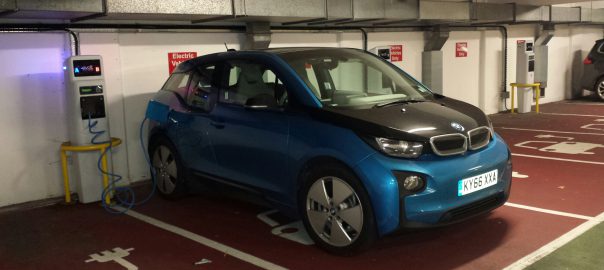
BMW says EV owners can turn i3 into ‘cash cow’, use more solar power

Over the past 3 years, BMW has been running a trial of its ‘ChargeForward’ program with BMW i3 owners willing to automatically delay the charging of their vehicle at the request of their local electric utility, PG&E, in order to offset peak demand.

BMW is presenting the results of the trial and says that electric car owners can turn i3 into ‘cash cow’ and use more solar power with controllable load technology

The idea is quite simple. Under the program, PG&E can request BMW to delay the charging sessions of BMW i3 owners by up to an hour in order to reduce the load.

Instead, the owners are incentivized to charge for cheaper when renewable energy production is higher.

In return, owners are compensated for the possible inconvenience. For the first trial run, owners received a $1,000 “gift card” at the launch of the program and they were able to get up to $540 more based on how their charging sessions were affected. BMW is actually reducing the rewards for the second round, presumably because they realized that it was a lot of money for what they were asking of the i3 owners.

It’s important to note that owners can easily temporarily opt out of the program before starting a charging session if they absolutely need to charge. But if your car needs to charge, but it’s not urgent, you plug it in and if PG&E needs to offset demand, they will delay it and your car will take up to one more hour to charge.

Read more: Electrek