Whether you are looking for your first electric car or your next electric car, there are many reasons why opting for a used one might be the best option for you.
See: Used ZOE 22kWh available now from £206 PCM with £250 deposit.
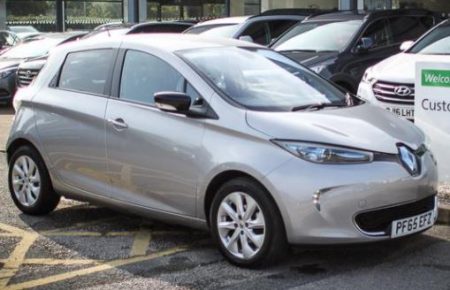
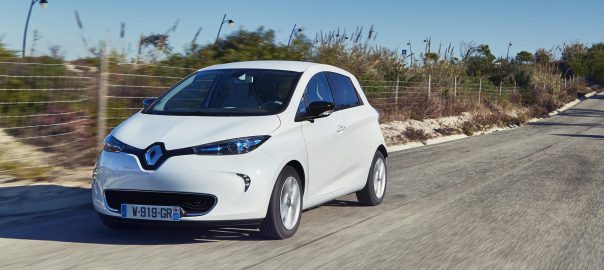
I’ve had my ZOE for almost 2 years, it’s a 2015 model with a reasonable range of 75-80 miles (real world). I was recently considering upgrading to the latest model that offers 250 miles (NEDC) range, however the price on the latest model was much higher than my current model (due to the larger battery and increased range). With budget in mind I started to weigh up the want for more range against the need for more range and soon realised that actually a used electric car with a range I am currently used to will continue to suit me just fine.
So when thinking about your first or next electric car, consider the following:
How many miles do you actually need your electric car to cover each day? And does a used electric car cover this?
If not, do you have the opportunity to charge it easily during your day? At work or during a commute?
What spec and features does a used electric car have compared to a newer one? Sometimes features in older model may cost extra in newer versions, for example the reversing camera in the ZOE is extra in the new model but comes as standard in most of the older models. And sometimes the features don’t differ much at all.
You still get a minimum of 1 year warranty with a used electric car.
Some used cars still come with a free charge point.
Availability of the car is almost always immediate so you can be driving electric in no time at all.
Low and zero deposit options are available, or you can increase the deposit to really drive down any monthly finance costs.
And let’s not forget opting for a pre-owned used electric car is a greener approach to electric car ownership, recycle and re-use.
“We run POLAR, the UK’s biggest public charging network. It links over 5,000 public charging points, not limited to just Chargemaster units, giving EV drivers a convenient and reliable nationwide charging system. The POLAR network is growing all the time, making the future of electric motoring possible for more and more drivers.
POLAR Plus is our unique subscription service that offers members better value and special benefits. With the first three months’ membership free, you pay just £7.85 per month thereafter. Members enjoy unlimited access to over 5,000 charging points, most of which are then free to use. For the others, they just pay for the electricity consumed (at only 9p per kWh, which is cheaper than the average cost at home). There’s no long term contract or nasty notice period to worry about. If you decide for any reason to cancel, you can do so. Immediately. It’s as simple and painless as that.
POLAR Plus members earn ‘POLAR Points’ when they charge in a different town each month. Points can be used to borrow one of our fleet of 20 EV Experience cars for free for a week, including our BMW i8 and i3, Tesla Model S and Nissan Leaf.
POLAR Plus Ts & Cs: To receive three months’ free POLAR Plus membership, you must first sign-up for the scheme and provide your Direct Debit details. From the start of month four you will automatically be charged £7.85 each month for membership on an ongoing basis, until you cancel. New customers only. You can see whether a charging post is free or chargeable using our live map. Please note that during the free membership period you will still be charged for any electricity used.
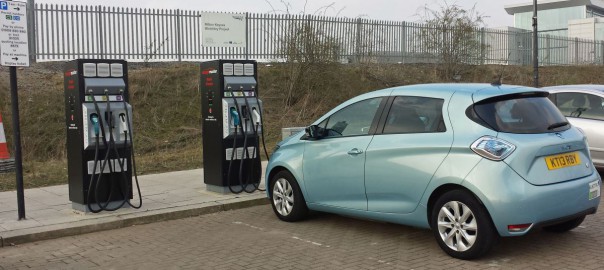
Close-up of POLAR charge point (Image: J. Pegram-Mills)
POLAR Instant is a smart phone app that is available for both iPhone and Android smart phones that enables you to use hundreds of charging points across the country directly from your smart phone without the need for a RFID card or pre-registration to a “scheme”. iPhone App will be available from Mid April,2014 and Android from early May.
You can view where all the charging points are across the country, check if they are free to use in or what tariff they are charging, see what type of socket and output they have, see if they are available for use in real time, get directions to the charging point and then simply start and stop the charge from your phone with simple instructions.
POLAR Instant Ts & Cs: All charges are subject to a £1.20 admin fee which is deducted from your balance once the charge is complete. Some chargepoints will also incur a cost for the electricity used. To check the costs of individual chargepoints, please view our map. You may set up your account, make credits, view charging point check locations and tariffs as well as check your charging history and account balance on line at www.POLARinstant.com in the same way as on your smartphone app. If you need any assistance when charging call the POLAR Instant Help line on 0845 5280 289.”
Our View
POLAR is the biggest network of chargepoints around England. If you have seen chargepoints around your town, at supermarkets, town centres, car parks and public buildings, then chances are they are part of the POLAR network. Most of the points are low power and will charge an electric car in 3-8 hours (for these you will need to provide your own Type 2 cable – there is usually one supplied with each car). However, some are rapid chargers that can charge to 80% in about half an hour (these have their own tethered cables); the majority are manufactured in-house by Chargemaster.
POLAR rapid chargers (Image: T. Larkum)
There are two ways to pay – by subscription on POLAR Plus or Pay As You Go (PAYG) on POLAR Instant. The POLAR Plus subscription costs £7.85 per month (including VAT) which gets you an RFID access card. Most charging is then free, though some is charged per unit of electricity (kWh). On POLAR Instant you use a Smartphone App and you prepay into your account. There is a £1.20 ‘administration fee’ per charge and most charging is then either free or charged per hour (for example, £1.50 per hour on the ones I use in Milton Keynes). Note, however, outside Milton Keynes the majority of Chargemaster rapid chargers are only available on POLAR Plus. If you charge regularly on POLAR, more than a few times a month, or you want access to all the rapids, it’s generally worth joining the POLAR Plus scheme; you will also get additional benefits such as ‘POLAR Points’ allowing you to borrow from Chargemaster’s pool of electric cars.
Reliability of the POLAR charge points is generally good, and as the maps are real-time you can check in advance if a particular one you want is working. Further, you can check to see if it’s actually in use.
The POLAR network continues to expand and develop. In January 2017 Chargemaster completed the acquisition of Elektromotive and its Charge Your Car network (though access is not available via Polar Instant). In March 2017 it took on some parts of the Source East network. In July 2017 it announced that it was switching to 100% renewable energy.
LONDON – Electric-vehicle manufacturers look as if they’ve cracked the youth market in the U.K., with 24- to 34-year-olds most likely to own one.
At the same time, research by the Automobile Assn. reveals people over 55 are the least likely to own an EV.
Results of the Populus polling firm’s survey of 16,508 AA members conducted in mid-July will come as welcome news to the U.K. government following its announcement it intends to eliminate sales of internal-combustion-engine-powered cars by 2040.
“This may confound the ‘boy racer’ image that older people may have of young drivers,” AA President Edmund King says of the survey results. “Although overall numbers are still low, it shows that young drivers are taking an interest in new-car technology despite the fact that three-quarters (76%) are concerned about the high purchase price of EVs – but even that compares with 84% of older drivers concerned about price.”
The study also shows that among those who don’t own an EV, barriers to ownership stubbornly remain: the perceived lack of charging stations, the cost of buying an electric car and durability of the battery.
Other concerns include the potential time it might take to offset low operating costs against purchase price and limited range.
“In reality, these concerns are evaporating much more quickly than perhaps most people realize,”
King says.
“It seems that young drivers certainly ‘get’ the concept of electric driving, and our research consistently showed that it is older drivers who are putting up concerns that simply don’t exist.
“In fact, a third of respondents overall say they have no understanding of EVs.”
To counter that lack of awareness, the AA Trust has launched Drive Electric, a series of free sessions designed to help drivers understand EVs and how to obtain the best economy from them. The first sessions are being run in conjunction with the new Electric Vehicle Experience Center in Milton Keynes – the first center of its type dedicated to electric and plug-in vehicles.
The French automaker believes this will add flexibility to charging infrastructure.
Call it Recyclin’ Renault: The French automaker is now using old electric-car batteries to power charging stations in Europe. These so-called “second-life” batteries were integrated with energy-storage systems from British firm Connected Energy and installed at two charging sites on highways in Belgium and Germany.
Like its partner Nissan, Renault is a major proponent of electric cars. Its Zoe hatchback rivals the Nissan Leaf as the best-selling electric car in Europe – meaning a lot of used batteries. The battery packs in electric cars eventually lose too much storage capacity to be useful. But even after they’re too degraded for automotive use, these packs still have plenty of capacity left over.
By using them to power charging stations, Renault claims DC fast-charging stations can be installed in more locations, since they won’t require a dedicated high-power grid connection. Instead, the battery packs can be charged using the same electricity infrastructure as lower-power stations.
In the United States, Tesla has used solar energy to charge energy-storage battery packs, taking some charging stations completely off the grid. Nissan and Chevrolet have experimented with turning old battery packs into energy-storage units, and BMW has even discussed selling them to homeowners.
More broadly, energy storage is now being used to increase the effectiveness of renewable-energy sources like wind and solar. Energy is harvested when wind and sunlight are available, and stored for when they aren’t. Energy storage can also help balance the grid by evening out the flow of electricity through the system. California already has some large energy-storage sites, and Tesla is involved with a major project in Australia.
Large-scale energy-storage projects will require a lot of batteries, and if electric-car sales live up to the hype, automakers could end up with plenty on their hands.
More details have emerged regarding Ford’s €4.2 billion plans to release 13 new electrified vehicles globally by 2021.
One of the first of these models set to launch will be a plug-in version of the Escape SUV crossover planned for 2019, sources told Automotive News. The North America-only Escape is near-identical to the Ford Kuga, suggesting a hybrid version of this is in the works for Europe.
The source also revealed American market models including the Escape platform partner Lincoln Navigator, as well as the Ford Expedition large SUV and platform partner Lincoln Navigator will all also come in hybrid drive from 2019. These four new hybrids follow the first of the 13-strong new wave of electric vehicles (EVs), the Police Responder hybrid sedan, coming in 2018.
The first model Ford has officially announced for Europe will be a plug-in hybrid version of the best-selling Ford Transit. Launching in 2019, the Ford Transit Custom plug-in hybrid, which is taking part in emission trials in London this autumn, will be followed by Ford’s flagship new all-electric small SUV, which is targeted at models such as the Opel Ampera-e, Volkswagen I.D. Crozz, 2018 Nissan Leaf, Jaguar i-Pace and Tesla Model S, all targeting 300-mile (482km) ranges.
Although Ford has only officially announced seven of the 13 models, most have now been revealed through sources, as outlined in the list below:
2018 – Police Responder hybrid sedan (officially announced)
2019 – Ford Escape plug-in hybrid, Lincoln MKC plug-in hybrid, Ford Expedition hybrid, Lincoln Navigator hybrid, Transit Custom plug-in hybrid (latter officially announced for Europe)
2020 – Small all-electric SUV with 300-mile range, Ford Mustang hybrid, Ford F-150 pick-up hybrid (all officially announced)
A second hybrid police vehicle (officially announced)
Two more currently unknown.
Following new CEO Jim Hackett taking the helm in May, analysts believe Ford will be taking a much more aggressive approach to EVs going forwards, while being cautious to launch models before there is enough of a market to realise significant returns on investment.
With the environmental credentials of traditional internal combustion engines and especially diesel much maligned following the Dieselgate scandal, vehicle manufacturers are increasingly switching to low and zero emission alternatives.
Petrol power emits higher CO2 levels, and so has led manufacturers towards diesel, which emits less and therefore helps them achieve a lower overall carbon footprint with their fleets. However, this has resulted in other consequences with higher levels of nitrogen oxides (NOx), which are now known can cause serious health issues and have been linked to further air pollution issues. Yet due to EU economy regulations, diesel helps carmakers meet strict guidelines, meaning their hands are tied when it comes to fuel technology. With these restrictions tightening further, manufacturers are now left with lots of diesel power, and nothing they can do with it.
Some manufacturers are trying to develop technology that will allow them to continue running petrol vehicles, with Mazda launching a new engine, the SkyActiv-X, which does away with spark plugs and works on the same principle as a diesel, using compression to produce the ignition of fuel and therefore making the engine more efficient and less polluting.
Now, vehicle technology and systems provider Delphi has developed a fuel saving technology using petrol, which would improve efficiency figures without the risk of further pollutants. The company believes that combining two emerging technologies can boost petrol efficiency, possibly by as much as 19%, bringing them in line with diesel, while preserving the low-end torque that diesel drivers are accustomed to.
Delphi’s proposal combines its 48-volt mild hybrid system with a new type of cylinder deactivation it calls Dynamic Skip Fire. Both systems are ready for production, Delphi says, though neither is likely to arrive before 2020. The 48-volt system and Dynamic Skip Fire can be used separately but complement each other by increasing engine efficiency at both low and high speeds.