Liverpool City Region’s (LCR) drive towards creating an eco-friendly environment is being helped by APT Controls, which has completed the installation of 28 of its Evolt Electric Vehicle (EV) charge points.
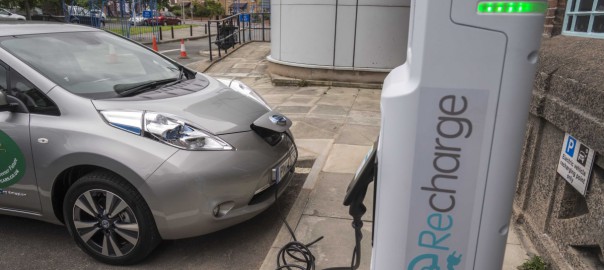
Evolt Charge Point in Liverpool (Image: Evolt)
Merseytravel, the executive body that provides professional, strategic and operational transport advice to the LCR’s Combined Authority, and the body responsible for coordinating bids and projects, chose Evolt after a full tender process.
Amy Coulson, Programme Development Officer at Merseytravel outlines LCR’s e-mobility strategy:
“It sets out our commitment to promoting the use of EVs across the region, and this includes installing a charging network for an even greater public take up of environmentally friendly transport. Evolt are helping us deliver this.”
Fourteen Evolt charge points have been installed and are available for public use at sites across Merseyside including rail stations, hospitals and the Seacombe Ferry Terminal; a further 14 have been strategically placed at sites of importance for the local authority, such as council buildings and NHS depots.
Of the 28 chargers, a mix of 7kW dual wallmount and 7kW standard dual posts were installed, forming the first phase of Recharge, the LCR’s scheme to encourage the public and the local authorities to simultaneously decrease their carbon footprints.
“The LCR, which includes seven local authorities, is committed to leading by example and has recently been awarded funding by the Office for Low Emission Vehicles to introduce 23 Ultra Low Emission Vehicles into its fleets over the coming year,” Amy continues.
Justin Meyer, General Manager of Evolt, anticipates that Evolt will remain integral to the Recharge scheme as it progresses through the phases:
“We have developed a significant relationship with the LCR, helped by our experience of dealing with local councils across the country, and are now the EV charge point supplier of choice in the City Region.”
Just a week after the first Tesla Powerwall for residential use in Australia has reportedly been installed in a Sydney suburb, it’s now the UK’s turn to get its first Tesla home battery pack.
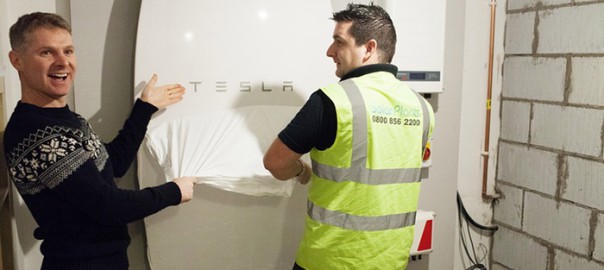
A SolarPlant engineer installs the UK’s first Powerwall home battery in Cardiff at Mark Keer and Lyndsey Bennett’s home (Image: G. Phillips/Guardian)
Homeowner Mark Kerr has become the first British Tesla Powerwall owner after a SolarPlant engineer installed the system at his home in Wales. Kerr and his family have a solar installation at their home and will use the excess energy produced during the day to charge the battery pack. Kerr talked to The Guardian about his new energy storage system:
“This is the future, definitely. For me this is the logical next step. We have the solar panels but we need a way to make best use of the power they produce. Me and my family are all out in the day, and we are not making use of the enormous amount of clean energy that our solar panels produce. The battery will allow us to store the energy we don’t use in the day to use when we need it in the evenings.”
Kerr, an electrician by trade, added about the design of the Powerwall:
“It’s a gorgeous-looking piece of technology, its design is very sleek and minimalistic and something you can hang on the wall like a piece of art, definitely nothing like some of the other clunky looking batteries.”
South Wales solar installer Solar Plants installed Kerr’s new home battery pack. The company shared some marketing statistics about the Powerwall. Since it has been made available, the company emailed 3,000 solar customers about the battery. Out of the 1,500 who opened the email, 600 said they wanted one.
These potential buyers will have to wait a bit since Solar Plants says Kerr’s installation will work as a pilot project to get a better idea of how the system works.
Hello, EV fans and interested parties! Trish, here. I know I’ve been pretty non-existent on this blog, but I’m finally chiming in to provide my thoughts on my new Soul EV. Further down, you’ll find Ty’s input as well, and a more technical analysis than I care to delve into.
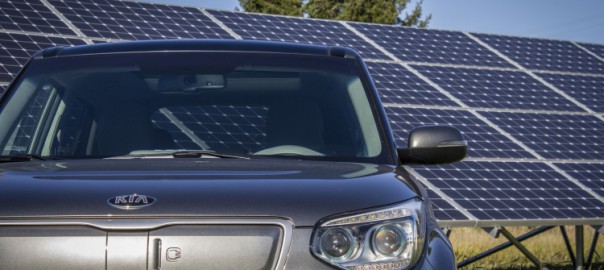
Kia Soul EV
I’m going to start this post off with a disclaimer: I’ve never been a fan of Kia. Moreover, I’ve always thought the Kia Soul was ugly as all get out and assumed that they were cheap and poorly made, and that I would never in a million years want one. So when Kia announced their new Soul EV, I was actually surprised to find myself liking what it had to offer; first, on a visual level, and then on a specs level.
And then I learned that they would only be offered in compliance states. In other words, not Washington. Sad trombone.
But then the 2016 Soul EV arrived, along with the announcement that it would be arriving at Washington Kia dealers this summer. And then they announced that the EV+ trim would be available with a “Sun & Fun Package,” which, most importantly, included a panoramic sunroof. And I was done for. Hook, line, and sinker: Kia reeled me in. On September 19th, we signed the lease papers at Smith Kia in Bellingham, and I drove my new titanium gray Soul EV+ with Sun & Fun Package home. Unfortunately, it was raining cats and dogs, so the sunroof needed to stay closed on her voyage home.
I’ve had many people in the EV community, most of whom have a Nissan LEAF, ask what I think about the car. After several months of driving it, I think I’m ready to share some of my feelings about it.
Sales of vehicles eligible for the UK Government’s Plug-in Car Grant (PiGC) have started the year strongly, taking 1.3 per cent of the overall market – the joint second highest market share ever. This is according to figures released by the Society of Motor Manufacturers and Traders (SMMT) today (Thursday 4th February).
There have been 2,176 PiCG eligible vehicles registered in January 2016, a 26.9 per cent rise compared with the same period last year. Of these 584 were pure electric vehicles (EVs), seeing a 14.1 per cent increase, while plug-in hybrid vehicles (PHEVs) increased sales almost by a third at 32.3 per cent. Since the launch of the Plug-In Car Grant in January 2011, there have been 49,866 eligible cars registered.
Plug-in registrations January 2016 (Image: SMMT)
The Alternatively Fuelled Vehicle (AFV) market, which includes models such as conventional hybrids and hydrogen fuel cell powered vehicles, saw 6,075 registrations in January which also represents a significant increase of 32.1 per cent against January 2015.
The AFV market share now sits at 3.6 per cent of the total 169,678 vehicles registered in January – itself an increase of 2.9 per cent – an improvement over last year’s 2.8 per cent.
Renault will provide used EV batteries to Connected Energy Ltd for second-life application in its E-STOR product
Renault is the electric vehicle market leader in Europe
E-STOR is a revolutionary energy storage system that can reduce costs and enable more flexible and efficient use of energy – including high capacity fast charging
E-STOR will be available in the UK from July 2016
2016 -Connected Energy Ltd E-Stor and Renault ZOE (Image: Renault)
Renault and Connected Energy are partnering to develop sustainable and efficient ways of using electric vehicle batteries at the end of their useable in-vehicle life in order to supply innovative and more affordable vehicle charging solutions.
At the end of their useful in-vehicle life, Renault EV batteries still have considerable remaining capacity, which means that they can continue to give great service in other applications before they are ultimately recycled. And with rapidly increasing EV sales – 97,687 EVs were sold in Europe in 2015, up 48% on 2014 – so is the requirement in energy to charge them.
E-STOR: a flexible and environmentally friendly energy management system
Through its award-winning E-STOR technology, Connected Energy is offering a highly innovative solution to this conundrum through use of ‘second life’ EV batteries.
This can be used, for example, to store energy generated from on-site renewable generation resources such as solar panels and wind turbines, and then release it as it’s needed at a later time. The system also allows the batteries to be charged via low-cost off-peak electricity tariffs, enabling users to reduce their energy costs.
The batteries used are Renault EV batteries, chosen by Connected Energy because Renault, as EV market leader with 23,000 units sold in Europe in 2015, has expertise in the technology, its lifecycle and impact on the environment.
The first E-STOR product is nominally rated at 50kW/50kWhr which could typically be used to support one rapid charger or a cluster of fast chargers but the system is fully scalable and higher capacity units will follow.
In practical terms, as well as allowing more efficient use of energy, the system can also enable installation of rapid electric vehicle charging in sites where electricity supply would traditionally only allow slower rates. Instead of charging vehicles via a high-capacity supply directly from the grid, E-STOR allows multiple batteries to be charged at a slower rate over a period of time, ready to release their energy and charge a car when an EV driver needs it.
Renault offers two concrete solutions with its electric vehicles and their batteries through E-STOR. First to the grid, by providing energy storage that prevents power grid overload and balances supply and demand. Second to the environment, because batteries not fitted for automobile use, but that still have considerable remaining capacity, can have a longer life and lower carbon footprint before they are actually recycled.
In June 2015, E-STOR was named winner of the innovation category in the prestigious British Renewable Energy Awards 2015, hosted by the Renewable Energy Association.
Matthew Lumsden, Managing Director, Connected Energy, said:
“E-STOR will enable the more cost-effective roll-out of electric vehicles in commercial and industrial settings, thus increasing the overall sustainability of this clean form of transport. With Renault we have secured the supply of second life batteries for future E-STOR installations.”
Eric Feunteun, Electric Vehicle Program Director, Renault, commented:
“The second life application of Renault electric vehicle batteries supports Renault’s commitment to the energy transition in the automotive industry. Through E-STOR, EV owners can charge their car at reduced costs with electricity that is less carbon-dependent. It makes driving an EV a smart and even more sustainable transportation solution. With this energy management technology, EVs and their batteries become an asset for the grid rather than create overload.”
Renault is a leader and pioneer in the emerging electric vehicle market and has sold electric vehicles since 2011, offering a range of 100 per cent electric cars and vans to suit most requirements. The ZOE supermini sits alongside the fun and distinctive Twizy urban run-around which is also available in a commercial vehicle version with a boot instead of a rear passenger seat – Twizy Cargo. Completing the Renault Z.E (Zero Emissions) line-up is the Kangoo Van Z.E. – the perfect compact van for urban deliveries and tradesmen and is available in a range of bodystyles.
In 2015, Renault was the best performing EV brand in Europe, with sales rising 49 per cent to 23,086 units, with a 23.6 per cent European EV market share. It was a similar story in the UK, with ZOE sales up 102 per cent in 2015 to 2,053 vehicles – significantly outpacing the UK electric vehicle market, which was up 48 per cent on 2014.
As these new crisis bailouts for fossil fuels show, it’s those who are least deserving who get the most government protection
‘Oil companies have already been granted ‘ministerial buddies’ to ‘improve access to government’ – as if they didn’t have enough already.’ (Image: A. Krauze)
Those of us who predicted, during the first years of this century, an imminent peak in global oil supplies could not have been more wrong. People like the energy consultant Daniel Yergin, with whom I disputed the topic, appear to have been right: growth, he said, would continue for many years, unless governments intervened.
Oil appeared to peak in the United States in 1970, after which production fell for 40 years. That, we assumed, was the end of the story. But through fracking and horizontal drilling, production last year returned to the level it reached in 1969. Twelve years ago, the Texas oil tycoon T Boone Pickens announced that “never again will we pump more than 82 million barrels”. By the end of 2015, daily world production reached 97m .
Instead of a collapse in the supply of oil, we confront the opposite crisis: we’re drowning in the stuff. The reasons for the price crash – an astonishing slide from $115 a barrel to less than $30 over the past 20 months – are complex: among them are weaker demand in China and a strong dollar. But an analysis by the World Bank finds that changes in supply have been a much greater factor than changes in demand. Oil production has almost doubled in Iraq, as well as in the US. Saudi Arabia has opened its taps, to try to destroy the competition and sustain its market share – a strategy that some peak oil advocates once argued was impossible.
The outcomes are mixed. Cheaper oil means that more will be burned, accelerating climate breakdown. But it also means less investment in future production. Already, $380 billion that was to have been ploughed into oil and gas fields has been delayed. The first places to be spared are those in which extraction is most difficult or hazardous. Fragile ecosystems in the Arctic, in rainforests, in remote and stormy seas, have been granted a stay of execution.
A longer range for one of the first electric cars on the market could be what it takes for buyers to conquer their EV anxiety
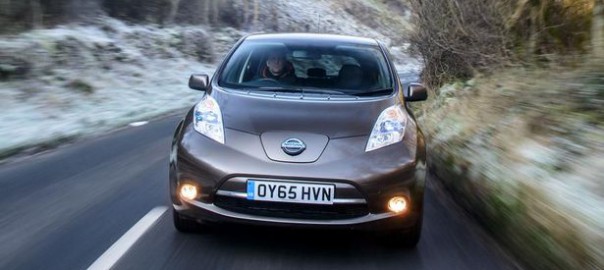
2016 Nissan Leaf 30kWh
As more and more electric vehicles come on to the market, Nissan has upped the Leaf’s game in terms of the thing that matters most – range.
This new 30kWh model runs a denser battery pack than the existing 24kWh version, giving it a claimed range of 155 miles. That’s a 25% improvement, and it gives the newcomer a place at the top of the Leaf range.
Available only in Acenta and Tekna trim, it costs from £30,935 – though that’s before the government’s EV grant contribution is taken off.
Our test vehicle was a Tekna, so it featured 17” alloys, heated seats, a premium stereo and more on top of the Acenta’s climate, rear-view camera, sat-nav and EV-specific telematic system.
Despite all the kit, though, the interior suffers from being trimmed out in plastics that are hard to the touch and all too often not very nice. That’s a shame, because it’s otherwise comfortable and, on the move, impressively refined.
Drivetrain noise is negligible, of course, but that just creates the risk of wind rustle and tyre roar taking its place. These are never offensive, however, even at high speed – and neither is ride quality, which was particularly good on every kind of road we could find.
As always with electric cars, initial pull is very strong indeed. But mid-range is a little lethargic, so it’s never much fun when you need to accelerate past a slower vehicle. Cars like the Leaf are most popular with people who do a lot of urban driving, however, and in this environment it’s in its element.
A longer range means this Leaf wants to tempt you out of the city, but it’ll take time before Motorway Man starts seeing such cars as a viable alternative to his mile-muncher.
Still, what we’re witnessing here is another step along that route. Dealing with range anxiety is a big issue for EV makers, and that’s what Nissan is doing with this new model.
They’ve addressed another kind of worry by upping the warranty on the Leaf’s batteries for eight years or 100,000 miles, too. All of which will help knock down the walls in people’s minds.