Daily Archives: January 7, 2016

The sun sets on drilling (Image: Pexels)

We could be seeing the beginning of the end of cheap oil

Has oil become an unwanted commodity? Plunging prices suggest something is going on.

The sun sets on drilling (Image: Pexels)

While diplomats in Paris hash out a legally binding accord to significantly curb greenhouse gas emissions, oil is trading at a seven-year low, closing Tuesday below $40 per barrel.

The price drop follows OPEC’s failure to put a cap on oil production last week. Energy analysts predict prices could go lower in the next 12 months, but Dan Dicker, an oil analyst with The Street and OilPrice.com, says we could be in for a wild ride that will drive oil prices back up — way up.

“I think there could be a change of four to five million barrels [a day] over the course of the next 22 or 23 months in terms of what comes off line in terms of supply and what gets added in terms of demand,” says Dicker, the author of “Shale Boom, Shale Bust: The Myth of Saudi America.” “It would mean a huge difference in the price of oil. In fact, I’m looking at prices in three digits as early as 2017.”

Dicker concedes that his hypothesis deviates sharply from other analysts who believes prices will stay low. He argues that the Saudis have reached a new limit when it comes to oil production.

“I think that they’re literally, and again I’m on the other side of this, as close to full production capabilities as they’re going to get,” he says. “They’re at a little more than 11 million barrels a day. We’ve talked about spare capacity for years with the Saudis, with a sort of a question mark on how much spare capacity they had. In other words, how much can the ultimately pump if they just wanted to open up the spigots full bore? This — 11 million barrels a day — has absolutely shocked the analysts from their predictions two, three, or four years ago. I think that the limits have really been reached.”

Over the next six to eight months, Dicker predicts that oil and gas prices will remain low, under $50 a barrel. In the long-term, other members of OPEC can increase production if they secure funding, including Iran and Iraq, but Dicker doesn’t find such a scenario possible.

“The potential there is huge,” he says. “But with all that’s going on there geopolitically, obviously that’s not a great bet to increase production two or three fold over the next three or four years.”

Source: PRI

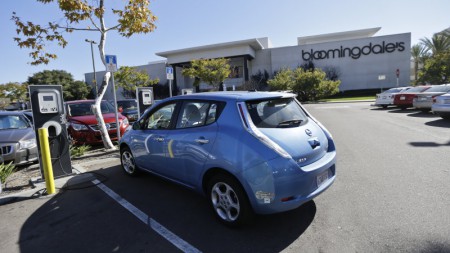
Nissan Leaf on charge

ZEV Alliance sets huge zero-emission goal for 2050

The International ZEV Alliance, an international group geared to cut greenhouse-gas emissions by spurring more electric vehicle sales, has used the United Nations’ COP21 climate-change conference in Paris to set a rather lofty goal.

Nissan Leaf on charge

The group wants to have all new cars sold within their jurisdictions to be emissions-free by 2050, according to Green Car Reports. The group includes eight US states, (California, Connecticut, Maryland, Massachusetts, New York, Oregon, Rhode Island, and Vermont) along with Quebec, Germany, the Netherlands, Norway, and the UK.

The Alliance was officially founded in September. At the time, it was determined that the group accounted for seven percent of global vehicle sales but also made up 38 percent of electric-vehicle sales, so these entities already appear to be the world leaders in the zero-emissions vehicle movement. The eight US states have been at it for a while, of course, joining up in May 2014 to state their collective goal to have 3.3 million electric vehicles on their roads by 2025. Those states and their Multi-State ZEV Action Plan account for almost one-fourth of US light-duty vehicle sales.

Of course, Norway always shoots high when it comes to zero-emissions transportation. Long known for its abundance in hydroelectricity and big-time plug-in vehicle incentives, that country is aiming to have all new cars emissions-free within the next decade.

Another group of US and non-US entities, including California, France’s Alsace region and parts of Holland, signed onto the Under 2 MOU agreement at COP21. Those members aim to cut greenhouse-gas emissions by 2050 to less than 20 percent of those in 1990.

Source: Autoblog

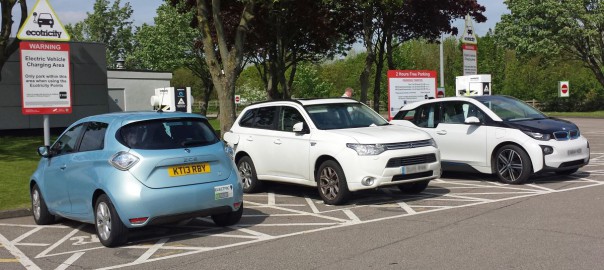
My ZOE plus an Outlander PHEV and i3 charging at London Gateway (Image: T. Larkum)

Electric vehicles are the future – there is no escaping it

Ultra-low emission vehicles (ULEVs) are becoming a more common sight on UK fleets, with this growth set to continue as manufacturers and companies aim to reduce CO2 emissions.

My ZOE plus an Outlander PHEV and i3 charging at London Gateway (Image: T. Larkum)

The latest Department for Transport (DfT) figures show that a total of 35,305 cars with CO2 emissions of 75g/km or below were registered at the end of June, compared with 12,200 on the same date last year.

Research from the latest Fleet200 – the UK’s biggest 200 fleets across 10 industry sectors – backs this up, with those organisations operating more hybrids and battery electric vehicles (EVs) than before.

But what does the future hold for fleets, and what are the implications for the UK’s road and power infrastructure?

We asked two of the country’s leading ULEV experts – Colin Herron, managing director of Zero Carbon Futures, and Denis Naberezhnykh, head of ultra-low emission vehicles for Transport Research Laboratory – for their views.

Read more: Fleet News

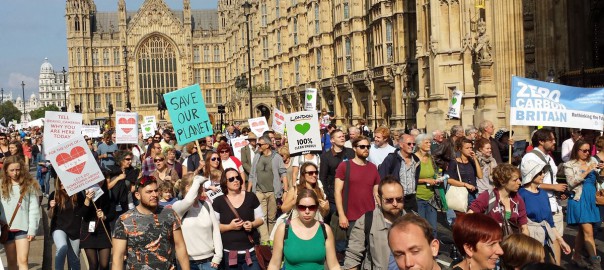
London Climate March - passing the Palace of Westminster (Image: T. Larkum)

Grand promises of Paris climate deal undermined by squalid retrenchments

Until governments undertake to keep fossil fuels in the ground, they will continue to undermine agreement they have just made

London Climate March - passing the Palace of Westminster (Image: T. Larkum)
London Climate March (Image: T. Larkum)

By comparison to what it could have been, it’s a miracle. By comparison to what it should have been, it’s a disaster.

Inside the narrow frame within which the talks have taken place, the draft agreement at the UN climate talks in Paris is a great success. The relief and self-congratulation with which the final text was greeted, acknowledges the failure at Copenhagen six years ago, where the negotiations ran wildly over time before collapsing. The Paris agreement is still awaiting formal adoption, but its aspirational limit of 1.5C of global warming, after the rejection of this demand for so many years, can be seen within this frame as a resounding victory. In this respect and others, the final text is stronger than most people anticipated.

Outside the frame it looks like something else. I doubt any of the negotiators believe that there will be no more than 1.5C of global warming as a result of these talks. As the preamble to the agreement acknowledges, even 2C, in view of the weak promises governments brought to Paris, is wildly ambitious. Though negotiated by some nations in good faith, the real outcomes are likely to commit us to levels of climate breakdown that will be dangerous to all and lethal to some. Our governments talk of not burdening future generations with debt. But they have just agreed to burden our successors with a far more dangerous legacy: the carbon dioxide produced by the continued burning of fossil fuels, and the long-running impacts this will exert on the global climate.

With 2C of warming, large parts of the world’s surface will become less habitable. The people of these regions are likely to face wilder extremes: worse droughts in some places, worse floods in others, greater storms and, potentially, grave impacts on food supply. Islands and coastal districts in many parts of the world are in danger of disappearing beneath the waves.

Read more: The Guardian

Climate March poster on the Underground (Image: T. Larkum)

World leaders hail Paris climate deal as ‘major leap for mankind’

Almost 200 countries sign historic pledge to hold global temperatures to a maximum rise of 1.5C above pre-industrial levels

Climate March poster on the Underground (Image: T. Larkum)

A historic, legally binding climate deal that aims to hold global temperatures to a maximum rise of 1.5C above pre-industrial levels, staving off the worst effects of catastrophic global warming, has been secured.

The culmination of more than 20 years of fraught UN climate talks has seen all countries agree to reduce emissions, promise to raise $100bn a year by 2020 to help poor countries adapt their economies, and accept a new goal of zero net emissions by later this century.

Formally adopted in Paris by 195 countries, the first universal climate deal will see an accelerated phase-out of fossil fuels, the growth of renewable energy streams and powerful new carbon markets to enable countries to trade emissions and protect forests.

As the final text of the agreement was released, the French president, François Hollande, said:

“This is a major leap for mankind. The agreement will not be perfect for everyone, if everyone reads it with only their own interests in mind. We will not be judged on a clause in a sentence, but on the text as a whole. We will not be judged on a word, but on an act.”

Economist Lord Stern added:

“This is a historic moment, not just for us but for our children, our grandchildren and future generations. The Paris agreement is a turning point in the world’s fight against unmanaged climate change which threatens prosperity. It creates enormous opportunities as countries begin to accelerate along the path towards low-carbon economic growth.”

Read more: The Guardian