Daily Archives: September 25, 2015

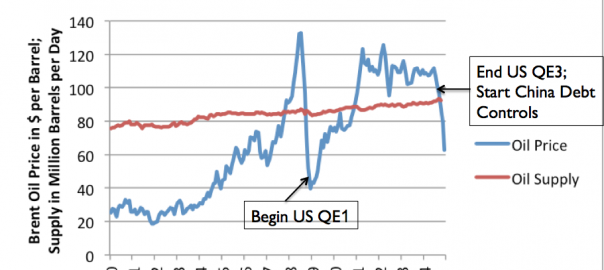
World Oil Supply (production including biofuels, natural gas liquids) and Brent monthly average spot prices, based on EIA data (Image: G. Tverberg/Our Finite World)

Deflationary Collapse Ahead?

Both the stock market and oil prices have been plunging. Is this “just another cycle,” or is it something much worse? I think it is something much worse.

Back in January, I wrote a post called Oil and the Economy: Where are We Headed in 2015-16? In it, I said that persistent very low prices could be a sign that we are reaching limits of a finite world. In fact, the scenario that is playing out matches up with what I expected to happen in my January post. In that post, I said

Needless to say, stagnating wages together with rapidly rising costs of oil production leads to a mismatch between:

  • The amount consumers can afford for oil

  • The cost of oil, if oil price matches the cost of production

This mismatch between rising costs of oil production and stagnating wages is what has been happening. The unaffordability problem can be hidden by a rising amount of debt for a while (since adding cheap debt helps make unaffordable big items seem affordable), but this scheme cannot go on forever.

World Oil Supply (production including biofuels, natural gas liquids) and Brent monthly average spot prices, based on EIA data (Image: G. Tverberg/Our Finite World)

Eventually, even at near zero interest rates, the amount of debt becomes too high, relative to income. Governments become afraid of adding more debt. Young people find student loans so burdensome that they put off buying homes and cars. The economic “pump” that used to result from rising wages and rising debt slows, slowing the growth of the world economy. With slow economic growth comes low demand for commodities that are used to make homes, cars, factories, and other goods. This slow economic growth is what brings the persistent trend toward low commodity prices experienced in recent years.

Read more: Resilience

Painting: "The Closed Bank" (Die geschlossene Bank). 1870s. Edoardo Matania (1847–1929). Via Wikimedia Commons.

Anxiety turns to fear

The characteristic feeling of the post-2008 world has been one of anxiety. Occasionally, that anxiety breaks out into fear as it did in the last two weeks when stock markets around the world swooned and middle class and wealthy investors had a sudden visitation from Pan, the god from whose name we get the word “panic.” Pan’s appearance is yet another reminder that the relative stability of the globe from the end of World War II right up until 2008 is over. We are in uncharted waters.

Painting: "The Closed Bank" (Die geschlossene Bank). 1870s. Edoardo Matania (1847–1929). Via Wikimedia Commons.
Painting: “The Closed Bank” (Die geschlossene Bank). 1870s. Edoardo Matania (1847–1929). Via Wikimedia Commons.

Here is the crux of the matter as expressed in a piece which I wrote last year:

The relentless, if zigzag, rise in financial markets for the past 150 years has been sustained by cheap fossil fuels and a benign climate. We cannot count on either from here on out….

Another thing we cannot necessarily count on is the remarkable geopolitical stability that the world experienced for two long stretches during the fossil fuel age. The first one lasted from the end of the Napoleonic Wars in 1815 to the beginning of World War I in 1914 (interrupted only by the brief Franco-Prussian War). The second lasted from the end of World War II in 1945 until now.

Following the withdrawal of U.S. military forces from Iraq, the Middle East has experienced increasing chaos devolving into a civil war in Syria; the rapid success of forces calling themselves the Islamic State of Iraq and Syria which are busily reshaping the borders of those two countries; and now the renewed chaos in Libya. We must add to this the Russian-Ukranian conflict. It is no accident that all of these conflicts are related to oil and natural gas.

As I view the current world landscape, I am reminded of two movies (which I’ve written about before) that I think capture the zeitgeist: Melancholia and Take Shelter. In both the protagonists increasingly sense that something is terribly wrong, but can’t quite put their finger on it. Everyone around them thinks they are ill or crazy. But for both protagonists, their anxiety comes from an inner vision that stems not from mere psychic disturbances, but rather from alarming real-world circumstances that are about to break into the open.

In a sense, these two characters represent those of us who cannot repress the pervasive anxiety of our times and who seek not merely to alleviate it, but rather to face it–to find out its origins and address its causes.

Read more: Resilience

If Paris succeeds Citigroup sees $100 trillion of stranded assets

The business world is finally waking up

If you hear a lot of noise about climate policies and climate action over the next few months in the lead up to the Paris climate conference, it is because there is a lot at stake. According to Citigroup analysts: $US100 trillion of potential stranded assets in the fossil fuel industry.

A new Citigroup report values the fossil fuel reserves that need to be left in the ground if the world is to meet its targets of trying to limit global warming to 2°C – a target that, according to a new Climate Council report, is actually a lot less “safe” for humankind than the science thought it was just 10 years ago.

Nevertheless, that is the stated target of all governments – including Australia’s – and Paris will endeavour to put in place a mechanism that will allow the world to meet that goal.

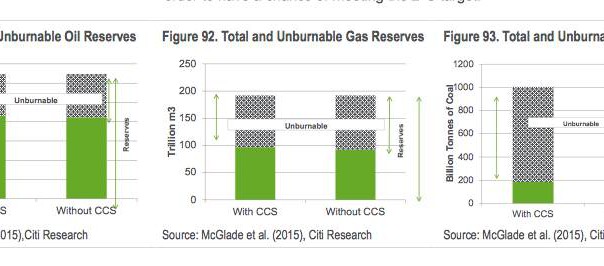
But if the world is serious about meeting this target, it needs to respect its “carbon budget” – and that calls for one-third of global oil reserves, one half of global gas reserves, and 80 per cent of global coal reserves to remain in the ground.

This graph sums up the findings of a new analysis published this year in Nature by McGlade and Ekins. The green represents the percentage of the various fossil fuel types that could be extracted under a 2C scenario.

graph_unburnable_reserves_citi

Translating that into dollar terms, and using metrics of $US70 per barrel of oil, $US6.50/MMBTU of gas (an average weighted price of US, European and Asian prices) and $US70 per tonne of coal, that amounts to a lot of money.

“We estimate that the total value of stranded assets could be over $US100 trillion based on current market prices,” Citigroup notes in the report. And coal bears the brunt, accounting for more than half the value of stranded assets, even in the unlikely event that carbon capture and storage becomes a viable technology.

Read more: Renew Economy

You might as well have fun as you change

A thought-provoking view (from 2012)

I spend much of my life making the case for changing one’s life (and not just one’s life – for supporting political and social change that is associated with it) in fairly radical ways, very quickly. I spend a lot of my time writing about this, and periodically I get on a train or a bus or something and go stand up in front of people and make the same case. I know this is a diffcult thing for many people, whose infrastructure envelopes them and pushes them powerfully towards a particular way of life, so I try to make good arguments for doing it now. I make moral arguments, about the use of a fair share. I make political arguments about not giving our money to causes we abhore. I make economic arguments. I make the argument that it will probably be a lot easier to adapt later if we have some practice.

But in the last year or two, I’ve been debating with myself how necessary I think these arguments actually are. Don’t get me wrong – I think there are still compelling moral arguments to choose to live in a certain way, and to support certain responses to climate change and depletion. For me personally, these are the most compelling possible reasons for doing this – even if climate change and depletion weren’t a reality, the truth is that Americans can only consume as they do if they tell themselves that other people in the world really won’t mind if they take more than their share, and of course, we all know that’s complete nonsense.

But I also think that the days of being able to choose to live with less are probably over. My prediction for the coming decade is pretty simple – we’re headed fairly rapidly into a time past all choosing. If the “aughts” were about the growing recognition that things are going to change, the teens, I think are now about the growing reality of that change – the recognition that none of us have the resources, or the wealth, or the immunity from changing circumstances to resist change for very long. The question is how we will change, not whether we will.

What do I mean by this? I mean that whether it comes from a worldwide economic crisis (begun already, not nearly as resolved as people say, and likely to be ongoing), from the gradual end of growth, from carbon finally being priced appropriately at the mine/well/etc…, from the costs of dealing with a rapidly increasing number of natural disaster linked to our lack of ecological awareness, from actual energy shortages or simply extremely volatile energy prices, from rising poverty and unemployment that absorb more and more of us or from failing infrastructure as we face the costs of not maintaining our sewers, electric greed, soil, water systems…. it is going to be increasingly impossible for most of us to go on as we have been.

It is no accident that the bills come due pretty much all at once in this decade. This is the decade, for example in which we can probably expect to firmly establish our oil peak, and if the promise of shale fails, as it may, our gas peak as well. This is the decade in which we run out of money to pay the Medicare bill (2017) and in which we have really begun to see the growing consequences of climate change – an ice free summer arctic, the first one in which we expect really big waves of climate refugees, etc…  This is the decade in which our deferred maintenence will begin to come due as more and more of the things we’ve left undone come back and bite us in the ass. This is the decade when we begin paying for all the things we were borrowing for in the last few years. How do we know this is true? Well, the most obvious reason is that these things are already happening.

Source: Casaubons Book
Domestic batteries help the grid

Let’s hope one day schemes like this get to the UK

Energy provider Ergon Retail is running a trial, with support from the Australian Renewable Energy Agency (ARENA), in 33 Queensland homes in Toowoomba in the south of the state and Townsville and Cannonvale in the north.

In recent months, about 30 country householders have joined a pilot project that provides a glimpse of the future of our energy grid.

For no up-front cost, these homes will get a state-of-the-art rooftop solar and battery system installed in their homes.

Tesla Motors plans to bring its new batteries in 2016 to Australia, which will join Germany as the company's first two markets outside the US (Image: Reuters)
Tesla Motors plans to bring its new batteries in 2016 to Australia, which will join Germany as the company’s first two markets outside the US (Image: Reuters)

Participants will pay a monthly fee to use the battery system, with their electricity bills expected to be significantly reduced because about 75 per cent of their power will be generated by the sun. Their shiny new cabinet-sized battery will allow them to store some of the energy from their solar panels that they then use during peak times – usually in the early evening.

For its part, Ergon will be able to remotely control and monitor these home batteries, and feed power back into the grid when the network is being stretched. The company talks about these in-home batteries as “virtual power plants” that will act to smooth out demand and strengthen the network.

Read more: World Energy News

Crisis Preparation

I don’t think I’m yet convinced that in the UK we need to worry too much about being prepared for disasters. However, I found these articles interesting and worthy of ‘bookmarking’ to consider later.

100 Items to Disappear First

“From a Sarajevo War Survivor”

1. Generators (Good ones cost dearly. Gas storage, risky. Noisy…target of thieves; maintenance etc.)
2. Water Filters/Purifiers
3. Portable Toilets
4. Seasoned Firewood. Wood takes about 6 – 12 months to become dried, for home uses.
5. Lamp Oil, Wicks, Lamps (First Choice: Buy CLEAR oil. If scarce, stockpile ANY!)
6. Coleman Fuel. Impossible to stockpile too much.
7. Guns, Ammunition, Pepper Spray, Knives, Clubs, Bats & Slingshots.
8. Hand-can openers, & hand egg beaters, whisks.
9. Honey/Syrups/white, brown sugar
10. Rice – Beans – Wheat
11. Vegetable Oil (for cooking) Without it food burns/must be boiled etc.,)
12. Charcoal, Lighter Fluid (Will become scarce suddenly)
13. Water Containers (Urgent Item to obtain.) Any size. Small: HARD CLEAR PLASTIC ONLY – note – food grade if for drinking.
14. Mini Heater head (Propane) (Without this item, propane won’t heat a room.)
15. Grain Grinder (Non-electric)
16. Propane Cylinders (Urgent: Definite shortages will occur.
17. Survival Guide Book.

Read more: The Power Hour

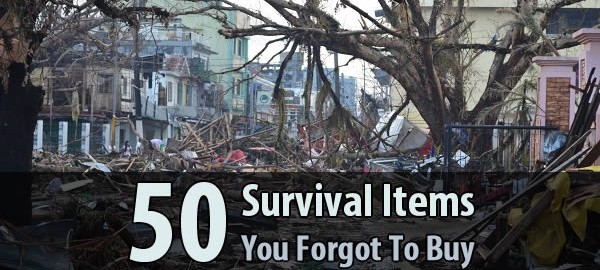
50 Survival Items You Forgot To Buy

1. Acoustic Instruments – For entertainment and morale.
2. Aluminum Foil – Great for all sorts of things like cooking food, boiling water, enhancing antennas, keeping sunlight out, etc.
3. Axes – How else will you chop firewood?
4. Baby Wipes – Really easy way to keep clean.
5. Baseballs, basketballs, footballs, etc. – Playing ball is a great way to stave off boredom and keep morale up during hard times.
Credit Card Knife
6. Bicycle Gear – If gasoline is in short supply, you might need your bike to get around. That means you’ll need a bike pump, extra tubes, etc.
7. Book lights – It’s difficult to read by candlelight and you don’t want to waste your flashlight’s batteries. Book lights are cheap and last a long time.
8. Books – You might be surprised how much free time you have after the SHTF. Now’s your chance to read those books you always meant to read (like Atlas Shrugged).
9. Bug Spray – There is usually a major lack of proper sanitation after a disaster, especially if there isn’t running water. That means there will be more roaches and other critters. There might also be a lot more mosquitoes.
10. Bullion Cubes – These make boring meals much more delicious.

Read more: Urban Survival Site