Monthly Archives: June 2015

VW Golf GTE Driven: Is It Really The GTI’s Hybrid Brother?

Imagine the lovechild of a Golf GTI with the all-electric e-Golf and you would be right on the money. The VW Golf GTE is exactly that car, offering a plug-in hybrid powertrain and the thrills of a GTI combined, at least on theory.

What’s what

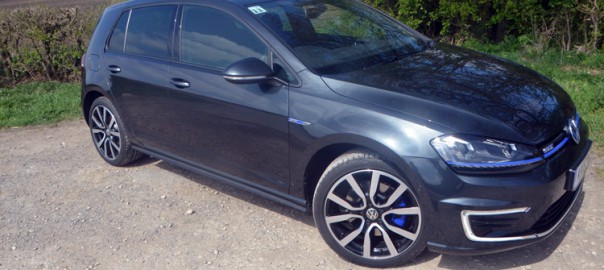
As a true lovechild of its parents, the Golf GTE combines the C-shaped LED daytime running lights from the e-Golf with the GTI’s horizontal fins at the front with every detail painted blue instead of the GTI’s red, even on the iconic tartan pattern of the seats. A standard set of 18-inch wheels dressed with 225/40 tyres complete the sporty appearance of this tech-infested Golf.

1625_2015-VW_GolfGTE_Carscoops

Under the bonnet we find a turbocharged 1.4-litre 148hp (150PS) TSI engine paired to a 101hp (102PS) electric motor integrated into the specially developed for hybrids six-speed DSG transmission. The combined output reaches 201hp (204PS) and 258lb-ft (350Nm) of torque which propel the VW Golf GTE to 62mph in 7.6 seconds and on to 138mph. But the most impressive figures claimed are about the efficiency of it: 166mpg UK (with the use of the battery, naturally) on the combined cycle and CO2 emissions of just 39g/km.

Plugged-In Details

The 8,7kWh lithium-ion battery is mounted underneath the rear seat and needs three hours and 45 minutes to be fully charged from a domestic mains outlet or two hours and 15 minutes from an optional fast charge wallbox. Depending on conditions, the all-electric range can reach up to 31 miles with the top speed limited to a more than sufficient 81mph.

The driver can choose from five different modes: E-mode, Hybrid Auto, Battery Hold, Battery Charge and GTE. As you might have guessed, the latter is the most aggressive of them all, tuning the powertrain for the best possible performance, while the Hybrid Auto mode proves to be the golden ratio between efficiency and performance.

Just Like A Tesla (Sort of)

When in E-mode, the Golf GTE feels brisk enough to tackle the usual city driving; put your right foot down and the 101hp electric motor pulls strongly the GTE in total silence, thanks to its instant torque reserves which are rated at a maximum 243lb-ft (330Nm) from a standstill with a continuous 125lb-ft (170Nm) on offer. Combine this with the direct steering and you have a fun zero-emissions car around the city. The real-world electric range is closer between 20 to 25 miles with the petrol engine stepping in when the battery levels are running low.

It’s when you take it outside the city limits that you start to really notice how smooth the driveline and how refined the collaboration between the two motors is, that makes the Golf GTE feel almost conventional, despite the crazy tech that goes under the skin. And that’s a compliment.

During our short drive on a mix of country roads and city driving we managed an average of 74mpg UK (equal to 61.6 mpg US and 3.8l/100km), which is a long way from the 166mpg UK (138mpg US or 1.7l/100km) official figure, but still remains an impressive result.

Does It Drive Like a GTI?

Not quite. Although it gives you the same, great confidence Golfs are known for, the GTE is unfortunately not the hybrid alternative of the GTI, but that’s not necessarily a bad thing. You can drive it fast and have a good time behind its wheel, especially with the GTE-mode engaged, enjoying the most balanced Golf chassis of the range due to the rear-mounted battery pack but the handling never comes close to that of the GTI’s. And there is one good reason for it: weight.

There is no escape from the inertia created by the GTE’s 1599kg kerb weight (including a 75kg driver). The battery pack alone adds 120kg to the sum, albeit it sits low in the chassis. But for the nature of it, the Golf GTE is a fun car to drive, certainly the most entertaining of the hybrids, with direct steering, solid performance and a nice ride too. You even get a miniature rev-counter for the petrol engine inside that always weird tachometer which shows whether you are draining or charging the batteries, going up and down like crazy during spirited driving.

To Sum Up

If you are looking for the same driving thrills of the Golf GTI, you’d be disappointed, but that’s more the marketing’s fault than the model itself. Because the VW Golf GTE offers one of the most capable hybrid powertrains in this price bracket, coupled with top levels of refinement and solid performance. It makes a great choice for those who want to try an electric vehicle but don’t want to suffer from the inevitable range anxiety and the usual bluntness. The main negative point is the price, with the VW Golf GTE starting at £33,085 in the UK which goes down to £28,035 after the £5,000 UK Government’s grant for plug-in vehicles and comes packed with kit, including adaptive cruise control, a 5.8-inch multimedia system and LED headlights.
This car uses green technology, not just to reduce emissions, but to go faster

Driving the hybrid Volkswagen Golf GTE

Volkswagen finally makes a hybrid, but will it electrify you?

The Pitch

The Golf GTE is Volkswagen’s first – ha-ha! – charge into hybrid driving, a short 18 years after Toyota’s Prius first apologised onto our streets. They’re late to the party, certainly, but with a compelling sell.

The GTE pairs an 8.8kWh lithium-ion battery powering a 102PS electric motor (bolted cleverly inside the gearbox housing) with a 1.4-litre, 150PS TSI direct-injection petrol engine. Together this somehow adds up to a combined power of 204PS – hmmm – and a theoretical range of 580 miles.

The Battery

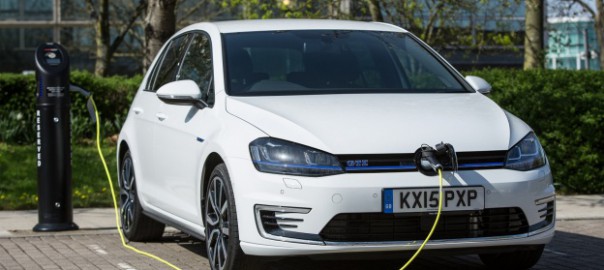
Giving a relatively titchy range of 31miles, the battery is charged via a nubbin under the front badge and should take around 3.75 hours from a domestic mains outlet, or 2.25 hours from a bespoke wall box. And here’s the big ticket number: 166. Volkswagen claims a combined cycle figure of 166mpg, while CO2 emissions should be zero in all-electric mode and 39g/km all round, so it’s expected to be exempt from VED and the Congestion Charge.

VW is desperate to position this in the same bracket as its GTi hot hatch. Hence the G and T up front. Indeed, they’re so serious about its GTi credentials they’ve even tailored the seat cloth with the brand’s iconic tartan bum-fondlers. Only in blue. Because blue’s “electric”, right?

This really is the best of all worlds: an electric runabout that’ll whizz you silently and cheaply to work – if you work reasonably nearby – while also an immensely fun hot hatch a spit off GTi performance when you marry the two engines. Wrapped in VW comfort, design skills and build quality. If the complicated engineering combination boasts VW’s legendary reliability, this is an enormously compelling vehicle.

Plus, with a £5k government electric vehicle rebate it’s £4,435 cheaper than a GTi. We know which one we’d rather have.

Read more: T3

The sun sets on drilling (Image: Pexels)

War, hedge funds and China: why oil will hit $100 a barrel

Oil prices are heading higher and could soon return to $100 per barrel as war in the Middle East and speculators drive market

It wouldn’t be the first time that oil experts have got it spectacularly wrong when predicting the price of crude.

Goldman Sachs went against the prevailing mood in 2008 when it famously predicted that crude would hit $200 per barrel within months. Instead, oil crashed to levels around $40 per barrel as the global financial crisis punctured world demand.

This time around, the US investment bank decided to follow the consensus view on Wall Street when earlier this year it downgraded its short-term forecast for the price of a barrel to around $40 per barrel.

But instead of falling, oil has rallied strongly. Brent crude now trading above $63 per barrel is up 36pc since reaching its year low in early January. At this rate oil will be back at $100 per barrel by the end of the summer driving season in the US when middle-class America hits the great open roads to visit their ‘Aunt Agatha’ in Pennsylvania.

The sun sets on drilling (Image: Pexels)

So why has the short-term outlook for oil changed overnight?

Lower prices have started to filter through to boosting growth in the world’s most advanced economies and with it demand for gasoline, which is once again on the rise.

Here are six reasons why oil is heading back to $100:

The market is tighter than you think: World demand for crude oil is beginning to rebound. After growth in consumption slowed last year the early signs are that demand is beginning to pick up led by developed markets that are responding to a period of lower prices. The Organisation of Petroleum Exporting Countries (Opec) expects demand for oil to grow by 1.17m barrels per day (bpd) in 2015 but this is a conservative estimate. Another 500,000 bpd of crude would erase the current 1.5m bpd surplus in the market. Remove this tight surplus and oil is back above $100 in a heartbeat.

Read more: Telegraph

10 Best ‘Eco Friendly’ Cars Of 2015

The 10 best ‘eco friendly’ cars of 2015 — as determined by the editors over at the noted vehicle valuation and information source Kelley Blue Book — were recently outlined in an interesting new list.

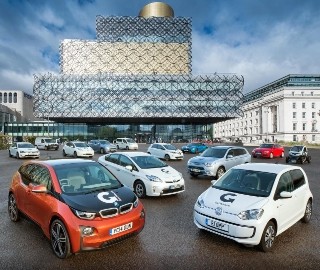
The top spot for the year was (not completely surprisingly) nabbed by BMW’s all-electric i3 model — following on the i3 grabbing other such honors elsewhere as well, and sitting at the top of all cars in the US in terms of “fuel” efficiency.

image24-e1429804688958_Green_Cars_Kelley

The new list from Kelley Blue Book is part of its yearly practice of compiling a ranking of the most efficient vehicles for the year, across all price ranges and power train variabilities.

“The list of ‘green’ vehicle standouts continues to blossom, and with strict Corporate Average Fuel Economy (CAFE) requirements coming down the pipeline, auto manufacturers are making stronger advancements each year in creating more environmentally friendly vehicles,” stated Jack R Nerad, executive editorial director and executive market analyst for Kelley Blue Book’s KBB.com.

“Topping this list for the second year in a row is the BMW i3 – an electric car that can sprint to 60 mph in just over 7 seconds, and is made in a factory powered entirely by four wind turbines. And if 81 miles of electric range doesn’t work for you, the i3 can be had with a small gas generator that lets you go as far as there are gas stations.”

Other vehicles that were ranked highly by the list include: the Volkswagen e-Golf (2nd); the Nissan Leaf (3rd); the Toyota Prius (4th); the Honda Accord Hybrid (5th); the Tesla Model S (6th); the Chevy Volt [Vauxhall Ampera] (7th); and onwards through the rest of the top 10.

Overall, a pretty ‘safe’ ranking arrangement — the e-Golf, the Leaf, and the i3 all got due recognition, as many other lists have been providing them. I suppose you could always contest Tesla’s position further on down the list, but all things considered, I’d say it’s probably fair. Myself, I’m heavily biased towards the Leaf, and would have placed it higher.

Source: Clean Technica

EVs could help reduce driving stress

According to new research, 70% of motorists believe that a quieter cabin would help improve their mood and reduce stress during the time they spend in the car.

The findings suggest that making journeys in an electric vehicle – renowned for the quietness of their interiors compared with road cars powered by internal combustion engines – can help keep driver and passengers happier.

The findings are the result of new research released today by the Go Ultra Low campaign, set up by the UK automotive industry and the public sector to highlight the benefits of ultra low emissions vehicles (ULEVs).

Tests performed by car manufacturers in the Go Ultra Low consortium showed that interior noise levels of electric vehicles and their conventionally-powered equivalents can vary by up to 6dB(A) – a significantly audible difference.

The new research also found that 74% of the UK’s car-driving population above 30 years-old desire “more ‘quiet time’ in everyday life”, with 83% of the same group believing that “Britain is a much noisier place compared with 10 years ago”.

Commenting on the findings, motoring journalist Quentin Willson said:

“When you start driving an electric vehicle the first thing you notice is the quietness of the cabin. Rather than it being a novelty, this can have a positive effect on your well-being. We all know how stressful car travel can be – I’ve found the electric motor can turn journeys into a zen-like experience!”

According to noise experts, fluctuations in sound levels can have a real impact on our emotions.

Professor Duncan Williams, psycho-acoustician at Plymouth University, said:

“Many of the sounds people find most annoying and stressful are dynamic – this is no surprise as humans are neurologically ‘hard-wired’ to respond to such noise. What makes this annoying is when the noises are beyond our control – they are basically unwelcome intruders into our personal space.”

While the research found that the ability to enjoy a ‘quiet’ car journey is important to the majority of motorists, eight out of 10 participants also believed that a reduction in car engine noise would allow them to hold better conversations with passengers and increase their enjoyment of music.

“Music has been shown to be a great mediator of moods,” added Professor Williams. “It has a clear effect on the brain, and is often prescribed in therapeutic contexts.”

Source: Newspress

Half of U.S. Fracking Companies Will Be Dead or Sold This Year

Half of the 41 fracking companies operating in the U.S. will be dead or sold by year-end because of slashed spending by oil companies, an executive with Weatherford International Plc said.

There could be about 20 companies left that provide hydraulic fracturing services, Rob Fulks, pressure pumping marketing director at Weatherford, said in an interview Wednesday at the IHS CERAWeek conference in Houston. Demand for fracking, a production method that along with horizontal drilling spurred a boom in U.S. oil and natural gas output, has declined as customers leave wells uncompleted because of low prices.

There were 61 fracking service providers in the U.S., the world’s largest market, at the start of last year. Consolidation among bigger players began with Halliburton Co. announcing plans to buy Baker Hughes Inc. in November for $34.6 billion and C&J Energy Services Ltd. buying the pressure-pumping business of Nabors Industries Ltd.

Weatherford, which operates the fifth-largest fracking operation in the U.S., has been forced to cut costs “dramatically” in response to customer demand, Fulks said. The company has been able to negotiate price cuts from the mines that supply sand, which is used to prop open cracks in the rocks that allow hydrocarbons to flow.

Oil companies are cutting more than $100 billion in spending globally after prices fell. Frack pricing is expected to fall as much as 35 percent this year, according to PacWest, a unit of IHS Inc.

While many large private-equity firms are looking at fracking companies to buy, the spread between buyer and seller pricing is still too wide for now, Alex Robart, a principal at PacWest, said in an interview at CERAWeek.

Fulks declined to say whether Weatherford is seeking to acquire other fracking companies or their unused equipment.

“We go by and we see yards are locked up and the doors are closed,” he said. “It’s not good for equipment to park anything, whether it’s an airplane, a frack pump or a car.”

Source: Bloomberg

Storm blackouts in Australia will push consumers to battery storage

Up to 200,000 business and household customers in New South Wales face extended blackouts of up to a week, or even more, following the dramatic storms in the Sydney region and to its north.

And the impact could have as galvanising an effect as Hurricane Sandy had on the New York region of the United States – causing utilities, business and household customers to consider battery storage and even micro grids.

NSW has more than 260,000 households with rooftop solar, but any houses with solar on their roof would still be without power, because their inverters are usually connected to the grid. So when the grid goes down, the inverters go down too.

The only way to be able to use that solar power is to have battery storage and a special battery storage inverter, which effectively creates its own mini grid, and can operate on its own when the main grid goes down.

“Every storm we get a surge of inquiries,” says Glen Morris, the vice president of the Australian Energy Storage Council, and the owner of a solar-storage business. (Morris also lives in an off-grid community).

“People realise that if they have got solar PV and a grid connected inverter it doesn’t work when the power goes down, so they must have storage.”

Muriel Watt, head of energy policy at renewable energy consultants IT Power Australia, says the number of customers looking at battery storage were likely to increase dramatically as a result of the blackout, and when an estimated 146,000 households in NSW come off their premium 60c/kWh tariff next year.

“With so many households now having PV, it is making even more sense for them to consider adding storage and an inverter which allows them to switch to off-grid mode,” Watt said.

“This would at least keep the lights on and prevent the ‘fridge defrosting. Japanese people have been very aware of this option after losing power for weeks after the Kobe earthquake, but prices for PV and batteries have fallen considerably since then.

“Cost effectiveness is never the only consideration for household investments – emergency power would rate quite high on the list if we are to have more frequent severe weather events.”

As for costs, Morris says it is currently making a 10-15 year payback. But like Watt, he says that is not the main consideration.

But, he notes, the cost of battery storage is coming down quickly – around 20 per cent in 2014 for lithium-ion batteries, and another 25 per cent fall expected in 2015, battery manufacturers tell him. That is the same price trajectory as solar modules over the past 5 years.

How much storage was needed depended on what the customer needed. One household recently installed a 4kWh battery storage system, but because they were careful with their energy use, that was enough for a full day.

Many households or businesses would want storage just to ensure the TV, lights and radio are kept on, and possibly the fridge. Others use storage to bank the output from their solar panels and use later in the day.

That’s because new owners are either getting paid little or nothing to export back to the grid, or are prevented from doing so.

Businesses, particularly those with refrigeration needs who find they are paying $40,000 to $50,000 for a back up generator with high maintenance, are also finding rooftop solar and battery storage is a cheaper and more effective alternative.

Some forecasts suggest that within a few years, it will be economic for households in city suburbs to disconnect from the grid. Some suggest one-third may do so within the next few decades.

Right now, though, Morris says even the market operator does not know how many battery storage systems are in place. That’s because most people installing storage are adding it to pre-existing solar systems.

Michael Anthony, from Solar360, says the bulk of his company’s business is now centred around storage. He says about 40-60 new storage systems are being installed each month, much of it in regional areas, but also in the city – both for businesses and households.

“Most dealers are trying to sell just solar, but they haven’t understood that adding storage gives a better result.”

Anthony says the levelised cost of energy for added battery storage systems is at the same level as grid power.

Ironically, Morris was speaking from the northern NSW town of Ballina, where he was hosting a course on battery storage for technicians from the local network operator.

The main grid operator in the Sydney, Hunter region, Ausgrid had to put out a warning on Wednesday in response to reports that desperate households and businesses – facing another week without power – were rushing to hardware stores to buy generators.

Morris said this was both illegal, and stupid. Generators could only work when powering appliances directly. If they are fed into a household wiring system, they can be incredibly dangerous, both for the occupants and network linesmen.

Source: RenewEconomy.au

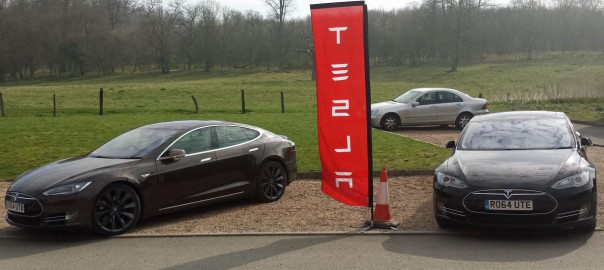
Tesla Model S Test Drive

In April we organised a test drive of the Tesla Model S for a group of drivers. There was a Tesla Event scheduled for Warwick so we booked in for that. On the morning of the big day we headed over there in my ZOE.

Our very own Tesla Model S – for a while anyway (Image: T. Larkum)

We arrived a little early and they were still setting up so we waited with a coffee and Danish pastry before having a brief presentation on the Model S. Then we headed out with our guide, Adrian. We each took a turn of 10-15 minutes driving before swapping over, and overall took in a large loop around the local area.

The Model S touchscreen system (Image: T. Larkum)

I was very impressed with the car, both with the driving and the technology. It really does accelerate very hard and fast, yet quietly and smoothly. It feels a little unnerving, a bit like holding a loaded gun, as it can just take off at any moment. And this was only a standard performance model, the P85, not the new higher performance 4WD version, the P85D.

The boot – with the lift-up panel for the rear jump-seats just visible (Image: T. Larkum)

I very much liked the media system with its large 17” touchscreen. It seemed very futuristic, and was intuitive to use. Certainly I can appreciate the attraction of having such a large display for your satnav, or the option of the satnav and media player each having half the screen.

The famous ‘frunk’ (front trunk) since the motor is between the rear wheels (Image: T. Larkum)
The famous ‘frunk’ (front trunk) resulting from the motor being between the rear wheels (Image: T. Larkum)

The time to return the car came only too quickly. After a quick debrief we headed back to Northampton in the ZOE. I very much enjoyed the test drive, and I know it definitely opened the eyes of a group of petrol-heads to the possibilities of driving on electricity – the Tesla grin was evident. One of the drivers has since bought a Leaf. Roll on the UK launch of the more affordable Tesla Model 3!

A classic Tesla grin (Image: T. Larkum)

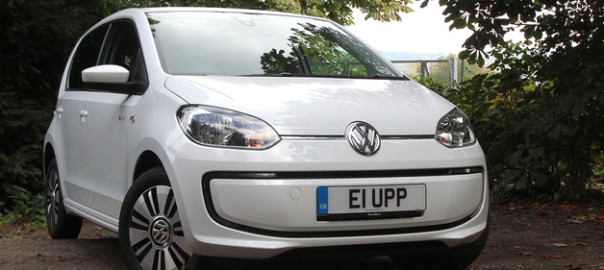
Volkswagen e-Up! review: Up against it

Say it quickly: “ee-up”. That Volkswagen feels happy to call its smallest electric car after the Yorkshire phrase for “hello” shows that Germans do truly have a sense of humour. We jest, of course – Yorkshiremen and women don’t say “ee up”, they say “ay up” – as Volkswagen’s press sheet for this car wryly points out.

Yorkshire greetings aside, the e-Up! poses a question: should you go electric? It’s been difficult to make a like-for-like choice between petrol, diesel and electric models, as most electric cars to date have tended to be standalone – the Nissan Leaf, BMW i3, Tesla Model S are all electric-only models. You can’t have a petrol version.

However, a few ranges are starting to appear which offer like-for-like choice – and Volkswagen has recently added electric versions of both Up! and Golf to its range. Bar some badges and wheel trims, you really won’t be able to spot the difference between them and their internal combustion-powered counterparts, so they could be the perfect option for electric car fans who don’t want to shout about their propulsion choice.

But taking the electric plunge will take some getting your head around, especially when it comes to price. At £19,270 – and that’s after the £5,000 UK government rebate – the e-Up! is one pricey small car. By way of comparison, the higher trim level version of the petrol Up! – on which the e-Up! is based (and that’s enough of the unwarranted exclamation mark after its name, by the way) – starts at £11,760 in five-door form, and although Volkswagen would point out there’s a host of extra kit that comes with the electric version, you’re still looking at the chunky end of a seven grand premium just to go battery powered. Perhaps more troubling for VW will be the fact that the larger, stand-alone Renault Zoe kicks off at a little over £14k.

So even before you’ve got in the driver’s seat, the e-Up is, er, up against it. Is it really worth so much cash?

Electric benefits

To save that seven grand you’re going to have to be doing an incredible amount of driving over the car’s life – at current prices, 10,000 miles in a petrol Up is likely to cost you about £1,000 in fuel.

Either that, or be extremely committed to the green cause, which isn’t entirely clear cut – electric cars aren’t truly zero emission because their electricity is most likely produced by a gas or coal power station.

From our perspective then, where the e-Up is going to make most sense is in the experience it provides. If it provides something better, extra or different over a petrol Up, then you shouldn’t rule it out.

And after jumping into the car and heading off down the road, there are some obvious benefits: the most obvious being performance. We love the 3-cylinder petrol engines in the regular Up, but they’re never what you’d call fast. And while the e-Up is still no race-car, step out of the petrol version and it does feel like a rocket.

In part that’s to do with the characteristics of the electric motor, which can deliver its full quota of torque from zero rpm. So it rips off the line and zips into gaps. In the context of city driving, which where we’d expect most e-Ups to spend their lives, it makes for a really great ally. It’s relaxing and easy in traffic – and really quite zippy and fun if you get the bit between your teeth.

Read more: Pocket Lint

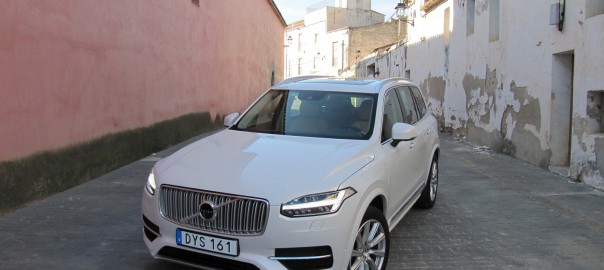
Volvo XC90 PHEV (Image: GCR)

Volvo eyes plug-in hybrid expansion

Surprised at the interest in its new plug-in XC90, Volvo could roll out more [plug-in] hybrids than planned

Plug-in hybrid tech could have more of a role to play than first expected as Volvo looks to increase UK sales from 45,000 to 60,000 in the next four years.

Volvo UK managing director Nick Connor told Auto Express that the company has been caught by surprise at the level of interest in the 390bhp T8 hybrid version of the new XC90.

“We were planning on a three-five per cent take rate of this model,” he said. “But our current rate on sold orders is over 20 per cent. We underestimated it.”

The hybrid is not due to arrive here until late this year, but demand has been so high that it is now sold out until well into 2016.

Connor added that all new Volvos launched from now will be available with hybrid tech. And the low-emissions versions could be available at all price points, rather than just at the top end of the range, as with the XC90.

A spokesperson explained:

“As with XC90 the intention is that it is kept at the upper end of each model, but if it was to be something that grows considerably, we could do it across every model.”

Read more: Auto Express