Monthly Archives: June 2015

Tesla Powerwall home battery storage system (Image: Tesla)

Why is the Domestic Battery so Important?

Earlier this year I saw an all in one inverter and domestic battery unit on display at the Bosch stand at CES.

2 years ago I stayed with my friend Simon Hackett in Adelaide, Australia and saw his line up of domestic batteries in sturdy cabinets outside his home. Simon’s house is covered in solar panels, he makes more electricity than he can use and he runs three electric cars from this power source.

Yesterday Tesla announced its domestic battery range.

Tesla Powerwall home battery storage system (Image: Tesla)

So, is this yet further ‘playthings for the rich’ as so many suggest to me on the Twitters?

What role can a domestic battery have for the ordinary Joe/Joanne?

With the advent of ever cheaper and more effective lithium ion battery technology, something government supported scientists have been working on for the last 40 years, a new paradigm is beginning to emerge.

On a personal level, if you have a few solar panels and a battery in your home, this doesn’t mean you can ‘live off the grid’ but it does mean you can reduce your electricity bill by a much larger amount that you can at the moment. You can obviously store the electricity coming from your panels during the day when you are not home and use it in the evening when you return.

But that really isn’t the story.

If a thousand homes had solar panels and domestic batteries fitted, it wouldn’t make any difference to the national picture.

Those homeowners would benefit from greatly reduced bills and maybe feel smug, but that’s about it.

If ten thousand houses had them, it might be possible to register the reduction in peak demand at the National Grid control room I visited for a Fully Charged episode.

If a million homes had them, solar panels or not, it would make a very profound difference.

If 10 million homes had them, well, everything would change.

But why?

Read more: Llew Blog

New Renault ZOE from £145 per month fuel included

Update: latest offer here.

THESE OFFERS EXPIRED ON 30 SEPTEMBER – FOR THE LATEST OFFERS SEE HERE:
New Renault ZOE from £155 per month fuel included.


(Update 1 September: Renault has confirmed that the £5060 discount will finish at the end of September so we expect the prices to be considerably higher from 1 October. Delivery is currently November-December. Update 25 August: Added prices for 18000 miles per year.)

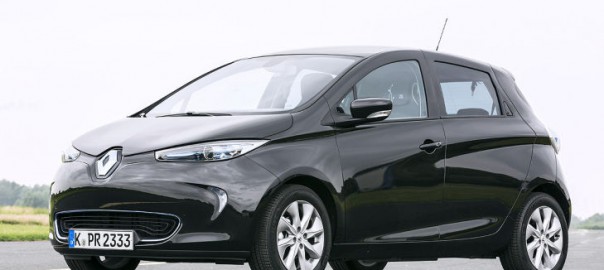
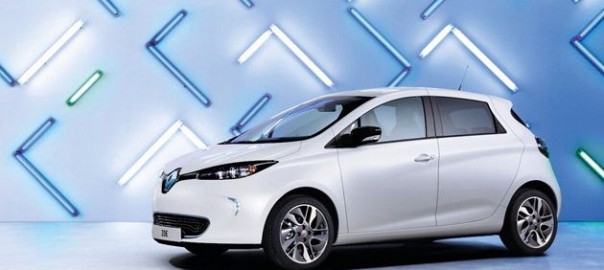
Yesterday we received the new June 2015 prices for the Renault ZOE (effectively an electric Clio) and though they have changed slightly they are still looking remarkably good.

Latest prices are as follows for a Renault ZOE Dynamique Nav on 2 year PCP (Personal Contract Purchase: like a lease but you can choose to pay an optional lump sum at the end and keep the car):

  • 3000 miles per year: £75 deposit plus £145 per month, Fuel included*
  • 7500 miles per year: £75 deposit plus £180 per month, Fuel included*
  • 9000 miles per year: £90 deposit plus £190 per month, Fuel included*
  • 10500 miles per year: £100 deposit plus £199 per month, Fuel included*
  • 12000 miles per year: £120 deposit plus £210 per month, Fuel included*
  • 15000 miles per year: £150 deposit plus £235 per month, Fuel included*
  • 18000 miles per year: £180 deposit plus £260 per month, Fuel included*

For clarity the monthly figure includes the battery rental. In all cases the excess mileage is effectively 15.5p/mile (8p per mile for the car and £7.50 per 100 miles for the battery).

Road tax is, of course, free, and no MOT is required during the term of the contract.

be1393e978dcb6da_Renault_Zoe_AutoBild

A home 13Amp charge cable isn’t included, though it isn’t required if a dedicated charge point is used – it can, however, be taken as an option for £22 per month. Metallic paint (black, grey, blue, Arctic White) is also available and adds £10-£25 per month on a standard Glacier White finish.

For comparison, consider the current deal for the Clio Dynamique S Nav TCE 90 for which the deposit is a massive £2879 and the monthly payment is £169. Even at 60mpg, if you could get it fuel included it would cost an additional £55 per month in fuel for 7500 miles per year. Therefore in total over 24 months it would cost £224 per month compared to the ZOE’s £180. And being electric the ZOE is much nicer to drive, and can be run from a renewable energy supply. And of course you’ve saved that £2800 deposit.

It’s worth noting that you get a lot of car for your money. The ZOE Dynamique Nav is a very high specification including satnav with traffic control, bluetooth, MP3, auto-lights, auto-wipers, electric mirrors and windows, reversing camera, cruise control, speed limiter, traction control, keyless entry, alloy wheels, air conditioning, etc. And being electric you can monitor the battery charge and remaining range, and control the heating or air conditioning, from your smartphone.

Who’d have believed you could drive away a new high-tech high-end car with no fuel costs, no road tax and no MOT required, for a deposit of £75?!

It’s the ultimate in predictable, fixed-cost motoring. Note, however, that virtually all stocks have been sold so cars are being built to order. Delivery for orders taken in June will be delivered in September-November, first-come first-served.

Personally I think this is a loss-leader for Renault.

If you want to know more please complete our Contact form – the high interest in this offer makes it difficult to track contacts in other ways.

Update 26 June: Renault have historically always paid for the installation of a home fast charge point (7kW/30A) by British Gas but this offer is no longer available; you should therefore budget £200-£300 for this. Update 3 July: This offer has been reinstated but the intallation is now done by Chargemaster (for more details see the Chargemaster brochure).

Also note that due to demand ZOE deliveries are now likely to be October-December.


*Fuel Included

The following are included on a June 2015 fuel included deal:

  1. Fuel (electricity) for the first 10000 miles at the Economy 7 rate
  2. Registration and access cards for the biggest charging network: Ecotricity (and Chargemaster/Polar Update 23 September: Chargemaster are in the process of limiting their network provision)
  3. Registration for London congestion charge exemption
  4. Out of hours telephone and email support for the first 6 months
  5. Office hours telephone and email support for the first 12 months
  6. Advice and support on installing a charge point.
  7. Advice and support on switching to a renewable energy supplier and Economy 7 for overnight charging (both optional).

Note that fuel included pays for 10000 miles of charging through your charge point. It does not prevent you combining offers to get additional free miles in other ways:

  • Charging at all motorway services is currently free (and at some other charge points)
  • We advise and support you to switch to a renewable energy supplier, e.g. Ecotricity. Currently you can get an additional 1000 miles per year free from Ecotricity, so you could have a total of 12000 miles free motoring on this 2 year contract.

You can also take advantage of free parking at many locations (include central London, many other city centres, London Midland rail stations, etc.). Finally note that generally if you use your private car for work purposes you can currently claim and get reimbursed at the petrol/diesel rate (at least 40p per mile) even though your fuel is free.
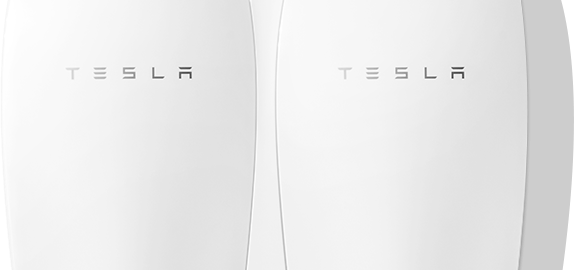
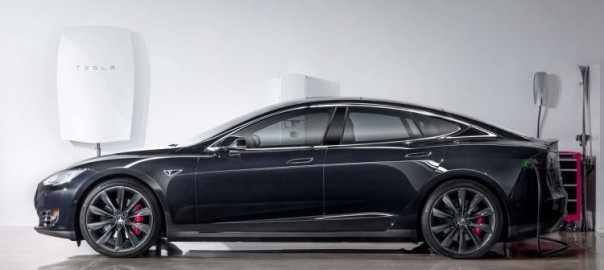
The Tesla Model S And The Powerwall (Image: Tesla)

Tesla Reveals Battery Storage Solutions

Late Thursday night [30 April] in Hawthorne, California, Tesla revealed its “missing piece to building a sustainable future,” which the company says puts the world on the road to “enabling zero emissions power generation.”

Tesla notes that the world currently uses 20 trillion kWh of energy annually, which is:

“Enough energy to power a single family home for 1.8 billion years or supply energy to a nuclear power plant for 2,300 years (or launch the Falcon 9 rocket seventeen million times).”

The company says that the Tesla Energy products launched today will help to start to wean the world off fossil fuels.

The Tesla Model S And The Powerwall (Image: Tesla)

More specifically the company is offering “a suite of batteries” for residential, business and utility use. Those solutions are outlined below.

As for what was available before today, Tesla CEO Elon Musk was very candid, “The issue with existing batteries is that they suck. They are expensive, unreliable and bad in every way.”

The Tesla CEO said that the first residential units will start shipping in about three months, but that the initial ramp will be slow, as early batteries will be built at the company’s Fremont factory.

However, next year production will switch to Tesla’s Nevada Gigafactory, and things will quickly speed up.

As a special bonus, the whole presentation made from California was done off the grid, via the company’s new utility grade “Power Packs”.

Read more: Inside EVs

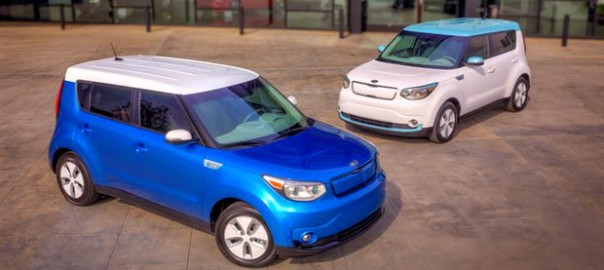
Kia Soul EV Named “Best Value In America” In Electric/Plug-In Hybrid Category

According to Vincentric, a “leading source of cost-of-ownership data and analysis within the automotive industry,” the 2015 Kia Soul EV is the “Best Value in America” in the Electric/Plug-In Hybrid category.

David Wurster, President of Vincentric states:

“As a first time winner of the ‘Best Value in America’ awards, the Kia Soul EV rose above the competition with a total cost of ownership that was more than 9% below expected. Contributing to its performance were low operating costs, which were powered, in part, by a 5-year, 60,000-mile comprehensive warranty.”

Orth Hedrick, vice president, product planning, Kia Motors America, remarked:

“The Kia brand has always stood for value, and even as we’ve grown and matured, adding ever more refined and diverse models to our lineup, we’ve never strayed from that commitment to our customers. The Soul EV, our first all-electric zero-emissions vehicle for the U.S. market continues that commitment. It offers iconic design, the best range of any vehicle in its class and superbly practical packaging, all at an affordable price. Being honored as a ‘Best Value in America’ by Vincentric is validation of Kia’s winning formula.”

The Kia Soul EV starts at $33,700 in the U.S.

Here’s how Vincentric calculates “best value:”

“Vincentric measures cost of ownership using eight different cost factors: depreciation, fees & taxes, financing, fuel, insurance, maintenance, opportunity cost, and repairs. Utilizing this methodology, Vincentric identifies which vehicles have lower-than-expected ownership costs relative to other comparable offerings. The statistical process evaluates each vehicle across all 50 states and Washington, D.C.”

Source: Inside EVs

European Buyers To Skip Over Hybrids, Go Straight To Plug-Ins

While hybrid cars have had a good 10-year run in North America as the most fuel-efficient alternative, Europe never warmed to hybrid-electric powertrains.

With roughly half the passenger cars sold in the European Union being powered by more efficient diesel engines, the difference between hybrid and diesel economy figures was much lower than in the U.S.

While the industry consensus even five years ago was that all makers would have to offer hybrids in notable volumes to achieve carbon-reduction and fuel-efficiency goals, that appears to have changed.

An article in trade journal Automotive News Europe notes that in just four years, European buyers are likely to purchase more plug-in hybrids than conventional (non-plug-in) gasoline-electric vehicles.

Japan’s Toyota still owns more than half of the world’s total hybrid market, led by its instantly recognizable and well-known Prius lineup.

In order, the next high-volume hybrid makers are Honda and Ford, followed by Korea’s Hyundai-Kia and a number of vastly smaller players.

Among those smaller players are virtually all European makers, who have issued small numbers of hybrid variants, only to cancel many of them after only a few years.

Those include hybrid versions of the Mercedes-Benz S-Class, starting in 2009, followed by the BMW 7-Series and then the BMW X6 and Mercedes-Benz ML-Class SUVs.

Today, the only European hybrid model on the U.S. market is the Volkswagen Jetta Hybrid, which sells in far lower numbers than its diesel-engined TDI counterparts in the lineup.

Instead, both European makers and their buyers seem to have concluded that the advantages of plug-in hybrids are far greater.

Read more: Green Car Reports

Car exhaust (Image: BBC)

UK government ordered to cut air pollution

Supreme court tells ministers to take “immediate action” to meet safe limits of nitrogen dioxide 25 years after original deadline

[From 29 April] Britain’s highest court today told the Government to draw up plans to tackle illegal levels of nitrogen dioxide.

In a victory for environmental lawyers ClientEarth following a five-year legal campaign, ministers must deliver proposals by the end of the year.

The government was ruled to be in breach of safeguards set under European law of the harmful pollutant in 16 UK regions and cities.

Nitrogen dioxide is produced by emissions from diesel engines.

Court justices were unanimous in the decision, saying:

“The new Government, whatever its political complexion, should be left in no doubt as to the need for immediate action to address this issue.”

ClientEarth called the ruling “historic” and said it would save thousands of lives a year.

“We brought our case because we have a right to breathe clean air and today the Supreme Court has upheld that right,” ClientEarth lawyer Alan Andrews said.

The Government has failed to bring under control levels of the pollutant for nearly 25 years, projecting it wouldn’t meet EU-set levels by 2030. In 2011 it won a grace period valid on regulations brought in 2005.

But ClientEarth today quashed the government’s statement that its actions since 2010 had been effective.

“It is very appropriate that the Supreme Court has ruled in the dying days of the government to hold it to account,” Simon Birkett, director of clean air in London said.

“The first job of the next government will be to produce a proper air quality plan and take immediate action to meet legal limits for nitrogen dioxide, currently breached up to three fold in central London,” he said.

Britain elects a new government on 7 May.

Diesel drive

Air pollution causes 29,000 premature deaths a year and costs the UK economy £9-19 billion, according to government figures.

Nitrogen dioxide is linked to respiratory problems, heart attacks and strokes.

The number of diesel cars surged to 9.4 million in 2012, a third of all licensed cars, according to official statistics. The cars, whose exhausts the World Health Organization labels as “carcinogenic” made up just 7.4% of all cars in 1994.

ClientEarth called for a “comprehensive plan” that considered “low emissions zones, congestion charging and other economic incentives”. Andrews called for London to modernise its transport fleet in an interview with RTCC earlier this month.

In London, one of Europe’s most polluted capital cities, a poll showed yesterday nearly seven out of ten Londoners thought political leaders weren’t doing enough to tackle the hazardous fumes in the capital.

Source: RTCC

Inconveniences of Gasoline 1: Gas Station (Image: Clean Technica)

Big Oil To ‘Lose Control Of Auto Industry’

It’s not uncommon for media commenters to look at electric-car sales numbers, only to conclude that the segment is teetering on the brink of death.

Electric cars will never become mainstream, they argue, because of fickle consumers who base their-car purchases on what the price of gas happens to be the moment they walk into a dealership.

Yet while the media engages in a tug of war over gas-price analysis, there are encouraging signs pointing to continued growth of electric-car adoption.

Sales have steadily increased since the Chevrolet Volt and Nissan Leaf first went on sale in December 2010, and the cost of the batteries that power these cars is decreasing.

Those trends inspired the provocative title “Big Oil Is About to Lose Control of the Auto Industry,” for a recent article by Bloomberg (via Charged EVs).

The article promotes the Bloomberg New Energy Finance (BNEF) conference held two weeks ago, where optimism about electric cars was in abundance.

Read more: Green Car Reports

(Image: D. Bacon/Shutterstock/Economist)

Bad News About Oil Prices

I have very bad news about oil prices. In the foreseeable future (12 months), their most likely trajectory is… volatile. That is right, bullish and bearish oil price narratives will be proven to be unsatisfactory and overly simplistic. The best bet would be to invest in volatility plays.

What explains this heightened volatility in oil prices? The short answer is the death of OPEC. The U.S. geopolitical deleveraging out of the Middle East has created a disequilibrium, with Iran and Saudi Arabia engaged in a competition for regional hegemony. This competition is unlike anything investors have seen in the Middle East because it takes place in the context of global multipolarity. The U.S. is no longer willing to expend increasingly scarce resources to micromanage the Middle East and no other power is going to step in to fill the vacuum. OPEC cannot survive in this environment because a cartel cannot be maintained when its members are openly at war with each other.

How important is the death of OPEC for oil prices? My colleague Robert Ryan, Chief Strategist of BCA’s Commodity & Energy Strategy, and I think that it is transformative. In our report – titled End Of An Era For Oil And The Middle East – we argue that the salient feature of the global oil market for the past 85 years has been coordinated control of production. Oil markets will see truly free-market pricing for the first time since 1930, when amidst a chaotic production free-for-all spawned by the oil boom the Texas Railroad Commission began pro-rating production in the state to control prices.

In addition to free-market pricing, oil prices are also no longer directly proportional to geopolitical risks in the Middle East. Geopolitics will now fatten both the left and right tails of the oil price probability distribution curve. Gone are the days when geopolitics of the Middle East played an obvious, unidirectional role that simply raised the risk premium on oil prices. The new paradigm, one of disequilibrium, will create headwinds and tailwinds to oil prices.

Read more: Linked In

Businesses in Milton Keynes are being given the opportunity to test out electric cars

High demand for free electric car loan to Milton Keynes businesses

After Milton Keynes Council’s electric vehicle partner Chargemaster Plc announced that it was offering a free electric vehicle loan service to Milton Keynes businesses – the company has seen a surge of interest, with the vehicles now being in ‘high demand.’

Chargemaster has a small fleet of electric vehicles (EV) that can be loaned to companies (and their staff) within Milton Keynes to allow them to experience an electric vehicle for themselves and to see what the benefits of electric motoring are.

A Renault Zoe and two Nissan Leafs are available for loan to MK companies. No charges are levied and companies have the free use of over 200 charging points in the Milton Keynes area including 56 rapid chargers which recharge these cars in less than 30mins.

Businesses in Milton Keynes are being given the opportunity to test out electric cars

Loan cars are available typically for two weeks at a time and are subject to availability on a first come first served basis.

Chargemaster require copies of drivers’ driving licences but otherwise there is no formal paperwork to complete.

This is a great way for companies to sample the benefits of EVs for themselves without having to buy a vehicle first.

With over 20 electric cars on the market from manufacturers such as BMW, VW, Audi, Renault and Nissan, there is a lot more choice within the EV market.

Over the next five years it is predicted that EVs are likely to become the mainstream vehicle with virtually every car manufacturer producing either plug-in hybrids or pure electric EVs with increasing range of over 150 miles.

Electric vehicles provide huge benefits such as low fuel costs, quieter engines and low emissions which will improve air quality in the city.

There are also considerable economic benefits for both companies and employees with very low benefit in kind taxes.

For further information contact Trevor via email (sales@fuelincluded.com).

The Renault ZOE will benefit from a 35% discount from 1st April 2015

Renault Cléon announces 100 new jobs to accompany the launch of the alliance’s new electric engine

The Renault Cléon plant will create 100 jobs with open-ended contracts in 2015 as part of a plan announced by Carlos Ghosn on February 12. The plan involves the hiring of 1,000 people in 2015, including 500 in French plants.

More than 50 years after it was built in 1958, the Cléon plant is taking on the production of the all-Renault electric engine, the R 240. Combined with optimised battery management, this engine extends the ZOE’s range to 240 kilometres[1] – a boost of 30 kilometres.

To enable the launch, €50 million were invested from the €300 million earmarked for the plant in 2011. This new technology is part of the Alliance’s electric strategy and will also benefit Renault partners.

100 jobs created

By creating 100 new jobs, the Cléon plant is reinforcing its skills to meet high commercial demand from the Alliance partners. These permanent positions will go to candidates in a range of occupational categories and having varied qualification levels, from vocational training certificates to two-year post-baccalauréat diplomas.

This job creation program follows a training plan developed in 2012, which features approximately 6,000 hours of training in preparation for the production of the R 240. The plan includes general theoretical training on the electric engine for all players involved in the project as well as technical training on the machines, in cooperation with the suppliers, for operators and maintenance staff.

Renault’s acquired electrotechnical expertise serving the alliance

Cléon has been leveraging its experience for a little more than two years with the production of the ZOE Junction Box, the system developed by Renault Technocentre engineers that manages the car’s energy transfers. The Cléon plant has mastered the assembly of electronic modules and gained invaluable experience for the production of the powerful R 240 electric engine. This expertise has made it possible to extend the ZOE’s range to 240 kilometres[1] – a boost of 30 kilometres – and will also benefit Alliance partners.

For the comparable common components of Renault and Nissan engines, the engineering and operating teams drew inspiration from Nissan’s experience in producing the LEAF engine. Cléon also gained from the expertise of local businesses that manufacture electric engines for other purposes.

Recognised industrial activity

The engines and gearboxes produced at the Cléon plant have been a true success which, in the first quarter of 2015, translated into an overall increase in activity and proportionally more business from partners (Nissan, Dacia, Samsung, Daimler, General Motors). These partners accounted for 43% of the plant’s engine and gearbox production in Q1 2015 compared to 37% at end-2014.

In addition to this burst in activity to meet high demand from Renault, Nissan and Daimler, the Cléon plant is also gearing up for several launches. The plant, which already supplies engines and gearboxes for the Trafic, recently delivered the first engines for the Opel version of the van. New vehicles in the Renault range such as the Espace and the Kadjar also benefit from powertrain components produced at Cléon. And the ZOE already features the Alliance’s brand new electric engine, the R 240. These recent and upcoming launches should help increase the site’s manufacturing volumes.

“This is fantastic news for the Cléon plant. These new hires will reinforce Renault’s skills in terms of designing and manufacturing electric vehicles. This activity in France, at the heart of the European market, is part of the Alliance’s electric strategy and will benefit its partners as well.” Stefan MUELLER, SVP Operations, Europe Region.

Key 2014 figures for Cléon:

  • More than 1 million engines and gearboxes manufactured
  • 14,537 tonnes of aluminium parts cast
  • 65% of production exported
  • 63% of production for Renault, with
  • 37% going to other Group, Alliance and partner brands
  • Nearly 20% of production for Nissan.
  • 44% of production for passenger cars and 56% for LCVs

[1] Range measured in accordance with standards in force

Source: Renault Press Release