Category Archives: Opinion

Fastned Charging Station (Image: Fastned)

The EV Tipping Point will arrive quickly

An Interview With Fastned CEO Michiel Langezaal; Why The Mass Adoption Of EVs Is Inevitable

Though the Netherland’s EV sales are picking up, Fastned’s co- founder & CEO Michiel Langezaal does think they will reach the national goal of 200,000 electric cars on the road by 2020. According to Michiel this number includes not only fully electric cars, but also the Hybrids.There are still parts of the country that are beyond the reach of EVs with a 100 kilometers per charge range. Around 85% of the population do not have their own parking spaces. Yet Fastned’s co- founder & CEO Michiel Langezaal says the EV tipping point will arrive quickly.

EVs Replace Gas Cars

He gave four reasons for expecting to see EVs replace gas cars

  1. Batteries get better every year. They charge faster, hold more energy, last longer and are cheaper.
  2. Charging will eventually be as filling up at a gas station
  3. Once the infrastructure is there, the switch to electric will be much easier
  4. Electric cars are “computers on wheels,” developed by software engineers. A gasoline car has one function, going forward. The apt comparison is an old dial phone to an iphone.

The Dutch may not meet their target for 200,000 fully electric cars in 2020, but Langezaal expects the to surge past the goal of 1 million EVs and hybrids by 2025.

He explained:

“One million is only 15% of the total cars in the Netherlands. History shows us that once you hit 5% or 6%, if the product is better, then the breakthrough comes much quicker. So I think that 2020 figure will be hard to achieve. We will work very hard, 200,000 is quite a lot, but beyond 2020 we will not go to one million cars on the roads we will go to 8 million.”

Read more: The Eco Report

Natural gas: The fracking fallacy

The United States is banking on decades of abundant natural gas to power its economic resurgence. That may be wishful thinking.

When US President Barack Obama talks about the future, he foresees a thriving US economy fuelled to a large degree by vast amounts of natural gas pouring from domestic wells. “We have a supply of natural gas that can last America nearly 100 years,” he declared in his 2012 State of the Union address.

Obama’s statement reflects an optimism that has permeated the United States. It is all thanks to fracking — or hydraulic fracturing — which has made it possible to coax natural gas at a relatively low price out of the fine-grained rock known as shale. Around the country, terms such as ‘shale revolution’ and ‘energy abundance’ echo through corporate boardrooms.

Companies are betting big on forecasts of cheap, plentiful natural gas. Over the next 20 years, US industry and electricity producers are expected to invest hundreds of billions of dollars in new plants that rely on natural gas. And billions more dollars are pouring into the construction of export facilities that will enable the United States to ship liquefied natural gas to Europe, Asia and South America.

All of those investments are based on the expectation that US gas production will climb for decades, in line with the official forecasts by the US Energy Information Administration (EIA). As agency director Adam Sieminski put it last year: “For natural gas, the EIA has no doubt at all that production can continue to grow all the way out to 2040.”

But a careful examination of the assumptions behind such bullish forecasts suggests that they may be overly optimistic, in part because the government’s predictions rely on coarse-grained studies of major shale formations, or plays. Now, researchers are analysing those formations in much greater detail and are issuing more-conservative forecasts. They calculate that such formations have relatively small ‘sweet spots’ where it will be profitable to extract gas.

The results are “bad news”, says Tad Patzek, head of the University of Texas at Austin’s department of petroleum and geosystems engineering, and a member of the team that is conducting the in-depth analyses. With companies trying to extract shale gas as fast as possible and export significant quantities, he argues, “we’re setting ourselves up for a major fiasco”.

That could have repercussions well beyond the United States. If US natural-gas production falls, plans to export large amounts overseas could fizzle. And nations hoping to tap their own shale formations may reconsider. “If it begins to look as if it’s going to end in tears in the United States, that would certainly have an impact on the enthusiasm in different parts of the world,” says economist Paul Stevens of Chatham House, a London-based think tank.

If natural-gas prices were to follow the scenario that the EIA used in its 2014 annual report, the Texas team forecasts that production from the big four plays would peak in 2020, and decline from then on. By 2030, these plays would be producing only about half as much as in the EIA’s reference case. Even the agency’s most conservative scenarios seem to be higher than the Texas team’s forecasts.

“Obviously they do not agree very well with the EIA results,”

says Patzek.

Read more: Nature

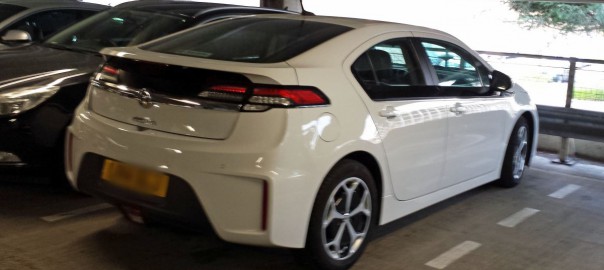
Vauxhall Ampera in Milton Keynes Central railway station multi-storey (Image: T. Larkum)

Why Plug-In-Hybrid Vehicles May Be The Car Of The (Near) Future

Owning a car provides freedom. Drive hundreds of miles if you want. When you’re low on gas, fill up in five minutes. Electric cars don’t work that way. Most modern models can travel fewer than 100 miles on a full charge, and gas tanks fill much faster than batteries charge. But one type offers a compromise that combines the benefits of an electric car with the convenience of a combustion-powered vehicle.

“I come to the conclusion that the main competitor of electric cars is the plug-in hybrids because they offer the best of both worlds,” said Ricardo Daziano, who studies the way engineering and economics affect the adoption and improvement of new technologies at Cornell University in Ithaca, New York.

“So you can go electric on your daily commute and then you feel good about the environment.”

Plug-in hybrids, such as the Chevrolet Volt (= Vauxhall Ampera), offer battery power sufficient for commuting. The battery power is often paired with a gas-powered engine that provides either direct propulsion or on-the-go battery charging during long-distance travel. In some cases a plug-in hybrid’s gas engine only charges the battery.

Vauxhall Ampera in Milton Keynes Central railway station multi-storey (Image: T. Larkum)

Current battery costs keep electric vehicles expensive and limit their range. But, electric cars don’t require gas and the vehicles themselves emit no greenhouse gases or other fumes. Of course, gas is relatively cheap right now, with oil at about $70 per barrel. Low gas prices could slow the adoption of new auto technology because the most direct benefit of using battery power to propel a vehicle is probably the money they’ll save at the gas pump.

Electric vehicles, in many ways, require a new approach to travel. Drivers can charge at home while they sleep, or at charging stations while at work. They don’t need to go to gas stations. But, if they expect to approach the limits of their range, they need to plan their daily trips carefully. They may even purposely choose busy, stop and go traffic instead of free-flowing highways.

“If people were to use some of these more congested areas, they can regenerate some of that battery charge,” said Srinivas Peeta, a transportation engineer at Purdue University in West Lafayette, Indiana. “In some sense, what we are saying is that the range can get extended a little.”

Hybrids, plug-in hybrids, and electrics typically recapture as much of the car’s energy as they can. When the driver applies the brakes, a portion of that energy is sent back into the battery for later use.

While traditional vehicles use extra fuel for heating and cooling the cabin, with an electric, all that energy has to come from the battery, further limiting the range.

Recharging an electric or plug-in hybrid is different than the typical routine of filling up a traditional vehicle. There’s not just one pump, like for gas. There are multiple types of charging, ranging from the trickle of a normal household outlet, which takes hours to fill a battery, to fast charging stations such as Tesla’s supercharger that add about half a charge to a battery in 30 minutes. It’s as if some gas pumps drip into the tank, and some are fire hoses. For electrics or plug-in hybrids, the additional time required to charge the car encourages businesses to offer expanded services at highway rest stops, in order to make it more engaging for people who would have to linger to charge a car’s battery.

“You have to come up with compatible services. People wouldn’t just wait there or stand there for 20 minutes, right? Because that doesn’t make sense,” said Eric Huang, a civil engineer at Clemson University in South Carolina, who led a session on electric vehicles and charging at the annual meeting of the professional society INFORMS this fall. He suggested that a company like Starbucks might begin offering outlets to electric vehicle drivers making intercity trips.

“Those fast chargers have to be strategically located along the highway with appropriate services.”

Developing the infrastructure to support intercity travel for electric vehicles will take time. There are other types of engines out there, including hydrogen fuel cells and compressed natural gas, but electrical power is generally easier to access. Developing an electric vehicle with both a moderate cost and a more robust range will take some time.

“You look at a car, whether it’s electric, or fuel cell, or an internal combustion car, you want it to be affordable and you want it to have adequate driving range,” said Cosmin Laslau, a technology researcher at Boston-based Lux Research, a firm that studies emerging technologies. “You can get a very affordable electric vehicle, but it has poor driving range. You can get one with astonishingly good driving range, maybe 300 miles or more, but it is going to be very, very costly. The challenge is to make a car that can drive 300-500 miles for the purchase price of $20,000-25,000. That’s not going to happen for another 10 or 15 years.”

Some experts think it might take longer. But many agree that in the next couple of decades, plug-in hybrids are going to be an important vehicle option. Why? Consumer demand.

Jonn Axsen, who studies the relationship of human behavior, energy technology and environmental policy at Simon Fraser University in Burnaby, British Columbia, said that one reason people are attracted to plug-in hybrids is because the first 10-30 miles are completely electric. But, he found that relatively few people are interested in all-electric vehicles.

“It seems no matter how I present it, there are far more consumers that are willing to buy a plug-in hybrid rather than a pure electric vehicle,” he said.

When drivers commute to work in a plug-in hybrid, it’s possible to use gas very rarely.

“Usually Chevy Volt owners drive on the battery alone,” said Laslau. “It’s a really high percentage of their driving pattern that’s battery power alone.”

Currently, these technologies are new to consumers, so experts don’t know how people will adapt to these choices. Also, the relative costs of use for electrics and plug-in hybrids are difficult to project into the future.

“There is so much uncertainty,” said Axsen. “Because you have to have perfect foresight about what the fuel costs are going to be over the next 15 years. And we have no idea.”

“If you’re looking at the whole picture, [a plug-in hybrid vehicle] has greater potential at least in the near term,” said Zhenhong Lin, a senior researcher at Oak Ridge National Laboratory in Tennessee.

Huang and Peeta, both indicated that electric vehicles will eventually win out. One factor is that by including a gas-powered generator in a plug-in, means that there are two systems of propulsion in the same car.

“Because they have two different power trains and so on, the cost associated with them in the long run is one thing to factor,” said Peeta.

Huang called plug-ins a transition model, and suggested that when the batteries and infrastructure are ready,

“I think battery vehicles are the way to go.”

How far into the future can we expect to observe that transition? As of today, it’s unclear.

Source: Physics Central

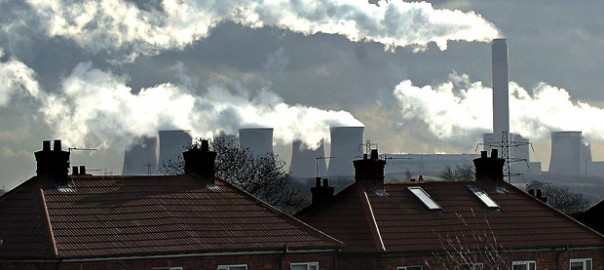
Pollution at Drax Coal Power Station near Selby (Image: J. Giles/PA)

How Solar Power Could Slay the Fossil Fuel Empire by 2030

In just 15 years, the world as we know it will have transformed forever. The ​age of oil, gas, coal and nuclear will be over. A new age of clean power and smarter cars will fundamentally, totally, and permanently disrupt the existing fossil fuel-dependent industrial infrastructure in a way that even the most starry-eyed proponents of ‘green energy’ could never have imagined.

These are not the airy-fairy hopes of a tree-hugging hippy living off the land in an eco-commune. It’s the startling verdict of ​Tony Seba, a lecturer in business entrepreneurship, disruption and clean energy at Stanford University and a serial Silicon Valley entrepreneur.

Seba began his career at Cisco Systems in 1993, where he predicted the internet-fueled mobile revolution at a time when most telecoms experts were warning of the impossibility of building an Internet the size of the US, let alone the world. Now he is predicting the “inevitable” disruption of the fossil fuel infrastructure.

Seba’s thesis, set out in more detail in his new book Clean Disruption of Energy and Transportation, is that by 2030 “the industrial age of energy and transportation will be over,” swept away by “exponentially improving technologies such as solar, electric vehicles, and self-driving cars.”

Tremors of change

Seba’s forecasts are being taken seriously by some of the world’s most powerful finance, energy, and technology institutions.

Last November, Seba was a keynote speaker at JP Morgan’s Annual Global Technology, Media, and Telecom Conference in Asia, held in Hong Kong, where he delivered a stunning presentation on what he calls the “clean disruption.”

Seba’s JP Morgan talk focused on the inevitable disruption in the internal combustion engine. By his forecast, between 2017 and 2018, a mass migration from gasoline or diesel cars will begin, rapidly picking up steam and culminating in a market entirely dominated by electric vehicles (EV) by 2030.

Not only will our cars be electric, Seba predicts, but rapid developments in self-driving technologies will mean that future EVs will also be autonomous. The game-change is happening because of revolutionary cost-reductions in information technology, and because EVs are 90 percent cheaper to fuel and maintain than gasoline cars.

The main obstacle to the mass-market availability of EVs is the battery cost, which is around $500 per kilowatt hour (kWh). But this is pitched to fall dramatically in the next decade. By 2017, it could reach $350 kWh—which is the battery price-point where an electric car becomes cost-competitive with its gasoline equivalent.

Seba estimates that by 2020, battery costs will fall to $200 kWh, and by 2024-25 to $100 kWh. At this point, the efficiency of a gasoline car would be irrelevant, as EVs would simply be far cheaper. By 2030, he predicts,

“gasoline cars will be the 21st century equivalent of horse carriages.”

It took only 13 years for societies to transition from complete reliance on horse-drawn carriages to roads teeming with primitive automobiles, Seba told his audience.

Lest one imagine Seba is dreaming, in its new quarterly report, the leading global investment firm Baron Funds concurs: “We believe that BMW will likely phase out internal combustion engines within 10 years.” (Investors at rival bank Morgan Stanley are making a similar bet, and are financing Tesla.)

Two days after his JP Morgan lecture, Seba was addressing the 2014 Global Leaders’ Forum in south Korea, sponsored by Korean government ministries for science and technology, where he elaborated on the prospects of an energy revolution. Within just 15 years, he said, solar and wind power will provide 100 percent of energy in competitive markets, with no need for government subsidies.

Over the last year Seba has even been invited to share his vision with oil and gas executives in the US and Europe.

“Essentially, I’m telling them you’re out of business in less than 15 years,”

Seba said.

Revolutionary economics of renewables

For Seba, there is a simple reason that the economics of solar and wind are superior to the extractive industries. Extraction economics is about decreasing returns. As reserves deplete and production shifts to more expensive unconventional sources, costs of extraction rise. Oil prices may have dropped dramatically due to the OPEC supply glut, but costs of production remain high. Since 2000, the oil industry’s investments have risen threefold by 180 percent, translating into a global oil supply increase of just 14 percent.

In contrast, the clean disruption is about increasing returns and decreasing costs. Seba, who dismisses biomass, biofuels and hydro-electric as uneconomical, points out that with every doubling of solar infrastructure, the production costs of solar photovoltaic (PV) panels fall by 22 percent.

Seba said:

“The higher the demand for solar PV, the lower the cost of solar for everyone, everywhere,”

“All this enables more growth in the solar marketplace, which, because of the solar learning curve, further pushes down costs.”

Read more: Motherboard.vice.com

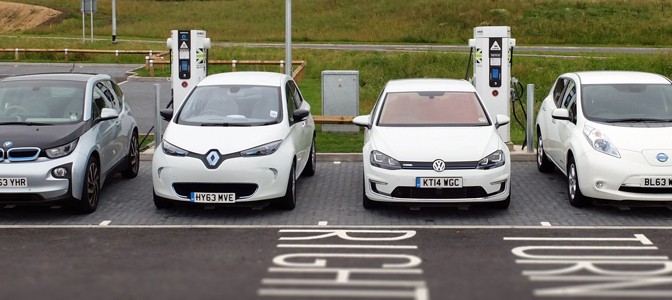
Electric Cars Fast Charging (Image: BusinessCarManager.co.uk)

Are Hybrids Being Supplanted By Electric, Plug-In Hybrid Cars?

Late in October, an interesting thing happened in Germany: Audi quietly killed off the hybrid version of its A6 luxury sedan. The model had been around for three years, and though it was initially expected to be sold in the U.S., that never actually happened.

According to Car and Driver, Audi sold about 4,000 A6 Hybrids during that time. Or as its headline said, “Nobody bought it.” The only hybrid Audi now on sale is a very, very low-volume model of the Q5 SUV that might as well be invisible for all the attention it gets.

The German makers, now on board to various degrees with electric cars, are turning their attention en masse to plug-in hybrids rather than conventional hybrids.

Meanwhile, California sales data shows that for every two hybrids sold in the state, one battery-electric or plug-in hybrid car is now delivered as well. And this is in a state where the Toyota Prius is the single highest-selling passenger car line.

Which leads to a question that is quietly being discussed among green-car advocates and most likely among automakers at large:

Have hybrid sales reached some kind of natural peak?

Certainly cars that plug in have assumed the mantle of the latest and coolest auto technology among early adopters; after 15 years, hybrids may now feel slightly old-hat.

Several years ago, before the introduction of plug-in electric cars, many industry analysts expected hybrids to increase their percentage of total sales to the point where perhaps one out of every five new cars by 2020 would be a hybrid. Thus far, that’s nowhere near happening. Instead, hybrid sales in the U.S. have stayed between 3 and 4 percent of the total for several years.

With gas prices heading toward their lowest levels in several years, the forecasts for near-term hybrid sales have darkened. But plug-in sales are increasing steadily, albeit not to the heady levels envisioned by the most optimistic forecasters five years ago.

Battery costs historically fall about 7 percent a year, so within five years, the batteries in high-volume electric cars will cost only half of what they did on launch in late 2010. Meanwhile, conventional gasoline cars are getting better-than-expected improvements in fuel efficiency via technologies like direct injection, turbocharging, and seven- to 10-speed automatic transmission.

Those technologies may mean that expensive hybridization looks less appealing as a way to meet corporate average fuel economy targets that rise steadily from now through 2025.

With battery-electric cars offering simplicity, silent operation, smooth running, and abundant torque from rest–and gasoline cars steadily improving in fuel economy–it seems likely that automakers may be more concerned about the future prospects for hybrids than they were a few years ago.

On the other hand, the 2016 Toyota Prius will be unveiled sometime within the next year–which could provide a substantial boost to the category.

Green cars: often hard to predict–and assuredly never dull.

Source: Green Car Reports

Electric Car Recharging

How Much Range Do Electric Cars Need?

Car buyers consider many factors before making a purchase – including comfort, style and efficiency. If they were honest and realistic about how much they drive, a majority of consumers inclined to purchase electric vehicles would choose battery-powered cars that can travel fewer than 100 miles on a full charge, new research finds. And according to the same study, that statistic isn’t likely to change unless battery costs drop dramatically, despite the drastic change that represents from gas-powered vehicles.

Tesla’s Model S has a range of up to about 300 miles on a fully charged battery, and a luxury car price to boot, but most electric-car models can travel no more than about 100 miles on a full charge. The new research finds that most customers will find the 100-miles or less category adequate to meet their daily driving needs, given battery costs now and in the likely near future. This is based on data that shows how far people actually drive each day.

Customers may prefer cars that are capable of driving hundreds of miles without stopping, but they may only rarely need that extra range. It may be more cost-effective to use one car for daily commutes and rent another vehicle for long trips.

However, a sticky question remains: Can car companies count on customers to purchase cars based only on economics-based considerations? Probably not, say other researchers. And, based on plans made available publicly, car manufacturers appear to agree with them.

Zhenhong Lin, a senior researcher at Oak Ridge National Laboratory in Tennessee, was trained as an engineer and now analyzes the economics and public policies related to transportation energy. His study in the journal Transportation Science, released in August, explored the multiple factors behind customer choices, including how far people actually drive on a daily basis, the variation in their driving patterns and how battery costs would have to decrease to promote electrically powered vehicles with longer ranges.

Range Issues

With gas-powered cars, driving range isn’t really an issue. A car that gets 30 miles per gallon and has a 14-gallon gas tank can go over 400 miles without refueling. And if you are about to run dry, it’s easy to find a place to fill up.

Electric vehicles don’t use gas at all – unlike a traditional Toyota Prius or other hybrid, in which various energy-capturing technologies charge an electric battery that then applies that energy to help move the car. Nor do electrics have backup gas engines like plug-in-hybrids do – this category includes one version of the Toyota Prius, the Chevrolet Volt (= Vauxhall Ampera), and others. For plug-in hybrids, the gas engine usually kicks in after a battery powers the first several to couple of dozen miles, depending on the particular model.

The longest range for an electric car is the 400 miles reported for the $100,000-plus Tesla Roadster, after a recent battery update. Most mass-market electric vehicles usually start at about $30,000. Rebates from both the federal and state levels can reduce the cost by thousands. Most of these cars boast ranges of fewer than 100 miles, including the Nissan Leaf, among others. Electric vehicles cost more than their gas equivalents, and there are far more gas stations than electric-charging stations if a driver needs to stop to top up the car’s battery. Most hybrids and plug-in hybrids have ranges similar to cars powered entirely by gas.

Read more: Inside Science

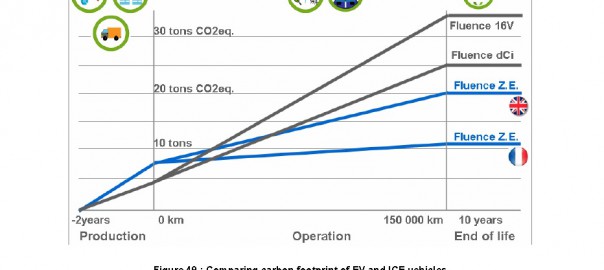
Fluence Emissions (Image: Renault)

Electric Car Life-Cycle Analysis

Renault Fluence ZE Vs Diesel, Gas Models

Fluence Emissions (Image: Renault)

The environmental impact of plug-in electric cars is a source for much debate these days. They use less energy on a wells-to-wheels carbon basis than the vast majority of new cars sold in North America, even if they’re recharged on coal-heavy electric grids.

But the manufacturing impact is greater–and the degree to which that is the case has been hotly debated for several years now. Proper life-cycle analyses of electric cars are hard to do, and expensive.

They require a great deal of careful investigation into the sources of the materials, the transportation of the raw materials and parts before they reach the assembly plant, and then the carbon impact of that assembly process.

Now, however, thanks to a tip from a reader, we’ve got a nice model of a comprehensive lifecycle analysis that compares the electric version of a car to its non-electric counterpart.

The car is the Renault Fluence ZE, the electric conversion of a French compact sedan not sold in North America. That analysis, titled “Fluence and Fluence ZE: Life Cycle Assessment” (PDF) is now three years old, but it remains an excellent model for looking at gasoline versus electric propulsion.

The Fluence ZE was developed specifically for the now-defunct Better Place project in Israel, which proposed to sell electric transportation by the kilometer, just as mobile-phone service is sold by the minute. That project collapsed into bankruptcy for a number of reasons, and the Fluence ZE is essentially a defunct model – although it lived on for a while longer in Korea as a Samsung vehicle.

But the analysis done by Renault concludes that the Fluence ZE has lower lifetime carbon emissions than either a diesel or a gasoline Fluence, not only on the French grid (which is substantially nuclear) but also the coal-heavy U.K. grid.

While the Fluence ZE is now gone, its legacy lives on in the form of an analysis – one that other automakers would do well to emulate.

Source: Green Car Reports

Electric Car Recharging

Is now the time to buy an electric or hybrid car?

Best cars and options explored

The future of driving appears to be electric, with Formula E in full effect, supercars adopting hybrid drive systems and range getting further all the time. Fuel powered engines may have their days numbered. But is it time to make the change to electric?

Now that the big car manufacturers are creating hybrid and electric cars we can be assured that it’s the future. And thanks to infrastructure improving all the time for charging stations range isn’t becoming such a big issue. But last year’s Tesla owners won’t get updated with the latest self-driving tech of this year’s Tesla, not a very nice reward for early adopting.

So is it still too early to adopt? Are batteries in cars suddenly going to improve to make current models a joke? We’ve looked at what going on to help give you a clearer idea of what to do.

Pure electric cars right now

The selection of pure electric cars right now isn’t huge, but it’s more than ever before and range is now good enough for day-to-day use. Prices, in the UK at least, are kept reasonable thanks to government assistance taking £5,000 off the price and offering free tax. If you offset petrol costs too you’re saving even more.

At the top end there’s Tesla with its Model S boasting all wheel drive and self-driving smarts starting at around the £50,000 mark. But this is in a league of its own with sports car performance, plus the latest model is not actually going to be in the UK until July 2015, even if you can buy yours now.

Then there are established brands like BMW, Ford, VW, Nissan and Renault all making fully electric cars at affordable prices right now.
Range, charging times, price and power

When going electric most people will be juggling these few key numbers: range, charging time, price and power.

PRICE: Firstly there’s price, at which the Renault Zoe wins by a fair margin starting at £14,000. Nissan’s Leaf can be bought from £16,500, Kia’s Soul EV is £25,000, the VW e-Golf is from £26,000, and BMW with its i3 is from £31,000.

RANGE: The range winner, from the reasonably priced cars, is the Kia Soul EV with 135 miles. In close second is the Nissan Leaf with 124 miles. Coming in behind them is the BMW i3 with a 118 mile range along with the VW e-Golf also sporting a 118 mile range, followed by the Renault Zoe with 93 miles.

Of course if you include the Tesla Model S that wins with its base model eeking out an impressive 240 miles on a charge and its top end offering 312 miles a go. But you get what you pay for.

CHARGE: This is a fairly even playing field with the cars all offering a rapid charge to 80 per cent in half an hour. Across the board it’ll cost you to upgrade your home charger for faster charging but this can result in as fast as a 3-hour charge to full.

POWER: Electric cars deliver all their torque instantly and the engine directly powers the wheels, this means they feel really nippy pulling away. The Nissan Leaf utilises 107hp to do 0-60mph in just 7 seconds making it the quickest of the lot off the mark.

The BMW i3 has 170hp for a 0-60mph time of 7.2 seconds, the Renault Zoe has 83hp for a 0-60mph time of 8 seconds, and the VW e-Golf manages 0-62mph in 10.4 seconds thanks to its 114hp motor. In last place is the Kia Soul EV with its 108bhp delivering a 0-60mph time of 10.8 seconds.

So for price the Renault Zoe wins it, but for range and power the Kia Soul EV comes out on top.

Plug-in hybrid electric cars right now

Hybrids have been around for years with the Toyota Prius leading the way with its dual-drive system. These are now more common than ever with Uber drivers using Prius as the car of choice.

But the market has grown, especially recently, with plug-in hybrids that allow drivers to charge at home so they may never need to use the fuel engine, instead reserving that for long distance journeys only.

From the Volvo V60 Plug-in and Ford Mondeo Titanium Hybrid to the Golf GTE or the BMW i3 with range extender, hybrids are fast becoming viable alternatives to single engine cars. The extra you may spend on the new technology can soon be made back in the petrol and tax savings they offer.

Range, charging times, price and power

Plug-in hybrid cars mean less of a worry about range than pure electric while also offering power and a reasonable price.

As with the Tesla we’re not going to include the likes of the McLaren P1, BMW i8, Porsche 918 and Ferrari LaFerrari as they’re all reserved for the super rich. And we’re only using plug-in hybrids as straight hybrids are fast becoming outdated in favour of the electric only options and extended range of plug-in hybrids.

PRICE: The plug-in hybrid range have all arrived at a similar time with manufacturers savvy to the government’s £5,000 contribution. For this reason they’re all very similarly priced.

The winner, by a narrow margin is the Ford Mondeo Titanium Hybrid from £25,000, with Mitsubishi PHEV GX3h from £28,250 in second and closely followed by the Toyota Prius Plug-In Hybrid from £28,395.

Then we have the Vauxhall’s Ampera from £29,000, Audi A3 Sportback e-tron from £35,000, BMW i3 Range Extender from £34,000 and Volvo V60 Plug-in hybrid from £45,000.

RANGE: Winning with an impressive 967 mile range is the Ford Mondeo Titanium Hybrid but it only manages around 20 miles on electric alone. Closely behind that is the BMW i3 with range extender that offers a 930-mile top end with pure electric for 105 miles, making it overall cheaper to run than the Ford. The Toyota Prius Plug-In Hybrid can manage up to 700 miles in one journey but loses on electric alone with just 15 miles on a charge.

Audi’s A3 Sportback e-tron can last for 585 miles with 31 of those miles on electric alone. Despite its size the Mitsubishi PHEV GX3h manages 500 miles with 32 on electric alone. Vauxhall’s Ampera eeks out 310 miles with between 20 and 50 of those miles on battery.

CHARGE: As in pure electric cars this is a fairly even playing field with the cars all offering a rapid charge to 80 per cent in half an hour. Across the board it’ll cost you to upgrade your home charger for faster charging but this can result in as fast as a 3-hour charge to full.

POWER: The Audi A3 Sportback e-tron, as the name suggests, wins this with a 0-62mph time of 7.9 seconds thanks to 204hp. The BMW i3 Range Extender model is second offering 170hp for 0-60mph in 7.9 seconds.

The Vauxhall Ampera does 0-60mph in 8.7 seconds with 148hp, despite having 178hp the Ford takes 9.2 seconds to get from 0-62mph, the Toyota Prius Plug-In Hybrid gets from 0-60mph in 11 seconds from 134hp, the Mitsubishi PHEV GX3h does 0-60mph in 11 seconds and has 186hp.

The winner for price is the Ford Mondeo Titanium Hybrid but the BMW i3 takes it for range with the Audi offering the most power.

Future electric and hybrid cars

The future of electric cars and hybrid machines is looking positive. Charging infrastructure is cropping up all over the country with Tesla’s Elon Musk promising to install his Supercharger network UK wide by the end of next year.

Crucially, right now, it’s possible to drive pure electric all the way from the top of Scotland to the bottom of England thanks to fast chargers along the way. It might take a little longer than petrol cars since you have to stop for half an hour to recharge, but it won’t cost as much by a long shot. So adopting right now, especially if you’re going for a hybrid, isn’t as risky as it once was.

Another issue is batteries. Developments are being made more and more regularly as car manufacturers pour money into research. But worrying about having an older battery shouldn’t be an issue as, hopefully, manufacturers will be able to swap out old for new future-proofing any car you buy now.

Next year Tesla hopes to offer a car which is nearly completely self-driving. But since that’s out of the price range of most people current electric car offerings are plenty futuristic.

If you’re already driving a car and the cost of petrol and tax are proving too much then electric or hybrid could be your way out.

Source: Pocket Lint
G20 nations had been spending almost $90bn a year on finding more oil, gas and coal

The moral issue of climate change

The politics of selfishness was embraced enthusiastically last week by Sen. Mitch McConnell. In dismissing President Obama’s deal with China to reduce carbon emissions, the incoming Senate majority leader said “carbon emission regulations are creating havoc in my state and other states around the country” by undermining economic interests.

For McConnell (Ky.) and other GOP critics, regulation of carbon emissions is a pocketbook issue where constituents’ short-term interests must prevail. They reject or minimize the arguments of leading scientists that such emissions are directly linked to global warming and climate change and could have catastrophic long-term consequences. The doubters question the data, to be sure. But their basic argument is political: Action to protect the environment will hurt “my state.”

But what if the climate change problem were instead treated as a moral issue — a matter like civil rights where the usual horse-trading logic of politics has been replaced by a debate about what’s right and wrong?

The case for treating climate change as an ethical problem is made subtly in “The Bone Clocks,” a new novel by David Mitchell. It portrays a dystopian future in which normal life has been shattered by environmental decay, rampant disease and global disorder. Mitchell’s book is long and complex, but it might just become the “1984” of the climate change movement. It dramatizes the consequences of our improvident modern economy in the way George Orwell’s novel awakened people to the “Big Brother” mentality of Soviet communism.

Mitchell imagines in the book’s concluding section an economic crash in 2039 that brings on an era he describes as the “Endarkenment.” Order breaks down as low-lying cities around the globe are flooded, communications networks collapse and transportation slows. The global economy declines as quickly as it rose during the past half-century. Chinese troops maintain control in a foreign outpost on the Irish coast, aided by a local government known simply as “Stability.” Ebola and “ratflu” ravage populations that are scavenging for food.

This is a novel, mind you, and it paints an extreme and unscientific picture. But in exaggerating the implications of current trends, it’s in the honorable tradition of similar works from Aldous Huxley’s “Brave New World” to Orwell’s masterpiece. Mitchell’s principal character, Holly Sykes, feels grief for what the world has become by 2043:

“It’s grief for the regions we deadlanded, the ice caps we melted, the Gulf Stream we redirected, the rivers we drained, the coasts we flooded, the lakes we choked with crap, the seas we killed, the species we drove to extinction . . . the comforting liars we voted into office — all so we didn’t have to change our cozy lifestyles. . . . My generation were diners stuffing ourselves senseless at the Restaurant of the Earth’s Riches knowing — while denying — that we’d be . . . leaving our grandchildren a tab that can never be repaid.”

Is this terrifying future really ahead of us? The honest answer is that nobody knows. Prominent scientists have become increasingly convinced that the connection between carbon emissions and rising temperatures is real, but skeptics have whole truckloads of studies to demonstrate the opposite. One simple way to make your way through the thicket is to ask yourself: What is the price of being wrong? If the doubters are wrong and the climate-change thesis is correct, the price is potentially catastrophic. The safe (and conservative) course is to assume the worst.

Take a stroll through the news archives of the past several months to get a sense of the possible consequences of what climate scientists say is a likely increase of at least 2 degrees Celsius through the end of this century. A Science magazine study last week forecast a 50 percent increase in lightning strikes in America. A U.N. report this month argued that recent progress against global hunger and poverty could be halted or reversed. An October Pentagon report warned of an immediate threat to national security due to increased risks from terrorism, infectious disease, poverty and food shortages.

Piers J. Sellers, a former astronaut and now the acting director of earth sciences at NASA’s Goddard Space Flight Center, wrote last week in the New York Times of what rapid temperature increase could mean by 2100:

“The impacts over such a short period would be huge. The longer we put off corrective action, the more disruptive the outcome is likely to be.”

Is this a moral issue? After reading Mitchell’s stark novel, and imagining the world of 2043, I am beginning to think the answer is yes. If the future quality of life around the world is at stake, people who resist action are not just misguided, they’re wrong.

Source: Washington Post

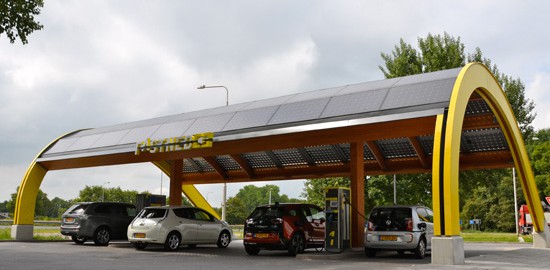
G20 nations had been spending almost $90bn a year on finding more oil, gas and coal

A 5 Minute History of Climate Politics

Today begins the UNFCCC’s COP20 which, since the failure of the Copenhagen Accord, will build on the Durban Platform which follows the Bali Roadmap and the Warsaw Outcomes to replace the Kyoto Protocol. Overwhelmed? Fair enough. Confused? Don’t be.

The world of international climate politics seems almost indulgently complex. Yet the negotiations that are about to take place in Peru are possibly the biggest thing ever to happen on climate change. So as a citizen of the world, we need you to know about it. In the next five minutes, let’s have a crash course on what it all means. It’s 20 years of complicated history coming up, so bear with me.

It all begins in 1992 when the world came together and realised there was a problem with the climate. The UN came up with its Framework Convention on Climate Change (UNFCCC) which remains the primary body through which climate negotiations take place. The UNFCCC receives advice of the Intergovernmental Panel on Climate Change (IPCC), a collection of the world’s top scientists who periodically compile the latest research on what’s happening with the climate (Disclaimer: the news is bad). The UNFCCC has the ultimate objective of stabilising greenhouse gas emissions at levels that prevent dangerous interference with the climate and that enable sustainable economic growth. This remains their basic aim to this day.

By 1995, it was pretty obvious that the emissions reductions originally proposed by the UNFCCC were not enough to halt climate change. So representatives from the world’s governments started negotiating a new agreement under the UNFCCC. When these representatives meet to talk about the UNFCCC, it is called the ‘Conference of the Parties’, abbreviated to COP. COP1 took place in 1995 in Berlin.

It took three years to sort out, but in 1997, COP3 announced the Kyoto Protocol. The Kyoto Protocol committed industrialised countries to cut emissions by 5% from 1990 levels by the year 2012. The USA and Australia refused to ratify it, most nations that did ratify ignored it, and besides, it was never enough to prevent climate change anyway. But it was a start.

In 2007, COP13 produced the “Bali Roadmap”. This paved the way for a new agreement for after 2012, when Kyoto was set to expire.

At the 2009 COP15 in Copenhagen, the world was hopeful about agreeing upon this new binding treaty. The time seemed ripe. However, at the Conference, infighting between the major powers (China, the US etc.) hindered the negotiations and so we ended up with non-binding ‘promises’ to cut emissions. The Copenhagen Accord decreed that we would hold warming to within 2 degrees Celsius. To do this, global emissions must peak in 2020, yet the individual pledges made under this accord, even if they were all realised, would miss this goal and see warming of 3 degrees Celsius by 2100. As a result, the accord was widely seen as a failure.

The big question since Copenhagen is how can we agree on a climate treaty for the post-2020 period? In Durban in 2011, the COP agreed on the “Durban Platform” which recognised that there was an increasing gap between what countries were promising in terms of action, and what was needed to avoid catastrophic climate change. In response, the Durban platform announced that a new agreement should be in place by 2015.

In 2012 in Doha, the COP extended the Kyoto Protocol until 2020. They also agreed on the “Doha Climate Gateway”, which emphasised the need for an agreement in 2015 to come into action by 2020.

At the last COP, in Warsaw in 2013, the UNFCCC agreed that the 2015 agreement must bind nations together to avoid the climate change ‘danger zone’ and stimulate faster action immediately. These are known as the Warsaw Outcomes.

This leads us to Lima. The savvier amongst you will have realised that it is not yet 2015. COP20 in Lima can be seen as the warm-up act to the main game in Paris next December. But you’ll also note that everything has been leading to this. The failure of Copenhagen in 2009 to produce a binding agreement has scared the climate world. We know we can’t rock up to Paris and hope for the best. That’s what happened in Copenhagen and everything fell apart. What we need out of Lima is agreement on a draft text to negotiate in Paris so that when COP21 starts, we have a reasonable chance of that text being adopted. If global emissions are to peak in 2020, action is needed now.

Source: The Verb