Category Archives: Opinion

Everything Has Changed: Oil, Saudi Arabia, and the End of OPEC

Saudi Arabia’s decision not to cut oil production, despite crashing prices, marks the beginning of an incredibly important change. There are near-term and obvious implications for oil markets and global economies. More important is the acknowledgement, demonstrated by the action of world’s most important oil producer, of the beginning of the end of the most prosperous period in human history – the age of oil.

In 2000, Sheikh Yamani, former oil minister of Saudi Arabia, gave an interview in which he said:

“Thirty years from now there will be a huge amount of oil – and no buyers. Oil will be left in the ground. The Stone Age came to an end, not because we had a lack of stones, and the oil age will come to an end not because we have a lack of oil.”

Fourteen years later, while Americans were eating or sleeping off their Thanksgiving meals, the twelve members of the Organization of the Petroleum Exporting Countries (OPEC) failed to reach an agreement to cut production below the 30 million barrel per day target that was set in 2011. This followed strenuous lobbying efforts by some of largest oil producing non-OPEC nations in the weeks leading up to the meeting. This group even went so far as to make the highly unusual offer of agreeing to their own production cuts.

The ramifications of this decision across the globe, not just in energy markets, but politically, are already having consequences for the global landscape. Lost in the effort to understand the vast implications is an even more important signal sent by Saudi Arabia, the owner of more than 16% of the world’s proved oil reserves, about its view of the future of fossil fuels.

Since its formal creation in 1960 the members of OPEC, and specifically Saudi Arabia (and in reality the Kingdom’s control over global oil markets is much larger than that 16% of reserves implies as its more than 260 billion barrels are among the easiest and cheapest to extract and before enhanced recovery techniques accounted for a much larger share of global reserves) have used excess oil production capacity to influence crude prices. The primary role of OPEC has been to support price stability. There are notable exceptions – like the 1973-1974 oil embargo and a period of excess supply that undermined prices and crippled the Soviet Union in the 1980s (though whether this was a defined strategy or serendipity remains in some question), but at its core the role of OPEC has been to control oil prices. As recent events show, OPEC’s role as the controller of crude oil pricing is coming to an abrupt end.

In acting as global swing producer, OPEC relied has heavily on Saudi Arabia, which can influence global prices by increasing or decreasing production to expand or reduce available global supply. Saudi Arabia can do this not only because it controls an enormous portion of global reserves and production capacity, but does so with crude oil that is stunningly inexpensive to produce compared to the current global market. A change, however, has occurred in Saudi Arabia’s fundamental strategic approach to the global oil market. And this new approach – to refuse to curtail production to support global prices – not only undermines OPECs pricing power, but also removes a vital subsidy for global oil producers provided by the Saudi’s longtime commitment to price support.

Read more: The Energy Collective

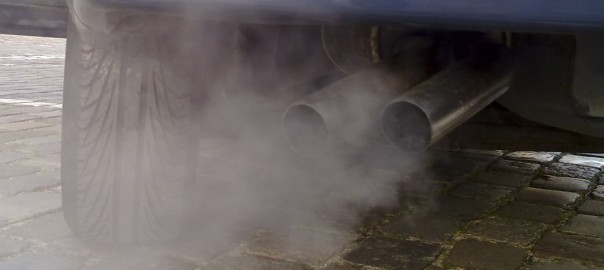
Car exhaust (Image: BBC)

Why cheap gas can’t kill the electric car

From 2010 to 2014, U.S. electric car sales surged from almost nothing to about 120,000 per year. But the haters and doubters persist. Analysts and investing forums are buzzing about a coming stagnation. After all, in the past seven months the price of oil has collapsed from $115 a barrel to below $50. Gasoline prices have plummeted, too, fast approaching $2 per gallon nationally, and commuters are rejoicing. That means a key selling point for electric vehicles — low fuel costs — is gone. The electric car appears to be in trouble.

Surprisingly, it is not. This past week, the floor of the North American International Auto Show in Detroit was stacked with glitzy new electric cars, from the BMW i3 to the Chevrolet Bolt to SUVs and micro-cars. That’s because today’s electric car boom isn’t really about oil prices at all; it’s about clean air. Under the leadership of California, a group of environmentally progressive states (Oregon, New York, Maryland, Massachusetts, Vermont, Rhode Island and Connecticut) has created market-based mandates that set a floor under the electric-vehicle market. In other words, they’re forcing automakers to sell electric cars. The goal is to have 3.3 million of them on their roads by 2025. Thanks to clever policy design, the survival of electric cars doesn’t depend on the vagaries of the global oil market.

For more than a century, electric cars have repeatedly lost out to oil. As early as the 1890s, electric taxi fleets were stealing market share from horse-and-buggy drivers in New York, Philadelphia and Atlantic City. Even Thomas Edison was in on the game, spending more than a decade — and $1 million of his own fortune — developing a battery technology aimed at electric cars.

Electric cars, however, couldn’t keep pace with the fast-improving internal combustion engine. Its range, power and portability were all superior, thanks to oil. By 1910, Henry Ford (a former Edison Illuminating Company employee) had effectively crushed the early electric car. By 1927, half of all American families owned an oil-fueled car. Electric cars were no longer serious contenders.

But between 1969 and 1979, oil prices spiked, reviving interest in electric cars. In 1975, Congress took up a bill called the Electric and Hybrid Vehicle Research, Development, and Demonstration Act, which included $30 million for studies and deployment. A year later, Congress overrode a presidential veto to authorize $160 million for electric-vehicle research and testing over a five-year period. But when oil prices plummeted in the 1980s, policymakers retreated, halting funding for research.

Today, pessimists see a depressingly familiar pattern: Energy prices spike; huge sums of capital flow from the government and the private sector into oil alternatives; energy markets crash; those funds vanish and industries wither. And, of course, the electric car dies.

What makes California different is that its electric-car program isn’t tied to oil prices — because the project predates the oil shocks by more than two decades. After World War II, a mysterious pall of smog strangled Los Angeles. California’s response was to build a potent architecture for researching and regulating air pollution. This eventually became the California Air Resources Board (CARB), a body that rapidly outpaced the federal government in the science and policy of pollution control.

By 1970, California’s regulatory infrastructure was so developed that the national Clean Air Act allowed the state to set its own standards for emissions — and gave other states the option to follow its strict guidelines in lieu of those set by the federal government. If automakers wanted to sell cars in California — or in other states with similar regulations — their vehicles had to adhere to California’s emissions standards. These efforts accelerated in 1975 when Gov. Jerry Brown installed a new, aggressive chairman, Tom Quinn, at the state Air Resources Board. For a decade, CARB focused on cleaning up the exhaust from combustion engines. In 1990, with oil prices around $20 a barrel, CARB went even further, setting its sights on a car that didn’t pollute at all: a zero-emissions vehicle, an electric car.

California mandated that a certain percentage of cars sold in the state had to be electric — initially 2 percent by 1998 and escalating to 10 percent by 2003 — and then set about building a long-range strategic plan to help automakers fulfill the mandate. One key element was creating a market for car companies to buy and sell zero-emissions vehicle (ZEV) credits issued by the state for electric vehicle sales. If one automaker failed to sell electric cars, it could buy credits from a competitor who had succeeded. While building electric cars was expensive, so was buying credits; it also took a toll on a company’s reputation and deprived manufacturers of the technological insights they would gain by developing the cars. The incentives for automakers to push forward were in place.

Implementing the mandate was a long, iterative process, and the regulators’ initial goals proved to be overly ambitious. Over the decades CARB muddled through lawsuits and high-stakes policy brawls with automakers and the George W. Bush administration. Carmakers grumbled that California could not simply mandate innovation. “I wish that, instead of zero-pollution vehicles, CARB had mandated a cure for cancer,” Automotive News sneered. Then, for years, the Bush administration refused to grant California regulators a federal waiver for emission standards that until then had been practically pro forma.

But California kept going. Because the state was America’s largest auto market, it was too big for carmakers to abandon.

In 2010, automakers began selling a new generation of truly mass-produced electric vehicles, starting with the Nissan Leaf. California’s market for credits rewarded companies such as Tesla and Nissan that got out in front. These companies have reaped hundreds of millions of dollars from selling credits to laggards that did not fulfill their quotas. In the third quarter of 2014, Tesla Motors earned $76 million on ZEV credits alone.

California has also rewarded buyers of electric cars. It granted cash incentives to early adopters and gave them access to high-occupancy vehicle lanes so they could bypass the daily crush of rush hour. And California helped other states design their own incentive programs, which include perks such as rebates, free city parking and in some places free charging. The benefits make electric cars more attractive financially, particularly since the upfront costs of purchasing one might not be offset by fuel savings for years.

Today America is the world’s largest market for electric cars, and about 90 percent of them are sold in states following California’s program. The project took time to develop, but it finally broke the link between innovation policies and the capricious commodity cycle. The electric-car effort is just the kind of strategic planning that will be needed to transition away from fossil fuels, avoid the next oil shock and drive America toward a clean-energy economy.

Electric-vehicle sales may sag for a month or a quarter, but will cheap oil kill the electric revolution? Don’t bet on it. Electric cars are here to stay.

Source: Washington Post

Car exhaust pollution (Image: Wikipedia)

Saudi prince: $100-a-barrel oil ‘never’ again

Saudi billionaire businessman Prince Alwaleed bin Talal told me we will not see $100-a-barrel oil again. The plunge in oil prices has been one of the biggest stories of the year. And while cheap gasoline is good for consumers, the negative impact of a 50% decline in oil has been wide and deep, especially for major oil producers such as Saudi Arabia and Russia. Even oil-producing Texas has felt a hit. The astute investor and prince of the Saudi royal family spoke to me exclusively last week as prices spiraled below $50 a barrel. He also predicted the move would dampen what has been one of the big U.S. growth stories: the shale revolution. In fact, in the last two weeks, several major rig operators said they had received early cancellation notices for rig contracts. Companies apparently would rather pay to cancel rig agreements than keep drilling at these prices. His royal highness, who has been critical of Saudi Arabia’s policies that have allowed prices to fall, called the theory of a plan to hurt Russian President Putin with cheap oil “baloney” and said the sharp sell-off has put the Saudis “in bed” with the Russians. The interview has been edited for clarity and length.

Car exhaust pollution (Image: Wikipedia)

Q: Can you explain Saudi Arabia’s strategy in terms of not cutting oil production?

A: Saudi Arabia and all of the countries were caught off guard. No one anticipated it was going to happen. Anyone who says they anticipated this 50% drop (in price) is not saying the truth.

Because the minister of oil in Saudi Arabia just in July publicly said $100 is a good price for consumers and producers. And less than six months later, the price of oil collapses 50%.

Having said that, the decision to not reduce production was prudent, smart and shrewd. Because had Saudi Arabia cut its production by 1 or 2 million barrels, that 1 or 2 million would have been produced by others. Which means Saudi Arabia would have had two negatives, less oil produced, and lower prices. So, at least you got slammed and slapped on the face from one angle, which is the reduction of the price of oil, but not the reduction of production.

Q: So this is about not losing market share?

A: Yes. Although I am in full disagreement with the Saudi government, and the minister of oil, and the minister of finance on most aspects, on this particular incident I agree with the Saudi government of keeping production where it is.

Q: What is moving prices? Is this a supply or a demand story? Some say there’s too much oil in the world, and that is pressuring prices. But others say the global economy is slow, so it’s weak demand.

A: It is both. We have an oversupply. Iraq right now is producing very much. Even in Libya, where they have civil war, they are still producing. The U.S. is now producing shale oil and gas. So, there’s oversupply in the market. But also demand is weak. We all know Japan is hovering around 0% growth. China said that they’ll grow 6% or 7%. India’s growth has been cut in half. Germany acknowledged just two months ago they will cut the growth potential from 2% to 1%. There’s less demand, and there’s oversupply. And both are recipes for a crash in oil. And that’s what happened. It’s a no-brainer.

Q: Will prices continue to fall?

A: If supply stays where it is, and demand remains weak, you better believe it is gonna go down more. But if some supply is taken off the market, and there’s some growth in demand, prices may go up. But I’m sure we’re never going to see $100 anymore. I said a year ago, the price of oil above $100 is artificial. It’s not correct.

Q: Wow. And you said you are in agreement with the Saudi government to not give up market share?

A: This is the only point I’m agreeing with the Saudi Arabian government on oil. That’s the only point, yes.

Q: Should the Saudis cut production if they get an agreement with other oil producing countries to take oil off the market?

A: Frankly speaking, to get all OPEC countries to approve and accept it, including Russia and Iran, and everybody else, is almost impossible You can never have an agreement whereby everybody cuts production. We can’t trust all OPEC countries. And can’t trust the non-OPEC countries. So it’s not on the table because the others will cheat. The past has proven that. When Saudi Arabia cut production in the ’80s and ’90s, everybody cheated and took market share from us. Plus, remember there is an agenda here also. Although Saudi Arabia and OPEC countries did not engineer the reduction in the price of oil, there’s a positive side effect, whereby at a certain price, we will see how many shale oil production companies run out of business. So although we are caught off guard by this, we are capitalizing on this matter whereby we’ll live with $50 temporarily, to see how much new supply there will be, because this will render many new projects economically unfeasible.

Q: What about the theory of the pressure on the Russians? There’s a theory that the U.S. and the Saudis have agreed to keep prices low to pressure Russia because of what Putin has done in Ukraine.

A: Two words: baloney and rubbish. I’m telling you, there’s no way Saudis will do this. Because Saudi Arabia is hurting as much as Russia, period. Now, we don’t show it because of our big reserves. But I’ll tell you Saudi Arabia and Russia are in bed together here. And both are being hurt simultaneously. And there’s no political conspiracy whatsoever against Russia. Because we are shooting ourselves in the foot if we do that.

Q: You said the price of oil will dampen the shale revolution in America. How?

A: Shale oil and shale gas, these are new products in the market. And we see big ranges. no one knows for sure what price is the breaking point for shale. Wells have a higher production cost. And very clearly these will run out of business, or at least not be economical. At $50, will it still be economically feasible? Unclear. This is a very much developing story.

Q: Some people believe this crash in oil will create a lot of new mergers in the energy industry. Do you agree?

A: No doubt about that. For sure there’ll be a lot of consolidation in the market. Because many small and medium-sized companies can’t afford this. Because they are very much dependent on the price of oil. Big companies like Exxon and Chevron are weathering the oil market crash because they are integrated vertically. But no doubt there’ll be some mergers and acquisitions coming in one to two years.

Read more: USA Today

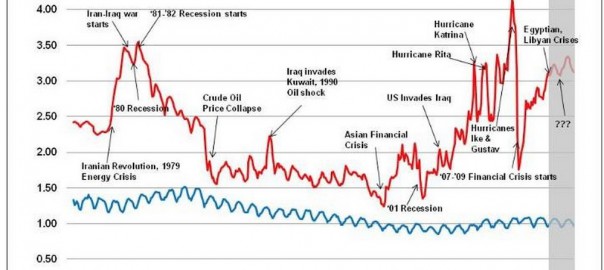
Gasoline Price vs Electricity Price (Image: EEI)

Oil Price Drop Kills Electric Car Sales?

Cheap Oil and Electric Cars

You are probably aware of the massive drop in the price of crude oil. It started before Christmas and it continues to fall.

This can only mean one thing, electric car sales will plummet, people will start buying bigger cars with bigger engines because petrol and diesel will be dirt cheap. Forever.

We all know that, once the price of oil goes down, it stays down, forever.

Oh wait, I’ve just remembered, no it doesn’t. It goes up again just as sharply, then down again, then up.

Gasoline Price vs Electricity Price (Image: EEI)

It’s a highly volatile market which keeps financial journalists busy so that’s good for them.

So why did the price of oil go down?

Oh yes, fracking. Of course, if only the namby-pamby-greenie-weeny-nimbies would allow this government and their mates to frack the hell out of Berkshire we’d have almost free oil and gas forever.

Except of course we wouldn’t, and now it seems even more unlikely.

Here’s an idea.

The tar sands in Alberta, the gas and oil in shale rock thousands of meters beneath the surface, geologists and oil companies have known about that stuff for decades, it’s only recently been financially viable to extract it because the oil price has been so high.

So extract it they did, they had a bonanza! Woop-de-doodie.

Then some chaps in Saudi Arabia noticed a bit of drop in demand for sweet crude (that’s a proper term by the way) and they said, ‘either we turn off the taps and make do with several billion dollars a day less than we’re used to, or we flood the market and put all the tar sands dudes and frackers out of business overnight.’

They did the latter.

It is now economically ridiculous to spend the amounts of money and energy to extract tar sands, fracked oil and all the associated problems that go with this absurd, last gasp effort to keep burning fossils. The fossil companies are moaning, they want more tax breaks or they’ll go out of business. Naturally they have the full support of the public….. not.

And interestingly this massive temporary reduction in the oil price has had no effect on electric car sales, they just keep going up.

It’s still tiny, it’s still a fraction of the total but the increases are in the 100’s of % per year.

Because as anyone with two brain cells is aware, people don’t buy electric cars just because petrol is expensive or cheap. There are hundreds of reasons, the main one being that the technology is more interesting, impressive, reliable and it is possible to make your own fuel.

That’s disruptive, that’s upsetting to the entrenched and well defended monopolies that govern us…. via the governments they pay for.

So I would suggest that electric car sales will not be affected by the drop in the price of oil.

As I always say, electric cars won’t save the world, but they might be pointing in a direction we should all be looking at.

Source: Llew Blog

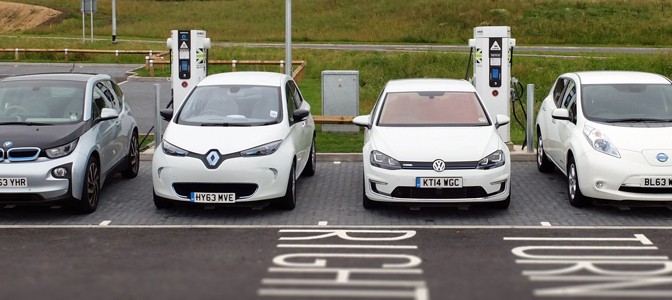
Electric cars charging in Milton Keynes (Image: T. Larkum)

At least one major oil company will turn its back on fossil fuels

Jeremy Leggett, former industry adviser, warns over plunging commodity prices and soaring costs of risky energy projects

The oil price crash coupled with growing concerns about global warming will encourage at least one of the major oil companies to turn its back on fossil fuels in the near future, predicts an award-winning scientist and former industry adviser.

Electric cars charging in Milton Keynes (Image: T. Larkum)

Dr Jeremy Leggett, who has had consultations on climate change with senior oil company executives over 25 years, says it will not be a rerun of the BP story when the company launched its “beyond petroleum” strategy and then did a U-turn. He said:

“One of the oil companies will break ranks and this time it is going to stick. The industry is facing plunging commodity prices and soaring costs at risky projects in the Arctic, deepwater Brazil and elsewhere.

“Oil companies are also realising it is no long morally defensible to ignore the consequences of climate change.”

Leggett, now a solar energy entrepreneur and climate campaigner, points to Total of France as the kind of group that could abandon carbon fuels in the same way that E.ON, the German utility, announced plans before Christmas to spin off coal and gas interests and concentrate its future growth on renewables.

Pressure on the energy industry to pull out of fossil fuels has grown in recent months with a campaign for pension funds to disinvest from coal, oil and gas.

A new report published this week by researchers at University College London deepened the message that vast amounts of oil in the Middle East, coal in the US and gas in Russia cannot be exploited if the global temperature rise is to be held at the 2C level safety limit agreed by countries.

Leggett, who once conducted research into shale funded by BP and Shell, chairs Carbon Tracker Initiative, a thinktank which aims to raise awareness among key decision-makers about the risks that fossil fuel investments pose to wider financial stability. He believes the current 50% slump in the price of Brent crude will cause the US shale boom to go bust with potentially alarming consequences for the financial system.

“Many of the shale drillers have been feasting on junk bond finance, which was so easy when oil prices were above $100 (£66) but with prices at $50 confidence is going to collapse,”

he said.

“Should the shale narrative evaporate then it is going to be very embarrassing for all sorts of political promoters of the industry, including George Osborne.”

Leggett said that despite the price collapse due to oversupply, he remained convinced the “peak oil” theory that supplies will eventually be unable to meet demand remains intact.

This is not because there are not the oil or gas reserves in the ground to meet future growth, but because they are too costly and environmentally dangerous to produce, he argues:

“I would say to both the utility industry and the oil and gas industry: its game over, guys. You have got to identify the point at which it’s all going to be thoroughly changed and you have got to map back from it.

“You have to think strategically. The point to map back from is zero carbon in the energy system, not the electricity system, by 2050, because more than 100 governments want that in the [next UN climate change] treaty being prepared for signing in Paris.”

But he also believes the energy industry is privately aware of the problems as it watches its own costs of fossil fuel extraction going up while the costs of solar and other new technologies are coming down.

Leggett, who plans to stands down as chairman of the highly successful Solarcentury renewable business he founded to focus on climate change campaigning, holds what he calls “friendly critic” sessions with the fossil fuel sector these days. The tone of the meetings has changed significantly over the past two years, he said.

“Before it was know your enemy. Now it’s: ‘Crikey. A lot of this may be coming true on our watch. What shall we do about it?’ There are top-to-bottom strategic reviews going on in E.ON but in other companies as well, utility and oil and gas. So it will be really interesting to see which is the first of the oil and gas companies to break from the pack, although I fear BP and Shell are going backwards not forwards on carbon.”

Source: The Guardian

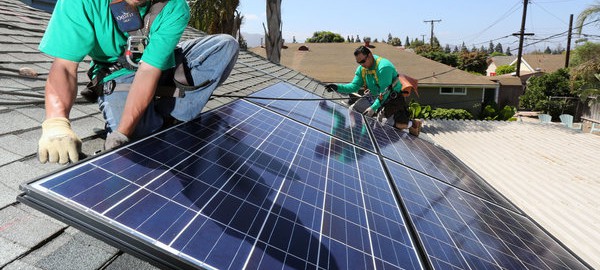
Workers for SolarCity installing solar panels (Image: JE Flores/NYTimes)

Is the solar panel & battery combo ready to change energy markets?

The big idea right now for solar and batteries is this: put solar panels on your roof, a battery in the backyard (or basement), and become utterly independent from the power grid, using free electricity from the sun. Batteries have long been looked to as a way to store energy solar energy during the day to be used at night, but they have long been too expensive to be used widely. But many companies are looking at 2015 as a very important year for the solar and battery partnership and I’ve heard the word “tipping point” being used repeatedly about this intersection recently.

Why all the excitement and why now? First off, traditional lithium-ion batteries — the kind being widely used in cell phones and laptops — are becoming cheaper than ever before. Electric car company Tesla and Japanese battery giant Panasonic have been working closely on lowering costs of their lithium-ion batteries significantly, and with Tesla’s “gigafactory” the companies expect to be able to reduce the lithium-ion battery cost by another third.

Navigant Research estimates that Tesla pays about $200 per kWh for its Panasonic battery cells today, and that price could drop as low as $130 per kWh by 2020 when Tesla’s massive factory — which is expected to more than double the world’s lithium-ion battery production — is fully up and running in Nevada. Several years ago, lithium-ion batteries cost closer to $1,000 per kWh. Tesla plans to sell some of the batteries from its factory into the power grid market, and SolarCity (the installer company chaired by Tesla CEO Elon Musk) already uses Tesla batteries for a solar panel energy storage system.

Lithium ion batteries are becoming such a clear low cost platform for energy storage that other startups beyond Tesla are adopting this idea, too. At CES last week, a startup called Gogoro launched an electric scooter and battery swapping infrastructure based around modular lithium ion batteries designed also in conjunction with Panasonic. Owners of the Gogoro scooter will some day be able to swap out their two depleted batteries at a nearby battery swap station, and they will likely pay a subscription for access to the batteries.

But it’s not just the economics of lithium ion batteries that are driving the pairing of solar and batteries. Other startups have been developing newer, low-cost battery chemistries that are optimized for the power grid, like Aquion Energy and Ambri. Aquion Energy last week announced that one of its largest battery installations to date (2 MWh) is going into a solar system on the Kona coast of Hawaii.

The surge in solar panel installations is one of the main drivers behind this grid battery trend. There’s a lot bigger market these days for solar: More than a third of all new electricity installed in the U.S. in the first three quarters of 2014 came from solar panels, both utility-scale solar and solar panels on residential rooftops. That’s second only to new natural gas plants.

Solar companies, like SunPower, SolarCity, Sunrun and others, are doing deals with battery makers, looking to offer new services. Startup Stem, which uses distributed battery packs to work like virtual power plants, is working with Kyocera Solar.

Then there’s the grid battery market that’s being opened up by the state of California’s aggressive mandates for energy storage. California utilities are being asked to buy 1,325 megawatts of energy storage services by 2020, and utility Southern California Edison has already said it will buy 250 MW of energy storage systems. Part of SCE’s plans will be made up by a huge 100 MW battery plant from AES Energy Storage and a 85 MW contract from Stem.

So clearly, utilities aren’t worried about energy storage in general, because they will some day be major users of this technology. But in the short term, some are worried about so-called grid defections. If your solar panels and battery offer you all the electricity options you need, why do you need the utility?

However, according to a recent report from Moody’s, batteries and clean power are just still too expensive to be too threatening right now. Moody’s said that even with battery prices at $200 per kWh, and solar panels at $3.50 per watt, these technologies are “an order of magnitude too expensive to substitute for grid power.” Battery prices would have to be closer to $10 per kWh to $30 per kWh range to be cost competitive widely for the power grid, said Moody’s.

Those costs might be difficult for (most) residential customers to justify, but it could be a different story for commercial building owners. GTM Research says the market for solar panels paired with batteries will surpass $1 billion in annual revenue by 2018 (up from just $42 million last year), with collectively 318 MW of solar and storage capacity installed in the U.S. by that time. One in ten new commercial solar customers will opt for an energy storage addition by 2018, predicts GTM Research.

Source: Gigaom

Inconveniences of Gasoline 1: Gas Station (Image: Clean Technica)

Lower Oil Prices in an EV World

What do declining oil prices mean for alternative fueled vehicles, plug-in hybrids and EVs? If anything is to be learned from the past periods where gasoline prices have dropped precipitously it is that they spell death for alternative fuels. Dropping oil prices are a very bad thing for all alternative fuels and most likely will be a very bad thing for electric vehicles and plug-ins as well.

From 1981 to 1986 reduced demand and overproduction created a large amount of oil not being consumed in the open market. I remember going to an area that had refineries at the time and seeing a large number of oil tankers just sitting, anchored out on the bay waiting for their turn to hook up to the refineries. The refineries were not operating at full capacity and when they shipped out their inventory as product, then and only then would they allow for the oil tankers to hook up. This five-year-long period has a direct correlation to the improved fuel economy that vehicles were required to achieve by the CAFE (Corporate Average Fuel Economy) standard laws passed in the 1970s. These laws took effect during the later part of the 1970s and the first part of the 1980s. Fuel economy for automobiles reached somewhere around 27 miles per gallon on average in 1986. Even though these laws may have been put in place during that period of time, it was consumers that rapidly embraced smaller more fuel efficient cars coming from Japan. It was a natural reaction after rising gasoline prices hit them hard in the pocket book and spurred deep recessions in the 1970s. It was a reaction that the US automobile manufacturers were slow to embrace.

Consumers also embraced alternative fuels. Even though the sales of such vehicles were small in number, electric cars made the scene with Bob Beaumont’s Sebring Vanguard Citicars and other brands in the mid 1970s. Although electric vehicles had some impact for alternative fuels it was ethanol that was the biggest entry for alternative fuels, typically blended with gasoline. Demand and pricing was such that independent stations selling ethanol blended gasoline sprang up to sell the stuff starting in the corn belt of the Midwest. By the end of the 1970s major oil companies jumped in the game. Despite being heavily subsidized the number of biomass ethanol producers dropped 47% by 1985. Gasohol as a readily used term to describe 10% ethanol blended gasoline disappeared from America’s vocabulary, and the gasohol independent stations disappeared from the gas station landscape.

I remember a Freedom Gasohol station on route 1 south of Alexandria, Virginia that stood abandoned for over a decade. It stood there as a reminder to me of how fortunes can change very rapidly for investors in alternative fuels. It was also a reminder to me that history is an important teacher. Those who don’t know history are likely to make the same mistakes as others have in the past. The United States by allowing for oil and gasoline prices to drop again without a price floor is reliving a past where alternative fuels were pushed from public awareness.

What is causing the prices to drop today is largely an over supply similar to that of the 1980s. Probably also caused by an anticipated dramatic increase in the CAFE gas mileage requirements signed into law in 2009, but that is not all. John Maynard Keynes referred to a phenomena that tended to keep prices high even though demand drops as “the sticky nature of prices.” Let me explain it to you in a more understandable way. Let’s say you have a house that you borrowed $90,000 for and put $10,000 as a down payment. Let’s say later you want to move from the area and want to sell your house. However, in the in-between time prices of houses comparable to yours have dropped to $70,000. Let’s say you still owe the bank $85,000 and you want to get back the cash you put into the home. You are going to be reluctant to drop the price to $70,000. You most likely will list your home at $95,000, where you will at least get back your down payment. However, the market demands a lower price. Once you get over the shock and accept the reality of the new price being $70,000 you will still have to deal with the bank. The bank is going to not accept a sale that is below what you owe them. So the price again can’t go below the $85,000. When the bank finally comes to grip with the reality of the market and accepts market pricing they will still want to have a say in what they will accept in terms of an offer. Basically, people and businesses get used to prices being a certain amount and have locked in their expenses and expected profits at that price. It is hard for them to move off of that expected price. When prices drop fast like they have with oil and gasoline lately, there are other factors at play. There has to be a willingness by the oil companies to sell at lower prices. The question is what are those other factors for the oil producers that have them willing to sell oil for far less money? Demand has lowered by 13%, so why are we seeing a 50% or more drop in oil prices and why are oil producers willing to accept that asking price when demand exists above that 50% drop in price?

There are odd other factors in the oil markets that make them not react to typical economic conditions, however, surplus crude oil is going to have a strong downward pressure on prices, and when coupled with other factors we get the big price drop. Wall street analysts point out that the price move by OPEC and in particular Saudi Arabia has to do with them believing that the cost factors in US fracking shale oil are high and that by dropping the price of oil OPEC might be able to stop US production since at a certain price per barrel of oil US shale oil becomes unprofitable. Saudi Arabia hopes that by maintaining market share they will be able to increase prices at some later date after the shale oil producers leave the market. Analysts point out that this is flawed thinking, because as soon as prices rise again to where shale oil becomes profitable these producers will comeback online to produce oil again. Since this idea is easily viewable as flawed this may not be the reason for dropping oil prices. I just don’t think the Saudis are stupid.

Other analysts think that the price drop might be a coordinated political move by Europe, Saudi Arabia and the United States to have an affect on global politics. They say that Europe has a desire to weaken Vladimir Putin’s meddling in the Ukraine, Saudi Arabia wants to keep Iran from attaining nuclear weapons and destabilizing the region, and the United State wants to keep Venezuela from influencing Cuba. The high price of oil funds all of Russia, Iran and Venezuela’s extracurricular activities. For the US, Europe and Saudi Arabia a drop in oil prices keeps Russia, Iran and Venezuela in check. If it were true, it seems to be working. Russia’s economy is on the verge of collapse, which, we would hope would curb Putin’s meddling in Ukraine. Iran seems to be coming around to the idea of negotiating a nuclear deal with the west, without oil propping them up they may be more willing to negotiate their nuclear ambitions away for a removal of the sanctions restricting their sale of oil. Venezuela has stopped subsidizing oil to Cuba and, despite other reasons given, many experts say that that is the main reason behind Cuba’s push for better relations with the US. I have already seen an article about US oil companies working with Cuba to do oil exploration there. However, this seems far fetched to me and rather complicated given the entities past cooperation. Also, the United States government and in particular this administration have very little influence on oil companies that are humongous international entities. Although Saudi Arabia might be able to control its oil output, Europe and the United States most likely would not be able to do much in this alliance to influence the price of oil. Which leads me to think that it is probably something else entirely that is leading to the willingness to accept a much lower price for oil.

It could be that oil companies maybe trying to reconstruct demand that was destroyed because of high oil prices and the deep recession it triggered. Oil companies and oil producing nations are hoping that consumers will abandon their thrift ways and go back to overusing petroleum in the form of big cars and trucks, or they may be hoping that consumers will not keep fleeing petrol powered vehicles for alternatively powered ones. This is, I believe, a very important possibility.

What is the one thing that can change the oil demand landscape where it would become irretrievable if it were to actually take hold? Alternatives. For example, we are multi-food consumers. If the price of a single food goes dramatically upward, we simply don’t purchase that food and choose an alternative food to eat. Therefore one source of food can’t jack up its prices and remain in the market for long. In real world economics prices always settle at an equilibrium between price and supply, and the price of whatever can be substituted for that item. The ability for consumers to choose a comparably priced alternative keeps the price of any item in the food market in check. Electricity in most of the United States is far cheaper than gasoline and therefor electric cars provide a competitive alternative to gasoline powered vehicles. This has proven to be a threat to the monopoly like hold that oil has had over the market of car fuels. When electric cars were just a novelty, oil producing nations and oil companies were unconcerned with electric cars and other alternatives and therefor jacked up prices. However, electric cars have sold well over a quarter of a million vehicles last year. That constitutes a real threat that oil sales can’t recover from.

My feeling is that oil companies and oil producing nations don’t want their gravy train to end and they are taking a momentary hit on extreme profits to kill alternatives. That is why I believe there is so much willingness to accept such a precipitous drop in the price of oil of 50% or more for a mere 13% drop in demand.

Source: EV World Blog

Electric Cars Fast Charging (Image: BusinessCarManager.co.uk)

Free? Why Electric Cars may soon be even more Cost Effective

Eco-friendly cars have long been a good investment for Londoners. Driving an electric vehicle means you are exempt from both congestion charges and VED (road tax) both pet hates of the average motorist. There are an abundance of charging points around the City and local government offer a grant that will give you up to 75 per cent off the cost of installing a domestic charge point. With no fuel charges and the majority of car journeys in and around London covering less than 10 km, an EV will often prove to be the most efficient choice.

Of course, depending on the model, they can be expensive to buy new, even with the local government grant of up to £5,000 towards the purchase of an electric car. It is my belief however that this won’t be the case for much longer. Some industry commentators believe that by 2020 only 2 or 3 per cent of the cars on our roads will be electric. The CEO of Renault-Nissan, Carlos Ghosn, believes the take-up will be much faster, with ten per cent of all new cars being electric-powered by 2020. Ford goes further still: Derrick Kuzak, Ford Group’s Vice President of Global Product Development has said that electric drive models could account for a quarter of Ford’s global automotive sales by 2020.

Not only will electric cars become more prevalent on our roads, but they will also become more cost-effective, to the point that they will eventually be free. Yes, free.

How? My reasoning is one of simple economics. Although oil prices fluctuate and at the moment are currently dropping, in the medium term, oil prices are only ever going to go up. Meanwhile, the price of an electric car is consistently falling. Eventually, the cost of leasing an electric car will be cheaper than the cost of putting fuel into a conventional car. At that point, the cost of the electric car itself is effectively zero.

Throughout the world, top economists have been talking about how business and buying patterns will evolve over the next thirty years. Chris Anderson, author of Free; The Future of a Radical Price argues that the economics of abundance forces the devaluation of products and services to the point where they are virtually free. Zero pricing is changing the face of business. For a product to be free, there has to be a related product or service that can be charged for. The free product must also be low-maintenance and have negligible ongoing costs associated with it.

A good example of a free product that we all have and use are cell phones.

By removing the dependency on oil, this sales model will be able to work for electric cars in the future. The cars themselves will be free and customers will choose a usage tariff that suits them. Usage tariffs will directly replace the fuel bills that everyone has to pay to use their existing cars. They will be calculated to work out at either the same cost or slightly cheaper than putting fuel into an equivalent combustion engine car.

So instead of paying £200 per month for fuel at service stations, you would pay a similar amount each month for the usage plan on your electric car. The electric car itself would be free. At the start of your contract, you’d be able to go into the car showroom, choose the car that you want and simply drive it away.

Given the choice between buying a £15,000 car with a combustion engine and then paying £200 per month on fuel, or just paying the £200 a month on a usage plan and getting the equivalent electric car for free, which would you choose?

So why aren’t electric cars already being sold like this? It’s simply a case of presentation and marketing. It took the mobile phone industry around fifteen years to get to the point where phones were given away free of charge, but the car industry has got to the same point, just four years after the first mainstream manufacturers launched their first electric models.

Expect the change to happen and expect it to happen soon, particularly in Europe, where the cost of fuel is so high. Walking into your local car dealership will be like walking into your local mobile phone store. Choose your electric car and drive it away.

Source: The London Economic

Vauxhall Ampera Charging (Image: OLEV)

Do Gasoline Prices Correlate With Plug-in Vehicle Sales?

Introduction

“..it is fair to suggest that falling gas prices will reduce demand for fuel-efficient, hybrid and electric vehicles”
-Alec Gutierrez, Kelley Blue Book

“..gas prices”certainly” have an effect on electric-drive cars.“
-Jessica Caldwell, Edmunds.com

The idea has been repeated often enough; rising gasoline prices cause drivers to turn to alternative fuel vehicles for relief; falling gas prices must then lead to less drivers buying electric cars. Seems logical. But does the data back this up? Plug In America decided to investigate.

To answer this question, we considered the period between December 2010, when the Chevy Volt and Nissan LEAF kicked off sales of the current crop of electric vehicles, and November 2014, which is the most recent month for which we have complete data. We examined average monthly U.S. retail gasoline prices (“U.S. All Grades All Formulations Retail Gasoline Prices (Dollars Per Gallon)” 2014). And we looked at U.S. sales of plug-in electric vehicles (PEV). These are original equipment manufacturer (OEM) vehicles that come stock with a connector to charge up the traction battery from grid power. This includes battery-electric vehicles (BEV) and all plug-in hybrids (PHEV) and extended-range vehicles (EREV/REEV). The PEV category does not include conventional hybrid-electric vehicles (HEV) like the Toyota Prius, but it does include the newer Toyota Prius PHV (“Sales Dashboard”).

Conclusions

“Green cars: often hard to predict–and assuredly never dull.”
-John Voelcker, Green Car Reports

Data from the period between December 2010 and November 2014 shows zero correlation between gasoline prices and plug-in vehicle sales. The data does not support the idea that falling gasoline prices have a negative effect on sales of plug-in vehicles. Plug-in vehicle sales appear to be independent of gasoline prices.

Read more: Plug In America

How solar power and electric cars could make suburban living awesome again

The suburbs have had it rough in the last few years. The 2008-2009 economic collapse led to waves of foreclosures in suburbia, as home prices plummeted. More recently, census data suggest that Americans are actually shifting back closer to city centers, often giving up on the dream of a big home in suburbs (much less the far-flung “exurbs”).

It doesn’t help that suburbia has long been the poster child for unsustainable living. You have to drive farther to work, so you use a lot of gas. Meanwhile, while having a bigger home may be a plus, that home is also costlier to heat and cool. It all adds up — not just in electricity bills, but in overall greenhouse gas emissions. That’s why suburbanites, in general, tend to have bigger carbon footprints than city dwellers.

You can see as much in the amazing map from researchers at the University of California, Berkeley, showing how carbon footprints go up sharply along the east coast as you move away from city centers.

But now, a new National Bureau of Economic Research working paper by Magali A. Delmas and two colleagues from the UCLA Institute of the Environment and Sustainability suggests that recent technologies may help to eradicate this suburban energy use problem. The paper contemplates the possibility that suburbanites — including politically conservative ones — may increasingly become “accidental environmentalists,” simply because of the growing consumer appeal of two green products that are even greener together: electric vehicles and solar panels.

“There’s kind of hope for the suburbs, basically,” says Delmas — even though suburbia “has always been described as the worst model for footprint per capita, but also the attitude towards the environment.”

Here’s why that could someday change. Installing solar panels on the roof of your suburban home means that you’re generating your own electricity — and paying a lot less (or maybe nothing at all) to a utility company as a result. At the same time, if you are able to someday generate enough energy from solar and that energy is also used to power your electric car, well then you might also be able to knock out your gasoline bill. The car would, in effect, run “on sunshine,” as GreenTechMedia puts it.

A trend of bundling together solar and “EVs,” as they’re called, is already apparent in California. And if it continues, notes the paper, then the “suburban carbon curve would bend such that the differential in carbon production between city center residents and suburban residents would shrink.”

The reason is that, especially as technologies continue to improve, the solar-EV combo may just be too good for suburbanites to pass up — no matter their political ideology. Strikingly, the new paper estimates that for a household that buys an electric vehicle and also owns a solar panel system generating enough power for both the home and the electric car, the monthly cost might be just $89 per month — compared with $255 per month for a household driving a regular car without any solar panels.

This dramatic savings becomes possible to contemplate, notes the study, due to the growing prevalence of $0 down payment options both for installing solar panels, and for buying electric vehicles.

So are we really on the verge of a widespread phenomenon of green “bundling” — suburbanites installing rooftop solar, and then using it to power both their homes and also their cars? The paper points to four separate trends that are, at least, suggestive.

Read more: Washington Post