Although recognised as a global movement, the UK has reaped the benefits from the EV100 initiative with nearly 16,900 EV chargepoints having been installed by companies signed up to initiative.
9822883 – cars pattern
“In March 2020 we become one of the first banks to announce an ambition to be net zero by 2050, which includes our operational emissions,” said Myriam Coneim, global sustainability and governance lead, operations at Barclays.
“To decarbonise our operations, earlier this year we committed to transitioning all of our UK vehicle fleet to electric by 2025 with an additional target of 2030 for our global fleet, using ultra-low emissions vehicles for the latter where electric is not viable.
If you would like to know more about Solar Panels and the PowerBanx range of home battery systems, and get a free instant quote, please complete our online form:
CAR BUYERS in the UK have purchased the second highest number of EVs in the world – second only to China.
The staggering rise in the number of electric vehicles (EVs) purchased by Britons was underlined by new figures showing the UK second only to China in the amount of battery-powered cars bought in the past ten years. The research by experts at PartCatalog showed there were more than 1.75million EVs sold in Britain since 2010.
It also showed that between 2015 and 2020, yearly sales of electric cars have increased a massive 444 percent globally, going from around 500,000 sales to just shy of three million per year over the five years.
Nissan Ariya EV SUV (Image: Nissan)
China leads the world in EV uptake with more than 4.5million cars sold over the past decade.
The country also manufactures more EVs than anyone else, with even US-based Tesla making more cars in Shanghai than they do in California.
But the UK is runner-up and way ahead of countries like Germany, the USA and France.
Even traditionally early technology adopters like Japan are way down the table.
Both China and the UK have seen their Governments hand large subsidies and grants to buyers to tempt them into buying electric vehicles, which is likely to be an influence on the amount sold.
However the Government here will shortly scrap the £350 grant for installing a home charger and last month lowered the grant for buying an EV from £2,500 to £1,500.
It was originally £5,000 when initially introduced but has been reduced every year since.
If you would like to know more about Solar Panels and the PowerBanx range of home battery systems, and get a free instant quote, please complete our online form:
(CNN Business)Ford is creating two new business units, one for electric vehicles and software and another for its traditional internal combustion vehicles. These companies will report their financial results separately from the rest of Ford but they will not be spun off as entirely separate companies.
This new corporate structure will allow investors to more clearly see the value of the two types of business, Ford (F) chief executive Jim Farley said, but it will not enable investors to buy stock in just the EV business. Farley said he had considered a full spin-off of the electric vehicle business, but it was simply too difficult to entirely carve it out as distinct from the rest of Ford’s operations. Also, he said, there was no need to sell stock in a new company.
“We have enough capital,” he said. “We can fund this ourselves.”
Farley, himself, will lead Ford Model e, the division focused on electric vehicles, technology, and software. Kumar Galhotra, president of Ford’s international business unit, will lead Ford Blue, the internal combustion business.
Model E is a play on Ford’s famous Model T, the car that popularized automobiles in America in the early 20th century. Tesla had once wanted to use the Model E name for its own more affordable electric car — the company’s model names would have spelled out S-E-X-Y, had it been successful — but Ford presented a legal challenge, thanks to the long-running production of Ford’s E-series van. Tesla ultimately named its vehicle the Model 3, instead.
If you would like to know more about Solar Panels and the PowerBanx range of home battery systems, and get a free instant quote, please complete our online form:
The first ever, zero emission bus fleet for Leeds is being prepared to enter service in a multi-million pound investment by First Bus in partnership with the West Yorkshire Combined Authority and Leeds City Council.
The nine Yutong E10 electric vehicles (EV) will be supplied by Pelican Coach & Bus, a family-owned engineering company based in Castleford, which has a 100-year history in transport and is the exclusive distributor in the UK for the Chinese-made buses.
Electricity charging infrastructure for the fleet is nearing completion at First’s Hunslet Park depot in the city.
The equipment and installation are being managed by Zenobe Energy, a tech start-up that entered the market four years ago and is already one of the largest independent owners and operators of battery storage, with some 160MW of contracted storage assets and around a 20 per cent market share of the EV bus sector.
A battery energy storage system (BESS), including two giant Tesla batteries – 390kW and 498kWh, will support the power requirements including fleet charging and grid services. The BESS is powered by the grid but returns electricity to support the grid when charging the buses.
Leeds Zero Emission Bus (Image: Yorkshire Evening Post)
The total investment in the fleet and infrastructure is £7.3m and includes £1.7m funding from the Department of Transport’s Ultra-Low Emission Bus Scheme (ULEB) which First West Yorkshire secured in 2019 with the support of the combined authority.
Simon Carlisle, engineering director of First West Yorkshire, said: “This is the first phase of our plan to bring zero emission buses into our fleet operations to further benefit the cleaner air ambitions of Leeds.
“We have worked closely with our local authority partners and leaders in their fields in Pelican and Zenobe Energy to combine vehicle, battery and charging technology that heralds a new era in public transport from our Hunslet depot.”
He added: “The engineering team have embraced the challenges required for running electric vehicles compared to traditional combustion engine technology and I am immensely proud of what they have achieved so far.”
The Yutong E10 boasts innovative battery technology on-board which stores energy generated when applying the brakes. It also has fully electric air conditioning, seat-sited USB charging points and LED-powered headlights, indicators and interior lighting.
The bus can travel 200 miles on a single charge and is estimated to save 45 tonnes of carbon a year compared to a Euro 6 diesel engine.
Ian Downie, Pelican’s head of Yutong Bus UK, said: “It is with great pleasure that we can deliver these state-of-the-art zero emission vehicles to First Bus.
“The passenger experience will be second to none, with smooth driving and quiet interiors. It is a real demonstration of First’s commitment to the environment that these vehicles will soon be in operation in Leeds.”
If you would like to know more about Solar Panels and the PowerBanx range of home battery systems, and get a free instant quote, please complete our online form:
With reduced taxes, well-proven technology and expanding infrastructure, it is now becoming more and more convenient to run electric vehicles when compared with running petrol or diesel vehicles
Electric vehicles are already looking cheaper to run for individual drivers compared with petrol or diesel but, when it comes to fuelling a fleet, businesses will still want to arrange preferential rates to make the numbers work at scale.
There are huge savings to be made by drivers who switch to electric vehicles (EVs) from petrol or diesel, according to Ben Fletcher, of Renault UK.
The Renault ZOE hatchback, for example, is 100pc electric, has a WLTP driving range of 186 miles and costs just “2p per mile whereas an equivalent petrol or diesel would typically be around 12p”, says Mr Fletcher, head of electric vehicles in the UK for the French manufacturer.
West Sussex Council Fleet Goes Electric With Renault ZOE (Image: Renault)
The amount of electricity it takes to charge an EV costs around a third as much as buying petrol for a normal car
Not only is the cost lower, drivers can also have peace of mind about where their electricity comes from, with far greater control “over who provides their energy, whether it comes from a renewable source and what tariff they are on, than they would do if they fill their cars with petrol or diesel on a forecourt”, he adds.
Both considerations are important for individuals, but when it comes to corporate approaches to transport they take on even greater significance.
Renault’s electric cars, for instance, are mirrored by a range of Renault Pro+ electric vans, demonstrating the opportunities for companies to switch to electric even on multi-tonne light commercial vehicles.
Fleet managers with multiple EVs will see considerable fuel savings and a large reduction of tailpipe emissions. Jon Lawes, managing director of Hitachi Capital UK’s vehicle solutions business, says: “If all of Britain’s vans and heavy good vehicles [HGVs] were to switch to electricity, businesses could save around £14bn a year in fuel costs alone.”
It’s not always easy being green, especially where business is concerned.
If you’re a business considering an alternatively fuelled fleet, you aren’t alone. In fact, more than half of fleets (56%) are already operating at least one alternative to traditional petrol and diesel models or are planning to do so in the next three years, according to new research from Arval.
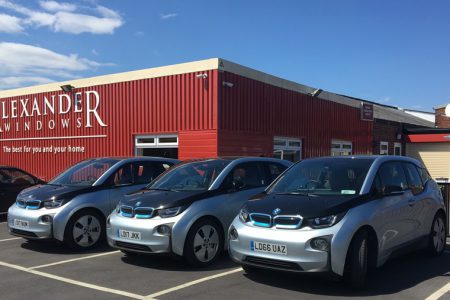
We’ve been in touch with a business that’s already taken the plunge and decided to replace its fleet of ageing Volvo V40s with all-electric BMW i3s. Was it a smart move?
BMW i3
Alexander Windows is one of the north west’s biggest supplier of windows, doors and conservatories, and as such has a team of sales people and surveyors travelling all over Manchester all-day, everyday.
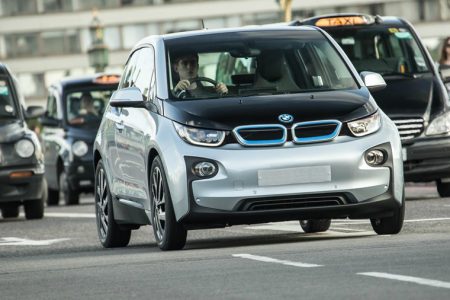
The BMW i3 hatchback makes up part of the company’s range of electric and hybrids – which includes the supercar-esque i8 – and is fast becoming a go-to choice as an eco-friendly fleet vehicle.
BMW i3
We asked Lauren Tutton, director of Alexander Windows, about how the BMWs have been received:
“They have a decent range (120 miles), which is very important because our field sales representatives and technical surveyors travel all over, and we don’t want them getting caught out.
“We still have a need for small vans, but the i3 is more than adequate for day-to-day survey appointments.”
Lauren also drives the stunning BMW i8 plug-in hybrid sports car, which boasts an official average fuel consumption rating of 134.5mpg, and CO2 of 49g/km. Ticking plenty of boxes when it comes to a directors’ car.
Like lots of businesses, Alexander Windows’ fleet is part of a wider eco-friendly initiative, and when it comes to windows, going green is far more involved than simply improving a home’s insulation.
“We’ve had a very positive response from everyone to the new fleet. They’re very quiet, have good acceleration and the standard specification of the vehicle is great. The initial scepticism that people expressed about driving an electric car soon disappeared once they began driving them.”