Category Archives: Away From Home

Zapmap statistics show EV charge point installation up more than 80%

Electric Vehicle (EV) chargepoint mapping service Zapmap has published mid-year statistics showing that the rate of chargepoint installations has increased 82% since the first half of 2022.

Cornwall Insight recently published a report suggesting that the rate of increase in chargepoints had reached 70% over the past year, but now Zapmap says deployment of chargers is taking place even faster.

In the first half of 2022, an average of 891 charge points were installed each month, a figure which has increased to 1,622 in the first half of 2023, an increase of 82%.

Zapmap calculates that there will be more than 50,000 chargepoints across the UK by the end of 2023. At the moment there are around 44,000 public charging devices across the UK, an overall growth of 36% year on year.

Almost 20% of chargepoints are rapid or ultra rapid chargers, with 8,680 of these at the end of June. Ultra rapid chargers showed the biggest year on year growth. There were 1,803 ultra rapid chargers across the UK at the end of June 2022, which has grown to 3,493 at the end of June 2023, a 94% increase.

The statistics show that charging hubs, with six or more rapid/ultra rapid chargers in one location, are also opening at a significant rate. There were 79 hubs in June 2022, which has increased to 170, with another 77 Tesla Supercharger hubs.

Ultra rapid chargers are also well distributed across the UK, with 9/12 geographical regions in the UK seeing more than 100 new ultra rapid chargers installed, with the most in the South East with 269.

Read more: Current+

It’s Time to Go Green!

If you would like to know more about Solar Panels and the PowerBanx range of home battery systems, and get a free instant quote, please complete our online form:

New rules to make it easier to use public electric car chargers

Motorists are currently forced to use multiple smartphone apps or membership cards to access different charging networks.

Electric car drivers will only need one app to pay for public chargepoints operated by different companies, under legislation laid in Parliament.

Motorists are currently forced to use multiple smartphone apps or membership cards to access different charging networks.

BP Chargemaster Rapid Charger at Milton Keynes Charging Hub (Image: T. Larkum)

Mandating so-called payment roaming is among new Department for Transport (DfT) regulations aimed at encouraging the uptake of electric vehicles by making it easier, cheaper and more convenient to charge them across the UK.

Operators will be required to accept contactless payments at newly installed chargepoints at eight kilowatts and above, and at existing rapid chargepoints.

A standardised pence per kilowatt hour price will be mandated to enable drivers to compare the cost of using different networks.

Rapid chargepoint networks will be required to function for 99% of the time during a calendar year, and a new helpline will be launched to support motorists when something goes wrong with electric vehicle charging.

Chargepoint data will also be opened up to make it easier for drivers to check their availability.

Transport minister Jesse Norman said: “As demand for electric vehicles continues to grow, the Government wants to make sure that drivers continue to have confidence in the UK’s charging network.

Read more: Independent

It’s Time to Go Green!

If you would like to know more about Solar Panels and the PowerBanx range of home battery systems, and get a free instant quote, please complete our online form:

Connected Kerb on-street charging (Image: Connected Kerb)

Off-peak kerbside EV charging costs drop by 10% in one month, says AA

The AA has revealed that off-peak slow kerbside electric vehicle (EV) charging in residential streets has dropped more than 10% in the past month to 33p/kWh.

According to the May 2023 AA EV Recharge Report, peak slow charging has also dropped by more than a quarter from 72p to 53p.

A reduction in the cost of kerbside EV charging is a positive for many within the industry. Previously, many had highlighted that with the introduction of the Energy Price Guarantee, home charging became significantly cheaper than public charging.

This caused issues when considering a “just transition” with this causing further EV charging disparity in the UK with those that are able to afford a driveway able to benefit from cheaper charging rates.

But with AA declaring that slow kerbside charging rates are now beginning to drop, this is a major boost for the industry and could well support the greater adoption of EVs on UK roads.

“Drivers without a driveway looking to switch to an EV will be happy to see off-peak kerbside charging now cheaper than the Energy Price Guarantee. This means they will feel some of the benefit EV owners with dedicated off-street parking have,” said Jack Cousens, head of roads policy for the AA.

Read more: Current+

It’s Time to Go Green!

If you would like to know more about Solar Panels and the PowerBanx range of home battery systems, and get a free instant quote, please complete our online form:

A standards war? A win for consumers? What the Ford and GM Tesla deals mean

And imagine if EV charging eventually follows the gas station model.

The news that rocked the electric transportation world earlier this month — General Motors’ deal to give its drivers access to the Tesla Supercharger network — is no doubt a big turning point for EVs in the U.S. It followed an identical deal in May between Ford and Tesla. Earlier this week, Rivian said its customers could access Tesla’s charging network starting in 2024. Together, these pacts could have serious ripple effects for the development of the charging network across the country.


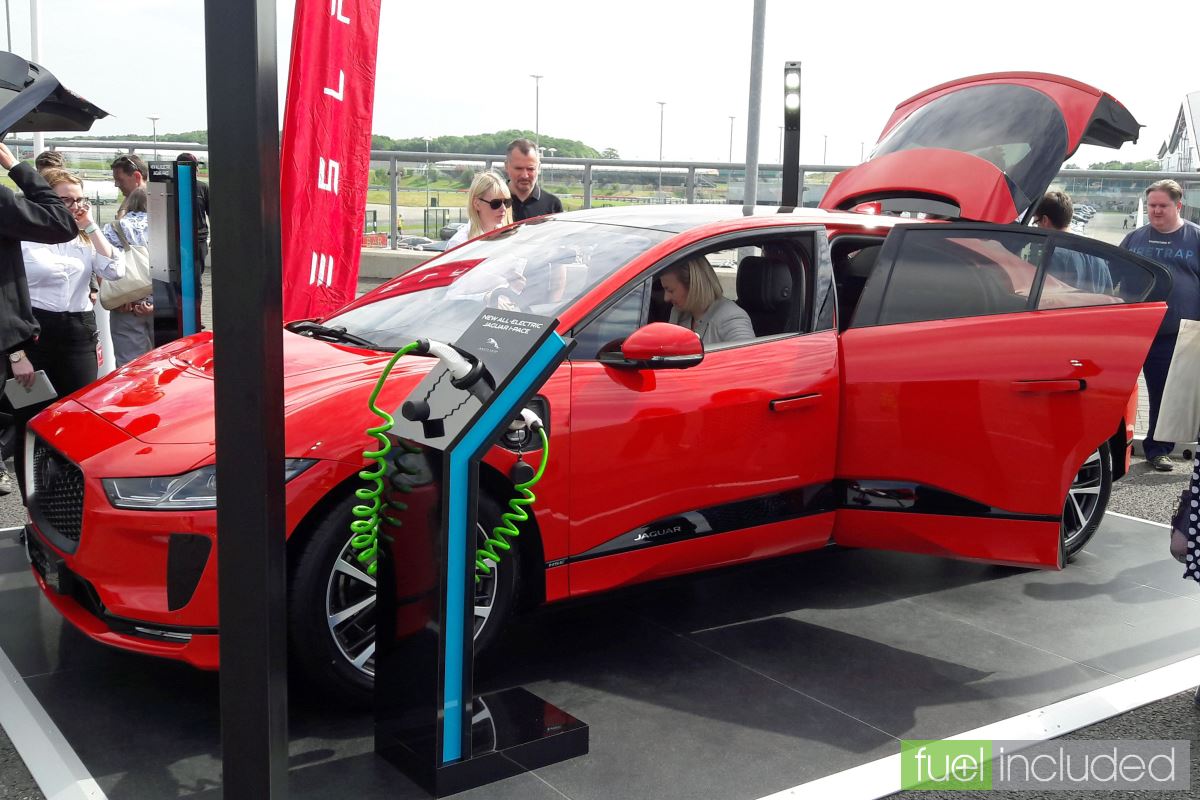
Jaguar I-PACE at Fully Charged Live show (Image: T. Larkum)

But they also generate a lot more questions than answers. Will these partnerships create a standards war between types of EV chargers? And will that hurt or help consumers? Experts don’t agree on that point, and they make varying predictions for what this news portends. It could usher in a new model for charging akin to gas stations, or it could be little more than a blip for drivers who will simply end up with a lot more charging options.

“I think it’s great news for the industry, and more generally for EV drivers, and for accelerating the electrification of the transportation fleet,” said Jeff Allen, executive director of Forth Mobility, an electric transportation advocacy group. “It’s creating more options for folks to charge, for one thing. And it is also going to push everybody to up their game in terms of reliability and customer experience.”

Read more: GreenBiz

It’s Time to Go Green!

If you would like to know more about Solar Panels and the PowerBanx range of home battery systems, and get a free instant quote, please complete our online form:

Electric Car Line-up (Image: Go Ultra Low)

Osprey Charging opens ‘South West’s largest EV charging hub’

Osprey Charging has opened the “South West’s largest [electric vehicle] EV charging hub” consisting of 16 ultra-rapid chargepoints.

The EV charging hub is located on the A38 Devon Expressway at Salmon’s Leap in Buckfastleigh and designed to support EVs of all types.

Each charger is capable of providing 300kW charging for vehicles able to accept this high power without wasting power on lower-capability cars, Osprey said. This allows customers of the hub to add 100 miles of range in 15 to 25 minutes.

Osprey also stated that it will provide local residents, businesses and visitors with reliable EV infrastructure, help improve air quality, reduce noise pollution and support local decarbonisation efforts.


An extra stop at Sedgemoor (Image: T. Larkum)

“I’m incredibly proud of what we’ve created at Salmon’s Leap. We purchased the land so have been able to precisely design the space and install hardware that maximises availability and ease of use of chargers for all types of vehicles and drivers,” said Ian Johnston, CEO of Osprey Charging.

“Our largest site yet, it is a significant milestone for the Osprey team as we work tirelessly to ensure that our nationwide infrastructure deployment of rapid EV charging stations continues at an unprecedented pace.”

Osprey was amongst a number of founding members of the new trade association ChargeUK. Revealed in April 2023, the association is aiming to invest £6 billion by 2030 in EV charging and double the size of the UK EV charging network in 2023.

Read more: Current+

It’s Time to Go Green!

If you would like to know more about Solar Panels and the PowerBanx range of home battery systems, and get a free instant quote, please complete our online form:
‘We tried out driving from Yorkshire to Dordogne in an electric car’

Journalist Nick Jenkins reports on how charging stops worked out travelling to his second home in France

The screen told us we had 0% left in our battery as our electric car crawled up to the charger. We had been holding our breath but could finally let out a sigh of relief. We plugged the car in – and disaster… the charger was out of order.

Only kidding.

Nothing at all like that happened on our recent drive to Dordogne, though it might surprise those who believe everything they read on some Brits-in-France Facebook pages.

Electric cars are no longer a novelty, of course.

The Renault Zoe has been around since 2012. All the major manufacturers are now producing electric vehicles (EVs) and plug-in cars accounted for a quarter of new sales in France last December – and a third in the UK.


PARIS (Nov. 30, 2015) Ð As the official passenger-car provider for the United NationÕs COP21 climate conference in Paris, the Alliance will provide 200 pure electric vehicles to the annual summit which runs from Nov. 30 to Dec. 11. A network of 90 charge spots has been set up to charge the vehicles using low-carbon electricity provided by French energy supplier EDF.

No doubt many readers already drive one. They are clearly the future, but there is still resistance.

Some people are so attached to the quaint mid-Victorian technology of the internal combustion engine that they cannot accept change is coming.

“I’m not buying a Noddy car that only goes 50 miles,” one Luddite told me.

Read more: TheConnexion

It’s Time to Go Green!

If you would like to know more about Solar Panels and the PowerBanx range of home battery systems, and get a free instant quote, please complete our online form:

Watford Council secures substantial grant for EV charging points

Watford Council is pleased to announce that a grant of £592,500 has been successfully secured through the On-Street Residential Charge Point Scheme (ORCS).

The funding will enable the installation of 79 new electric vehicle (EV) charging points across the town, bringing the total number of locations to 112.

The 29 new charging columns will be installed on-street in a mix of 2/3/4 charge points per location, providing residents and visitors with more convenient access to EV charging facilities. This will significantly contribute to our efforts to become a net zero carbon town and promote sustainable transport in the borough.


Elected Mayor of Watford, Peter Taylor, said: “I’m thrilled that we have secured this funding. It will help us expand our EV charging infrastructure, making it easier for people to use of electric vehicles. The council is committed reducing carbon emissions in the borough through a range of initiatives.

Thousands of people already drive electric vehicles in Watford and we know that these reduce pollution and improve air quality locally. It’s important that we have the charging infrastructure needed to support this, so I want to thank the team that worked so hard to secure this grant funding. It will make a real difference.”

Read more: WatfordBoroughCouncil

It’s Time to Go Green!

If you would like to know more about Solar Panels and the PowerBanx range of home battery systems, and get a free instant quote, please complete our online form:

Electric dream? What it’s really like to drive 285 miles to The Lakes in a leccy car

With its rugged landscape, winding country lanes and laidback lifestyle, you wouldn’t necessarily put The Lake District down as being an electrifying hotspot.

However, the folks at BMW have teamed up with 15 UK National Parks  – including The Lakes – as part of a three-year initiative called Recharge in Nature, which aims to install electric vehicle (EV) charging points at some of our best-loved beauty spots.

It’s a wise move. With sustainable tourism and off-grid adventures being big business these days, eco-friendly destinations are becoming a must-have on our in our holiday tick list. (Not to mention the boom in staycations due to the pandemic and cost of living crisis.)

Being England’s largest and most visited National Park, The Lakes are the first to be kitted out with charging points in three locations, Windermere and Ambleside, Hawkshead and Coniston.

But just how well will this eco-conscious initiative work in reality?

To find out I was loaned the newly launched fully-electric BMW iX1 and told to head to the Langdale Hotel just outside Ambleside – a mere 285 miles away from my Essex home.

Advised that the car had a range of between 259 and 270 miles on a single charge, and able to recharge up to 80% of the range in less than half an hour, it looked like we’d need just one pit stop along the way, so we were more than excited to jump in our fancy new wheels and head towards the M6.

Read more: Metro

It’s Time to Go Green!

If you would like to know more about Solar Panels and the PowerBanx range of home battery systems, and get a free instant quote, please complete our online form:

38% of UK drivers rate their understanding of Electric Vehicles as ‘poor’ or ‘very poor’

New research conducted by Peugeot UK has revealed that less than a quarter of UK drivers say they have a good understanding of electric vehicles.

The survey of 2,000 UK motorists found that only 23% thought their understanding of electric vehicles was ‘good’ or ‘excellent’, while 38% described their knowledge as ‘poor’ or ‘very poor’.

Peugeot e-2008 electric SUV (Image: Peugeot)

Amazingly, less than half of those spoken to were aware that battery electric vehicles emit zero emissions while 12% also thought that plug-in hybrid cars and electric cars are exactly the same type of vehicle.

Perhaps less surprisingly, when asked about the EV charging network, 70% of respondents said they found the way different providers operate to be confusing.

The same percentage also said they found the language surrounding electric vehicle power, battery capacity and efficiency difficult to understand, with only 31% aware that Kilowatt Hours (kWh) is the unit used to measure battery capacity in EVs.

A generation gap comes into play here as 46% of 18-24-year-olds correctly selected ‘Miles per kWh’ as the unit commonly used to measure efficiency in electric vehicles, compared to just 20% of the over 65s.

Of the former group, 58%  rated their knowledge as ‘good’ or ‘excellent’ while, half of those over 65 admitted that their knowledge was ‘poor’ or ‘very poor’.

Read more: AirQualityNews

It’s Time to Go Green!

If you would like to know more about Solar Panels and the PowerBanx range of home battery systems, and get a free instant quote, please complete our online form:
Scottish Water Renault Kangoo electric van (Image: Renault)

Busting EV myths – Breaking down the biggest misconceptions surrounding EVs

Despite the expected shift towards electric and zero emission vehicles, there’s still a lot of controversy surrounding them. Are they really any cheaper to run? What’s their true environmental impact? In this article, Simone Bruckner, managing director of resistor manufacturer Cressall, breaks down the biggest myths surrounding electric vehicles (EVs).


MINI Cooper Concept (Image: MINI)

With more than a quarter of a million new electric car registrations last year, uptake of EVs is definitely on the increase. More than one in five of us expect to be driving an EV within the next five-to-ten years. But there are still a lot of misconceptions surrounding EVs that keep potential buyers on the fence.

EV’s have insufficient range

Many potential buyers are concerned about EV range. Their concern is well-founded in part, with the Nissan Leaf’s lowest range sitting at just 73 miles back when it was launched in 2011.

Thankfully, EV technology has improved in leaps and bounds since then, and most EVs now sit comfortably within the 200-to-300-mile range mark. And these figures aren’t restricted to high-end models either, with models like Hyundai’s Kona and Kia’s e-Niro entering the market at around £35,000 and offering modest real-world ranges of around 250 miles according to Autocar.

99 per cent of car journeys in England are less than 100 miles, and the average length of a trip was less than ten miles pre-pandemic. Based on these numbers, EVs have a perfectly sufficient range for the vast majority of travel.

Read more: Altenergymag

It’s Time to Go Green!

If you would like to know more about Solar Panels and the PowerBanx range of home battery systems, and get a free instant quote, please complete our online form: