Category Archives: Electric Vans

News and reviews of electric vans (including plug-in hybrids).

Renault Kangoo ZE 33 (Image: Renault)

EU states set binding CO2 limits for trucks and buses

The first European CO2 emission standards for trucks and other heavy commercial vehicles have now been set: the European Council’s formal adoption of the regulation was the final step in the procedure after the EU Parliament had passed the CO2 targets in April.

According to the now-binding regulations, manufacturers must reduce CO2 emissions from new heavy commercial vehicles by an average of 15 per cent from 2025 compared to 2019, and by 30 per cent from 2030. “Such a stepwise approach also provides a clear and early signal for the industry to accelerate the market introduction of energy-efficient technologies and zero-and low-emission heavy-duty vehicles. The deployment of zero-emission heavy-duty vehicles should also contribute to addressing urban mobility problems,” the paper states.

Emission-free and low-emission vehicles will be credited several times by 2024, with a factor of 2 applying to emission-free, i.e. fully electric vehicles. By 2025, manufacturers must also ensure that zero-emission or low-emission vehicles account for at least two per cent of all new vehicles sold.

Renault Kangoo ZE 33 (Image: Renault)

Originally, the EU Parliament had called for more ambitious targets. For example, EU parliamentarians wanted to reduce CO2 levels by 35 per cent by 2030 and by 20 per cent by 2025. However, the member states were not willing or able to achieve this.

The European Council has made it very clear that the guidelines are binding – manufacturers who fail to meet these targets must pay a fine in the form of an excess emissions premium. The Council also iterated a number of times that the measuring and monitoring of CO2 emissions will be robust and transparent. Data will be obtained through on-board devices that monitor the actual fuel and energy consumption of heavy-duty vehicles.

Read more: Electrive

EZ-FLEX Electric LCV (Image: Renault)

Renault Unveils EZ-FLEX Electric Concept For Last Mile Delivery System

The new Renault EZ-FLEX concept showcased at Viva Tech 2019, was first revealed in April, as an experimental, electric and connected LCV that is compact and easy to handle and features a modular rear design.

Groupe Renault has unveiled an all-new electric light commercial vehicle (LCV) concept, Renault EZ-FLEX, at the recently concluded Viva Tech 2019, in Paris. Designed to be an improved and efficient mobility solution for urban delivery system, the new Renault EZ-FLEX concept was revealed in April 2019, as an experimental, electric and connected LCV that is compact and easy to handle and features a modular rear design, for different applications. In fact, Renault has partnered with La Poste Group, the postal service company in France, for an experimental run and they will work together to develop and further improve this urban delivery ecosystem.

EZ-FLEX Electric LCV (Image: Renault)

Talking about Renault EZ-FLEX, Denis Le Vot, Alliance Director of the Renault-Nissan Commercial Vehicles Division, said,

“With traffic congestion in cities and the rise of e-commerce, urban deliveries are transforming. As a European leader in vans and light commercial vehicles, Groupe Renault is duty bound to continue proposing disruptive solutions. Renault EZ-FLEX, an experimental light commercial vehicle, gives us the opportunity to join forces with La Poste Group, through an innovative and collaborative approach designed to develop and anticipate future practices in urban deliveries.”

Read more: Car and Bike

Mercedes eVito electric van (Image: DPD)

DPD puts fleet on EV fast track with new 2021 target

DPD is to incorporate over 500 EVs into its delivery fleet, claiming a UK first with the addition of new Mercedes-Benz eVito vans.

The move comes as part of the delivery company’s commitment to having 550 EVs as part of its fleet by 2021, with 100 of these to be added this year.

The delivery company has commissioned 10 eVito vans to be part of its London fleet, with plans for more to be a part of a nationwide roll-out of EVs later this year. The vans are the 3.2 tonne long-bodied version and can be fully charged in six hours, with a range of approximately 93 miles.

Mercedes eVito electric van (Image: DPD)

As part of its commitment to reducing emissions in its deliveries, DPD is also intending to open eight all-electric micro-depots in London. It opened its third all-electric microin March this year and it is also working on developing an eCargo bike with Electric Assisted Vehicles Limited.

Read more: Current News

All Electric Dust Carts Hit The City Of London

Plans for the UK’s first fully electric refuse fleet have been revealed as Veolia has signed a new tech-driven City of London waste contract.

The City of London Corporation has awarded the pioneering new waste collection service, street cleansing and ancillary services contract – which got going on Saturday April 6.

As part of the contract, the City Corporation aims to become the first authority in the UK to run a fully electric fleet of Refuse Collection Vehicles (RCVs).

Veolia’s RCVs will be equipped with 360-degree cameras and audible warning reversal systems to improve safety.

The vehicles will use on-board weighing equipment to digitally record bin weights at residential properties, enabling recycling performance to be efficiently calculated. And street cleaners will carry hand-held devices for on-the-go reporting and job completion.

All vehicles will be digitally tracked to monitor and auto-allocate cleansing tasks dependant on geographical location and capacity.

The contract will deliver 74 solar auto-compacting BigBelly bins which send notifications to collection crews when they are full, allowing more waste to be collected.

Read more: Twin FM

Renault rolling-out V2G trials across Europe

First vehicle-to-grid projects live in the Netherlands and Portugal.

Renault has launched the first large-scale bi-directional charging pilot projects in Europe, starting in Utrecht, the Netherlands and on the Portuguese island of Porto Santo. Similar projects will follow in five more European countries with the aim to develop services and gather learnings for future harmonisation.

In concrete terms, Renault intends to introduce a fleet of 15 Renault Zoe vehicles with vehicle-to-grid functionality in Europe during the course of the year, in order to develop new bi-directional charging offers together with partners and lay the foundations for future standards. The aim is to get to the bottom of feasibility and potential benefits, according to a press release by the French. It is interesting to note that Renault is using alternating current technology, which is apparently based on the type 2 connector.

More than a year ago, the carmaker announced that, together with the energy supplier Empresa de Electricidade da Madeira, it wanted to turn the Atlantic island of Porto Santo into an “electric island” including electric cars, second-life batteries and V2G in combination with “smart” charging. While this trial is going ahead, not as much is known about the second project in the Dutch town of Utrecht. Renault only mentions that it is a pilot project in an ecosystem developed by We Drive Solar.

Read more: Electrive

First Ultra Low Emissions Zone drives up EV values at auction

The introduction of the UK’s first Ultra Low Emissions Zone in April is pushing up prices of EVs at auction.

Shoreham Vehicle Auctions (SVA) said it had seen a “significant rise” in demand for EVs in recent months with the market witnessing stronger residual values on both cars and vans.

Alex Wright, managing director of SVA, said: “The second half of 2018 saw a strong demand for used EVs and that has continued into 2019, which has resulted in ever stronger prices.

“For example, the Nissan e-NV200 van has appreciated in value year-on-year by around £1,000.

“Part of this rise in value is because of the increasing awareness across London and the south east of the pending introduction of the UK’s first Ultra Low Emissions Zone in April.”

SVA teamed up with the Energy Saving Trust to launch the first ever used electric vehicle training course for car and van dealer sales staff in May 2018. One of its main jobs was to dispel many of the myths surrounding EVs to help educate dealers on which customers will benefit most from buying and running an electric car.

“We have helped support an increase in knowledge of EVs within the market and many progressive dealers have a good understanding of EVs, customer suitability and battery types,” explained Wright.

Read more: Motor Trader

New Renault Master ZE Electric Van with Kangoo ZE Electric Van behind (Image: Renault)

UKPN, UPS among partners in OLEV-backed wireless EV charging pilot

UK Power Networks and delivery giant UPS are among the partners on a new pilot aimed at demonstrating the commercial viability of cutting edge, wireless EV chargers.

The duo are to work with High Speed 1 and the Warwick Manufacturing Group on the project, which will see wireless charging technology deployed in three live locations in London and Tamworth.

The project, funded by the Office for Low Emission Vehicles and Innovate UK, will run for the first three months of this year and is aimed at broadening the understanding of how wireless EV chargers can become commercially viable.

New Renault Master ZE Electric Van with Kangoo ZE Electric Van behind (Image: Renault)
Example Renault Electric Vans (Image: Renault)

UPS delivery vans will be charged at the company’s depot in Tamworth while they are being loaded with parcels, while electric taxis will receive charge wirelessly while waiting for passengers outside St Pancras International railway station in central London.

UK Power Networks’ fleet of electric vans will also take part in the trial.

It is hoped that wireless EV charging technologies could provide a significant boost for the adoption of electric vehicles in commercial fleets and fleet managers, in turn helping decarbonise the transport sector.

The feasibility study could also lead to a second round of funding from OLEV and Innovate UK should it demonstrably rove the viability of the technology and commercial model surrounding it.

Read more: Current News

Scottish Water Renault Kangoo electric van (Image: Renault)

Scottish Water Looks to Purify its Fleet with the Aid of the All-Electric Renault Kangoo Z.E. 33

  • Scottish Water chooses the Renault Kangoo Z.E. 33 for its first-ever electric vehicles
  • Water Provider’s sampling division to use a specially-converted version across the Highlands
  • Initial order designed to allow Scottish Water to determine how it can electrify its entire fleet
  • Zero-emissions-in-use Renault Kangoo Z.E. 33 will assist Scottish Water’s drive to lower its carbon footprint
  • Kangoo Z.E. 33 was chosen for its environmental compatibility, ease-of-use and versatile load area
  • Renault Kangoo Z.E. 33 is priced from £18,392, excluding VAT, after the Plug-in Van Grant

A pure-electric Renault Kangoo Z.E. 33 refrigerator conversion is enabling Scotland’s water provider to continue its drive to make the country’s air and water the cleanest it can be.

Scottish Water, which provides drinking water to nearly 2.5 million households across the country, is using the zero-emissions-in-use, refrigerated Renault Kangoo Z.E. 33 to assist with the water sampling undertaken by its Scientific Services team across the Highlands.

Scottish Water Renault Kangoo electric van (Image: Renault)

The introduction of the award-winning light commercial – the first electric vehicle utilised by Scottish Water – will also help the water supplier to determine how it can rollout EVs across its fleet and make a significant contribution to its support of the Scottish Government’s carbon target to reduce carbon emissions by 90 per cent by 2050.

As part of the conversion by Bott Ltd, and which also contributes to the van having minimal impact in terms of noise and pollution on the beautiful landscape of the Highlands, the strikingly-liveried Renault Kangoo Z.E. 33 features roof-mounted 150-watt solar panels to power its onboard refrigeration equipment. The panels charge a 200 amp lithium battery, which in turn powers the 140-litre temperature-controlled refrigerator that is required to keep water samples in optimum condition during transportation.

With a ‘real-world’ range of up to 124 summer miles (75-99 miles in winter) on a single charge, the Renault Kangoo Z.E. 33 is able to comfortably accommodate the routes throughout the Highlands that are regularly completed by Scottish Water’s water samplers. Scottish Water plans to charge the van via 26 charging points that are available at its numerous locations, which include The Bridge, Castle House, Fairmilehead, Juniper House, Gowans Terrace, Henderson Drive, Bullion House and Shieldhall.

Complementing the bespoke conversion is an additional Renault Kangoo Z.E. 33 Panel Van, which will be used by Scottish Water’s maintenance team. Offering a near identical payload to its diesel counterpart, the Kangoo Z.E. 33 Panel Van offers Scottish Water a viable, all-electric alternative to the conventionally-powered compact vans that feature on its fleet.

Scottish Water chose sampling and general cargo vans for its EV trial as these types of vehicle represent the highest proportion of its small van fleet. Sampling vans represent approximately 12 per cent of the total Scottish Water fleet, with general cargo vans accounting for circa 20 per cent.

Working in collaboration with Renault Pro+ Commercial Vehicles on the trial, which has included the manufacturer delivering EV training to Scottish Water employees, Scottish Water opted for the Renault Kangoo Z.E. 33 due to its usable range, versatility and ease of operation.

Read more: Renault Press

Nissan’s e-NV200 transports seven electric style

If you need to be able to transport up to seven people but thought electric motoring was not an option then think again.

Nissan has billed its e-NV200 Combi as the world’s first electric MPV.

It might not get the same sort of coverage at its higher profile stablemate the Nissan Leaf or more upmarket electric offerings like the Jaguar I-Pace and Tesla Model S but the e-NV200 certainly fills a niche and in many ways makes perfect sense.

Its van underpinnings (essentially it’s a version of the e-NV200 van) mean it might be just a little too rough and rugged for some but the ability to transport up to seven people and its immense practicality combine to make a fairly compelling USP.

There are both five and seven-seat versions of the e-NV200, though I would imagine most buyers will probably plump for the seven-seater.

The two seats in the third row can be folded up, while the middle-row three-seat bench can also be folded and tumbled out of the way, boosting carrying capacity.

According to Nissan it’s possible to accommodate three full-size bikes with all the seats out of the way.

My initial feeling when I set off in it for the first time was that of being in a kind of upmarket milk float – given the silence, its van-like character and high driving position.

However, once you get over its initial oddness the e-NV200 is a vehicle that is very easy to like and for eco-minded families it is absolutely perfect.

No doubt it will also prove attractive to taxi drivers and shuttle firms.

Read more: Coventry Telegraph

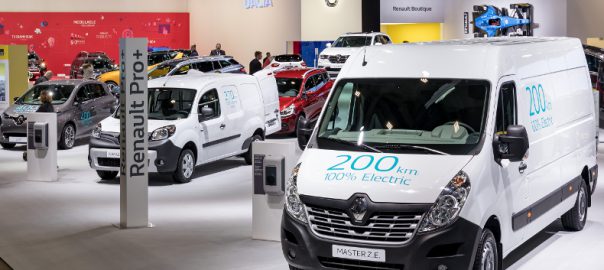
New Renault Master ZE Electric Van with Kangoo ZE Electric Van behind (Image: Renault)

Renault Pro+ commercial vehicles announces pricing and specification of new Renault Master Z.E.

Ordering is now open for the New Renault Master Z.E., the all-electric version of the largest Renault Pro+ LCV priced from £45,700 excluding VAT (after the Government PiVG)

Ideal for emissions-free access to city-centres and benefiting from a payload of up to 1,128kg, New Master Z.E is perfect for last-mile deliveries.

Utilising the manufacturer’s electric vehicle expertise – the Renault Kangoo Z.E. 33 and the Renault ZOE being the best-selling electric van and electric car in Europe in 2017 – Master Z.E. combines the new-generation 33 kWh battery and a highly efficient motor to provide a real-world driving range of 74 miles with half payload and a charging time of empty to fully-charged in only six hours.

New Renault Master ZE Electric Van with Kangoo ZE Electric Van behind (Image: Renault)
Renault Master ZE Electric Van (Image: Renault)

Master Z.E. is available in a choice of three wheelbase configurations – SWB, MWB and LWB – with a choice of two roof heights, LR & MR. All are based on the well-equipped Business specification that is available across the award-winning Renault Master range. Focused on providing drivers with high levels of comfort, convenience, connectivity and safety, standard features of the Business trim level include electric front windows and mirrors, DAB radio, Bluetooth, CD player, USB, full steel bulkhead, ESC, Hill Start Assist and Trailer Swing Assist.

Specific equipment that is unique to the New Master Z.E. includes a side Z.E. charging socket, pre-heating function, and Z.E. voice – a specific sound that the vehicle makes at low speeds in order to be more noticeable to pedestrians.

Exclusive New Master Z.E. options include a charging cable suitable for a domestic three-pin plug and a three-year renewal subscription to My Z.E Connect, which when combined with the R-Link media system, lets you view the vehicle’s range on a smartphone or computer connected to the internet.

Read more: Automotive World