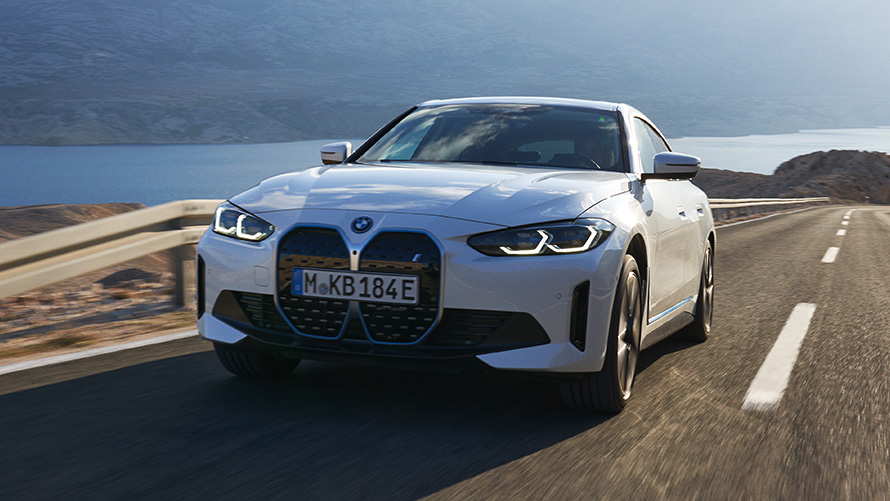
Analysis suggests electric operations will become rapidly more profitable than petrol and diesel arms within five years
The world’s largest traditional carmakers could improve their profit margins and boost their value to investors by accelerating the transition to electric cars in the next decade, a new analysis has found.
The electric carmaking operations of Toyota, Volkswagen, Stellantis, Volvo, BMW and Mercedes-Benz will rapidly become more profitable than their traditional petrol and diesel counterparts within the next three to five years as carbon emissions regulations tighten, according to modelling by Profundo, a consultancy.
Volkswagen ID.3 electric car (Image: Volkswagen.com)
The world’s biggest carmakers are all seeking to increase electric car production rapidly in the next decade, as laws in major markets including the EU and UK seek to ban new internal combustion engines as part of the effort to curb carbon pollution from transport. Yet at the same time carmakers still intend to sell millions more vehicles with petrol and diesel engines, in part because they remain more profitable but also because making the transition to electric vehicles (EVs) can include major upfront costs.
If you would like to know more about Solar Panels and the PowerBanx range of home battery systems, and get a free instant quote, please complete our online form:
Volkswagen is “basically sold out” of electric cars for this year in Europe and the USA, according to Group CEO Herbert Diess, as persistent bottlenecks in the supply chain are affecting global production.
In the first quarter, the Wolfsburg-based group handed over 99,100 BEVs to customers worldwide across all brands. In Western Europe alone, the order backlog for the electric vehicle models stands at 300,000 vehicles, Diess now stated in the context of the announcement of the business figures for the first quarter of 2022. Customers who now place orders for electric cars in Europe and the USA would not receive their vehicles before 2023.
VW’s 99,100 BEVs made it the world’s second-largest EV manufacturer in Q1 in terms of volume – but market leader Tesla delivered more than three times as many vehicles to customers, with over 300,000 units.
VW is targeting a total of around 700,000 electric vehicle sales for 2022 as a whole. However, production has been hampered, especially in China, where only 28,800 electric cars were sold in the first quarter due to pandemic-related lockdowns.
Volkswagen ID 4 (Image: Volkswagen.co.uk)
Despite the restrictions in China and the shortfalls in Europe due to a lack of Ukrainian-made wiring harnesses, Diess said demand had remained robust. “We have very high order books and […] order intake on electric vehicles,” Diess added. “That accounts for all of our models from ID.3, ID.4, the Audi models — [all] are extremely well received in the markets, Škoda models are also very well received in Europe.”
If you would like to know more about Solar Panels and the PowerBanx range of home battery systems, and get a free instant quote, please complete our online form:
From Mazda to Mini, Vauxhall to Volkswagen, these are the EVs to buy on a budget
“The Fortwo is like a hypercar. And not just ‘cos it’s a two-seater. We mean that it’s great in its chosen environment, and pretty rubbish elsewhere. In crowded streets it’s agile like a little kitten, as parkable as your shoes, fresh-breeze clean and as cheap as the coffee you drink on the way to work. But stray far beyond the ring road and it’s slow, wobbly and short on range. Use it as intended and you won’t find much wrong with the execution.”
“The 500 is small, but if you don’t need space it could be your only car. That’s because it’ll go far enough on a charge to make motorway trips tenable. Whereas the Honda e or Mini Electric would have to be second cars to anyone who ever drives beyond conurbations rather than just within them. It’s not as fun to drive as those are, mind. It’s trying harder to feel normal. With a stylish, recognisable design and a quality feel. So the recipe’s been re-cast for health and welfare, but it still looks and tastes like la cucina della nonna.”
“The e-Up is certainly a frumpier, subtler EV than a Honda e or Mini Electric or even a Renault Zoe, but there’s a huge amount to be said for VW’s ‘just a good car, but electric’ approach – it’s what made the e-Golf such a sleeper hit. It’s also kept the e-Up relevant, recommendable, and ready for a new dawn in the small car world.”
If you would like to know more about Solar Panels and the PowerBanx range of home battery systems, and get a free instant quote, please complete our online form:
Several automobile manufacturers have made pledges in recent months to halt or drastically reduce producing cars with internal combustion engines between 2030 and 2035.
Fuel Included BMW i3 on static display (Image: T. Larkum)
The latest was Audi, a subsidiary of Germany’s Volkswagen, which pledged Tuesday to launch only fully electric vehicles from 2026 and halt manufacturing cars with internal combustion engines by 2033. Here’s a look at other major automakers who have already set a deadline for their model line-ups to go fully electric.
BMW
The German carmaker has increased its electric vehicle sales targets as stricter EU emission limits are pushing all manufacturers to make the shift.
Over the coming decade, BMW now wants to sell 10 million fully-electric vehicles, up from its previous target of four million.
If you would like to know more about Solar Panels and the PowerBanx range of home battery systems, and get a free instant quote, please complete our online form:
In the wake of 2015’s dieselgate scandal, Volkswagen’s image was sorely in need of a makeover. The company’s brutal attack on the principles of corporate social responsibility made it for some time a pariah in the eyes of much of the public, although its sales were never affected.
So Volkswagen’s management decided to commit to electrification, based on the belief that if it didn’t it would “end up like Nokia”. In a bid to avoid fines resulting from the change in emissions standards planned for this year, Volkswagen said goodbye to hybrids in 2019, accelerated its electric vehicle manufacturing targets to one million units by the end of 2023 and 1.5 million by the end of 2025, built the largest electric vehicle factory in Europe, and carried out an ambitious investment program and reached supply agreements for batteries, which will culminate in a €35 billion investment in six battery factories and a global network of charging stations.
Unable to catch up with Tesla’s technological lead, Volkswagen’s goal is to become the number two electric vehicle manufacturer. The announcement of these plans has doubled the company’s share price over the past year, despite experiencing a 37% fall in profits due to the pandemic. The company’s electric vehicle sales tripled last year to 230,000 units: according to some analysts, Volkswagen will be able to manufacture electric vehicles for less than it now costs to make gasoline or diesel ones by 2025.
VW e-Golf (Image: Volkswagen.co.uk)
What’s missing from the German carmaker’s epiphany? Something fundamental if it really wants to be taken seriously: it must stop making diesel and petrol engines. Tesla is not the leader in electric vehicles solely because it researches and develops this technology better than anyone else, but because under no circumstances would it ever consider making cars with engines that pollute the air. That is, in addition to its quality, which also makes it a leader, in customer satisfaction. Tesla owners see themselves as fans, part of a plan, of ambitious and credible goals.
In short, what really sets a carmaker apart from the competition is that it no longer makes diesel and petrol engines. As long as Volkswagen and others that claim to have seen the light refuse to commit to going fully electric in the immediate future, it will be the same company that prefers to pay emissions fines and that prioritizes its short-term profits over the long-term common good.
If you would like to know more about Solar Panels and the PowerBanx range of home battery systems, and get a free instant quote, please complete our online form:
Our second go with VW’s upcoming EV leaves us convinced that electrification is the way forward.
It’s been a long time coming, but the 2021 Volkswagen ID 4 EV is nearly here. That is, nearly ready for patient buyers to actually take the things home and experience what VW can do when it makes up its mind to build an electric car from the ground up.
Don’t get me wrong, the VW e-Golf was great, but shoving a battery pack in a car designed around an engine and gasoline tank necessarily results in some substantial compromises. The ID 4’s MEB platform was designed for EVs like this, and as such offers far more range and a much better layout than the humble Golf.
How much more range? At 250 miles per the EPA, the ID 4 can go twice as far on a charge as the e-Golf. That’s despite having much more power (201 horsepower and 228 pound-feet of torque) and being bigger and roomier, too.
My colleague Steven Ewing already had a go in the American flavor of the ID 4, so I won’t rehash too many details, but suffice to say my impressions behind the wheel were very much the same. Despite all that power going to the rear axle, there’s very little that’s sporty about the ID 4. It accelerates briskly but not angrily and offers a comfortable, relaxed ride quality. It’s a very different thing from Volvo’s electric XC40 Recharge, which is surprisingly quick.
Volkswagen ID 4 (Image: Volkswagen.co.uk)
This observation is not a strike against the VW. Far from it. I really liked the chill feel of the ID 4, a vibe you pick up as soon as you get in the car. The stark, white of the steering wheel and other interior highlights present on this First Edition give the car a bright, modern aesthetic that’s more concept car than conventional cruiser. Even the act of driving away is free of drama. You just sit down, tilt the gauge-cluster-mounted shifter in the direction you want to go, and step on the accelerator.
The shifter is very much in the style of that found in another EV, BMW’s i3, which I adored. This style didn’t catch on back then, and I’d probably be letting optimism get the better of me to hope that it might do so now. Regardless, it’s far more intuitive than the push-button solutions showing up on more and more cars.
After you get where you’re going, just push a button to put the car into park (it clicks like a mouse when you do), get out, and walk away. The car powers itself down.
To find more fresh takes on everyday tasks, look no further than this VW’s HVAC system. Sure, you can do the usual zones and temperatures and defrost settings, but the ID 4 adds some smarts and personality with Smart Climate modes. Are your hands cold? There’s a mode for that, which turns on the steering wheel and directs warm air through the dashboard vents. Feet too hot? There’s a mode for that too, plus one called Fresh Air that quickly sucks in some ambient atmosphere — not something I sampled much on my chilly New Jersey drive, I confess.
Control freaks will surely want to dial in their own climate settings, which they can do, but I’ll be curious to see how well these modes strike their targeted scenarios when we get a chance to spend a little more quality time with the ID 4. I’m also curious to see whether Volkswagen can improve the responsiveness of the software the car is running, because right now, it’s all sorts of laggy. That’s not good given how many of the car’s systems are all handled via the center-mounted touchscreen.
Really, though, that’s the only fly in this ointment. The 2021 Volkswagen ID 4 is an impressive package. From the fresh look inside and out to the overall calm, relaxed aura of the thing, it left me smiling and wanting more. Hopefully that’s something we’ll all get soon.
If you would like to know more about Solar Panels and the PowerBanx range of home battery systems, and get a free instant quote, please complete our online form:
Morgan Stanley analyst Adam Jonas wrote in a note to clients on Friday that global EV sales will grow 50% or more next year, while sales of internal combustion engine vehicles are expected to grow 2% to 5%. He also predicted that global EV penetration will rise from 4% to 31% by 2030.
Those predictions may or may not come true, but one thing is certain and that is 2021 is shaping up to be a critical year for EV adoption. Mercedes-Benz just announced its Tuscaloosa plant will build large, electric SUVs starting from 2022 as part of what it calls its electric-vehicle “fireworks display”. Aiming to take the lead in premium EVs from Tesla Inc (NASDAQ: TSLA), Mercedes-Benz announced plans to deliver eight new all-electric models starting from early 2022.
But near-term, Europe remains the most fertile EV ground. Stricter emission regulations and government subsidies that make these vehicles much more affordable are speeding up the de-adoption of internal combustion engine (ICE) vehicles. Here are six electric vehicles that could bring on the “ICEpocalypse” to European roads.
Volkswagen’s ID.3 And ID.4
Volkswagen’s (Pink: VWAGY) ID3 was the top-selling EV in Europe only one month after being launched. But Europe has been shifting toward larger vehicles, so the ID.4 should grow in popularity quickly and, with its highly competitive price considering the range and specs, it should give the ID.3 a run for its money.
Renault ZOE
ZOE (Pink: RNLSY) has been the top-selling electric vehicle on the continent in most of the last decade. As it continues to improve and range increases, the ZOE should replace the Clio, which sold 230,000 units in Europe during the first 10 months of the year. Although the ZOE, which was the top-selling EV in Europe until the ID3 came along and took its throne in October, was at 73,403 units, it’s only a matter of time before it reaches 100,000 in European sales per year. But it needs to fend off the competition and grow a backbone.
The improved Renault Zoe has a longer range and posher interior (Image: Renault)
Tesla’s Model 3 and Model Y
Tesla’s Model 3 is the top selling EV in the world. In Europe, it is second on the top-selling list. It’s not exactly on track to beat 100,000 sales in 2020, but Tesla is determined to win over Europe considering its ambitious developments at its upcoming Berlin factory. However, it has been ordered again to suspend its preparations due to a successful court injunction by environmentalists. This time round, Tesla was stopped by snakes and lizards. But its Model Y will arrive to Europe eventually and it is probably going to sell considerably better than the Model 3, due to its features and an overall preference for its class of vehicle.
Peugeot e-208
Peugeot’s (Pink: PUGOY) 208 was the 7th best-selling vehicles in the first 10 months of the year. So, while the e-208 had only about 25,000 sales in that time period, it could gradually rise up the rankings as tech improves, range increases, and cost drops in the coming year. It is considered by many as one of the best European EV offerings on the market, a testament to Peugeot’s upswing.
If you would like to know more about Solar Panels and the PowerBanx range of home battery systems, and get a free instant quote, please complete our online form:
Competitive EV hatchback is pleasing to drive and attractive to sit in – but doesn’t change the game
What is it?
“Can I be geeky and take a closer look?” asks a man charging his Nissan Leaf, no sooner than I’ve plugged the VW ID 3 into an Instavolt charger in Banbury. Why of course you can, sir, although one question: as an electric vehicle convert, driving the world’s most populous EV, does the arrival of the new ID 3 still feel like a significant moment? “Absolutely.”
Interesting. You can already buy an electric vehicle that does everything an ID 3 does. You’ve even been able to buy an electric Volkswagen before now. But, somehow, the ID 3, in the UK here in ‘1st Edition’ trim, still feels like a waypoint on the road.
It sits, as you’ll doubtless know, on Volkswagen’s MEB electric architecture, so although, at 4.3m, it’s about the length of a Golf, it has a longer wheelbase and, it’s claimed, much more interior space.
The battery (this one is the mid-range 58kWh unit with a WLTP range of 260 miles and a 100kW charge capacity) sits beneath the floor, with the motor (at 201bhp, the higher powered of two offerings) at the back axle. The ID 3 is rear motored and rear-wheel drive, like the original Beetle but, alas, because there’s an inverter and lord knows what else in the front, it doesn’t have a frunk.
Instead, the boot has a high load lip and the rear seats split and fold, revealing that this 1.6m-tall car is a practical hatchback, with plentiful head room front and rear. Cabin fitment is good but material choice is pretty scratchy in places, including the door tops. Not such a biggie further down the range, one suspects, but the UK price for a 1st Edition with the middling battery is £35,215 (after the government grant).
Volkswagen ID.3 electric car (Image: Volkswagen.com)
Someone will be along shortly to argue that overall ownership costs are no more than a lower-priced internally combusted car, which is true if you get your electricity cheaply enough, but if you always have to refill on the road, probably isn’t.
What’s it like?
There aren’t many buttons inside. VW has promoted/relegated everything it can to a touchscreen, save for light switches, steering wheel shortcuts or voice control, plus iffy temperature buttons and a couple of menu selectors.
This approach works at both cleaning up an interior and worsening its functionality, making adjusting the temperature harder than I’ve known in a Volkswagen bar my own 1973 Beetle. Perhaps that was the inspiration. You can verbally whinge to the car that you’re cold, but then I feel like a child asking their dad to turn the heating on in September.
The driving position, and much of the driving experience, is pure Volkswagen – and perhaps that’s where the impression that this is an EV ‘moment’ comes from. It’s an interestingly designed car and not too ‘weird’. The stalks are VW, the instrument pack plain and clear, steering smooth and linear if perhaps short on self centring, and the driving experience as seamless and quiet as an EV gets; the sort of thing that makes them really agreeable to scooch along in smoothly. It doesn’t feel its 1794kg.
I’d want a back-to-back test with a rival to assess rolling comfort (one is on the way, handily), but it seemed fine to me, even on 19in rims. It’s not a driver’s car in the traditional sense, like a Ford Focus is, but there’s a different driving pleasure to be had. I’d rather the level of lift-off energy regeneration was variable by wheel paddle, as on an Audi E-tron, rather than a reach to the gear stalk.
If you would like to know more about Solar Panels and the PowerBanx range of home battery systems, and get a free instant quote, please complete our online form:
Demand for electric cars is on the rise in Europe and elsewhere around the world, prompting BMW to ramp up production of the i3 and VW to build the e-Golf for longer than originally planned.
BMW has significantly increased production capacity compared to the original plan for the second half of 2020 at its Leipzig plant in Germany. The company is extending shifts and shortening breaks to increase the number of vehicles built per day from 114 to 130.
BMW i3 120Ah (Image: BMW Group)
In addition, the automaker has cancelled the one-week summer break for the i3 assembly line. Automobilwoche reports the decisions are motivated by increasing demand and the need to recuperate the long production stoppage in the second quarter of the year caused by the COVID-19 outbreak. In the first half of 2020, BMW built just over 12,500 i3 EVs, while in the entire 2019 calendar year production reached 38,937 units.
As for the VW e-Golf, production will continue at the Transparent Factory in Dresden until Christmas, contrary to initial plans. However, e-Golf production ended for good at the Wolfsburg plant on July 23.
VW currently makes 74 e-Golfs every day but aims to reach an output of 80 vehicles per day. Mind you, this will only continue until Christmas, when the Dresden plant will be converted to build the ID.3 starting January 2021.
If you would like to know more about Solar Panels and the PowerBanx range of home battery systems, and get a free instant quote, please complete our online form:
In what is perhaps the clearest sign that German carmaker Volkswagen is not joking around when it comes to its plans of becoming the planet’s largest electric car producer, the group announced at the end of last week a major shift in the production plan of its factory in Zwickau, Germany.
Having rolled its lines for the first time in 1990 for VW (the facility dates back to 1904, and was used by others as well, including Audi and Trabant), the site was mainly tasked with making the Volkswagen Golf (it also made Polos and Passats), and in the 30 years that have passed since, over 6 million units of the carmaker’s most successful car were produced there.
But no more. Last week, the last ICE-powered Golf rolled off the assembly lines. Starting this week, the facility will begin churning out electric vehicles only, starting of course with the ID.3.
Volkswagen ID.3 electric car (Image: Volkswagen.com)
For next year, the carmaker has a planned production output of 330,00 vehicles, as it will add production of electric cars made with the logos of Audi and SEAT as well. With this development, Zwickau is set to become Europe’s largest EV manufacturing hub.
“Zwickau is steeped in German automotive tradition. Our team has always delivered excellent performance and built vehicles with excellent quality,” said in a statement Jens Rothe, Chairman of the General Works Council at Volkswagen Sachsen.
“We have gained the trust in the Group to become the first location to start fully electric large-scale series production. The Zwickau plant is therefore well-equipped for the future.”
If you would like to know more about Solar Panels and the PowerBanx range of home battery systems, and get a free instant quote, please complete our online form: