VW’s e-Golf is the car maker’s first EV to hit the U.S market. But how does it stack up against other electric vehicles like Ford Fusion Electric, Nissan Leaf and Fiat 500e?
Category Archives: Volkswagen
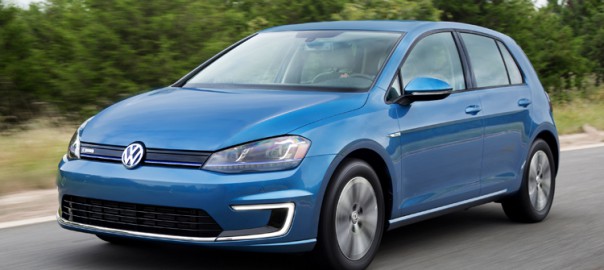
2015 Volkswagen e-Golf: Volkswagen Enters the Electric Car Game
About 10 years ago alternative fuel vehicles became become a hot topic as gas prices peaked and consumers started focusing on miles-per-gallon as a primary factor when shopping for a new car. Automakers quickly rallied around their preferred routes to improve fuel efficiency. Some took the hybrid/electric path, some talked up fuel cells, other brands (primarily European car companies) continued to tout diesel as the answer to our fuel efficiency quandaries. But things have changed in recent years, with most automakers realizing they can’t stick to a single alt fuel strategy. The wide range of consumer demands and government regulations related to fuel efficiency requires a comprehensive alternative fuel plan, one that incorporates multiple solutions.
Volkswagen is a shining example of a modern car company embracing this multi-pronged approach. VW has long been the leader in the diesel segment. Year-to-date, over 23% of all Volkswagen sales in the U.S. have featured clean diesel technology, a much higher percentage than overall industry sales for diesel, which make up barely 3% of the total U.S. market. But in the last two years the German automaker has displayed a flurry of activity around plug-in hybrids and electric vehicles, including the revolutionary XL1 and the new all-electric 2015 Volkswagen e-Golf. We recently had an opportunity to visit Volkswagen’s factories in Wolfsburg and Braunschweig to take a closer look at the new e-Golf and hear Volkswagen’s plans for electrification. Just a few years ago we couldn’t have imagined such an experience with VW, yet the company’s rapid progress in the field of electric cars is impressive.
Because VW has multiple variants of the Golf (diesel, all-electric or plug-in hybrid), and because the Golf now utilizes VW’s new modular platform, the automaker can shift assembly line configuration in short order. It has the ability to produce up to 1,100 alt fuel Golfs per day, though as of now only about 70 e-Golfs are being assembled daily. They went on sale in select U.S. states in early November. If demand warrants it Volkswagen can easily shift that number (up or down) to match consumer interest. This flexibility makes sense in a world where gas prices can pivot on a geopolitical headline or natural disaster. But it also begs the question – is Volkswagen building these electric variants because it sees a need to meet broadening consumer demand? Or is it simply positioning itself to address future regulatory requirements? The answer may not matter, as enhanced production flexibility is the wave of the future. Automakers that don’t master it will be at a major competitive disadvantage.
Volkswagen Automotive Group’s ‘modular toolkit’ production system, utilizing four major platforms to address the entire group’s vehicle needs, continues to roll out across brands and models. The all-new 2015 Golf is one of two early vehicles built off the new MQB platform and already on sale in the U.S. (the 2015 Audi A3 is the other one). Because of this system Golf production, including body styles and drivetrain configurations, can be shifted almost instantaneously. However, production capacity and flexibility is only half the battle. One of the main hurdles Volkswagen’s new e-Golf will face is an electric car market saturated with vehicles offered at the same price and touting the same battery range.
Source: Forbes
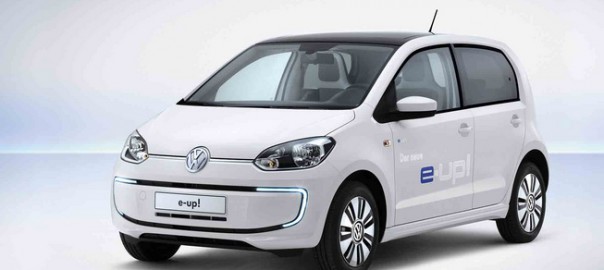
2014 Next Green Car Awards fetes VW e-Up!, Tesla Model S
The California-made Tesla Model S was one of about a dozen models given props by the Next Green Car Awards. And the prizes ran the gamut between conventional, diesel, plug-in and battery-electric powertrains because who doesn’t like variety?
Leading off in the Next Green Car awards was the Volkswagen e-Up!, which took home the City Car award:
“With the e-up!, Volkswagen has produced a high quality, practical and affordable electric city car which is perfect for zero-emission urban driving where space is a premium.”
Americans may associate “Family Estate” cars with huge, fake-wood-paneled station wagons of the ’70s and ’80s (and with Clark Griswold), but NGC gave the Family Estate award to the far-more-fun Audi A3 Sportback e-tron plug-in hybrid.
“As the first plug-in hybrid estate car, the A3 Sportback e-tron perfectly combines conventional fuel practicality for long distance driving with zero-emission motoring for urban trips.”
The Mitsubishi Outlander Plug-in Hybrid, Nissan e-NV200 Combi and Mercedes-Benz B-Class Electric were also all given props.
“The Outlander PHEV sets the SUV bar high offering plug-in capability for the price of a diesel. With a 5% BIK rate, you can see why the Outlander is the UK’s most popular plug-in hybrid.”
“With the e-NV200, Nissan has broken new ground offering an affordable and practical zero-emission alternative to the ubiquitous diesel van.”
“Powered by Tesla know-how, the Mercedes electric B-Class brings electric mobility to the compact MPV class for the first time. High on quality, long on range, and zero on emissions.”
Finally, the Tesla took home the top-of-the-line “Executive” prize.
“Simply the most beautiful and technologically advanced electric car on the market, the Model S combines a gadget-packed interior with an exhilarating electric driving experience.”
Read more: Autoblog, Next Green Car
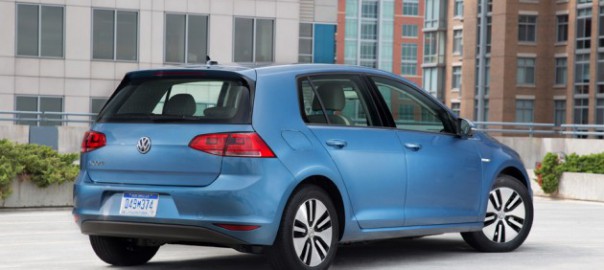
The Brilliance of VW’s New Electric Golf
The E-Golf doesn’t make much of a statement. In fact, part of its charm is that the “e” features are decidedly low key. Perhaps what’s true of wearable devices such as fitness trackers and smart glasses is also true of electric cars: They will fully arrive only when they stop announcing themselves to the world and just resemble “normal” products. From this perspective, the electric Golf might be downright futuristic.
The car looks like a regular Golf and has all the German engineering Volkswagen likes to brag about: tidy fit and finish, tight gaps between body panels, and more room than one would expect. It even drives like a regular Golf, particularly between zero and 30 miles per hour, when it’s peppy. Ticking up to 65 mph on Manhattan’s West Side Highway took a bit of prodding, but the car showed no problem zipping out in front of an pushy taxi cab at a light change.
Bells and whistles are scarce. The control panel doesn’t fill up with animated leaves and butterflies when the driver pilots with particular efficiency. The center-stack screen isn’t usurped by a flow chart of the car’s vitals.
The Volkswagen’s take on e-monitoring is Teutonic in its simplicity. A single gauge—the analog kind—with a needle tilts into a green area when the brakes are recharging the battery and ticks the other way when one steps on the accelerator. A tad to the right, the Golf displays a digital number showing how many more miles the car will go before it goes to sleep, just like an overworked iPhone (AAPL). And then there’s the speedometer: The Golf almost seems embarrassed that it doesn’t burn dead dinosaurs.
Read more: Business Week
Focus Magazine Reviews Volkswagen e-Up! – Video
This year, the Formula E championships will see battery-powered cars tear their way around some of the world’s biggest cities. With the series well under way, Focus decided to see what the current crop of electric cars can do for day-to-day motorists. Next up: the Volkswagen e-up!
Source: InsideEVs
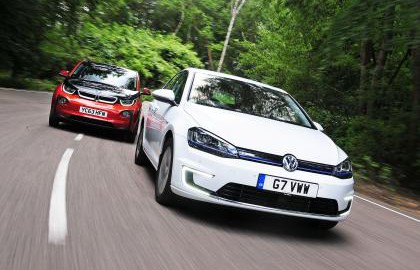
Volkswagen e-Golf vs BMW i3
Can the new VW e-Golf put battery-powered cars on the road to mainstream success? We find out as it meets the brilliant BMW i3
Electric cars have yet to spark a wholesale switch away from the combustion engine, but sales are rising and the launch of an electric version of Europe’s biggest-selling car is another example of the growing surge towards the mainstream.
The new VW e-Golf is available to order now and follows hot on the heels of the e-up! city car. Plus, once you factor in the Government Plug-in Car Grant, the newcomer costs £25,845 – which places it squarely in the path of BMW’s new i3.
The £25,680 i3 has already impressed us with its head-turning image, cleverly packaged interior and advanced composite structure. So if you’re ready to make the switch to electric motoring, is the cutting-edge, futuristic BMW or the electrified Golf the better choice?
Read more: AutoExpress
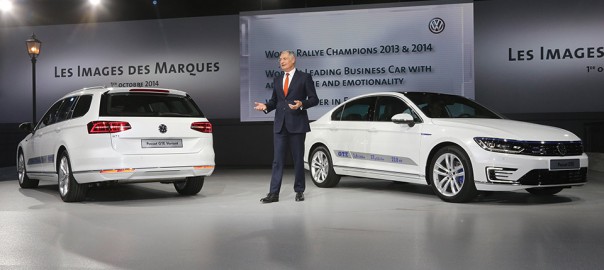
VW Presents New Passat GTE with Plug-in Hybrid System
Volkswagen is presenting four new models at the Paris Motor Show which begins today (2 October). Along with the XL Sport concept car – a highlight in terms of its drive system, efficiency and aerodynamics – the new Passat GTE makes its debut in Paris with a plug-in hybrid system. Rounding out the Volkswagen presence at the motor show are the world premieres of the Golf Alltrack with all-wheel drive and a distinctive off-road look and the new extremely sporty Polo GTI.
As a follow-up to the Golf GTE2, Volkswagen is now presenting the Passat GTE3 in Paris. The plug-in hybrid comes with a 1.4-litre TSI engine (115 kW / 156 PS) combined with an electric motor (85 kW / 115 PS) which is supplied with energy by a lithium-ion battery. Fusion of the two drive units generates a system power of 160 kW / 218 PS and enables a driving range of over 1,000 km.
In all-electric driving, it can cover over 50 km. The plug-in hybrid drive has a maximum torque of 400 Nm. The car’s eco-friendly and efficient NEDC fuel consumption is 2.0 l/100 km and 13.0 kWh/100 km – CO2 emissions are less than 45 g/km. The front-wheel drive car with a 6-speed dual clutch gearbox accelerates from zero to 100 km/h in 8.0 seconds and reaches a top speed of over 220 km/h. In its all-electric driving mode, a top speed of 130 km/h is possible. The Passat GTE can be ordered in the Estate or Saloon version.
Source: VW via VW Vortex
Volkswagen Passat GTE revealed ahead of Paris debut

Volkswagen has unveiled the plug-in hybrid Passat GTE prior to its official premiere during the Paris Motor Show next week.
Based on the eight generation Passat, the model is the third plug-in hybrid from the German manufacturer after the limited-run XL1 and the Golf GTE. When sales start in the second half of 2015, the vehicle will be available in both saloon and estate body styles.
Visually the GTE modification differs from the standard Passat with its blue accents on the radiator grille, the restyled front bumper with integrated C-shaped LED lights and the bigger alloy wheels. The interior benefits from a blue ambient lighting, a redesigned gear knob and a leather-trimmed flat bottom steering wheel.
The Passat GTE is powered by a petrol-electric hybrid system that includes a tuned version of the 1.4-liter TSI petrol unit rated at 156 HP (115 kW), supported by an electric motor with 115 HP (85 kW) and 400 Nm (243 lb-ft). The combined output is 218 HP (160 kW), while the transmission is a six-speed dual-clutch automatic.
Volkswagen says the average fuel consumption is 2.0 l/100 km (141 mpg) and 13.0 kWh/100 km, which responds to CO2 emissions of less than 45 g/km. With full 50-liter fuel trunk and lithium-ion battery fully charged, the car has a range of 1000 km (622 miles). The 0-100 sprint (0-62 mph) takes less than eight seconds, while top speed reaches 220 km/h (137 mph).
Source: Volkswagen

Car review- GTE is an electric dream
Creating a hot hatch used to be simple. Shoehorn the most powerful engine you can find into a small hatchback. Add some stiffer suspension, garnish with bigger brakes, flavour with large alloys and finally sprinkle with ‘GTI’ badges. This tried-and-tested formula has worked ever since the Golf GTI first appeared back in 1976.

However, Volkswagen didn’t stop there. Over the years the German firm has constantly pushed the boundaries of what a hot hatch is. From a turbo-diesel to four-wheel drive, fast V6 engines and even a small petrol with both a turbo and a supercharger, there has been no end to their hot-hatch tweaking. But nothing yet, has been as ambitious as this new Golf GTE plug-in hybrid.
Looking like a pumped-up GTI, the plug-in hybrid Golf doesn’t look all that different in the metal, but make no mistake this car is out to rewrite the hot hatch rulebook. Under the VW’s skin is the same hybrid powerplant as the Audi A3 e-tron that we tested on these pages back in July. That means it packs the same 150bhp 1.4-litre turbo petrol as well as a 75kw electric motor that pumps the overall output up to an impressive 204bhp.
That’s enough to give it a brisk 0 to 60mph time of just 7.6 seconds and onto a 137mph top speed while returning an 188mpg average fuel economy and just 35g/km emissions. Anyone lucky enough to run one as a company car will face an ultra-low 5 per cent Benefit-in-Kind tax bill – the kind of level that even company car drivers of conventional frugal cars can only dream of. Perhaps the most impressive aspects of this high-tech hybrid are its 31-mile electric-only range and the fact it takes just three and a half hours to charge from flat using a domestic plug socket. It can also travel at up to 81mph in electric mode alone.
All that means you could commute in the GTE without using a single drop of petrol all week, says Volkswagen. Which is why engineers had to use a petrol engine that could go for weeks without turning over. But if you do need to venture out of town at the weekend, the petrol engine will kick in and extend your range to a very reasonable 580 miles. So far, so revolutionary.
But what’s it actually like behind the wheel? Unsurprisingly, it feels like a Golf. Aside from an extra gauge where you’d normally find the rev counter (that shrinks and sits below it), the fit, finish and layout is just like the regular hatch. The only drawback we could find is that the battery cells have shrunk the boot capacity by almost a third and the rear seats no longer fold completely flat – but if you can live with that, you’re in for a treat once you’re on the move.
Read more: Sunday Express
Road test: Volkswagen e-Golf

At first glance, VW’s latest model looks like an ordinary Golf. Then you notice C-shaped LED front lights, aerodynamic alloy wheels and the lack of a tailpipe, which add up to the all-electric e-Golf.
Under the bonnet, there’s a 113hp electric motor with a top speed of 87mph and a single-speed automatic gearbox, plus some clever tweaks to increase the range to a claimed 118 miles. To drive, it feels like an almost silent version of a conventional Golf, with a sprightly pick-up which accelerates the car to 62mph in 10.4 seconds (much the same as in a 1.6-litre Golf BlueMotion turbodiesel), although using Eco and Eco+ modes will restrict the power and throttle response to increase the range.
You can further extend the mileage by using five different states of brake regeneration, which means you can drive most of the time using just the throttle.
A standard full charge for the lithium ion battery takes 13 hours, but you can fast-charge it to 80 per cent in 35 minutes.
Volkswagen e-Golf
Top speed: 87mph
Emissions: 0g/km
Economy: 12.7kWh/100km
Price: £25,845, including government grant
Source: London Evening Standard