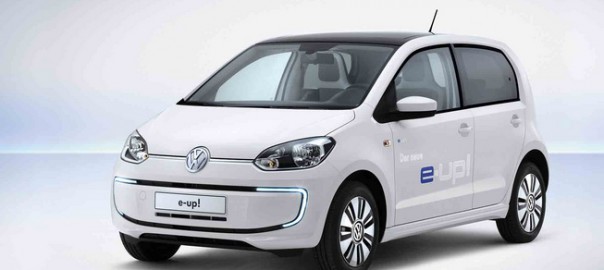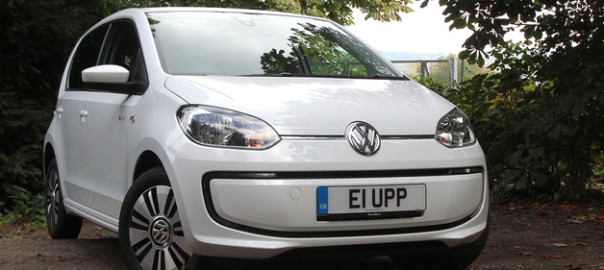
Say it quickly: “ee-up”. That Volkswagen feels happy to call its smallest electric car after the Yorkshire phrase for “hello” shows that Germans do truly have a sense of humour. We jest, of course – Yorkshiremen and women don’t say “ee up”, they say “ay up” – as Volkswagen’s press sheet for this car wryly points out.
Yorkshire greetings aside, the e-Up! poses a question: should you go electric? It’s been difficult to make a like-for-like choice between petrol, diesel and electric models, as most electric cars to date have tended to be standalone – the Nissan Leaf, BMW i3, Tesla Model S are all electric-only models. You can’t have a petrol version.
However, a few ranges are starting to appear which offer like-for-like choice – and Volkswagen has recently added electric versions of both Up! and Golf to its range. Bar some badges and wheel trims, you really won’t be able to spot the difference between them and their internal combustion-powered counterparts, so they could be the perfect option for electric car fans who don’t want to shout about their propulsion choice.
But taking the electric plunge will take some getting your head around, especially when it comes to price. At £19,270 – and that’s after the £5,000 UK government rebate – the e-Up! is one pricey small car. By way of comparison, the higher trim level version of the petrol Up! – on which the e-Up! is based (and that’s enough of the unwarranted exclamation mark after its name, by the way) – starts at £11,760 in five-door form, and although Volkswagen would point out there’s a host of extra kit that comes with the electric version, you’re still looking at the chunky end of a seven grand premium just to go battery powered. Perhaps more troubling for VW will be the fact that the larger, stand-alone Renault Zoe kicks off at a little over £14k.
So even before you’ve got in the driver’s seat, the e-Up is, er, up against it. Is it really worth so much cash?
Electric benefits
To save that seven grand you’re going to have to be doing an incredible amount of driving over the car’s life – at current prices, 10,000 miles in a petrol Up is likely to cost you about £1,000 in fuel.
Either that, or be extremely committed to the green cause, which isn’t entirely clear cut – electric cars aren’t truly zero emission because their electricity is most likely produced by a gas or coal power station.
From our perspective then, where the e-Up is going to make most sense is in the experience it provides. If it provides something better, extra or different over a petrol Up, then you shouldn’t rule it out.
And after jumping into the car and heading off down the road, there are some obvious benefits: the most obvious being performance. We love the 3-cylinder petrol engines in the regular Up, but they’re never what you’d call fast. And while the e-Up is still no race-car, step out of the petrol version and it does feel like a rocket.
In part that’s to do with the characteristics of the electric motor, which can deliver its full quota of torque from zero rpm. So it rips off the line and zips into gaps. In the context of city driving, which where we’d expect most e-Ups to spend their lives, it makes for a really great ally. It’s relaxing and easy in traffic – and really quite zippy and fun if you get the bit between your teeth.
Read more: Pocket Lint