Category Archives: Tesla

News and reviews of Tesla electric cars (including plug-in hybrids).

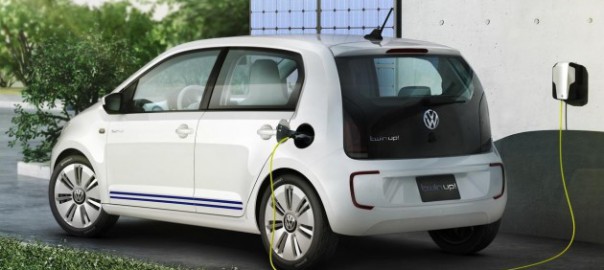
Volkswagen twin-up! PHEV (Image: VW)

Top Ten 2015 Green Car – Twin-up!

The year 2015 will see the strengthening of the market for electric vehicles (EVs); both pure electric and plug-in hybrids. With over 17,000 EVs already on UK roads, Next Green Car forecasts almost 40,000 will be in use by the end of the year.

New low emission petrol and diesel models will also be launched in 2015 with a shift to petrol cars reflecting the increasing concern about air quality. While diesel vehicles can offer lower CO2 emissions, petrol units provide lower NOx and particulates which are associated with poor respiratory health in urban areas. Look out for fuel-frugal petrol two- and three-cylinder turbo engines which can now offer the driving performance of larger engines.

As noted by Dr Ben Lane, Managing Editor of Next Green Car: “2015 will see a continuing roll out of battery electric and plug-in hybrid models as UK motorists become more accustomed to electric drive-trains. This year will be the year when EVs start to considered as ‘normal’.

“If an electric car isn’t right for your driving requirements, an ever increasing choice of sub-100 gCO2/km petrol and diesel models will become available with zero car tax and high MPG. You will need to choose a conventional model wisely, however, as the official MPG figures of some brands are increasingly at odds with the real-world fuel economy data.”

To mark a year which will bring high quality, high-tech, low emission models to UK showrooms, the following ‘Top 10’ list highlights some of the most important models due for launch and delivery in 2015.

1: Volkswagen twin-up! – Plug-in Hybrid – CO2: 27 g/km

Volkswagen twin-up! PHEV (Image: VW)

The twin-up!’s 55kW powertrain consists of a 0.8 litre TDI diesel engine working in conjunction with a 35kW electric motor. The energy storage system includes a lithium-ion battery (energy capacity: 8.6 kWh), a conventional 12V battery for on-board electrics, and a 33 litre capacity fuel tank.

On the official test cycle, the twin-up! delivers a combined fuel economy of over 250 MPG with a CO2 emissions of just 27 g/km. In zero-emission operation the PHEV can cover a range of 31 miles and is anything but a slouch: the twin-up! accelerates up to 62 mph in 15.7 seconds and has an all-electric top speed of 80 mph. Pricing to be announced.

2: Smart fortwo 1.0 start/stop – Petrol – CO2: 93 g/km – NGC: 26

3: SKODA Fabia 1.4 TDI – Diesel – CO2: 88 g/km – NGC: 25

4: Kia Soul EV – Electric – CO2: 0 g/km – NGC: 32 (14)**

Kia Soul EV
Kia Soul EV

The new Soul EV is the result of almost 30 years of research and development into the feasibility of electric vehicles at Kia and it shows. A 27 kWh lithium-ion battery gives the Soul EV an official range of 132 miles beating everything but the Model S. As you’d expect for an electric car, the Soul EV is quiet and perfect for nipping around town. Unlike most other EVs, however, it also scores highly on the use of low impact materials including bio-degradable plastic, bio-foam and bio-fabric which are all used in the interior. Zero tail-pipe emissions mean zero London Congestion Charge and zero car tax (Vehicle Excise Duty). Priced from £24,995 the Soul EV isn’t cheap but it does come with Kia’s class-leading 7-year warranty.

 **If powered using renewable (e.g. wind, solar) electricity

5: Mazda2 1.5 SKYACTIV-D – Diesel – CO2: 89 g/km – NGC: 27

6: Mercedes-Benz B-Class Electric Drive – CO2: 0 g/km

Mercedes-Benz B-Class Electric Drive (Image: NGC)

The Mercedes-Tesla relationship is evident (and welcome) in the B-Class ED with the drive-train and battery pack coming from the California-based company. Capable of 125 miles per full charge, the B-Class ED provides electric motoring in a quality package with more reserved styling than some other brands such as the BMWi range. While the motors can deliver up to 179 bhp (Sport mode), two other driving modes are available: ‘Economy’, where power is limited to 131 bhp; and ‘Economy Plus’ with just 87 bhp and a maximum speed of 70 mph. Expected to be priced from around £27,000.

7: VW Passat GTE – Plug-in Hybrid – CO2:

Volkswagen Passat GTE PHEV

Now in its eighth incarnation, the new Passat range includes the GTE, the first Passat with a plug-in hybrid drive. Powered by a turbocharged direct injection petrol engine (TSI) and an 85kW electric motor, the GTE is capable (on the official test) of over 141 MPG (petrol) and 13.0 kWh/100km (electric) with CO2 emission of under 45 g/km. On a full tank and fully recharged 9.9 kWh lithium-ion battery, the new PHEV has a total driving range of over 620 miles. In ‘E-Mode’, the Passat GTE can also cover a distance of up to 31 miles with zero emissions. AC charging options include standard (or ‘slow’) charging at 2.3 kW from a domestic socket in 4.25 hours or an optional a home 3.6 kW charger which provides a full charge in 2.5 hours. Anticipated pricing from around £20,000.

8: VOLVO XC90 – Plug-in Hybrid – CO2: TBC* g/km

Volvo XC90 Plug-in Hybrid (Image: AutoExpress)
Volvo XC90 Plug-in Hybrid

No doubt encouraged by the huge success of the Mitsubishi Outlander PHEV, Volvo will bring its own plug-in SUV to market in 2015, in addition to the usual range of petrol and diesel engines. While all will offer four-wheel drive, for the first time there will also be a front-wheel drive option. The XC90 PHEV will also feature a collection of entertainment and safety technology including a 9.3 inch screen compatible with Apple’s new CarPlay interface and Volvo’s new collision avoidance system. The XC90 range is priced from £45,750.

9: Toyota Mirai FCV – Hydrogen Fuel Cell – CO2: 0 g/km

10: Tesla Model X – Electric – CO2: 0 g/km

Tesla Model X
Tesla Model X

Originally scheduled for 2013, Tesla recently announced that the eagerly anticipated Model X crossover will be launched in the third quarter of 2015. Despite being larger than the Model S, the all-wheel electric drive will give the Model X a similar level of performance (that’s 0 to 60 mph in around 5.9 seconds!). With 10% additional weight, the expected driving range will be slightly less; around 170 miles for the 60 kWh battery pack or 230 miles for 85 kWh battery. One the striking features of the next Tesla will be its rear ‘Falcon’ doors which open upwards instead of swinging outward. Final pricing has yet to be announced. Although its been a while in coming, with the new Model X, Tesla is unlikely to disappoint.

Read more: Next Green Car
Carbuyer Reviews Tesla Model S – Video

Carbuyer gets its hands on the Tesla Model S… Prepare to hear the word “brilliant” a lot throughout the video.

Like is typically the case when someone reviews the Tesla Model S, they instantly feel like a kid in a candy store.

Mat, the Carbuyer reporter, mentions that the charging network is not all there (UK), so you may find yourself in a pickle, but we’ll point out that the charging network (especially Tesla’s Supercharger network) is rapidly growing and you can surely charge at home, so this is a non issue.

Aside from that little mistake by Carbuyer, we enjoyed this review of the Model S!

Source: Inside EVs

Electric Car Recharging

How Much Range Do Electric Cars Need?

Car buyers consider many factors before making a purchase – including comfort, style and efficiency. If they were honest and realistic about how much they drive, a majority of consumers inclined to purchase electric vehicles would choose battery-powered cars that can travel fewer than 100 miles on a full charge, new research finds. And according to the same study, that statistic isn’t likely to change unless battery costs drop dramatically, despite the drastic change that represents from gas-powered vehicles.

Tesla’s Model S has a range of up to about 300 miles on a fully charged battery, and a luxury car price to boot, but most electric-car models can travel no more than about 100 miles on a full charge. The new research finds that most customers will find the 100-miles or less category adequate to meet their daily driving needs, given battery costs now and in the likely near future. This is based on data that shows how far people actually drive each day.

Customers may prefer cars that are capable of driving hundreds of miles without stopping, but they may only rarely need that extra range. It may be more cost-effective to use one car for daily commutes and rent another vehicle for long trips.

However, a sticky question remains: Can car companies count on customers to purchase cars based only on economics-based considerations? Probably not, say other researchers. And, based on plans made available publicly, car manufacturers appear to agree with them.

Zhenhong Lin, a senior researcher at Oak Ridge National Laboratory in Tennessee, was trained as an engineer and now analyzes the economics and public policies related to transportation energy. His study in the journal Transportation Science, released in August, explored the multiple factors behind customer choices, including how far people actually drive on a daily basis, the variation in their driving patterns and how battery costs would have to decrease to promote electrically powered vehicles with longer ranges.

Range Issues

With gas-powered cars, driving range isn’t really an issue. A car that gets 30 miles per gallon and has a 14-gallon gas tank can go over 400 miles without refueling. And if you are about to run dry, it’s easy to find a place to fill up.

Electric vehicles don’t use gas at all – unlike a traditional Toyota Prius or other hybrid, in which various energy-capturing technologies charge an electric battery that then applies that energy to help move the car. Nor do electrics have backup gas engines like plug-in-hybrids do – this category includes one version of the Toyota Prius, the Chevrolet Volt (= Vauxhall Ampera), and others. For plug-in hybrids, the gas engine usually kicks in after a battery powers the first several to couple of dozen miles, depending on the particular model.

The longest range for an electric car is the 400 miles reported for the $100,000-plus Tesla Roadster, after a recent battery update. Most mass-market electric vehicles usually start at about $30,000. Rebates from both the federal and state levels can reduce the cost by thousands. Most of these cars boast ranges of fewer than 100 miles, including the Nissan Leaf, among others. Electric vehicles cost more than their gas equivalents, and there are far more gas stations than electric-charging stations if a driver needs to stop to top up the car’s battery. Most hybrids and plug-in hybrids have ranges similar to cars powered entirely by gas.

Read more: Inside Science

Electric Car Recharging

Is now the time to buy an electric or hybrid car?

Best cars and options explored

The future of driving appears to be electric, with Formula E in full effect, supercars adopting hybrid drive systems and range getting further all the time. Fuel powered engines may have their days numbered. But is it time to make the change to electric?

Now that the big car manufacturers are creating hybrid and electric cars we can be assured that it’s the future. And thanks to infrastructure improving all the time for charging stations range isn’t becoming such a big issue. But last year’s Tesla owners won’t get updated with the latest self-driving tech of this year’s Tesla, not a very nice reward for early adopting.

So is it still too early to adopt? Are batteries in cars suddenly going to improve to make current models a joke? We’ve looked at what going on to help give you a clearer idea of what to do.

Pure electric cars right now

The selection of pure electric cars right now isn’t huge, but it’s more than ever before and range is now good enough for day-to-day use. Prices, in the UK at least, are kept reasonable thanks to government assistance taking £5,000 off the price and offering free tax. If you offset petrol costs too you’re saving even more.

At the top end there’s Tesla with its Model S boasting all wheel drive and self-driving smarts starting at around the £50,000 mark. But this is in a league of its own with sports car performance, plus the latest model is not actually going to be in the UK until July 2015, even if you can buy yours now.

Then there are established brands like BMW, Ford, VW, Nissan and Renault all making fully electric cars at affordable prices right now.
Range, charging times, price and power

When going electric most people will be juggling these few key numbers: range, charging time, price and power.

PRICE: Firstly there’s price, at which the Renault Zoe wins by a fair margin starting at £14,000. Nissan’s Leaf can be bought from £16,500, Kia’s Soul EV is £25,000, the VW e-Golf is from £26,000, and BMW with its i3 is from £31,000.

RANGE: The range winner, from the reasonably priced cars, is the Kia Soul EV with 135 miles. In close second is the Nissan Leaf with 124 miles. Coming in behind them is the BMW i3 with a 118 mile range along with the VW e-Golf also sporting a 118 mile range, followed by the Renault Zoe with 93 miles.

Of course if you include the Tesla Model S that wins with its base model eeking out an impressive 240 miles on a charge and its top end offering 312 miles a go. But you get what you pay for.

CHARGE: This is a fairly even playing field with the cars all offering a rapid charge to 80 per cent in half an hour. Across the board it’ll cost you to upgrade your home charger for faster charging but this can result in as fast as a 3-hour charge to full.

POWER: Electric cars deliver all their torque instantly and the engine directly powers the wheels, this means they feel really nippy pulling away. The Nissan Leaf utilises 107hp to do 0-60mph in just 7 seconds making it the quickest of the lot off the mark.

The BMW i3 has 170hp for a 0-60mph time of 7.2 seconds, the Renault Zoe has 83hp for a 0-60mph time of 8 seconds, and the VW e-Golf manages 0-62mph in 10.4 seconds thanks to its 114hp motor. In last place is the Kia Soul EV with its 108bhp delivering a 0-60mph time of 10.8 seconds.

So for price the Renault Zoe wins it, but for range and power the Kia Soul EV comes out on top.

Plug-in hybrid electric cars right now

Hybrids have been around for years with the Toyota Prius leading the way with its dual-drive system. These are now more common than ever with Uber drivers using Prius as the car of choice.

But the market has grown, especially recently, with plug-in hybrids that allow drivers to charge at home so they may never need to use the fuel engine, instead reserving that for long distance journeys only.

From the Volvo V60 Plug-in and Ford Mondeo Titanium Hybrid to the Golf GTE or the BMW i3 with range extender, hybrids are fast becoming viable alternatives to single engine cars. The extra you may spend on the new technology can soon be made back in the petrol and tax savings they offer.

Range, charging times, price and power

Plug-in hybrid cars mean less of a worry about range than pure electric while also offering power and a reasonable price.

As with the Tesla we’re not going to include the likes of the McLaren P1, BMW i8, Porsche 918 and Ferrari LaFerrari as they’re all reserved for the super rich. And we’re only using plug-in hybrids as straight hybrids are fast becoming outdated in favour of the electric only options and extended range of plug-in hybrids.

PRICE: The plug-in hybrid range have all arrived at a similar time with manufacturers savvy to the government’s £5,000 contribution. For this reason they’re all very similarly priced.

The winner, by a narrow margin is the Ford Mondeo Titanium Hybrid from £25,000, with Mitsubishi PHEV GX3h from £28,250 in second and closely followed by the Toyota Prius Plug-In Hybrid from £28,395.

Then we have the Vauxhall’s Ampera from £29,000, Audi A3 Sportback e-tron from £35,000, BMW i3 Range Extender from £34,000 and Volvo V60 Plug-in hybrid from £45,000.

RANGE: Winning with an impressive 967 mile range is the Ford Mondeo Titanium Hybrid but it only manages around 20 miles on electric alone. Closely behind that is the BMW i3 with range extender that offers a 930-mile top end with pure electric for 105 miles, making it overall cheaper to run than the Ford. The Toyota Prius Plug-In Hybrid can manage up to 700 miles in one journey but loses on electric alone with just 15 miles on a charge.

Audi’s A3 Sportback e-tron can last for 585 miles with 31 of those miles on electric alone. Despite its size the Mitsubishi PHEV GX3h manages 500 miles with 32 on electric alone. Vauxhall’s Ampera eeks out 310 miles with between 20 and 50 of those miles on battery.

CHARGE: As in pure electric cars this is a fairly even playing field with the cars all offering a rapid charge to 80 per cent in half an hour. Across the board it’ll cost you to upgrade your home charger for faster charging but this can result in as fast as a 3-hour charge to full.

POWER: The Audi A3 Sportback e-tron, as the name suggests, wins this with a 0-62mph time of 7.9 seconds thanks to 204hp. The BMW i3 Range Extender model is second offering 170hp for 0-60mph in 7.9 seconds.

The Vauxhall Ampera does 0-60mph in 8.7 seconds with 148hp, despite having 178hp the Ford takes 9.2 seconds to get from 0-62mph, the Toyota Prius Plug-In Hybrid gets from 0-60mph in 11 seconds from 134hp, the Mitsubishi PHEV GX3h does 0-60mph in 11 seconds and has 186hp.

The winner for price is the Ford Mondeo Titanium Hybrid but the BMW i3 takes it for range with the Audi offering the most power.

Future electric and hybrid cars

The future of electric cars and hybrid machines is looking positive. Charging infrastructure is cropping up all over the country with Tesla’s Elon Musk promising to install his Supercharger network UK wide by the end of next year.

Crucially, right now, it’s possible to drive pure electric all the way from the top of Scotland to the bottom of England thanks to fast chargers along the way. It might take a little longer than petrol cars since you have to stop for half an hour to recharge, but it won’t cost as much by a long shot. So adopting right now, especially if you’re going for a hybrid, isn’t as risky as it once was.

Another issue is batteries. Developments are being made more and more regularly as car manufacturers pour money into research. But worrying about having an older battery shouldn’t be an issue as, hopefully, manufacturers will be able to swap out old for new future-proofing any car you buy now.

Next year Tesla hopes to offer a car which is nearly completely self-driving. But since that’s out of the price range of most people current electric car offerings are plenty futuristic.

If you’re already driving a car and the cost of petrol and tax are proving too much then electric or hybrid could be your way out.

Source: Pocket Lint

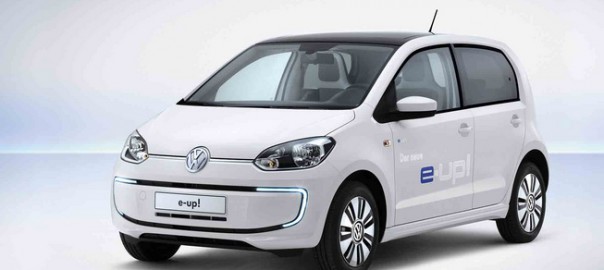
Volkswagen e-UP (Image: VW)

2014 Next Green Car Awards fetes VW e-Up!, Tesla Model S

The California-made Tesla Model S was one of about a dozen models given props by the Next Green Car Awards. And the prizes ran the gamut between conventional, diesel, plug-in and battery-electric powertrains because who doesn’t like variety?

Leading off in the Next Green Car awards was the Volkswagen e-Up!, which took home the City Car award:

“With the e-up!, Volkswagen has produced a high quality, practical and affordable electric city car which is perfect for zero-emission urban driving where space is a premium.”

Americans may associate “Family Estate” cars with huge, fake-wood-paneled station wagons of the ’70s and ’80s (and with Clark Griswold), but NGC gave the Family Estate award to the far-more-fun Audi A3 Sportback e-tron plug-in hybrid.

“As the first plug-in hybrid estate car, the A3 Sportback e-tron perfectly combines conventional fuel practicality for long distance driving with zero-emission motoring for urban trips.”

The Mitsubishi Outlander Plug-in Hybrid, Nissan e-NV200 Combi and Mercedes-Benz B-Class Electric were also all given props.

“The Outlander PHEV sets the SUV bar high offering plug-in capability for the price of a diesel. With a 5% BIK rate, you can see why the Outlander is the UK’s most popular plug-in hybrid.”

“With the e-NV200, Nissan has broken new ground offering an affordable and practical zero-emission alternative to the ubiquitous diesel van.”

“Powered by Tesla know-how, the Mercedes electric B-Class brings electric mobility to the compact MPV class for the first time. High on quality, long on range, and zero on emissions.”

Finally, the Tesla took home the top-of-the-line “Executive” prize.

“Simply the most beautiful and technologically advanced electric car on the market, the Model S combines a gadget-packed interior with an exhilarating electric driving experience.”

Read more: Autoblog, Next Green Car

Tar Sands in Alberta (Image: Wikimedia/Howl Arts Collective)

The scale of electricity use by fossil fuel refining

This is a fascinating episode of Robert Llewellyn’s (highly recommended) Fully Charged show. Ostensibly it’s a review of the rather dull Lexus is300h (just another hybrid) but actually the second half is an analysis of how much electricity is used in refining petrol and diesel fuels. He comes up with a figure of 4.5kWh of electricity wasted to refine one gallon.

This video is set to start at that point:

It gives a UK perspective on the well-known quote from Revenge of the Electric Car, usually attributed to Elon Musk (CEO of Tesla Motors) but really from the film’s director Chris Paine:

“you have enough electricity to power all the cars in the country if you stop refining gasoline. You take an average of 5 kilowatt hours to refine gasoline, something like the Model S can go 20 miles on 5 kilowatt hours. You basically have the energy needed to power electric vehicles if you stop refining.”

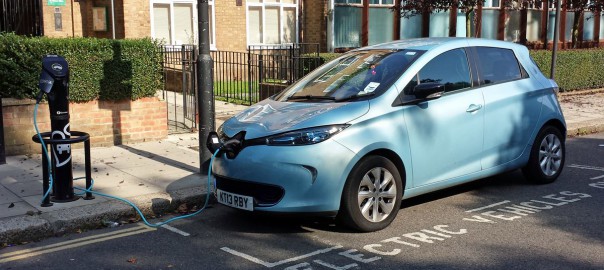
Slow Charging the ZOE at Highgate (Image: T. Larkum)

People’s Climate March – Part 1

Fast Charging the ZOE at Toddington (Image: T. Larkum)

On 21 September I had a bit of an adventure, travelling down to London to attend the People’s Climate March – my first ever protest march.

I have been concerned about climate change for about three years, and have blogged about climate and energy for the last two. Wanting to know more about the scientific understanding of it I completed an online educational course ‘Climate Change in 4 Dimensions’ earlier this year. While I would highly recommend the course, learning more about the subject has only reinforced my concerns. The scientific conclusions are clear – the climate is changing fast, it’s caused by human carbon dioxide emissions, and it’s going to have major impacts on our lives and especially on the lives of our children and grandchildren.

Having made many changes in my lifestyle to reflect my concerns – including installing solar panels on our house, switching to a renewable energy supplier, and buying and blogging about my Renault ZOE electric car – it seemed to me that the next natural step was to become more active politically. I’m not sure what direction that will take long-term, but I felt it was necessary to start by ‘standing up to be counted’ and attending the first ever Climate March.

Slow Charging the ZOE at Highgate (Image: T. Larkum)

I toyed with the idea of going by train but somehow it seemed most appropriate to go by electric car. I therefore headed out along my regular and familiar route down the M1 towards London, stopping as usual at the Toddington Services fast charger on the way. I then drove into north London and parked up at a slow charger in Highgate (the same one I had used previously when attending a rock concert in Kentish Town).

Tesla Model S in Highgate (Image: T. Larkum)

I walked south from where I parked to Kentish Town underground station so I could take the tube down into central London. On the way I was surprised to pass two electric cars – clearly they are more popular in London than in Northampton – and I took that to be a good omen.

The first was a navy blue Tesla Model S parked on Highgate Road, in a bus lane outside a restaurant. It’s a big, good-looking car – though I don’t imagine that most people can tell it’s electric.

Renault ZOE in Highgate (Image: T. Larkum)

Then a few minutes later I saw a ZOE, much like mine apart from being white. It was just parked in a side road, probably in front of the owner’s house, looking perfectly natural.

Climate March poster on the Underground (Image: T. Larkum)

The trip on the underground was uneventful, heading to Temple for the start of the march. I was encouraged on the way to see a couple of posters by the escalators publicising the event. I anticipated that would mean the march would be well-attended, and so it transpired.

[Part 2]

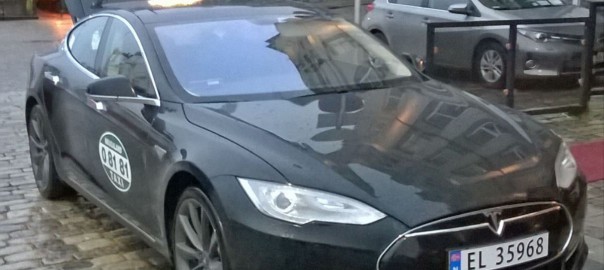
Tesla Model S Taxi in Norway (Image: J. Tisdall)

A Trip by Tesla Taxi in Norway

Tesla Model S Taxi
Tesla Model S Taxi

On a business trip last month (21st October) I arrived with a colleague at Haugesund, a small airport on the windswept west coast of Norway.

We were quickly out and walked over to the taxi rank and straight into a Tesla. I was delighted as I am very interested in electric cars, and the Tesla is definitely the flagship EV in my mind.

Tesla Model S Taxi: 17" Touchscreen
Tesla Model S Taxi: 17″ Touchscreen

I made sure I got the front seat. The car is a delight. Comfortable, quiet and smooth. The dashboard contains an absolutely enormous LCD screen with a myriad of context relevant data.

Close-up of Tesla Touchscreen

We got talking with the driver. He had received the car in March and, so far as he knew, he was the only Tesla operating as a taxi driver in that region. He said on most days he worked the full day on one charge. Only if he had some exceptional journeys might he need to recharge.

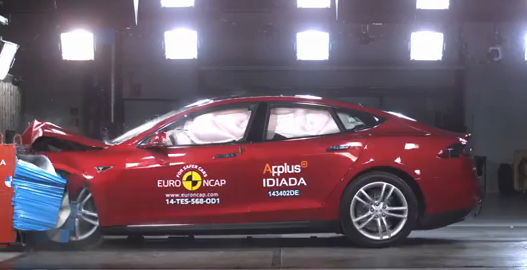
Tesla Model S Euro NCAP Crash Test

Tesla Model S scores Euro NCAP five star safety rating

Despite some much overblown crash controversy in the US, the Tesla Model S has once again proved its safety credentials, adding a five star Euro NCAP score to its five star result from the US road safety authority, NHTSA.

In the latest round of safety tests, the Model S secured a five star result alongside the new Nissan Pulsar, BMW 2 Series Active Tourer and Skoda Fabia. Also tested was the Suzuki Celerio which scored a less impressive three star result.

For the Model S though the latest result reaffirms just how safe electric cars are despite overblown coverage of a number of crashes involving Model S cars last year, which might have suggested the car was a fire risk.

An investigation into fires involving the Model S by NHTSA last year, reaffirmed that the Model S was safe, although Tesla did nonetheless decide to make a few tweaks to improve the car further including adding a new titanium body shield.

Read more: Green Car Website

Tesla Model S (Image: AutoExpress)

Tesla announces new finance deals for Model S

Manufacturer promises to buy back Tesla Model S electric car for 50 per cent of original value

Tesla has revealed the new finance packages available to private buyers of the Model S. The company claims that the deals have been created from the ground up rather than as copies of plans offered by other manufacturers.

The financing will be offered through Tesla’s partner, Alphera Financial Services. The main news is that Tesla promises that the resale value guarantee, the price given to customers when their three-year agreement comes to an end, will be 50 per cent of the base purchase price of the 60 kWh Model S electric car.

Tesla claims that the new programme has no gimmicks, and offers customers the option to sell the car back to the company once the three years is over, or extend the hire purchase agreement for longer.

Buyers will have to put down a 15 per cent deposit initially, with the choice of a 48-, 60- or 72-month contract. With an interest of 5.9 per cent APR, monthly costs will be around £820 month. The agreement limits mileage to 15,000 miles per year, with owners charged 17p per mile if they go past this.

Georg Ell, Tesla’s UK Country Director, said:

“We understand that many customers enjoy the simplicity of a Hire Purchase but also may seek some assurance of the future value of Model S. We want to do the right thing for customers, so we’re delighted to be able to offer this transparent and fair financing programme.”

Source: Auto Express