Strong demand for electric vehicles (EVs) saw values rise 0.9% in September, while average used values remained static, says Cap HPI.
Particular strength has been seen for pure battery electric cars with values increasing for as diverse models like the Renault Zoe, BMW i3 and Tesla Models S and X.
At three years and 60,000 miles, average used values didn’t move in September, while newer cars have increased by a negligible 0.1% at the six month and one-year points. Older cars have dropped slightly, but the 0.3% decrease at five-years-old is again negligible.
Model 3 easily outpaced its German car competition
Tesla is selling every Model 3 it can screw together. Astonishingly, it’s selling so many of them that the Model 3 outsold every BMW passenger car combined. We should note that BMW still leads if you include SUV sales, but beating the Germans at passenger cars is no small feat.
Here’s the number breakdown: BMW sold 14,450 passenger cars in the U.S. market in August. This number includes sales from compact crossovers like the X1 and X2 as well. That’s a 13.5 percent decrease in car sales from August 2017. Car sales tracking site GoodCarBadCar lists Model 3 sales at 20,450 for the month of August. However, that’s only an estimate because Tesla doesn’t report official sales numbers. Other news outlets have estimated figures in the 17,000 range. And Bloomberg’s Tesla Tracker site puts the current production level of the Model 3 at 4,800 cars per week. But any of the estimates are safely above BMW’s exact figure. The BMW 3 Series (the Model 3’s direct competitor) sold only 3,751 cars in August.
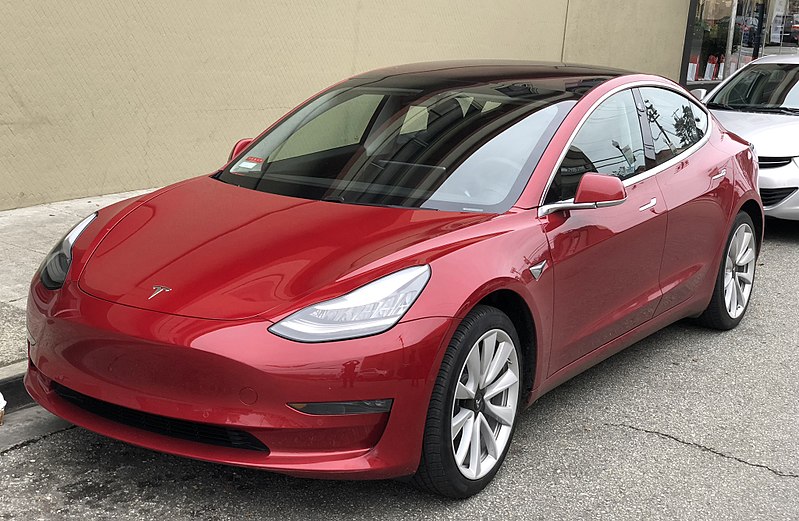
Tesla Model3 (Image: Wikimedia/Carlquinn)
Lexus led the luxury vehicle segment, but its big winners were crossovers. From the start of the year, BMW is up compared to 2017 because of its SUVs as well. Tesla certainly isn’t experiencing the same drop in car interest after this surprising month of sales. As for the BMW i3, it sold all of 418 cars last month. The company’s only pure EV will be eclipsed by the new generation of electrics that BMW has in the works.
Selling this many Model 3s isn’t particularly surprising given the 420,000 reservations remaining as of July. It’s unlikely that all those turn into orders, but it explains why sales are so ludicrous at the moment. And In a week when the Mercedes EQC electric crossover was revealed and BMW is almost ready to show its Vision iNext concept, Tesla is starting to hear hoofbeats from competitors and needs to sell Model 3s as fast as it can.
There’s no questioning the fact that electric cars are the new ‘it’ thing, especially with major players like Tesla and Formula E in the scene. But this is also why recently the debates have been shifting more and more towards their environmental impact.
There are definitely many challenges that need to be addressed before electric cars can be declared as a completely green alternative to fossil fuels. For now, some of the major concerns for environmentalists have been the manufacturing process of the vehicles and the processes through which their batteries are charged. In fact, the batteries themselves are a greater cause of concern, mainly because of a key ingredient that lets the Li-ions battery generate electricity, i.e. cobalt.
Red Tesla Model S (Image: T. Larkum)
Discovering Cobalt
If you are just hearing about cobalt for the first time then you should be surprised to know how often it is used. Cobalt is the name of a chemical element that was discovered in 1739 by a Swedish chemist, Georg Brandt. This metal is silvery-white in appearance and it’s mostly produced as a by-product of nickel and copper mining.
Cobalt is used in a number of everyday products such as paints, medicines, powerful magnets, cutting tools, smartphones and even in some very basic items such as pottery. But the use that concerns us here is its use in car batteries. Cobalt, combined with other elements produces cathodes, which are then used in lithium-ion batteries – a major component of electric vehicles.
The Challenges
In recent years, cobalt has actually been a major cause of speed bumps on the road to developing the ideal electric vehicle. There are numerous economic and ethical issues that have surfaced regarding the use of cobalt.
The price of cobalt is set to rise as its supplies are dwindling. They are predicted to hit critically low levels by 2050, according to the the Helmholtz Institute Ulm (HIU) in Germany. Hopefully, this will lead to an increased need for manufacturers to replace its use with a new technology.
From an ethical, political and environmental stance, it’s seen as an ingredient that needs replacing, fast. The unearthing process is infamous for being unhealthy for miners, with the U.S. Centers for Disease Control and Prevention reporting that “chronic exposure to cobalt-containing hard metal (dust or fume) can result in a serious lung disease called ‘hard metal lung disease’”.
Positive Advancements
With so many things going against its use, it’s pretty clear that battery manufacturers have to look for alternative sources to power their car batteries. A lot of advancements have already been made and many positive signs for the future have been observed.
For instance, Tesla has been working with its battery cell suppliers, Panasonic, to produce batteries that would work with significantly lower levels of Cobalt and their ultimate aim is to completely eliminate its use.
How Practical is This?
While they’ve announced their goal, Panasonic and Tesla have not exactly made it clear how they plan on achieving it. However, there are a number of promising technologies around that they may choose from.
One option could be the use of lithium-manganese spinel or lithium-iron phosphate that might work without cobalt. However, certain concerns regarding the feasibility of these alternatives and their cost-effectiveness when it comes to using them for commercial vehicles still exist. There are also some other alternatives like solid-state lithium batteries, which are very promising, but their production processes are still in the testing phase.
The only thing that seems clear right now is that cobalt is not a sustainable element and thus it is not a viable option for future production of electrical vehicles. The success of both the ordinary and autonomous car industry is based heavily on sustainability, which rules out the use of an element that is likely to run out in future. It’s important for investors like Tesla to continue their research and experiments to produce greener car batteries in order to make the common use of electric cars a possibility.
Sitting in an electric car on the start line at Silverstone, about to go head to head with the latest Aston Martin, I quietly wonder what on earth I am doing.
While the guttural rumbling from the Aston’s V8 engine seeps into my right ear, the Tesla S I am in (£130,000 on the road) is totally silent. You would not even know it was switched on. But while the Aston has thunder, the Tesla produces lightning — accelerating from 0 to 60mph in under three seconds with a g-force that puts roller coasters to shame.
As the British supercar shrinks in my wing mirror, I can attest that driving an electric car is undoubtedly fun. But for everyday driving, could you really live with a battery-powered vehicle?
Red Tesla Model S (Image: T. Larkum)
It is a question more car buyers are asking. Electric vehicles have graduated from a niche environmental concern to a serious proposition for mainstream motorists, as the technology comes of age and major manufacturers prepare to flood forecourts with battery-driven alternatives.
However, sales remain tiny. The majority of buyers are daunted by the high prices of electric cars, plus the limited mileage range, not to mention how — and where — they can recharge their vehicles. About 6 per cent of vehicles sold between January and June this year had a plug, while a mere 0.5 per cent were fully electric, meaning they have no traditional engine whatsoever.
As we enter September, traditionally Britain’s second-biggest month for forecourt sales, here are all the financial points you need to consider before buying an electric car.
June was the second-best month all time for plug-in electric car sales in Europe with more than 38,000 units put on the road.
With year-over-year growth of 37% in June, market share jumped to 2.4% (2.2% for the first half of the year).
The total sales in the first six months nearly hit 185,000 (43% more than a year ago) and it’s expected that more than 400,000 is possible in all of 2018.
Ultra-low emission registrations up (Image: OLEV)
The top five best selling models in Europe – for the year are:
Nissan LEAF – 3,377 and 17,944 YTD
Renault ZOE – 3,425 and 17,016 YTD
BMW i3 – 2,002 and 11,301 YTD
Volkswagen e-Golf – 1,447 and 9,796 YTD
Mitsubishi Outlander PHEV – 2,174 and 9,662 YTD
Renault ZOE this time managed to beat Nissan LEAF and close the gap a little bit in the race for the best selling model.
As usual, the last month of the quarter brings some decent numbers from Tesla – 2,105 Model S and 1,829 Model X in June and 7,699 and 5,600, respectively for the year-to-date.
The Model 3 Performance has two motors and can go from 0-60 mph in 3.5 seconds, with a top speed of 155 mph.
A “base” Performance version can be ordered for $64,000; the car I sampled was fully loaded, at $78,000.
I drove the Model 3 Performance for only about an hour, in less-than-ideal Manhattan conditions, but my overall impression was that the car is completely brilliant.
Here’s the bottom line: I really, really, really liked the Tesla Model 3 when I drove it earlier this year — but I like the high-performance version much, much better.
Earlier this year, I took my first proper spin behind the wheel of the Tesla Model 3, perhaps the most anticipated car in the history of the automobile industry. I had driven the Model 3 for about 15 minutes when it was launched in July of 2017, and I was impressed. The few hours that Business Insider had with the well-equipped $57,500 rear-wheel-drive version of the vehicle reinforced all my initial enthusiasms.
Tesla Model3 (Image: Wikimedia/Carlquinn)
That was just the appetizer, however. The entrée arrived this week: the $78,000 high-performance, dual-motor, all-wheel-drive Model 3. Tesla has labeled its previous cars in this category with a “P” (for performance) and a “D” (for dual-motor), along with the kilowatt-hour designation of the battery. Thus, the high-performance AWD Model S with the biggest battery available in the P100D.
Not so with the Model 3. The trim I sampled doesn’t have Model 3 badging at all and get just a “Dual Motor” label on the rear. Tesla refers to it as the Model 3 Performance.
I had a few complaints about the Model 3, but they’ve faded with time. And my main beef with what I’ve been calling the P3D was with the elevated pricing. But Tesla has adjusted it, so that a “base” P3D can be had for $64,000. If you take a pass on some of the upgrades, you get a considerably better driving experience than what the tricked-out RWD Model 3 offers — for less than $10,000 extra.
The P3D is an important evolution of the Model 3 for Tesla, which isn’t currently manufacturing the no-frills $35,000 version of the car (that vehicle will have a smaller battery than the Model 3’s now on sale, as well as a more bare-bones interior). Tesla needs revenue, and the pricey P3D will bring it in. Besides, the company’s history is that buyers tend to flock to its more expensive cars, at least initially.
The Prius has been the long-standing darling of the eco-conscious car crowd. But that’s changing in a hurry with the Tesla Model 3.
First some background. Let’s start with Elon Musk speaking during this past week’s second-quarter 2018 earnings conference call.
“The more Model 3s we deliver to the field, it’s actually causing viral growth of our sales. So, if we deliver a Model 3 to somebody [and] they love it, they tell all of their friends…really our customers are our primary sales force…that’s the thing that fundamentally drives our sales.”
–Elon Musk, August 2, 2018 Tesla earnings conference call
Tesla Model3 (Image: Wikimedia/Carlquinn)
Then later in the conference call Robin Ren, VP Worldwide Sales at Tesla, cited the Prius as the first among a list of five cars that Model 3 buyers are trading in.
“So, we looked at what people who are buying Model 3 cars in the United States, what cars they are trading in. What we found is through this year, from January to July, the top five non-Tesla cars people are trading in to get into a Model 3. They are Toyota Prius, BMW 3 Series, Honda Accord, Honda Civic and Nissan Leaf.”
–Robin Ren, VP Worldwide Sales at Tesla, August 2, 2018 Tesla earnings conference call
Many — if not most — of those are likely older traditional Prius hybrids and not the newer plug-in hybrid Prius Prime. The former, which Toyota began producing in 1997, has been the top-selling car for eco-conscious buyers for almost two decades.
The European passenger plug-in market continues pushing forward. In June, the continent registered some 38,000 plug-in electric vehicles (PEV), up 37% relative to the same period last year and the continent’s second best performance ever.
That showing pulled the year-to-date (YTD) count to some 185,000 deliveries (+43% year over year, or YoY). In total, the 2018 PEV market share of the overall car market there is up to 2.2% (2.4% in June).
This time, fully electric cars (BEVs) grew slower (+20%) than PHEVs (+55%). Will we see all-electrics bounce back in the second half of the year?
Looking at Europe’s fuel mix, diesel continues to drop significantly (-16% YoY) in a growing market (+5.2%), while all other fuels (including CNG, LPG, …) are on the rise, profiting from the diesel-fleeing stampede. At this pace, the new registrations of diesel-powered vehicles will be virtually dead by 2025.
June saw the Renault Zoe beat the Nissan Leaf for the first time since February, with BEVs continuing to own the top positions. The Tesla Model S, meanwhile, profited from the usual last-month-of-quarter peak to join the top 5. It landed in the #4 position.
The Mitsubishi Outlander PHEV managed to score another top 5 presence as well, winning at the same time the bestselling PHEV award.
Among models that landed in 2018, the best selling one is the Land Rover Range Rover Sport PHEV, which registered 235 units in June, adding to the current 498 registrations made this year.
My grandfather was quite intrigued with those horseless carriages. Here he is, with a big grin on his face, testing out a Model T back in 1913.
A few years earlier, Henry Ford had debuted his Detroit assembly line and began cranking out Model Ts – the world’s first mass-produced automobile. The rest is history.
Then, a hundred years later in 2010, Nissan (OTCPK:NSANY) became the first company to mass-produce EVs (cars powered only by electricity), the Nissan Leaf. Motortrend at the time noted that the Leaf “could be the most significant vehicle of the century.”
Red Tesla Model S (Image: T. Larkum)
Did the 2010 Leaf and does today’s Tesla (NASDAQ:TSLA) Model 3 indeed herald a transportation revolution into EVs, much as Henry Ford’s Model T did into “horseless carriages” a century earlier?
Well, EV sales have soared from practically nothing in 2010 to an estimated 1.6 million in 2018 and are up 68% over 2017.
The surge in EV sales (growing 50-100% each year now) is primarily due to better and more affordable batteries and today virtually every major automaker plans on introducing electric cars, if they haven’t already, both hybrids and EVs.