Category Archives: Model 3

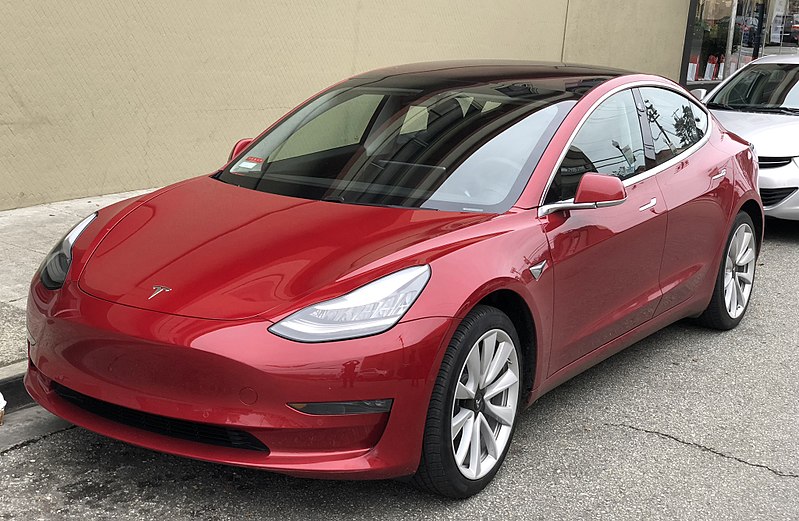
Tesla Model3 (Image: Wikimedia/Carlquinn)

New Tesla Model 3: European prices and specs revealed

The Tesla Model 3 is now on sale in select European markets, with first deliveries penned in for February 2019

Tesla has outlined European specifications and prices for the Model 3, and first European reservation holders will have been invited to begin placing their final orders.

In the United States, the Model 3 has been on sale for well over a year and deliveries are well underway, with production totalling over 50,000 units in the third quarter of 2018.
Tesla Model3 (Image: Wikimedia/Carlquinn)

With European sales finally beginning, two configurations of the Model 3 are available from market launch – the Model 3 Long Range Dual Motor All-Wheel-Drive, and the recently revealed, BMW M3 baiting Model 3 Performance.

Both models are expected use a 75kWh battery pack, and have been homologated under the new WLTP testing procedure with an official range of up to 338 miles on a single charge. As for the Model 3 Performance, Tesla claims that the European specification model achieves 0-62mph in 3.7 seconds, with top speed clocked at 155mph. No European performance figures have been published for the regular Long Rane Dual Motor AWD model, but Tesla’s American configurator claims 0-60mph in 4.5 seconds, with a top speed of 145mph.

Read more: Auto Express

Tesla Model3 (Image: Wikimedia/Carlquinn)

Tesla to open up CCS fast charging for European Model 3, Model S and Model X

Third-party CCS fast charging available to all Tesla Model 3 owners with adaptors coming for Model S and Model X owners

European Tesla Model 3s will come with a CCS (Combined Charging System) fast charging compatible port when they arrive in the early part of 2019. That means that, as well as using Tesla’s own Supercharger and Destination networks, the Model 3 will be able to fast charge on third-party networks such as Polar/BP Chargemaster and Ionity.

Owners of Model X and Model S cars will also be able to use third-party CCS chargers by buying an adaptor that can be plugged into their cars’ existing on-board Type 2 sockets. The new adaptors are expected to be priced similarly to existing CHAdeMO fast-charging adaptors, which cost around €500 (£435), yet will be slightly smaller in form.

Tesla Model3 (Image: Wikimedia/Carlquinn)

Speaking exclusively to Auto Express, Tesla’s head of global charging infrastructure, Drew Bennett, said: “There’s a lot of excitement about Model 3 coming to Europe and charging is always part of that conversation.

“We’ll be continuing to invest in our network – that’s a huge part of the ownership experience. But we’ll be enabling our owners to have access to the CCS networks that are starting to grow in Europe, so the Model 3 will have a charge port for the CCS standard and we’ll also have an adaptor for Model S and X.

“All existing Tesla customers will be able to use the Supercharger network still, but these changes will allow people to venture outside the network – this is something that could really help our owners and is really exciting for us to be able to say that about the infrastructure in Europe.

“We’re all about accelerating the advent of sustainable energy and transportation and this is another way to help everybody scale.”

Read more: AutoExpress

White Tesla Model S (Image: T. Larkum)

45% of Current Electric Car Drivers Plan to Buy a Tesla Next

You’re going to be shocked — the electric car that respondents most frequently said they were most likely to buy next (or for the first time in the case of non-EV drivers) was the Tesla Model 3.

Over 100,000 reservations ($1,000 each) were placed for the car in under 24 hours — even before the car was shown. The demand was through the roof and ended up being the single biggest product reveal in history by certain key metrics. So, it is not a surprise in the least that this electric car tops the list of “expected next EV model.”

That said, the Tesla Model 3 didn’t account for the majority of answers, demonstrating that the electric car market is broad and goes far beyond the Model 3. Delving into the less desired models is perhaps more interesting than dwelling on the Model 3’s dominance, since they get much less attention but are still cars that many consumers are eager to place in their garages.

White Tesla Model S (Image: T. Larkum)

As with our first two EV owner reports, one thing that stands out is how loyal many consumers are to the brands and models they are currently driving. Many Volt drivers plan to get a Bolt, many LEAF drivers plan to get another LEAF, and many Tesla drivers are filling out their family fleets with other Tesla models or are upgrading to the latest and greatest versions of the Tesla vehicles they already have.

Read more: Clean Technica

Tesla showroom in Milton Keynes (Image: T. Larkum)

Tesla (TSLA) surpasses BMW’s valuation as one soars and the other slips

Tesla’s stock (TSLA) is surging since announcing record profits and the company is now worth more than BMW as the stock of the latter is slipping following disappointing financial results.

The California-based electric automaker’s market cap is now worth over $59 billion while BMW’s slipped below 49 billion euros ($55 billion) yesterday after it announced lower than anticipated profit for the last quarter.

While it’s hard to directly compare Tesla to other automakers because the company is more than an automaker due to its growing energy division, most of its revenue currently comes from its automotive business.

Tesla showroom in Milton Keynes (Image: T. Larkum)

As a premium automaker, BMW is probably one of the best comparisons for Tesla.

But even though Tesla’s production increased significantly this year, the two automakers deal in completely different kinds of volume.

The BMW Group delivers over 2 million vehicles per year between all its brands while Tesla is currently producing vehicles at a rate of about 360,000 unit per year.

Nonetheless, investors are betting on the company’s future and they are encouraged by its growth and profitability over the last quarter.

The Model 3 is already disrupting the midsize premium sedan market, which has been an important market for BMW.

BMW’s sales of midsize sedans have been down in the US, where Tesla is mainly delivering the Model 3, this year.

The German automaker’s BMW 3 Series is seen as one of the biggest losers in the rise of the Model 3.

Read more: Electrek

Electric vehicles will be allowed to drive at higher speed limits than gas cars, says Austrian government

A new initiative from the Austrian government is set to reward electric car owners with a unique incentive.

On October 25, the Austrian ministerial cabinet announced that it would be adjusting the speed restrictions for electric vehicles traveling in the country’s IG-L-Hundred zone, which covers a total area of 440 kilometers (273 miles). With the updated rules in place, owners of Teslas and other electric vehicles will be allowed to travel up to 130 km/h (80 mph) on the highway, 30 km/h (20 mph) faster than their fossil fuel-powered counterparts.

Austrian Minister of Sustainability Elisabeth Köstinger noted that the speed limit exception for electric vehicles is part of the country’s initiative to encourage the adoption of sustainable transportation. Together with the adjusted speed limits, the Austrian government is also pushing to open bus lanes for zero-emissions cars, and promote free parking programs for electrified vehicles.

“The exception for electric vehicles in the IG-L-Hundred is an advantage that we want to give owners of e-vehicles to internal combustion engines,” Köstinger said.

While the specifics of the speed limit incentive are yet to be fully announced, the Austrian government’s wording on the program suggests that the exception would be tailor-fit for battery-powered vehicles like Tesla’s electric cars. Köstinger, for one, noted that the top speed advantage would be given to EV drivers over drivers in vehicles with internal combustion engines. With this statement in mind, it appears that hybrid vehicles such as the BMW i8, which are equipped with a internal combustion engines and electric motors, would not be awarded the same top speed incentive.

The country’s EV community would likely appreciate a speed limit incentive for electric cars, and if it proves effective in Austria, there is a good chance that the program would be adopted in other regions as well. Electric cars, after all, emit no emissions regardless of their speed, and with the advent of high-performance vehicles like the Tesla Model S, Model X, and Model 3, EVs are now more than capable of maintaining high speeds for long periods of time. With batteries getting cheaper and better, electric cars will soon be able to travel even farther than before as well. With this in mind, even simple perks like a higher speed limit would likely encourage even more drivers to join the growing electric car movement.

Read more: Teslarati

Tesla Model3 (Image: Wikimedia/Carlquinn)

Tesla shares jump as Musk delivers quarterly profit, cash

SAN FRANCISCO (Reuters) – Tesla Inc (TSLA.O) reported a net profit, positive cash flow and wider-than-expected margins for the latest quarter on Wednesday, delivering on Chief Executive Elon Musk’s promise to turn the electric carmaker profitable as higher production volumes of its new Model 3 began to pay off.

Tesla reiterated that it expected to repeat its net profit in the current quarter, helping drive the company’s shares up 14 percent in after hours trading.

The controversial Musk, who has often set goals and deadlines that Tesla has failed to reach, surprised investors by delivering on his pledge to make Tesla profitable for only the third quarter in its 15-year existence, providing a positive end to a difficult quarter for the CEO whose leadership was openly questioned only weeks ago.

Tesla Model3 (Image: Wikimedia/Carlquinn)

“We can actually be cash flow positive and profitable in all quarters going forward,” Musk said, qualifying that he excluded those in which a big debt payment comes due, such as the first quarter of 2019.

Musk reiterated that Tesla currently does not plan to raise equity or debt.

Tesla said it would begin taking orders in Europe and China for the Model 3 before the end of 2018. Deliveries would begin to Europe in late February or March, and those to China in the second quarter, if not before, Musk said.

Musk said he planned to begin local production in China next year in a ‘capital efficient manner,’ suggesting the company might use a similar tent structure for car assembly that has already been used at its Fremont, California, plant. He gave no further details on plans in China.

Meanwhile, seeking to quell speculation that a large number of prospective buyers had canceled their reservations due to delays receiving their cars, Tesla said only 20 percent of North American reservation-holders had canceled their bookings.

Free cash flow at $881 million was positive for only the third time in Tesla’s history and was helped by a surge of new production of the Model 3, lower capital expenditures, and more efficient use of working capital.

While still below the production target it set for June of 5,000 Model 3s per week, the roughly 4,300 Model 3s the company is now averaging per week were enough to boost results.

Read more: Reuters

Tesla Model3 (Image: Wikimedia/Carlquinn)

Tesla Model 3 outsells entire BMW car lineup in August

Model 3 easily outpaced its German car competition

Tesla is selling every Model 3 it can screw together. Astonishingly, it’s selling so many of them that the Model 3 outsold every BMW passenger car combined. We should note that BMW still leads if you include SUV sales, but beating the Germans at passenger cars is no small feat.

Here’s the number breakdown: BMW sold 14,450 passenger cars in the U.S. market in August. This number includes sales from compact crossovers like the X1 and X2 as well. That’s a 13.5 percent decrease in car sales from August 2017. Car sales tracking site GoodCarBadCar lists Model 3 sales at 20,450 for the month of August. However, that’s only an estimate because Tesla doesn’t report official sales numbers. Other news outlets have estimated figures in the 17,000 range. And Bloomberg’s Tesla Tracker site puts the current production level of the Model 3 at 4,800 cars per week. But any of the estimates are safely above BMW’s exact figure. The BMW 3 Series (the Model 3’s direct competitor) sold only 3,751 cars in August.

Tesla Model3 (Image: Wikimedia/Carlquinn)

Lexus led the luxury vehicle segment, but its big winners were crossovers. From the start of the year, BMW is up compared to 2017 because of its SUVs as well. Tesla certainly isn’t experiencing the same drop in car interest after this surprising month of sales. As for the BMW i3, it sold all of 418 cars last month. The company’s only pure EV will be eclipsed by the new generation of electrics that BMW has in the works.

Selling this many Model 3s isn’t particularly surprising given the 420,000 reservations remaining as of July. It’s unlikely that all those turn into orders, but it explains why sales are so ludicrous at the moment. And In a week when the Mercedes EQC electric crossover was revealed and BMW is almost ready to show its Vision iNext concept, Tesla is starting to hear hoofbeats from competitors and needs to sell Model 3s as fast as it can.

Read more: Autoblog

Tesla Model3 (Image: Wikimedia/Carlquinn)

I just drove the high-performance Model 3 — here’s why it’s my new favorite Tesla

  • The Model 3 Performance has two motors and can go from 0-60 mph in 3.5 seconds, with a top speed of 155 mph.
  • A “base” Performance version can be ordered for $64,000; the car I sampled was fully loaded, at $78,000.
  • I drove the Model 3 Performance for only about an hour, in less-than-ideal Manhattan conditions, but my overall impression was that the car is completely brilliant.

Here’s the bottom line: I really, really, really liked the Tesla Model 3 when I drove it earlier this year — but I like the high-performance version much, much better.

Earlier this year, I took my first proper spin behind the wheel of the Tesla Model 3, perhaps the most anticipated car in the history of the automobile industry. I had driven the Model 3 for about 15 minutes when it was launched in July of 2017, and I was impressed. The few hours that Business Insider had with the well-equipped $57,500 rear-wheel-drive version of the vehicle reinforced all my initial enthusiasms.

Tesla Model3 (Image: Wikimedia/Carlquinn)

That was just the appetizer, however. The entrée arrived this week: the $78,000 high-performance, dual-motor, all-wheel-drive Model 3. Tesla has labeled its previous cars in this category with a “P” (for performance) and a “D” (for dual-motor), along with the kilowatt-hour designation of the battery. Thus, the high-performance AWD Model S with the biggest battery available in the P100D.

Not so with the Model 3. The trim I sampled doesn’t have Model 3 badging at all and get just a “Dual Motor” label on the rear. Tesla refers to it as the Model 3 Performance.

I had a few complaints about the Model 3, but they’ve faded with time. And my main beef with what I’ve been calling the P3D was with the elevated pricing. But Tesla has adjusted it, so that a “base” P3D can be had for $64,000. If you take a pass on some of the upgrades, you get a considerably better driving experience than what the tricked-out RWD Model 3 offers — for less than $10,000 extra.

The P3D is an important evolution of the Model 3 for Tesla, which isn’t currently manufacturing the no-frills $35,000 version of the car (that vehicle will have a smaller battery than the Model 3’s now on sale, as well as a more bare-bones interior). Tesla needs revenue, and the pricey P3D will bring it in. Besides, the company’s history is that buyers tend to flock to its more expensive cars, at least initially.

Read more: Business Insider

Tesla Model3 (Image: Wikimedia/Carlquinn)

Tesla Model 3 Is Replacing Toyota Prius As Green Car Of Choice

The Prius has been the long-standing darling of the eco-conscious car crowd. But that’s changing in a hurry with the Tesla Model 3.

First some background. Let’s start with Elon Musk speaking during this past week’s second-quarter 2018 earnings conference call.

“The more Model 3s we deliver to the field, it’s actually causing viral growth of our sales. So, if we deliver a Model 3 to somebody [and] they love it, they tell all of their friends…really our customers are our primary sales force…that’s the thing that fundamentally drives our sales.”

–Elon Musk, August 2, 2018 Tesla earnings conference call

Tesla Model3 (Image: Wikimedia/Carlquinn)

Then later in the conference call Robin Ren, VP Worldwide Sales at Tesla, cited the Prius as the first among a list of five cars that Model 3 buyers are trading in.

“So, we looked at what people who are buying Model 3 cars in the United States, what cars they are trading in. What we found is through this year, from January to July, the top five non-Tesla cars people are trading in to get into a Model 3. They are Toyota Prius, BMW 3 Series, Honda Accord, Honda Civic and Nissan Leaf.”

–Robin Ren, VP Worldwide Sales at Tesla, August 2, 2018 Tesla earnings conference call

Many — if not most — of those are likely older traditional Prius hybrids and not the newer plug-in hybrid Prius Prime. The former, which Toyota began producing in 1997, has been the top-selling car for eco-conscious buyers for almost two decades.

Read more: Forbes