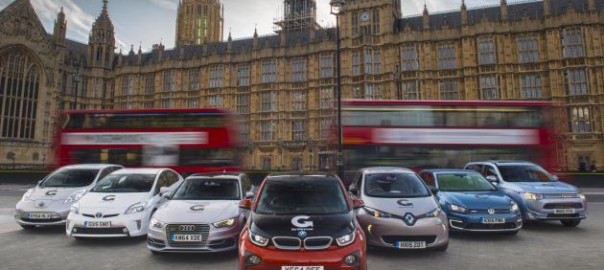
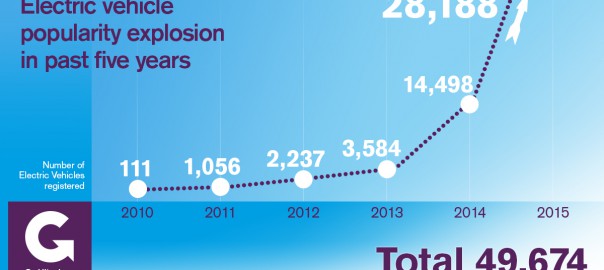
The UK government’s initiatives for the ‘electrification’ of the country’s roads appear to be paying off, with the news that plug-in electric vehicle (EV) registrations reached a record high in 2015, as 28,188 new ultra-low emission vehicles (ULEVs) were licensed, which is more than the past five years’ totals rolled into one.
The switch to electric power marked a 94% annual rise compared to the previous year, while the popularity of plug-in vehicles shows no sign of slowing, with an even greater selection of ULEVs due to be launched in 2016.
The UK saw record sales of plug-in cars last year.
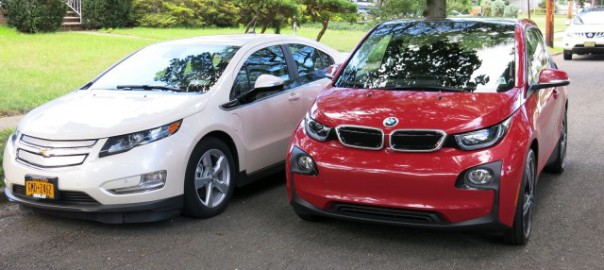
BMW i3 Goes Head-to-Head with VW e-Golf (Image: AutoExpress)
According analysis by the government and the Go Ultra Low campaign, which is backed by the Society of Motor Manufacturers and Traders, as well as leading companies in the industry, plug-in sales for 2015 exceeded the total for 2010 to 2014 combined.
In all, 28,188 new ultra low emission vehicles (ULEVs) arrived on UK roads in 2015, a rise of 94 per cent compared with the previous year.
Fuelling the demand is a greater choice of models, with thirty pure electric or plug-in hybrid cars now available in the UK, ranging from high-performance sports cars to family run-arounds – and more are on the way in 2016. Last year, the plug-in hybrid vehicles proved most popular among motorists, with 18,254 registrations, a 137 per cent increase on 2014. Fully electric vehicle sales increased 48 per cent to 9,934 registrations.
Transport Minister Andrew Jones MP said,
“The UK has one of the fastest growing ultra-low emission vehicle markets in the world and these record figures show more and more people across the country are enjoying the benefits of this cheap-to-run and green technology.
BMW i3“British drivers have a wider choice of vehicles than ever before and we have increased our support for plug-in vehicles to £600 million over the next five years to cut emissions, create jobs and support our cutting-edge industries.”
Head of Go Ultra Low, Poppy Welch, said,
“This sustained level of growth represents how plug-in vehicles are becoming the norm for drivers who want to buy a fun, economical, stylish new car. Now, instead of facing high running costs, motorists can reap the rewards of an economical ultra low emission vehicle, which can save the typical car owner hundreds of pounds every year. With this growth showing no signs of stopping, it’s proof that electric car ownership is the new normal. Now, it’s not a question of will motorists choose electric, but when.”
The past twelve months have been exciting for many reasons, from new EV model releases to exciting events such as our #FollowTheSuitcase competition; but for us, the highlight has to be seeing a record number of plug-in vehicles on the road.
Last year over 28,000 electric cars were registered across the country. That’s more than the combined totals of electric cars sold every year since 2010, and marks a phenomenal 94% annual rise compared to the previous year.
Plug-in power is fast becoming a mainstream option for drivers alongside petrol and diesel, and EV popularity shows no sign of slowing.
We saw every region in the UK record improve year-on-year registrations for plug-in cars. Ultra low emission vehicles (ULEVs) proved to be the most popular in the South East of England, closely followed by the South West and the West Midlands.
More than 3,000 plug-in cars were sold during December 2015, taking 1.7 per cent of new car sales in the UK, representing a record breaking month for green cars.
One in 60 cars sold in December 2015 was an ultra-low emission vehicle
The sales mix is the highest ever seen in the UK and is a significant step forward on the previous best of 1.3 per cent seen in November 2015 and December 2014, according to the Society for Motor Manufacturers and Traders’ (SMMT) figure
The news is especially good considering that overall December sales were the best ever – up 8.4 per cent – saw more than 180,000 vehicles registered. Almost 1,000 more Plug-in Car Grant (PiGC) vehicles were registered in December 2015 than in the same period the previous year with total sales at 3,090 – compared with December 2014’s 2,149. This represents one in every 60 cars sold was an ultra low emission vehicle.
Now with the end of the 2015 calender year complete, the figures show that 28,188 PiGC eligible cars were sold in 2015, almost double the 14,532 sold in 2014. This now puts the total number of PiCG eligible cars sold since the start of the grant at 47,690 – and this excludes commercial vehicles. Add in non-grant eligible plug-in cars and vans, the UK electric fleet now numbers almost 54,000 vehicles.
The popularity of more sustainable transport among Milton Keynes residents continues to grow, boosted by record numbers of plug-in electric car sales in the run up to Christmas.
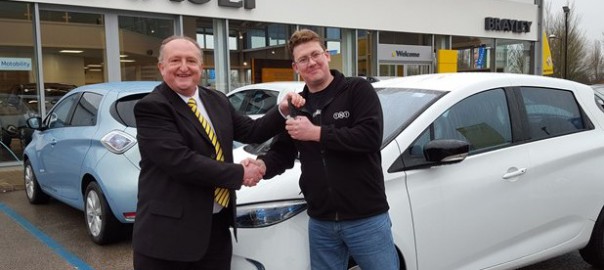
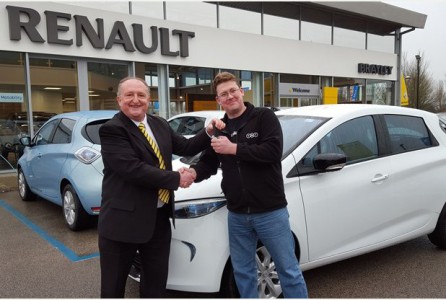
David Wallace from Oxley Park, Milton Keynes, receives the keys to his new Renault ZOE from Brayleys’ sales executive, Graham Glover
That’s according to Westcroft based dealership, Brayley Renault, which reported more than 30 sales of the 100 per cent electric Renault ZOE in December alone, a record for a single month.
The surge in electric cars on the roads of Buckinghamshire reflects the national demand for more environmentally friendly motoring.
Plug-in electric car registrations in the UK totaled 20,992 units during the first nine months of 2015, consisting of 6,951 pure electric cars and 14,041 plug-in hybrids.
Figures from the Society of Motor Manufacturers and Traders show that total registrations during this period increased by 140 per cent from the same period in 2014, with all-electric car registrations growing 55 per cent year-on-year.
One of eight national pilot projects set up by the Government to explore and encourage the take-up of electric vehicles, the Milton Keynes Plugged-In Places Scheme now consists of more than 200 charging points in Milton Keynes and across the county.
A quarter of these are rapid charging stations, enabling a full charge in just 20 minutes. A number of local rail stations have also installed charging points and offer discounted parking fees for electric vehicles.
Paul Brayley, managing director of Brayleys Cars, said:
“Our Renault dealership in Westcroft has seen significant growth in enquiries and sales of all-electric vehicles as people become more aware of their environmental credentials, low running costs and excellent driving characteristics.”
Sales of alternatively fuelled vehicles continue to grow according to November’s sales figures released by the Society of Motor Manufacturers an Traders (SMMT) released today (Friday 4th December).
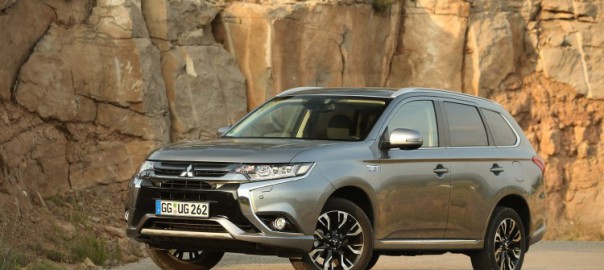
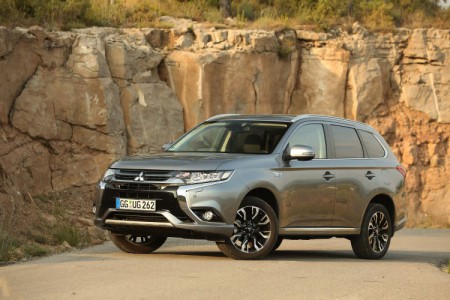
Mitsubishi Outlander PHEV
After October’s sales saw the first drop in 44 months of growth, November returned to growth with overall sales up 3.8 per cent against November 2014. Alternatively fuelled vehicles (AFVs) – which include hybrids, plug-in hybrids and electric vehicles – saw an 8.6 per cent growth versus November 2014 – more than diesel (3.6 per cent) and petrol (3.8 per cent) combined.
AFVs accounted for a three per cent market share in November’s figures, and now represent 2.7 per cent of the overall market 2015 year to date. Diesel powered cars are seeing their past dominance tested in 2015 with market share down to 48.4 per cent – down from last year’s 50 per cent. That said, diesels still had the upper hand in November, selling almost 10,000 more units than petrol models.
Overall growth year to date sees diesel at just 2.7 per cent, petrol at 8.3 per cent and AFVs at a huge 41.1 per cent – with the latter category having already sold almost 20,000 more cars than at the same point last year.
Cars eligible for the Plug-in Car Grant (PiGC) saw a 21.4 per cent increase versus November 2014, up to 2,276 models sold in the month. This accounts for 1.3 per cent of the month’s market share, with signs that the plug-in market could be kicking on again and growing at a significant rate. The year to date market share sits at 1.02 per cent for example. Certainly year to date sales are far in advance of last year, with 2015’s 25,096 vehicles more than double 2014’s sales up to November.
Mike Hawes, SMMT Chief Executive, said,
“November’s figures come as a reminder of the strength of the UK car market, as low interest rates and competitive finance deals continue to attract consumers to new car ownership. We have been expecting a levelling-off in demand for some time now – a development that is being realised following an unprecedented three-and-a-half years of non-stop growth.”
Government reaffirms UK’s commitment for almost all cars and vans to be zero emission by 2050 at Paris COP21 conference.
The UK government has continued to lead global efforts to cut vehicle emissions at the international climate conference in Paris today (3 December 2015).
The UK was one of 13 international members of the Zero Emission Vehicle (ZEV) Alliance to sign a commitment to promote cleaner motoring and slash transport emissions, alongside Germany, Holland, Norway and California. It includes an agreement to make all passenger vehicle sales zero emission vehicles by 2050.
Transport Minister Andrew Jones said:
“The UK already has the largest market for ultra-low emission vehicles in the EU, and the fourth largest in the world and today’s pledge reaffirms our commitment to ensuring almost every car and van is a zero emission vehicle by 2050.
“Electric cars are greener and cheaper to run and we are making them more affordable, spending more than £600 million between 2015 and 2020 to support the uptake and manufacturing of ultra-low emission vehicles here in the UK.
“By leading international efforts on this issue, we are playing our part in helping achieve greenhouse gas emission reductions of more than 1 billion tonnes per year across the world by 2050.”
The ZEV Alliance formed in September this year with the ambition to increase the global uptake of greener vehicles through international co-operation.
As well as the UK, members include:
Germany, the Netherlands and Norway in Europe
California, Connecticut, Maryland, Massachusetts, New York, Oregon, Rhode Island and Vermont in the United States
Most general automotive observers note nearly a 25% drop in Volkswagen’s U.S. car sales last month compared to one year ago.
“The November sales results reflect the impact of the recent stop-sale for all 2.0L 4-cylinder TDI vehicles as well as for the 3.0L V6. The voluntary stop-sales were issued in light of notices received by the Environmental Protection Agency (EPA) and the California Air Resources Board (CARB) regarding emissions compliance.”
Diesel Gate is setting in, as Golf sales sunk by 64%, but how is all this affecting the all-electric e-Golf?
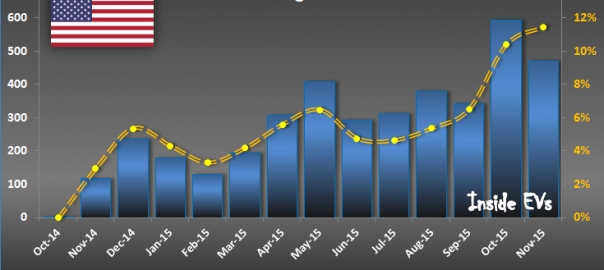
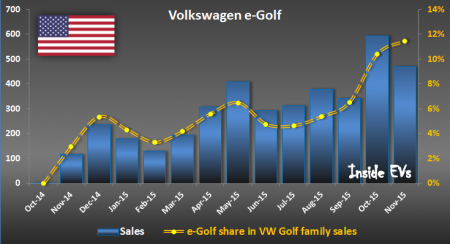
Volkswagen e-Golf sales in U.S. – November 2015 (Image: Inside EVs)
November 2014 marked the first full month of e-Golf in the U.S., sales so it’s hard to judge by the year-over-year increase of 297% from just 119 in November 2014 to 472 in November 2015.
However, by comparing the ratio of consumers who opt for the electric version instead of conventional Golfs, we see a clearer picture. In November 2015, 11.5% of all Golfs sold in the U.S. were e-Golfs.
Overall, share of e-Golf out of total Volkswagen sales (including SUVs) is at a record high of 1.98%, so we’d say that Diesel Gate is positively affecting e-Golf sales.
The government will spend more than £600 million between 2015-16 and 2020-21 to support uptake and manufacturing of ultra-low emission vehicles (ULEVs) in the UK, maintaining the global leadership that has seen 1 in 4 of all European electric vehicles built here and keep the UK on track for all new cars to be effectively zero emission by 2040.
This investment will save 65 million tonnes of carbon and help deliver the Long Term answer on urban air quality.
More than seven years ago, President Obama called for one million electric cars to be on the road by this year, and the vehicles have gained a large fan club. Environmentalists promote them as a smart way to cut dangerous emissions. Owners love their pep and the gas money they save. Apple and Google have jumped into the race to build next-generation battery-powered cars.
So why are only about 330,000 electric vehicles on the road? One answer lies in an unexpected and powerful camp of skeptics: car dealers. They are showing little enthusiasm for putting consumers into electric cars.
Some buyers even tell stories of dealers talking them into gas cars and of ill-informed salespeople uncertain how far the cars can go on a charge or pushing oil changes that the cars do not need.