In the next decade or so, experts predict that electric car sales will surpass gas-powered car sales.
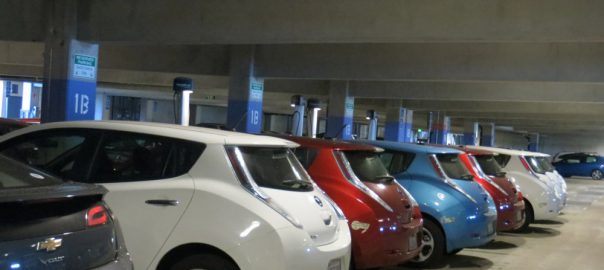
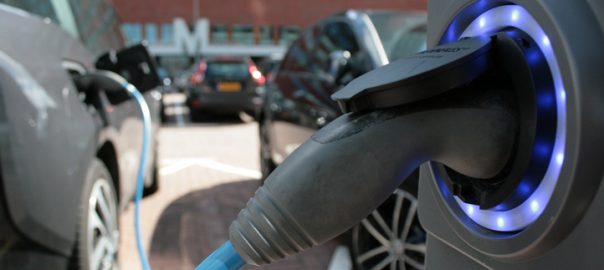
Chevrolet Volt and Nissan Leafs on charge (Image: Business Insider/J. Bort)
That may seem hard to believe. In 2015, all of the alternative fuel cars (hybrid, electric, natural gas, etc.) put together only made up about 7% of the 129 million total cars in the US, according to the US Energy Information Administration.
But by 2030, a report from Argonne National Laboratory predicts, electric cars will make up 58% of the light vehicle market, and non-hybrid gas cars will only comprise 23%.
That flip-flop would mean Americans would use 2.4 million fewer barrels of oil per day, reducing greenhouse gas emissions by 400 million metric tons of carbon dioxide per year.
We have a ways to go, but the technology powering electric cars has been leapfrogging itself in the last few years.
Tesla’s highly anticipated Model 3 — expected for release in late 2016 — will be priced at about $35,000, and will be able to drive over 200 miles per charge.
And now GM has come to play: Wired said the auto giant “beat Elon Musk in the race to build a true electric car for the masses.” The Chevy Bolt, expected for late 2016, can also go 200 miles on a single charge, and will be priced at $33,000.
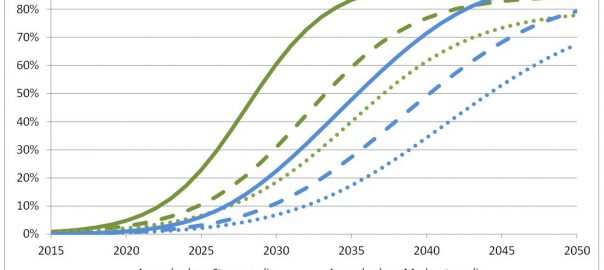
Various policy driven scenarios show electric vehicles gaining market share over the next few decades but with the turnover of the vehicle stock taking longer.
EV Global Market Share (Image: OCCP)
I recently argued that BP’s projections showing almost no take-up of plug-in vehicles[1] by 2035 was unrealistic in view of several convergent trends. There is increasing pressure to reduce CO2 emissions, there is large and growing concern about urban air quality, and electric vehicles are likely to prove attractive to consumers in many respects. In line with these drivers, sales are growing very quickly and many new models are coming on line, while battery technology is improving rapidly, with costs falling sharply and energy density rising.
However while these factors suggest that electric vehicles will gain substantial market share it does not say how much how soon[2]. So how fast might the market for plug-in vehicles grow if policy drivers are strong and matched by favourable economics? Here I consider how quickly electric vehicles could gain market share on that sort of optimistic view.
Market share gains for new technologies
The transition to electric vehicles is in its early stages, so extrapolating historical trends offers only limited guidance. Similarly, highly detailed modelling may not offer robust insights, because too many assumptions are required. Instead it seems appropriate to look at some broad indicators.
A good starting point is to look at adoption other new technologies. The chart below shows the rates of penetration of new technologies in the USA over the 20th and early 21stcenturies. It shows variants on a characteristic s-curve shape, with most technologies reaching eventual penetrations of 80-100%. The typical time to reach about 80% penetration following the first 1% or so of deployment (about where plug-in vehicles are now) is around 20-30 years, although some modern highly scalable technologies have become nearly ubiquitous faster than this, and other technologies have taken as long as fifty years or so to reach high penetration.
For example, cars themselves experienced rapid growth between around 1910 and 1930, reaching 60% of households, before experiencing hiatus and decline during the Great Depression and Second World War, before growing steadily again through the to the second half of the 20th Century.
[10 June] Sooner or later, it can happen in a romance: the two parties decide they’re just not that into one another.
Car entering London’s Congestion Charge zone (Image: Flickr/jovike)
The state of California dumped hybrid-electric vehicles on July 1, 2011, when it ended the rule that allowed them to use carpool lanes on freeways even with just one occupant.
Now the city of London is ending its affection for hybrids, too—and there’s even a date. It’s June 24, just two weeks from today.
That’s when hybrid drivers, who were previously allowed to enter central London’s Congestion Charge zone without paying the stiff fees (now £11.50, or roughly $16.50) that are levied on conventional vehicles during weekday business hours, have to start paying up.
The old system of charges permitted vehicles with emissions rated at 75 to 100 grams of CO2 per kilometer to enter the congestion zone for free. Those were almost entirely hybrid cars.
That plan was supplanted in July 2013 by an Ultra-Low Emission Discount plan that only allows cars or vans with CO2 emissions of 75 g/km or less to enter for free—and they must meet Euro 5 emission limits as well.
But owners of cars in the 75-to-100 g/km band were given a two-year grace period, which is now coming to an end.
Not only hybrids but even ultra-efficient European small diesel cars fall above the 75 g/km limit, so pretty much any car that will be let in free is now going to have a plug.
The majority of those may well be plug-in hybrids, including larger vehicles like the Mitsubishi Outlander Plug-In Hybrid and a slew of newer plug-in hybrid luxury SUVs.
There will also be battery-electric vehicles, everything from the Mitsubishi i-MiEV and its Citroen and Peugeot siblings to the Tesla Model S and Model X.
Electric cars, of course, have tailpipe emissions of 0 g/km.
And as Electric Cars Report noted this week, Nissan UK has been quick to take advantage of the impending change with a new marketing campaign.
The company is offering an additional £500 ($710) incentive to owners of older hybrid vehicles when they purchase a new Nissan Leaf electric car.
The Leaf is manufactured at Nissan’s Sunderland assembly plant in the north of England, and it’s the U.K.’s best-selling battery-electric car in both 24-kwh and 30-kwh versions.
At the end of June, many hybrid drivers will be “waking up to a bit of a ‘hybrid hangover’,” noted Nissan’s Edward Jones, “facing ongoing costs of almost £3,000 a year to drive [their] cars into the Congestion Charge zone.”
Nissan is more than happy to help with the hangover.
After all, sometimes finding a nice new paramour is the best way to recover from being dumped by the old one.
Electric cars are often touted for their financial and environmental benefits, but there’s another major perk they offer to consumers.
They’re very nice to drive.
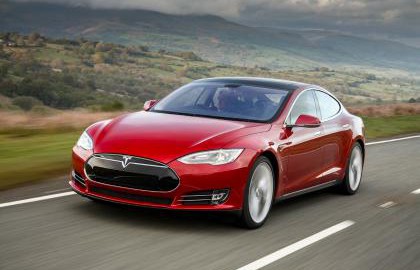
Tesla Model S (Image: AutoExpress)
Many drivers have been won over by electric cars’ near-silent operation and instant torque delivery.
Now, there’s at least a glimmer of hope that carmakers may finally begin promoting those qualities as they seek to sell more electric cars.
Low gas prices dampened sales in 2015, but carmakers will have to produce more electric cars to meet stricter emissions standards nonetheless.
That is spurring automakers to promote the benefits of electric cars more aggressively, judging from the tone of a panel discussion at the 2016 SAE World Congress covered by Wards Auto.
“Quite frankly, we’ve been bad at explaining our technology to customers,”
Larry Nitz, executive director of hybrid and electric powertrain engineering at General Motors, said.
Indeed, many electric-car advocates have expressed frustration with inadequate marketing of plug-in cars by GM and other companies over the past five years.
Nitz believes word-of-mouth marketing will help deal with general consumer ignorance of electric cars.
Current owners can help promote electric cars by sharing what they like about their cars, Nitz said, including how nice they are to drive.
Those positive reactions seem to be the norm.
Jackie Birdsall—executive engineer, Toyota Engineering and Manufacturing North America—said she doesn’t know anyone who, after driving an electric car, wanted to go back to internal combustion.
Every smog cloud has its silver lining. Volkswagen is still on the hook for installing “cheat devices” – software that made its cars appear cleaner than they were – but it’s now emerged that it’s not the only one to play dirty. To one degree or another, it seems a number of car brands have been playing fast and loose with the rules.
Mitsubishi Motors president Tetsuro Aikawa is in the firing line
The car industry won’t be able to forget last week fast enough. We saw the bosses at Japanese car firm Mitsubishi hang their heads in shame. Evidence that they had falsified fuel economy data was uncovered in raid on their factory in Okazaki, central Japan. The government has given them until tomorrow to explain themselves.
Closer to home, French car maker Peugeot Citroen was on the receiving end of an unexpected visit from the authorities. It claims it’s done nothing wrong, echoing Renault which was raided in January.
Also last week, 37 car models in Britain and 56 in Germany were found to exceed EU standards on air quality and pollution when tested.
And at the weekend, the Germans were pointing accusing figures at the Italians after their tests suggested “some Fiat vehicles showed irregular diesel exhaust pollution”, Reuters reported. The Italians have yet to respond.
That’s a lot horn-blowing in the space of just a few days. So what on earth is going on?
Last week, I explained a dismaying reality for planet-savers everywhere: Not even mega-blowout sales for Tesla’s new Model 3 sedan are enough to substantially green and decarbonize our global transportation system. There are simply too many cars on the road and too many new cars sold each year — the vast majority of which run on gasoline, not electricity, and will for some time.
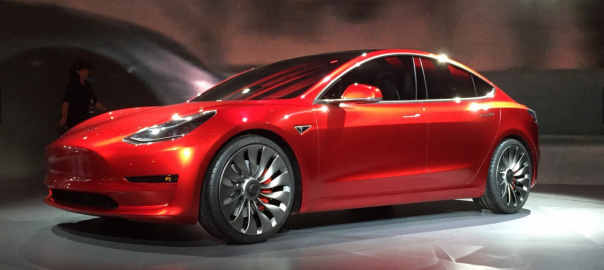
Tesla Model 3 Unveil (Image: Tesla)
What this means is that we’re probably now at the beginning of a gradual, rather than rapid, electrification of the transportation sector. Yeah, it’ll help out when it comes to greenhouse gas emissions — especially as the electricity that powers Teslas and other electric cars also becomes greener — but it probably won’t do so fast enough to save us in the critical two decades or more when all the big decisions about the planet’s future need to be made.
So how is it possible to scale up faster? Well, one answer may come by looking at the example of a country that has already done just that: Norway, where electric vehicles were fully 18 percent of new cars sold last year.
In a new paper in Applied Energy, Måns Nilsson of the Stockholm Environment Institute and Björn Nykvist of the KTH Royal Institute of Technology in Stockholm examine the policy moves that made this kind of high growth possible, using Norway and several other examples from around the world to drive their analysis.
The gist? You essentially need two things — public policies that address the current higher cost of these vehicles (through tax breaks or rebates) until those costs decline, and then other public policies that do something else: Get past people’s psychological blocks when it comes to driving electric vehicles. That’s a very big issue when people are used to pumping gas rather than charging, and so develop ‘range anxiety’ — the fear that their EV will run out of juice far from a recharging station.
“When you start to change some of the economic incentives, you get the first movers,” says Nilsson. “But then what we have seen is this norm change, that it’s like a cultural shift in certain pockets, typically certain communities, it could be certain suburbs, certain cities, where the electric car becomes the norm.”
One right-hand-drive nation is going in the right direction when it comes to sales of electric vehicles. The UK recorded 10,496 electric vehicle sales during the first quarter of 2016. This was a quarterly record and a 23 percent jump from last year, according to Autocar Professional. March accounted for 7,144 of those vehicles, a monthly record in itself.
In these sales increases we can see the UK government’s efforts to spur plug-in vehicle demand via its Plug-In Car Grant finally taking effect. Enacted in 2011, that grant reimburses electric-vehicle buyers for up to 35 percent (with a max of 4,500 pounds, or $6,400) of the price of a plug-in car. The UK has set a goal of having every light-duty vehicle on its roads be “ultra-low emission” by 2040.
The UK’s new quarterly sales number is pretty impressive considering there were about 17,000 battery-electric vehicles sold in the first quarter in the US, where there are about five times as many residents. Demand in the UK, which accounts for about a fifth of the European Union’s electric-vehicle sales – second in the EU only to the Netherlands – also appears to be a departure from the rest of Western Europe, where plug-in vehicle sales surged in 2015 but are more mixed this year. Autocar Professional’s sales statistics come from Go Ultra Low and the UK’s Society of Motor Manufacturers and Traders (SMMT). They did not break out sales of any particular EV models.
Still, we do know that Western European sales for the Renault Zoe and Nissan Leaf are up, Tesla Model S demand has grown little, and Volkswagen e-Golf sales are down, according to the European Alternative Fuels Observatory (EAFO). Last year, things were a bit more uniformly positive, as 2015 plug-in vehicle sales jumped more than 80 percent to about 184,000 units.
The UK Government will lose out on major economic benefits unless it makes a significant investment in upgrading the nation’s electric vehicle (EV) charging infrastructure and upskilling the motor industry, an independent academic report will warn this week.
The report, commissioned by the Institute of the Motor Industry (IMI), concludes that the overall economic and social benefit of EVs, connected and autonomous vehicles could be in the region of £51bn per year by 2030, with the potential for 320,000 newly-created industry jobs.
Researchers will present the report’s findings to a cross-party group of MPs on Wednesday (13 April), calling on the Government to focus on protecting the economic growth of the motor industry by acting strategically to make charging low emission cars more convenient for drivers, and ensuring that there are enough skilled technicians to service and repair them.
Loughborough University professor Jim Saker, who will host Wednesday’s Parliamentary meeting, said:
“The UK, by the nature of its size and geography, has a natural advantage in the rapid adoption of vehicles with the new power train technologies, but it is dependent on Government investment to pump prime this initiative.
“Without proper regulation, a skills gap will emerge with only a limited number of technicians working in the franchised sector being able to service and repair new technology vehicles. If this trend is found to be true then it is likely that the independent sector of the retail automotive sector will decline. This will mean that the market will fail to open up and develop to the benefit of the UK economy.”
Electric cars are here to stay. Don’t take our word for it though, take the word of the British public, who have since the start of 2016 been registering a new electric vehicle every 13 minutes.
Those figures come courtesy of Go Ultra Low, a government-led organisation that looks to support the growth of EVs in the UK.
Thanks to huge improvements in the UK’s electric infrastructure and advances in technology EVs are now no longer considered the choice of the early adopter.
According to Go Ultra Low this has been a record quarter for EVs in the UK with 10,496 new cars hitting UK roads since the start of this year.
How does this compare to last year? Well it’s a 23 per cent increase over last year’s performance.
With new affordable purely electric vehicles being announced such as the Tesla Model 3, the government hopes to smash those results in 2017.
The Model 3 is unsurprisingly at the forefront of this discussion thanks to the quarter of a million pre-orders that Tesla received when it unveiled the car.
That, combined with Tesla’s promise to double the number of dedicated charging points means that there should be a strong enough infrastructure in place to remove ‘range anxiety’ when the car launches early 2017.
[7 April] Electric vehicle registrations had another record braking month in March, this time seeing more cars eligible for the UK Government’s Plug-in Car Grant (PiCG) sold than ever before. March’s total of 7,144 PiCG eligible cars smashes the previous best monthly total of 6,104, set in March 2015.
The record sales again took almost 1.4 per cent of total UK car registrations – at 1.37 per cent – and sees the 1.3 per cent ratio reached or exceeded for the last five consecutive months. This is according to figures released by the Society of Motor Manufacturers and Traders (SMMT).
This strong take up of PiCG eligible cars comes in a record month for UK registrations with more than half a million cars sold. The total of 518,707 is the largest monthly sales figure since the change to the bi-annual number plate change in 1999.
Pure electric vehicles (EVs) saw something of a renaissance in March, having dropped behind plug-in hybrid vehicle (PHEV) sales in recent times. Last month’s registrations saw 2,341 EVs sold, up 22.9 per cent on last year’s figure. PHEVs still saw solid growth but increased 14.1 per cent to 4,803 units in March.
The stronger increase in EV sales was expected after changes to the PiCG came into effect from 1st March. Beforehand, all plug-in cars eligible for the grant had £5,000 taken off the list price, where now there is a stronger incentive for EVs over PHEVs. Both had a cut in grants available but EV buyers now get £4,500 off the cost of a vehicle, where PHEVs are only eligible for £2,500.
SMMT figures also show that there have now been 58,186 PiCG eligible cars registered since the grant began in January 2011, with just under 10,500 of those coming in 2016. This sees a 22.7 per cent increase in year-to-date registrations for PiCG cars when compared to 2015’s statistics, compared to the the 5.1 increase for overall sales.