Category Archives: Sales

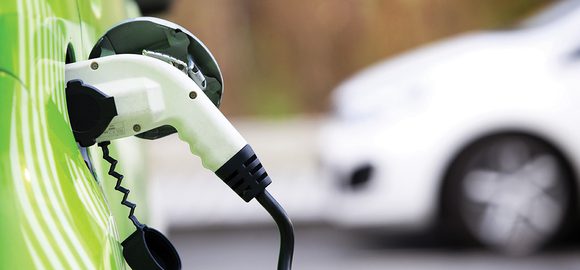
Electric cars can be a very effective way to save you money on motoring (Image: Go Ultra Low)

Diesel reliance reducing faster than expected

Contracthireacar.com customers are reducing their reliance on diesel models faster than expected, says the leasing company.

Electric cars can be a very effective way to save you money on motoring (Image: Go Ultra Low)

It carried out analysis of its own risk fleet following the research published by Arval for its 2016 Corporate Vehicle Observatory Barometer, which points to a 5% overall reduction in UK fleets’ use of diesel by 2021.

Arval’s study forecasts a 12% reduction in diesel use for larger fleets and a 1% reduction for smaller fleets of 40 or fewer vehicles, the latter accounting for the majority of Contracthireacar.com’s client base.

During the period January to July 2015, diesel made up 86% of car leasing deals written by the firm, with petrol on 12.57%. Alternative vehicle fuels such as hybrid and electric accounted for 1.42% of orders.

A year on, Contracthireacar.com data covering the period January to July 2016 stands at 79.29% diesel usage, with petrol having risen to 17.61% and alternative fuels having increased to 3.10%.

Craig Davy, business development manager for Contracthireacar.com, said: “With influencing factors ranging from the Volkswagen headlines, fuel price trends, advancements in turbocharged petrol engines and the EU leave result, to new London Mayor Sadiq Khan likely to introduce a T-Charge to deter older diesels and bring forward the city’s ULEZ, it’s no surprise that we’re seeing the switch to petrol and particularly hybrids and electrics accelerate.

“ULEV and EV orders doubling is to be expected but the 5% switch back to petrol within just a year is somewhat surprising.”

Read more: Fleet News
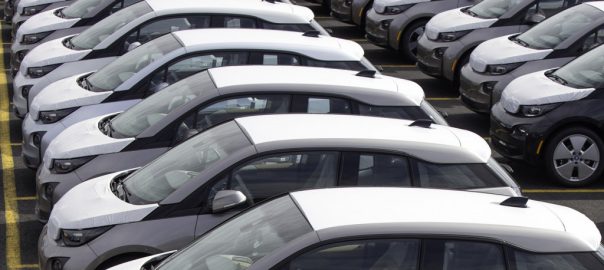
2016 BMW i3

1 in 6 cars sold in 2020 must be electric to meet fuel-economy rules

Several nations have enacted strict fuel economy standards but, for the most part, they have not required automakers to sell electric cars.

2016 BMW i3
2016 BMW i3

In the U.S., only the state of California has a zero-emission vehicle mandate that puts such a requirement on carmakers.

Yet even without mandates, automakers may soon be forced to sell large numbers of electric cars just to meet fuel-economy rules.

That’s the conclusion of a study published in June by the World Energy Council (WEC), which argues that automakers will need quite a lot of electric cars indeed.

Among the major the points in the full study (pdf) is a prediction that 16 percent of cars sold in 2020 will have to be electric in order to meet emissions standards.

The study compares emissions-reductions targets for the U.S., China, and the Europe Union—the world’s three largest car markets, with anticipated fuel-economy improvements that can be achieved with internal-combustion engines alone.

By the WEC’s estimation, larger volumes of electric-car sales will be needed to plug an “EV Gap” between fuel-economy targets and the improvements that can be realistically expected from internal-combustion engines.

Read more: Green Car Reports

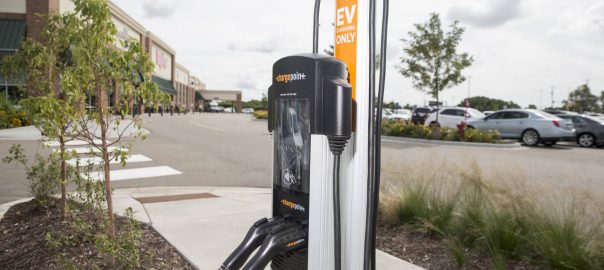
Hy-Vee, a Midwestern grocery chain, installs charging stations at all its new locations. The number of commercial charging stations is growing quickly. (Image: A+G/WSJ)

Why Electric Cars Will Be Here Sooner Than You Think

Adoption of electric vehicles will not be gradual, because the factors required to unlock demand for them are in place

Hy-Vee, a Midwestern grocery chain, installs charging stations at all its new locations. The number of commercial charging stations is growing quickly. (Image: A+G/WSJ)

In 2015, about one in every 150 cars sold in the U.S. had a plug and a battery. But mass adoption of electric vehicles is coming, and much sooner than most people realize.

In part, this is because electric cars are gadgets, and technological change in gadgets is rapid.

One big leap is in batteries. A typical electric vehicle today costs $30,000 and will go about 100 miles on a charge, if that. Within a year, you’ll be able to get double that range for just a little more money.

Tesla Motors Inc. is the standard-bearer, promising a Model 3 vehicle meant to appeal to the masses at $35,000 without incentives and more than 200 miles of range. By comparison, the average new car in the U.S. today sells for about $33,000.

But Tesla is hardly alone. Later this year, Chevrolet will roll out its $37,500 Bolt EV. It, too, boasts more than 200 miles of range, which appears to be the new goal for eliminating “range anxiety”—the fear that a vehicle will run out of juice—among potential electric-vehicle buyers.

And that is just the start. Pasquale Romano, chief executive of ChargePoint Inc., the world’s largest maker of electric-car charging stations, says he works with, and talks to, most major car companies.

“We have seen their internal plans to just electrify everything,” he said.

In the short run, many of these cars will be plug-in hybrids, with both electric motors and gasoline engines. It makes sense to lump them with electric vehicles because most new models have enough battery power to get the average U.S. commuter to work and back without using any gasoline.

Steve Majoros, a marketing director at General Motors Co.’s Chevrolet unit, says that 90% of trips and 65% of miles driven in its Volt plug-in hybrid are on electric-only mode. The Volt can go 53 miles on a charge.

Every plug-in hybrid is effectively an electric car that is carrying a “range extender,” just in case. They will help electrify a large share of the miles Americans drive. They’ll also help ease consumers into electric vehicles, overcoming any remaining fear about being stranded after running out of juice.

Competition among electric vehicles and plug-in hybrids will be intense, which will drive down prices. Volkswagen AG has pledged to make every model available as a plug-in hybrid by 2025. BMW AG has made the same promise. Hyundai Motor Co. promises eight plug-in hybrid models by 2020, plus two all-electric vehicles. Toyota Motor Corp.’s overhaul of the plug-in Prius, boasting twice the range, arrives before the year is out.

Read more: Wall Street Journal

The government target is for electric cars to make up 9% of the fleet by 2020 (Image: S. Lee/Guardian)

UK government ‘falling behind’ on electric car pledge

MPs warn that the uptake of ultra-low emission vehicles is too low to meet national climate change targets

The government target is for electric cars to make up 9% of the fleet by 2020 (Image: S. Lee/Guardian)

The government is falling behind on its commitments to switch a proportion of Britain’s car fleet to electric vehicles, an influential committee of MPs said on Thursday.

Take-up of electric vehicles has been slower than hoped in the UK, but the technology is essential to reducing greenhouse gas emissions from transport, and tackling the air pollution produced by the increased number of diesel cars on the road.

According to the guideline target recommended by the government’s climate advisors, ultra-low emission vehicles such as electric cars should make up 9% of the fleet by 2020, but current forecasts by the Department for Transport (DfT) show the figure by the end of the decade is likely to be about half that. Ministers have not said what should happen if the target is not met, nor produced a plan for beyond 2020.

Parliament’s environmental audit committee said ministers were failing to put forward the incentives and infrastructure needed to encourage drivers into electric cars, while air pollution was breaching regulations, with 38 of 43 clean air zones exceeding acceptable levels of nitrogen oxides.

In addition, the committee said the lessons of the Volkswagen emissions scandal, in which the manufacturer was found to have cheated on tests to make vehicles seem greener than they really were, had not been learned. Affected models were only starting to be withdrawn from the market, the MPs were told.

Mary Creagh, chairwoman of the committee, said:

“The uptake of ultra-low emission vehicles is too low to meet the UK’s climate change targets at the lowest cost to the public. Air quality targets that were supposed to be met in 2010 won’t be hit until 2020 at the earliest. And it’s been almost a year since we discovered VW had fitted cars with cheat devices, but the government has still to decide what action to take against the company.”

Read more: The Guardian

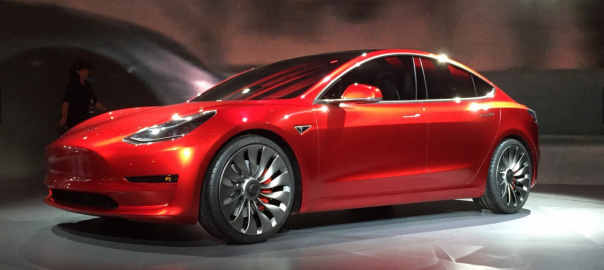
Tesla Model 3 (Image: Green Car Reports)

One in six new vehicles will need to be electric to meet global standards in 2020

Having one out of every six new vehicles be of the battery-electric variety? Heck, that’s California’s Silicon Valley in a nutshell, and that’s only if you count Teslas.

But the rest of the world will have to catch up in order to meet greenhouse-gas emissions standards set by the world’s largest governments.

Tesla Model 3 (Image: Green Car Reports)

That’s what Green Car Reports synopsized out of a World Energy Council (WEC) study, which said 16 percent of new vehicles sold in 2020 would have to be battery-electric to comply with US, European Union, and China greenhouse-gas emissions mandates. Specifically, 10 percent of Europe’s new cars would need to be electric by the end of the decade, while 11 percent of US new vehicles would be required to be electric. As for China, a whopping 22 percent of new-vehicle sales would have to be electric in order for the country to meet progressively stricter transportation-emissions limits.

The good news is that such an increase in electric-vehicle adoption would raise global electricity demand by just a half percent. The bad news is that US, Europe, and China would all have to build additional power-generating capacity in order to meet that 16-percent figure for electric-vehicle sales. Of course, power generation often involves using resources that spew emissions, but we’d prefer not to end up in a wormhole here.

To put that percentage into context, Navigant Research last year said Americans will buy 7.4 million plug-in light-duty vehicles between 2015 and 2024, or an average of 740,000 a year. Last year, Americans bought about 17.5 million vehicles, indicating that even Navigant’s optimistic forecast would still leave the US well short of that 11 percent of new-vehicle sales even while including plug-in hybrids.

Source: AutoBlog

Rapid rise in electric vehicles to ‘reverberate through wider economy’

Falling costs of renewables and batteries will boost EV market over next 20 years and have huge impact on wider global economy, BNEF paper argues

580x358_electric_car_bg

The rapid rise in electric vehicle numbers expected across the world over the next two decades will reverberate throughout all business sectors and make a huge impact on the global economy. That is the…

Read more: Business Green

Nissan Leaf

Birmingham is the UK’s EV capital

The DfT’s data shows a total of 57,207 electric, plug-in hybrid and hydrogen fuel cell passenger cars registered in the United Kingdom in the first quarter of 2016. That’s 0.18% of the 31.4 million total passenger cars on the road, including models which aren’t eligible for the government’s Plug-in Car Grant.

Audi A3 e-tron, Mitsubishi Outlander and BMW i3 plug-ins

Discounting anomalies due to small volume areas, the West Midlands has the highest concentration of these vehicles, at 8,146 units or 0.27% of a total 2.98 million passenger cars in the region. Within that, 5,449 are registered in Birmingham – that’s almost one in every 100 vehicles, and only just behind the 6,094 in the London Boroughs.

At 0.92% of all passenger cars, that means Birmingham residents are four times more likely to own a ULEV than those living in Greater London (where these account for 0.23% of the total).

In England, one in every 500 registered cars (0.20%) is a now plug-in hybrid, electric or hydrogen fuel cell model, with uptake skewed towards the south of the country. The North East, North West, Yorkshire and East Midlands were all significantly below that overall average.

By region or local authority, the largest concentrations are found in the Cotswolds (2.03%), Peterborough (1.59%) and Slough (1.52%).

Uptake is slower in the other nations. Scotland has 3,041 ULEVs registered, or 0.13% of a total parc of 2.42m, with Glasgow (408 vehicles) and Edinburgh (252 vehicles) as the largest by volume. The technology is also finding a home in the Islands, with the Shetland Islands at 0.20% and the Orkneys at 0.74% – though obviously of a much smaller overall parc.

That falls to 0.13% (903 vehicles) in Northern Ireland, while in Wales, 0.09% (1,320 of 1,52m vehicles) are plug-ins, with Swansea recording the highest number of registered vehicles (171 units).

Source: EV Fleet World

The two firms will launch an information campaign, install chargepoints, and improve network access

AA and Chargemaster partnership set to bust EV myths

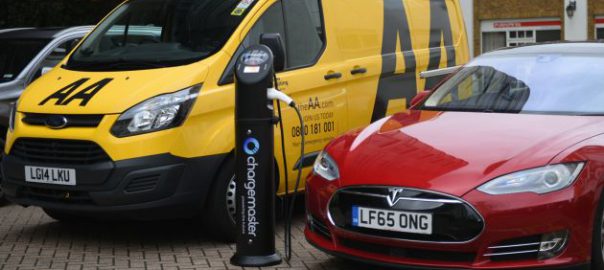
A new partnership between the AA and Charagemaster is set to help boost sales of electric vehicles. In the first partnership of its kind, the Automobile Association and EV charge point specialists will combine forces to provide discounted charging, increased access to home charge points, an information campaign, and the roll-out of charge points at AA-rated hotels.

The two firms will launch an information campaign, install chargepoints, and improve network access

According to research conducted through AA members, 96 per cent of motorists don’t know the real cost of running an EV. This is despite the Association predicting that more than 500,000 plug-in vehicles will be on UK roads by 2020.

To combat this, the AA and Chargemaster will be attempting to overcome misconceptions with an information campaign that highlights the benefits of EV use and ownership. The partnership will also have practical financial impact on AA members with a discount worth more than 10 per cent on Chargemaster’s Polar Plus network. This brings monthly membership down by £1 to £6.85.

The number of charge points located at AA-rated hotels is also set to expand dramatically thanks to the partnership. With 2,500 hotels in the UK rated by the AA, the potential expansion of the EV charging network is huge.

Edmund King OBE, AA president, says:

“We think that the EV revolution is about to take off and we want to help consumers understand the benefits of low cost, low emission driving and to show them it is accessible and affordable. Per mile driven an EV is five times cheaper than the average petrol car and carries no Vehicle Excise Duty.

“Modern electric vehicle designs and performance are comparable to conventional internal combustion-powered vehicles. Concerns and regulations about diesel emissions may also prove to be a tipping point. Sales of new ultra-low emissions vehicles (ULEV) doubled over the last year. And 63,000 drivers have taken advantage of the plug-in car grant. We expect the market to grow substantially, as buyers overcome their misconceptions.

“The vast number of car journeys are under 25 miles and a third of households have two or more cars. Hence, we estimate that more than two million second cars could be electric tomorrow, with no disadvantages and many cost-saving benefits. The AA’s research also shows that if drivers owned an electric vehicle, three-quarters (75 per cent) would expect to charge it overnight, mainly at home while a quarter (25 per cent) would rely on public charging points away from home.”

David Martell, Chargemaster CEO, points out that a significant barrier to electric vehicle ownership is concern that when they reach their destination, drivers will not find a charging point available. This worries 81 per cent of respondents to the AA’s research.

“We want to change that perception,” he says. “This new relationship with the AA will see hundreds more AA branded charging points installed. They’ll go in at AA-rated hotels and other accessible public places such as supermarkets, public car parks and town centres while we will be embarking on a public awareness campaign to show that charging a vehicle at home is neither difficult or costly.”

Edmund King concluded:

“The facts speak for themselves. The cost of electric vehicles is coming down and the £4,500 government grant helps make them competitive. Myths about batteries not lasting long have been blown away by use. Some of the earliest models have clocked up very high mileages with almost no diminution of battery capacity.

“Modern EVs have a much greater range and battery technology is advancing as fast as the cost is falling. Most family saloon cars will drive for 80 to 100 miles without difficulty, well over the average journey length. EV performance is startling – top-range vehicles will accelerate faster than sports cars and provide all the creature comforts.

“This is the future of motoring and we are proud to be launching this initiative with Chargemaster today. Now is the time to charge up the EV revolution.”

Source: Next Green Car

Electric cars can be a very effective way to save you money on motoring (Image: Go Ultra Low)

Electric car sales to rise ‘once running costs myths are busted’

Electric car sales will soar once motorists overcome their misconceptions about the running costs, according to a new study.

Electric cars can be a very effective way to save you money on motoring (Image: Go Ultra Low)

More than half a million electric vehicles (EVs) will be in use by 2020 based on current buying intentions, research by the AA found.

The motoring organisation published a report which claimed this figure could rise significantly if concerns over the purchase price of EVs, availability of public charging points and the mileage that can be covered on a single charge are overcome.

Sales of new ultra-low emissions vehicles doubled over the past year and 63,000 drivers have taken advantage of plug-in car grants since they were introduced in 2011.

Motorists buying new vehicles with a zero emission range of over 70 miles are eligible for up to £4,500 while those purchasing cars with a shorter range – such as plug-in hybrids with a petrol or diesel engine – can receive £2,500.

AA president Edmund King said:

“We think that the EV revolution is about to take off and we want to help consumers understand the benefits of low cost, low emission driving and to show them it is accessible and affordable.

“Per mile driven an EV is five times cheaper than the average petrol car and carries no vehicle excise duty.

“Modern electric vehicle designs and performance are comparable to conventional internal combustion-powered vehicles. Concerns and regulations about diesel emissions may also prove to be a tipping point.”

The AA report stated that many plug-in hybrids are sold at “a very similar price” to the diesel equivalent, while it can cost as little as two pence per mile to power an EV.

It noted that within two years the vehicles are expected to have a range of around 200 miles on a single charge, making them a good option for a household’s second car.

Hundreds of charging points are to be installed at hotels rated by the AA in partnership with manufacturer Chargemaster.

Government advisers, the Committee on Climate Change, warned last year that 9% of new car sales should be electric vehicles by 2020 for the UK to meet its legal obligation to cut greenhouse gas emissions by 80% by 2050, compared to 1990 levels.

Source: Money AOL

Electric cars can be a very effective way to save you money on motoring (Image: Go Ultra Low)

Plug-in car sales continue rise at record rates

Sales of electric cars continue to break records with the announcement by Go Ultra Low that more plug-in vehicles have been sold in the first half of 2016 than at any other half-way point. Electric car registrations are up almost a third compared to January – June last year at 31.8 per cent.

Electric cars can be a very effective way to save you money on motoring (Image: Go Ultra Low)

In 2015, it took another three months to reach this year’s 19,252 registrations, 4,640 units ahead of the same point in 2015, with that figure not reached until September last year. Also Q2 2016 is the 22nd consecutive quarterly rise for new plug-in car sales.

Records begin in 2011 when the UK Government introduced the Plug-in Car Grant (PiCG), offering electric car buyers an incentive to go green. Sales have continued to rise despite a change to the grant system that came into place in March 2016, which saw the original £5,000 subsidy for eligible vehicles – both pure electric (EV) and plug-in hybrid (PHEV) – halved for PHEVs and dropped by £500 for EVs.

The strong start to 2016 sees sales of PiCG eligible cars sit around the 70,000 mark. Transport Minister John Hayes said:

“I am delighted to see record numbers of motorists coming round to the benefits of cleaner, greener vehicles, which are also cheaper to run. The low-emission sector supports over 18,000 UK jobs and is a key pillar in our ambition for a low carbon, high tech and high skills economy.

“We want to make the UK a world leader in electric vehicle uptake and manufacture, to ensure that by 2050 every car and van on our roads is a zero emission vehicle. We are backing this with one of the most comprehensive support packages in the world, with more than £600m of government investment to help grow the UK market.”

Poppy Welch, Head of Go Ultra Low – the campaign backed by government and vehicle manufacturers to promote ultra low emission vehicles (ULEVs) – said:

“The continued growth in uptake of electric cars speaks for itself as registration records continue to be broken by motorists encouraged by the benefits electric motoring can bring.

“As awareness grows and motorists see the wide variety of vehicles already on UK roads coupled with benefits such as running costs from as little as 2p per mile, more drivers than ever are becoming motivated to go green. Since the introduction of the Plug-In Car Grant was introduced in 2011 the variety of electric models has expanded significantly, notably so in the past two years, giving motorists more choice than ever before.”

Source: Next Green Car