Category Archives: Renault

News and reviews of Renault electric cars (including plug-in hybrids).

Even more flexible EV ownership packages from Renault

EVEN MORE FLEXIBLE EV OWNERSHIP PACKAGES FROM RENAULT

  • Full purchase battery option now available on ZOE i and Kangoo Van Z.E. i
  • Battery Hire scheme continues on ZOE, Twizy & Kangoo Van Z.E.
  • Five-year / 60,000-mile battery warranty on i versions
  • ZOE i available from £18,443 after Government Plug-in Car Grant
  • Kangoo Van Z.E. i from £16,161 (+VAT) after Government Plug-in Van Grant
  • Battery Hire now even more affordable with new offers – from £25 per month for ZOE and from £33+VAT for Kangoo Van Z.E.

Renault UK is today introducing new ownership packages with two of its most popular electric vehicles as part of its determination to make Z.E. (zero emissions in use) mobility flexible and accessible to the widest number of drivers.
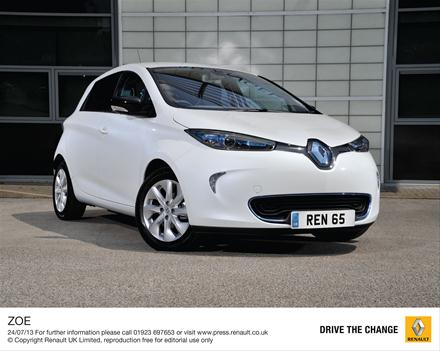
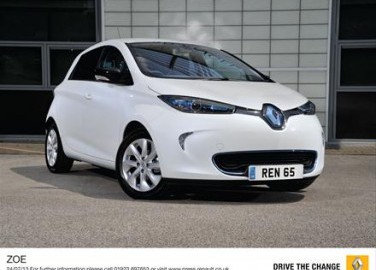
CHR1882_ZOE_Static_Renault

Customers will now be able to order new ZOE i and Kangoo Van Z.E. i versions that are supplied ‘Full Purchase’. This means that there is now the choice between full ownership of the vehicle and the battery, or buy-the-car/hire-the-battery schemes.

Potential Renault electric-vehicle customers can therefore tailor an ownership package to their exact requirements. There’s also good news for those who prefer the peace of mind and lower purchase cost of battery hire, with a special offer with lower monthly rates for ZOE and Kangoo Van Z.E.

Whichever ownership package the customer chooses, the model line-up is exactly the same, with the exception of an ‘i’ badge on the tailgate for full purchase vehicles to ensure easy identification for the used vehicle market.

The ZOE continues to be available in Expression, Dynamique Zen and Dynamique Intens trim levels, while the Kangoo Van Z.E range mirrors the versions available in diesel form, with Van, Maxi, Crew Van and Kangoo Maxi Crew Van Cab to choose from.

The ZOE i is available from £18,443 ‘on-the-road’, after the Government’s Plug-in Car Grant, compared to £13,995 on battery lease. The Kangoo Van i range starts at £16,161 (+VAT) after the Government grant, compared to £12,995 (+VAT) if the battery is leased.

These full purchase models are protected by a five-year, 60,000-mile warranty on the batteries in addition to the standard Renault vehicle protection of four years / 100,000 miles. The battery warranty gives the customer peace of mind against possible decreases in battery performance over time, guaranteeing a minimum of 70 per cent of the original capacity for ZOE and 66 per cent for Kangoo Van Z.E.

Ken Ramirez, Managing Director, Renault UK, commented:

“Renault was a pioneer in the EV market and has remained a leader by offering the best technology, across a wide Z.E. line-up and at affordable prices. The battery leasing scheme has proved popular with customers for the flexibility and lower purchase prices it offers. The addition of full purchase versions on our core EV models will offer private and business customers a greater choice and further strengthen our position in the UK EV market.”

CAP Monitor, one of the UK’s leading assessors of vehicle residual values, has responded positively to these initiatives. Martin Ward, CAP Manufacturer Relationship Manager commented:

“The ZOE and Kangoo Van Z.E. ranges have become a time-tested, high-quality, innovative and important component of a fast-growing vehicle sector. CAP Automotive welcomes any steps that broaden choice for the customer and increase the opportunities for take-up of these cars by the motoring public and businesses.”

Battery Hire – Customer Offers

Meanwhile, the battery hire scheme, which has proved to be such an attractive proposition with early adopters of electric vehicles, becomes even more appealing with the introduction of a new special offer.

Battery hire will start from £25 per month (down from £45) for the ZOE and from £33+VAT per month (down from £61+VAT) for the Kangoo Van Z.E. range. Over a 36-month period this represents a total saving of £900 on ZOE and £1,008+VAT on Kangoo Van Z.E. on the cost of the battery lease.

The flexibility and convenience of Battery Hire make these offers even more attractive, with a Lifetime Performance Guarantee on batteries under its lease scheme, including repair or replacement if they fall below 75 per cent of their original capacity, as well as the peace of mind of roadside recovery even in the event of an owner running out of charge away from a charging point.

Renault has the widest range of all-electric vehicles on sale in the UK. In addition to the stylish ZOE supermini and workaholic Kangoo Van Z.E., it also offers the fun-in-the-city Twizy. Renault has already sold a total of 2,000 electric vehicles in the UK.


PRICING – ZOE & ZOE i

Battery Hire* Battery Purchase

ZOE Expression £13,995 n/a

ZOE Dynamique Zen £15,195 n/a

ZOE Dynamique Intens £15,195 n/a

ZOE i-Expression n/a £18,443

ZOE i-Dynamique Zen n/a £20,043

ZOE i-Dynamique Intens n/a £20,043

*= Battery Hire on ZOE from £25/month


N.B. All pricing figures are after the Government Plug-in Car Grant.


PRICING – KANGOO Z.E. & KANGOO i Z.E.

Battery Hire* Battery Purchase

Kangoo Van Z.E. £12,995 n/a

Kangoo Maxi Z.E. £13,895 n/a

Kangoo Maxi Crew Van Z.E. £14,395 n/a

Kangoo Maxi Crew Van CAB Z.E. £14,895 n/a

Kangoo i Van Z.E. n/a £16,161

Kangoo i Maxi Z.E. n/a £17,062

Kangoo i Maxi Crew Van Z.E. n/a £17,561

Kangoo i Maxi Crew Van CAB Z.E. n/a £18,062

* = Battery Hire on Kangoo Z.E. from £33/month


N.B. All prices excluding VAT and after the Government Plug-in Van Grant.
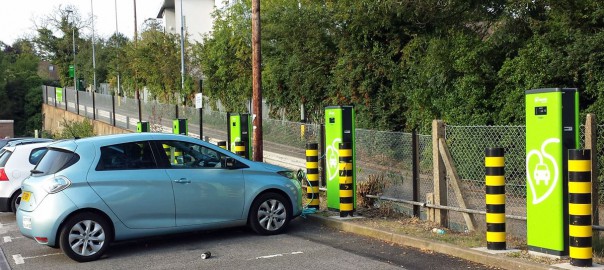
Fast charging at one of the dozen rapid chargers at Stanmore (Image: T. Larkum)

People’s Climate March – Part 3

[Part 1]

[Part 2]

Once the Climate March was over I expected the return journey to be straightforward, but it wasn’t to be. I knew that there was extensive engineering work underway on the London Underground but it did not impact directly on the route I intended to use back from Westminster to Kentish Town.

However, early in the journey it became clear there was another problem. Announcements over the tannoy system indicated that a significant part of the northern section of the tube was experiencing a temporary closure. The reason given was that there was a person on the line, and the implication seemed to be that there had been a suicide attempt.

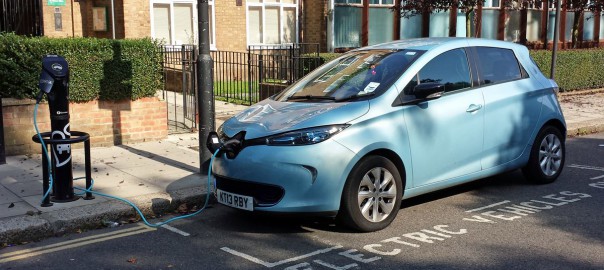
Nissan Leaf on charge in Highgate (Image: T. Larkum)

Anyway, after a number of changes of route and failed redirections I got back to Camden Town and decided to walk from there, even though it was further than I would have liked. At least, I felt, my progress was under my control.

On the way I spotted another electric car, this time a Nissan Leaf. It was plugged in and charging in the compound of a civil engineering firm off Highgate Road – an encouraging sign, I thought, a commercial company using an EV.

I got back to my car, unplugged and drove off without incident. I was actually still doing quite well for time so decided to take a detour. In planning the trip down I had considered parking at Stanmore Underground Station as I had read that it was equipped with a dozen fast chargers – an unprecedented concentration that doesn’t exist anywhere else in the UK, so far as I know.

Fast charging at one of the dozen rapid chargers at Stanmore (Image: T. Larkum)

Finding the chargers was tricky as they were in a car park beside the station with a virtually concealed entrance. However, plugging in and charging was easy – there were half a dozen bright green charge points, each with two connectors, and no other cars charging.

I didn’t really need the charge, of course, since I was fully charged when I left Highgate – I just wanted to assure myself I could make use of them next time I came down to London. In fact, on this day I had made the right choice as – due to engineering works – there was only a replacement bus service from Stanmore.

The rest of the trip home went fine. I went at a steady pace and was able to go all the way to Northampton without needing to stop. I had enjoyed the day – my first time as an ‘activist’ – and committed myself to get more involved in climate change activities in the future.

Renault presents EOLAB, a new ultra-low fuel consumption prototype

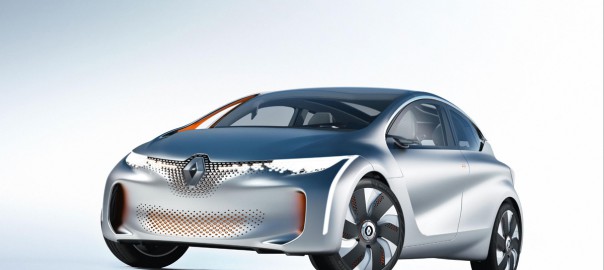
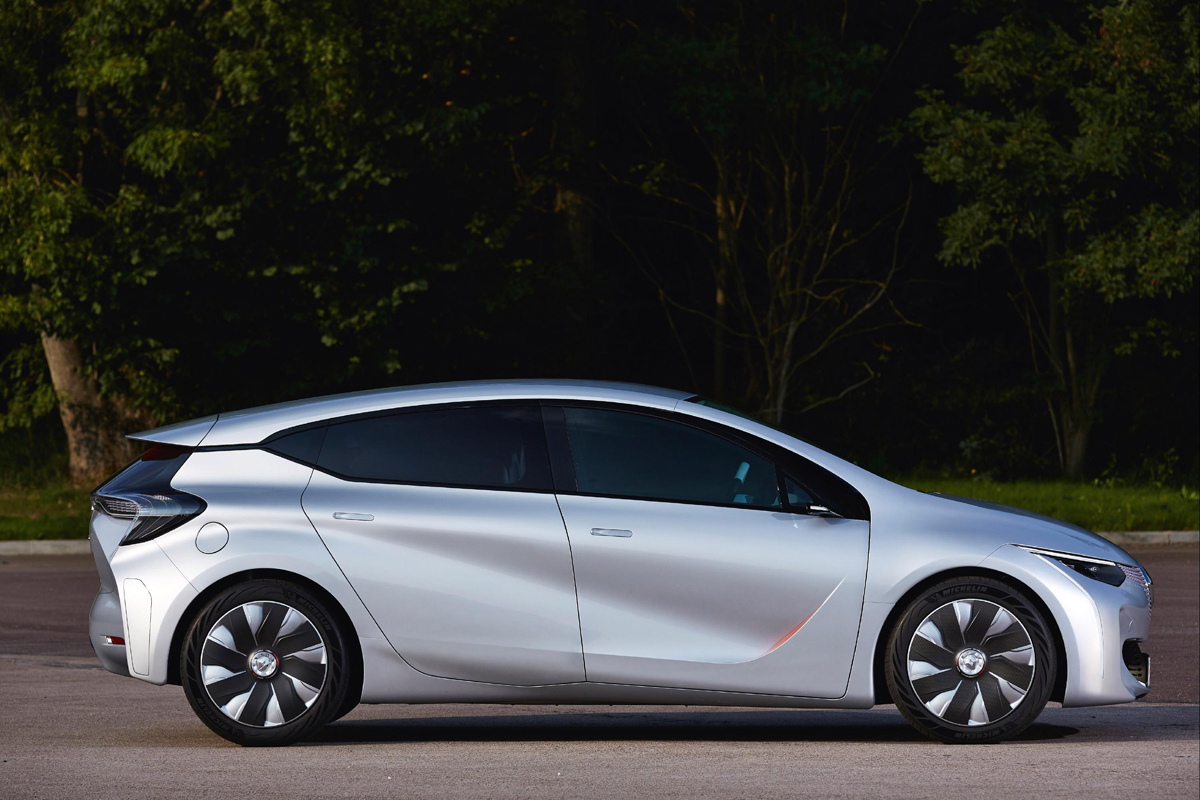
Renault EOLAB Ultra-Low Fuel Consumption Prototype (Image: Renault)

WITH 1 LITRE/100KM, EOLAB IS A SHOWCASE FOR RENAULT’S INNOVATIONS IN FAVOUR OF THE ENVIRONMENT AND RISES TO THE CHALLENGE OF ULTRA-LOW FUEL CONSUMPTION

Renault presents EOLAB, a new plug-in hybrid (PHEV) prototype which explores ways to deliver ultra-low fuel consumption. It boasts NEDC combined cycle consumption of 1 litre/100km, equivalent to 22g of CO2/km.

To achieve such low figures, the designers focused their efforts on three main areas: minimising weight, refining aerodynamics and using “Z.E. Hybrid” technology for all, a brand new initiative which permits zero emissions motoring during everyday use.

As an innovative showcase with an environmental core, EOLAB includes a very high number of technological advances that are destined to be carried over gradually to vehicles available in the showroom. As a consequence, EOLAB underlines the undertaking of Renault – already a pioneer in the field of zero-emission mobility thanks to its range of electric vehicles – to take even greater steps to produce affordable models that have an increasingly smaller carbon footprint.
CHR2784_Renault_EOLAB_Renault_cs

Technologies geared to achieving ultra-low fuel consumption for all

For Renault, the purpose of EOLAB is to remain true to the company’s DNA by ensuring that ultra-low fuel consumption becomes a reality for as many people as possible. This in turn means making its technologies available at a price that people can afford. EOLAB features materials such as magnesium and aluminium, which are extremely light and also much cheaper than titanium. Meanwhile, the notion of such a car being produced in large numbers within the next 10 years was dialled into the plan from the very start.
CHR2795_Renault_EOLAB_Renault_cs

100 technological advances for future Renaults

EOLAB is much more than just a styling exercise or a mere shop window. Conceived around a B-segment platform, the prototype incorporates around 100 new, realistic technological developments that are designed to be introduced gradually on upcoming Renault vehicles.

EOLAB’s recipe

The EOLAB prototype’s exceptional fuel economy – namely 1 litre/100km – is the fruit of work on three main fronts: refined aerodynamics, weight saving and Z.E. Hybrid technology (petrol/electricity):

  • The car’s shape was designed to slice through air efficiently, while movable devices such as an active spoiler and lateral vanes perform the same way as ailerons.
  • A weight saving programme brought the car’s mass down to just 400kg, thanks in particular to a multi-material body shell combining steel, aluminium and composites, as well as a remarkable magnesium roof that tips the scales at barely 4kg. Saving weight was a virtuous circle since it enabled the size, and therefore the cost of the prototype’s chief assemblies (engine, batt
    ery, wheels, brakes, etc.) to be kept low, thereby financing the decision to employ certain more costly materials;
  • Z.E. Hybrid technology: this new, compact and affordable hybrid power unit combines ultra-low fuel consumption with zero-emission mobility for journeys of less than 60km and at speeds of up to 120kph. In coming years, Z.E. Hybrid technology will become complementary to Renault’s zero-emission electric vehicle range.

EOLAB Concept: a concept car to capture the imagination

Renault’s designers were closely involved with the EOLAB project from its very early days. In the case of EOLAB Concept, they pushed the design parameters to perfect the car’s styling and paid significant attention to detail in order to optimise aerodynamics and weight. With its sloping roof and breathtakingly slender rear end, the concept car’s true purpose is well masked: beneath its seductively designed shell, everything is geared towards frugality. It demonstrates that Renault is able to add a touch of dream-like magic to a prototype whose fundamental mission is to achieve ultra-low fuel consumption.

Slow Charging the ZOE at Highgate (Image: T. Larkum)

People’s Climate March – Part 1

Fast Charging the ZOE at Toddington (Image: T. Larkum)

On 21 September I had a bit of an adventure, travelling down to London to attend the People’s Climate March – my first ever protest march.

I have been concerned about climate change for about three years, and have blogged about climate and energy for the last two. Wanting to know more about the scientific understanding of it I completed an online educational course ‘Climate Change in 4 Dimensions’ earlier this year. While I would highly recommend the course, learning more about the subject has only reinforced my concerns. The scientific conclusions are clear – the climate is changing fast, it’s caused by human carbon dioxide emissions, and it’s going to have major impacts on our lives and especially on the lives of our children and grandchildren.

Having made many changes in my lifestyle to reflect my concerns – including installing solar panels on our house, switching to a renewable energy supplier, and buying and blogging about my Renault ZOE electric car – it seemed to me that the next natural step was to become more active politically. I’m not sure what direction that will take long-term, but I felt it was necessary to start by ‘standing up to be counted’ and attending the first ever Climate March.

Slow Charging the ZOE at Highgate (Image: T. Larkum)

I toyed with the idea of going by train but somehow it seemed most appropriate to go by electric car. I therefore headed out along my regular and familiar route down the M1 towards London, stopping as usual at the Toddington Services fast charger on the way. I then drove into north London and parked up at a slow charger in Highgate (the same one I had used previously when attending a rock concert in Kentish Town).

Tesla Model S in Highgate (Image: T. Larkum)

I walked south from where I parked to Kentish Town underground station so I could take the tube down into central London. On the way I was surprised to pass two electric cars – clearly they are more popular in London than in Northampton – and I took that to be a good omen.

The first was a navy blue Tesla Model S parked on Highgate Road, in a bus lane outside a restaurant. It’s a big, good-looking car – though I don’t imagine that most people can tell it’s electric.

Renault ZOE in Highgate (Image: T. Larkum)

Then a few minutes later I saw a ZOE, much like mine apart from being white. It was just parked in a side road, probably in front of the owner’s house, looking perfectly natural.

Climate March poster on the Underground (Image: T. Larkum)

The trip on the underground was uneventful, heading to Temple for the start of the march. I was encouraged on the way to see a couple of posters by the escalators publicising the event. I anticipated that would mean the march would be well-attended, and so it transpired.

[Part 2]

Fleet World MPG Marathon - Nissan Leaf

EVs successfully complete MPG Marathon with less energy & no pollution

The electric vehicles taking part in this year’s MPG Marathon demonstrated how cost effective and reliable they were by completing the course in virtually the same time as their competitors – but by using less energy and with no pollution.

Three electric vehicles took part for the first time in the 23-team eco-driving event, which was again sponsored by ALD Automotive and TRACKER and was won by Honda engineers Fergal McGrath and James Warren, driving a Honda Civic Tourer and recording an outstanding 97.92mpg.

The electric vehicles taking part, two Nissan LEAFs and a Renault ZOE, attempted the same two-day course as the line-up of conventionally powered diesel and petrol cars and light commercial vehicles.

Like their competitors, they had to stop at set checkpoints en route, but were allowed to take scheduled rest time at recharging stops. This meant that careful route planning was essential to avoid range anxiety and ensure they had enough power to complete the course.

Ultimately it was a very close run thing and there was a photo-finish for first place with all three electric vehicles producing very similar results in terms of overall energy usage.

Read more: Fleet World

Packing up the ZOE in Brighton ready to go home (Image: T. Larkum)

My Longest Trip in the Renault ZOE – Part 2

Packing up the ZOE in Brighton ready to go home (Image: T. Larkum)

Once our Brighton trip was over, after lunch we packed up and headed north out of town. We charged up at Cobham services again without incident, and then headed into London to visit family.

An EV Queue at Cobham (Image: T. Larkum)

Late in the evening after our visit was over we went to Cobham again. This new opportunity to charge (Cobham has only been open a few months) has been a real boon to us as a family. Previously there had been no chargers in this area, and so we’ve had to visit family by driving through London and using the Scratchwood/London Gateway services, with all the potential delays that entails. Now we can just stay on the M25 and charge ‘as we go past’.

A BYD E6 electric car at Cobham (Image: T. Larkum)

Anyway, things didn’t go quite as smoothly as we’d hoped this time. There was a small queue of other EVs waiting to charge – two Nissan Leafs were ahead of us. By this time it was pouring with rain and we needed to eat so we decided to just wait anyway and have dinner. In fact less than an hour later we were charging up so it wasn’t a huge delay. Another EV turned up before we left, a Chinese BYD E6 – a type I have seen a couple of times charging at Cobham.

364 Miles: A new ZOE trip range record (Image: T. Larkum)

The rest of the journey home was uneventful – just another top-up and loo stop at Toddington, and we were home. The final tally for the trip was 364 miles to Brighton and back in the weekend. It had been very straightforward, indicating that an EV is practical as a primary family car, even for cross-country trips.

My Renault ZOE fast charging at Rothersthorpe Services (Image: T. Larkum)

My Longest Trip in the Renault ZOE

Mitsubishi Outlander fast charging at Rothersthorpe Services (Image: T. Larkum)

During the summer we took our longest ever single trip in the ZOE, from our home in Northampton down to Brighton and back in a weekend. We went down for a gymnastics competition on the Saturday in which my daughter was taking part. After the event was over, we had a good time walking around the town on the Saturday and lazing on the beach on the Sunday.

My Renault ZOE fast charging at Rothersthorpe Services (Image: T. Larkum)

We started out Friday evening. I had been at work in Milton Keynes as usual that day so by the time I got back to Northampton I was already 40 miles down on range. I therefore went home via the Northampton Rothersthorpe motorway services to top up at an Ecotricity rapid charger. I initially tried the northbound side but the chargepoint there was occupied by a Mitsubishi Outlander PHEV. Instead I hopped over to the southbound side, and filled up without incident so getting home (about 10 miles further on) nearly full. I plugged in the ZOE while we packed to leave so it would be 100% full on leaving.

Fast charging at Toddington Services (Image: T. Larkum)

We left home a little before 8pm and headed down the M1. We pulled in at Toddington to recharge only to find the charge point broken. Not a major emergency, however, as we had had this occur before and knew what to do. I got permission from the service station manager and drove across the service road to the northbound side. There we plugged in, charged up and had some food.

Taking a break at Cobham Services (Image: T. Larkum)

We continued our journey down the M1 and then around the M25 to the new services at Cobham. There we had our second charge, after which we headed down the M23 towards Brighton. This was the longest leg of the journey and although we had just about enough charge to get to Brighton, I wasn’t confident that we could easily get a charge once we arrived. We therefore popped into the Pease Pottage services as we went past and just had a five minute top-up (enough for an extra 15 miles driving) while sitting in the car.

A brief top-up in a rather dark corner of Pease Pottage Services (Image: T. Larkum)

We needn’t have worried though, as we didn’t use the car much once we were in Brighton. It had comfortably enough charge to get us to the gymnastics venue and back. The competition went well, and my daughter was awarded a gold medal in her category.

Gymnastics medal event (Image: T. Larkum)
Gymnastics medal ceremony (Image: T. Larkum)

After the event we spent Saturday afternoon walking along the promenade and around the town. On the Sunday we had a great time on the beach, and then it was time to head home.

BMW, Nissan, Renault And Volkswagen Join Forces For EV Charging

UK Rapid Charge Network

UK Rapid Charge Network (RCN) project, through the European Union’s Trans-European Transport Network (TEN-T) program, attracted four automakers – BMW, Nissan, Renault and Volkswagen, which will join forces to build a network of a multi-standard fast chargers in Ireland and Europe.

According to the latest news, 10 out of 74 of the multi-standard chargers are already installed and a further 28 have been commissioned.

All of them will be 44kW CCS, 44kW CHAdeMO and 43kW AC systems, so no EV will be left without a charge option.

“Nissan is joined in the project by BMW, VW and Renault: it’s the first time leading BEV companies have united to accelerate the growth of EV charging infrastructure, seen as a key enabler towards making zero-emission mobility a market reality. The project, managed by Zero Carbon Futures in Sunderland also draws on the network expertise of ESB, one of Ireland’s foremost energy company and leader of a previous TEN-T project completed this summer, and Newcastle University.”

“When complete, the UK Rapid Charge Network (RCN) will comprise more than 70 multi standard rapid chargers covering some 1,100km of major trunk routes and providing EV-friendly links to five seaports and five international airports.”

“Running on two priority road axes on the mainland of the UK, the RCN will link major ports and cities including Stranraer, Liverpool, Holyhead, Birmingham, Felixstowe, Leeds and Kingston upon Hull. There will also be networks embracing Dublin, Ireland and Belfast, Northern Ireland.”

“The UK RCN is part of the European Union-financed Trans European Transport Network (TEN-T) and represents a substantial partnership investment of €7,358,000, half of which is being funded by the EU.”

Baroness Kramer, UK Minister of State for Transport stated:

“We are serious about plug-in vehicles and have a comprehensive package of measures to help consumers and industry make the switch to electric. The UK now has the best rapid charging network in Europe. Projects like this highlight how industry is showing its confidence in the rapidly growing market.”

Source: InsideEVs

Renault ZOE Dashboard after range record (Image: T. Larkum)

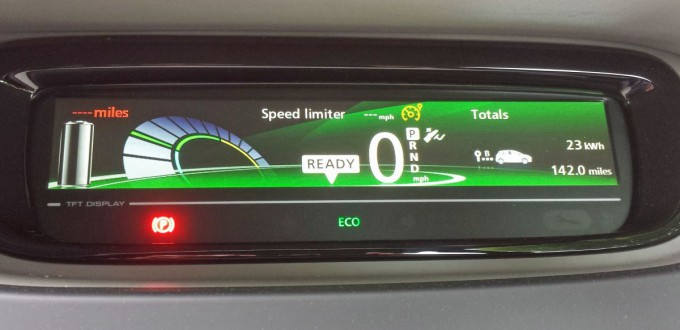
Renault ZOE Range Record: 142 Miles

Renault ZOE Dashboard after range record (Image: T. Larkum)

It’s a year since I managed to persuade my ZOE to go 122 miles on one charge so, with the weather being mild, it seemed like a good time to try for another range record. Previously I had aimed for driving to work and back (typically 38 miles round trip) twice, and then driving around locally to make up the distance. This time I was more confident so I charged up last Tuesday night then drove to work and back on Wednesday, Thursday and Friday.

This time I chose a more convoluted route (about 42 miles round trip) so I could avoid long stretches with speeds above 40mph, instead travelling mostly on back roads, through villages and an industrial estate, to keep my average speed down. I had prepared by inflating the tyres to 38psi, but otherwise the car was unmodified in any way. The air conditioning was on but since I was in Eco mode it was pretty feeble as usual.

Read more: MyRenaultZOE: ZOE Keeps Her Promise

Electric cars ready for free test drives in Milton Keynes (Image: T. Larkum)

Renault and Bolloré form EV partnership

Renault and Bolloré are joining forces to promote electric vehicles (EVs) as part of three agreements relating to industrial cooperation, the founding of a joint-venture to sell EV car sharing solutions and a feasibility study on the development of a specific new Renault vehicle for car-sharing plans.

The Bolloré Group has commissioned Renault for its expertise in electric cars to gradually take over assembly of the Bluecar, formerly built solely in Italy. The vehicles will be assembled at the Renault plant in Dieppe (Normandy, France) from the second-half of 2015. For the Dieppe plant, this decision is an acknowledgement of its expertise and a promise for its future activity.

The Dieppe plant specialises in building vehicles in small series. It currently builds Clio Renaultsport and is set to build the future Alpine, scheduled for launch in 2016. The Dieppe plant will be able to rely on the expertise of the Renault group in electric vehicles to acquire the skills necessary to assemble this type of vehicle.

A new final assembly workshop will be set up specially within the plant to build these vehicles. The Bolloré group will thus have access to modern production tooling tailored to its requirements and delivering a significant reduction in costs.

Read more: Next Green Car