Category Archives: Electric Cars

News and reviews of the latest electric cars (full electrics and plug-in hybrids).

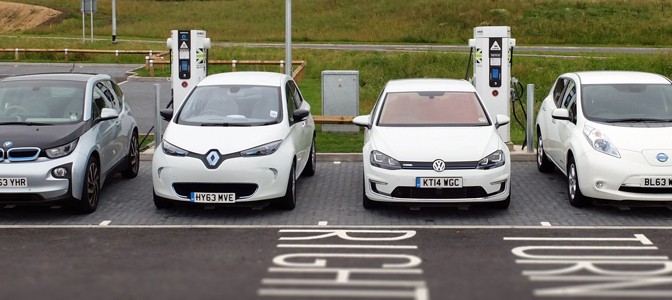
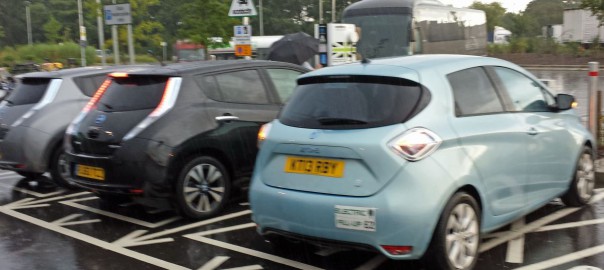
An EV Queue at Cobham (Image: T. Larkum)

Plug-In Electric Car Sales UK At 1% Of Market In November

Plug-in Car Registrations in UK – November 2014 (Image: Inside EVs)

The take off of electric cars sales continues in the UK in November.

The percentage of growth from a low base is outstanding – from 290 to 1,871.

Most of the sales are plug-in hybrids, which with 1,225 registrations, went up over nine times year-over-year.

All-electric cars are at a lower level of 646 registrations, but growth of 124% is strong.

Compared to the 172,327 total passenger car registrations in November, EVs took 1.1%.

UK now has some 18,000 EVs on the roads, from which over 12,000 were added this year alone.

Source: Inside EVs

Electric Cars Fast Charging (Image: BusinessCarManager.co.uk)

Are Hybrids Being Supplanted By Electric, Plug-In Hybrid Cars?

Late in October, an interesting thing happened in Germany: Audi quietly killed off the hybrid version of its A6 luxury sedan. The model had been around for three years, and though it was initially expected to be sold in the U.S., that never actually happened.

According to Car and Driver, Audi sold about 4,000 A6 Hybrids during that time. Or as its headline said, “Nobody bought it.” The only hybrid Audi now on sale is a very, very low-volume model of the Q5 SUV that might as well be invisible for all the attention it gets.

The German makers, now on board to various degrees with electric cars, are turning their attention en masse to plug-in hybrids rather than conventional hybrids.

Meanwhile, California sales data shows that for every two hybrids sold in the state, one battery-electric or plug-in hybrid car is now delivered as well. And this is in a state where the Toyota Prius is the single highest-selling passenger car line.

Which leads to a question that is quietly being discussed among green-car advocates and most likely among automakers at large:

Have hybrid sales reached some kind of natural peak?

Certainly cars that plug in have assumed the mantle of the latest and coolest auto technology among early adopters; after 15 years, hybrids may now feel slightly old-hat.

Several years ago, before the introduction of plug-in electric cars, many industry analysts expected hybrids to increase their percentage of total sales to the point where perhaps one out of every five new cars by 2020 would be a hybrid. Thus far, that’s nowhere near happening. Instead, hybrid sales in the U.S. have stayed between 3 and 4 percent of the total for several years.

With gas prices heading toward their lowest levels in several years, the forecasts for near-term hybrid sales have darkened. But plug-in sales are increasing steadily, albeit not to the heady levels envisioned by the most optimistic forecasters five years ago.

Battery costs historically fall about 7 percent a year, so within five years, the batteries in high-volume electric cars will cost only half of what they did on launch in late 2010. Meanwhile, conventional gasoline cars are getting better-than-expected improvements in fuel efficiency via technologies like direct injection, turbocharging, and seven- to 10-speed automatic transmission.

Those technologies may mean that expensive hybridization looks less appealing as a way to meet corporate average fuel economy targets that rise steadily from now through 2025.

With battery-electric cars offering simplicity, silent operation, smooth running, and abundant torque from rest–and gasoline cars steadily improving in fuel economy–it seems likely that automakers may be more concerned about the future prospects for hybrids than they were a few years ago.

On the other hand, the 2016 Toyota Prius will be unveiled sometime within the next year–which could provide a substantial boost to the category.

Green cars: often hard to predict–and assuredly never dull.

Source: Green Car Reports

Car exhaust (Image: BBC)

London will follow Paris and ban diesel cars, campaigners warn

Pollution is so high in the capital, and diesel fumes so damaging, experts believe Boris Johnson will follow Paris’ lead and ban the cars from London’s roads within the decade

London will follow Paris and introduce an outright ban on diesel cars which are causing “serious health damage” in the capital, campaigners warn. The Mayor of Paris has announced radical plans to ban diesel cars from the French capital by 2020 due to concerns about how much pollution the cars cause.

Boris Johnson, the Mayor of London, is also grappling with the issue of how to tackle pollution from the fuels fumes which contain tiny particles and nitrogen oxides and have been increasingly proven to be seriously damaging to health. France, which has the highest number of diesel cars on the road, will now ban the cars out right with Anne Hidalgo, the Parisian Mayor pledging “an end to diesel in Paris in 2020”.

She also said the city would have more semi-pedestrianised areas with special zones introduced at weekends.

Boris Johnson currently plans to raise the congestion charge for diesel cars by £10 in a move to cut air pollution. The change would mean diesel drivers could have to pay a total of £20 to get into Central London. Under the plans petrol cars registered before 2006 would also have to pay extra under the plans which the Mayor wants in place by 2020.

However campaigners say this will not be enough and London will still be following the Parisian example with an outright ban. Stephen Joseph, of the Campaign for Better Transport, said:

“I think the motor industry is wholly unprepared for the way in which the science is turning against diesels. The sciences is hardening up and it is showing different and serious health damage which is a really serious problem.

“All this emerging science I was going to have wide ranging ramifications, both in terms of the kind of cars we drive and where they are driven.

“London is very polluted and busy. Where Paris goes London won’t be far behind – London is already talking about an ultra low emission zone, banning all sorts of diesel vehicles, this is not unlikely that they will banned altogether in the same way Paris has done.”

In Britain, about 29,000 premature deaths a year are thought to be caused by air pollution and people living in London, Birmingham and Leeds will be exposed to dangerous air pollution from engine fumes until the 2030s unless stricter rules are imposed, according to the Department for Environment, Food and Rural Affairs.

Earlier this year Mr Johnson’ Mayor’s senior advisor for environment and energy Matthew Pencharz, said:

“When it comes to tackling London’s air pollution. and protecting the health and well-being of all Londoners, diesel cars are an issue which must be addressed.

“Over recent years the Euro diesel engine standards have not delivered the emission savings expected, yet governments have been incentivising us to buy them. This has left us with a generation of dirty diesels.”

Cllr Caroline Russell, Green Party Local Transport spokesperson, said:

“This is the third EAC report in five years and scandalously there has been no government action since the last report in 2011.

“Quite clearly our health is being severely damaged by exposure to polluted air caused by traffic emissions particularly from diesel vehicles.”

“The hand wringing has to stop. We need brave political action to tackle our over-dependence on motorised private transport. That means investing seriously in public transport, scrapping the proposed new roads and ensuring that everyone has access to safe convenient networks of walking and cycling routes.”

Source: Telegraph

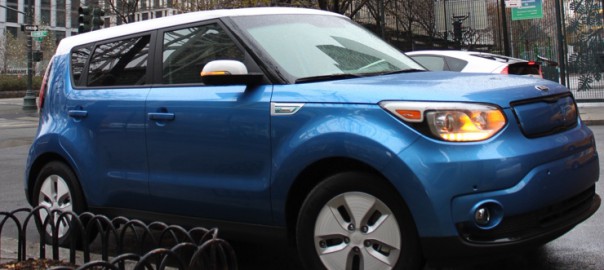
Kia Soul EV in New York City (Image: Oh Gizmo)

Behind The Wheel: The 2015 Kia Soul EV

It was a cold and rainy day in New York City, a thick fog ominously blanketing Manhattan in a muffling layer of grey. I had made my way into the city to spend an afternoon with the all-new 2015 Kia Soul EV, the company’s first all-electric, zero-emissions vehicle, and I was excited at the opportunity despite the Lovecraftian weather. How would the Soul, a car known as a fun, quirky, and uppity Urban Passenger Vehicle, handle the transition from piston power to electromagnetic locomotion? Would its range estimates hold true, or would anxiety creep in? How would the added battery weight affect its ability to handle Brooklyn’s dilapidated tarmac? I was about to find out.

Range

Let’s start with the #1 concern for electric vehicle buyers: range. Kia proudly proclaims an EPA estimated range rating of 93 miles with an MPGe of 92 miles highway and 120 miles city for a combined mileage of 105 miles. That pride is deserved, as it puts it second in the range department, behind only Tesla, but ahead of other competitors like the Ford Focus Electric or the Nissan Leaf. It’s a decent helping of miles, sure, but still not high enough for a prospective buyer to contemplate venturing very far outside city limits. This is not so much Kia’s fault as it is the reality of current EV technology.

Within the city however, I found that the car’s estimates were pretty much spot on. I drove from the Port Authority Bus Terminal in Manhattan to Sheepshead Bay in Brooklyn, and back to Carlstadt in New Jersey, for a roughly 45 mile trip. The car had been delivered to me with 89 miles of range, and I returned it with 43 miles left on the dial. This included two or three wide-open-throttle passes, and a fair amount of idling time, so I was impressed at the accuracy. Yes, while 93 miles isn’t as comforting as carrying around a 400 mile tankful of fossil juice, you should at least know that what you see on the dashboard really is what you get in real life.

Performance

The Soul EV carries a highly energy-dense battery that weighs 620 pounds, and is located in the floor, beneath the seats. This both lowers the center of gravity and stabilizes the cabin in potholes, contributing to a more comfortable, planted ride. The 60-volt, 192-cell, lithium-ion polymer, gel-electrolyte battery battery pack has a capacity of 27kWh, and an output of 81kW (109hp) and 210 lb.-ft. of instantaneous torque. And we need to emphasize that “instantaneous”, as this is the saving grace of otherwise seemingly underpowered electric motors. You get all your torque the second you step on the pedal, with no build-up like in a traditional combustion engine. This, coupled with the single-speed constant-ratio gear reduction unit, means you get pushed back into your seat and remain there with zero interruptions until you let off. Sure, the 0-60 times aren’t stellar, hovering around 11 seconds, but you don’t care as much because it feels fast. It’s a feeling that’s hard to describe to someone who’s spent their life driving vehicles that need to take tiny breaks between gears. But the point is that although the Soul EV is not a sports car, it definitely doesn’t feel sluggish.

Comfort and Silence

Additionally, the motor is almost completely silent. Kia explains this by saying that the “liquid-cooled AC synchronous permanent magnet motor uses multi-layer magnets to help improve efficiency and reduce the whine common to most electric vehicles.” This is important, because there’s nothing more annoying when you’re flooring it than to make a raucous; on a vehicle that outputs a little over 100hp, it’s great being able to squeeze every drop of power without alerting the entire neighbourhood that your ride is at its limits. Given the motor’s silence, all you’re left with is road noise and wind, which is kept at a minimum thanks to excellent sound-proofing.

Read more: Oh Gizmo

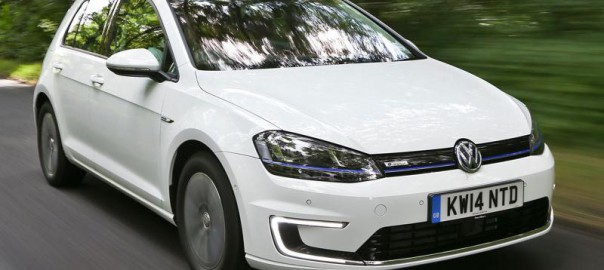
Volkswagen e-Golf electric car (Image: Autocar)

Volkswagen e-Golf review

Over time, you can loosely map the progress of affordable electric cars by the way they travel from Autocar’s Teddington offices to the test tracks we use.

All of the ‘ordinary’ EVs we’ve tested have reached the circuit that we use for photography, about 30 miles away, under their own power – even if some (Renault Twizy) have needed recharging when they get there.

The MQB platform the e-Golf is based on was designed with an electric powertrain in mind from the outset

But MIRA’s proving ground, in Leicestershire, is a different matter. The Mini E, Renault Zoe and early Nissan Leaf have needed stops en route or to be taken by trailer. A Tesla, however – Roadster or Model S – will do it in its stride. Any range-extended EV will call on fossil fuel reserves.

But the prospect of gliding into our test track car park with some miles showing on the ‘range remaining’ estimator, and without beads of sweat on our brows, is a tantalising prospect that is becoming more realistic by the month.

The current hope is this Volkswagen e-Golf, priced and sized to compete with the Nissan Leaf and BMW i3. It’s time to see how it fares, not just on the drive to the test track but also when it gets there and on all roads and sundry in between.

Read more: Autocar

Car exhaust (Image: BBC)

Air pollution ‘causing deadly public health crisis’

New schools, care homes and hospitals should be built far away from major roads because of the dangers of air pollution, a report by MPs says.

The Environmental Audit Committee argues air pollution is a “public health crisis” causing nearly as many deaths as smoking. It also suggested a scrappage scheme for diesel cars to cut emissions.

The government said it was “investing heavily” in clean air, but campaigners said it was ignoring the issue. There are an estimated 29,000 deaths annually in the UK from air pollution. Nitrogen dioxide is known to cause inflammation of the airways, reduce lung function and exacerbate asthma. Particulate matter – tiny invisible specks of mineral dust, carbon and other chemicals – are linked to heart and lung diseases as well as cancer.

Some particulate matter lodges in the lungs, while the finest particles can enter the bloodstream, risking damage elsewhere in the body.

‘Forecasts’

London lost in air pollution London in April this year, when dust from the Sahara combined with pollution from mainland Europe

Joan Walley, the committee chairwoman, told the BBC:

“There is a public health crisis in terms of poor air quality.

“There are nearly as many deaths now caused by air pollution as there are from smoking, so the main thing is we stop a new generation of children being exposed.”

She said government “should make it impossible” for new schools, care home or health clinics to be built in pollution hotspots.

She added that “well over a thousand” schools were already near major roads and that it “made sound economic sense” to filter the air coming into the buildings.

The committee’s report says traffic is responsible for 42% of carbon monoxide, 46% of nitrogen oxides and 26% of particulate matter pollution.

It said government had promoted diesel vehicles as they produced less of the greenhouse gas carbon dioxide.

But the committee said diesel was now seen as “the most significant driver of air pollution in our cities”.

They called for government to pay for diesel drivers to upgrade their engines or for a national scrappage scheme to take the most polluting vehicles off the road.

Other measures suggested include:

  • The Met Office and BBC producing high pollution forecasts alongside ones for pollen and UV.
  • A national plan for “low emission zones” to tackle heavily polluting vehicles, like the one in London.
  • Changes to fuel duty to encourage low nitrogen dioxide vehicles as well as low carbon dioxide.
  • Financial incentives for alternative fuels.
  • Encourage walking and cycling as the “ultimate low emission” option

Dr Ian Mudway, a lecturer in respiratory toxicology at King’s College London, told the BBC:

“The evidence is there. The 29,000 figure is very solid, so really it is a case of acting.

“But it is a strange one, because it’s their third [report] in five years and it is an attempt to get the government to do anything.”

The British Lung Foundation said the recommendations “may seem drastic”, but air pollution was so bad they were necessary “to protect the nation’s health”.

“Our dirty air will simply not clean itself, and this issue is one that will, without the government’s intervention, continue to impact on current and future generations,”

said Dr Penny Woods, the charity’s chief executive.

Asthma UK said air pollution increased the risk of a life-threatening attack and “urgent and concerted action” was needed to bring pollution levels down.

Chief executive Kay Boycott said:

“In the short term some of the measures recommended in this report, such as the publicising of high air pollution forecasts, could help people with asthma know in advance if they should seek advice from their GP or asthma nurse.”

Simon Gillespie, the chief executive of the British Heart Foundation, said:

“The government cannot continue to ignore this issue.

“Enough is enough. The government must act on these recommendations quickly if we are to improve the quality of the air we breathe and protect the nation’s heart health.”

A government spokesperson said there would be a full response to the report in the future, but added:

“Clean air is vital for people’s health and, while air quality has improved significantly in recent decades, we are investing heavily in measures across government to continue this, committing £2bn since 2011 in green transport initiatives.”

Source: BBC

Electric and Hybrid in Demand on Salary Sacrifice Car Schemes

A survey of over 600 drivers by Zenith Leasedrive Group has revealed that over 61 per cent are interested in ordering an electric or hybrid car through a salary sacrifice car scheme.

Of these, 12 per cent would choose an electric car, 33 per cent a plug-in hybrid and 55 per cent a non-plug-in hybrid. Salary sacrifice car drivers can save money through selecting an alternative fuelled car, through both fuel savings and reduced tax.

The most popular electric car ordered through Zenith’s salary sacrifice car schemes is the BMW i3, followed by the Vauxhall Ampera and then the Nissan Leaf. The Toyota Prius is the most ordered plug-in hybrid, with the Lexus CT 200h being the most in demand non-plug-in hybrid car.

Andrew Kirby, Zenith’s commercial director – employee benefits schemes, commented:

“With this high level of interest in alternative fuelled cars, we expect to see many more drivers switch from diesel or petrol cars over the next 12 months. When taking into account the lower fuel costs and tax savings, they can be significantly more cost effective to run than a fossil fuelled option.”

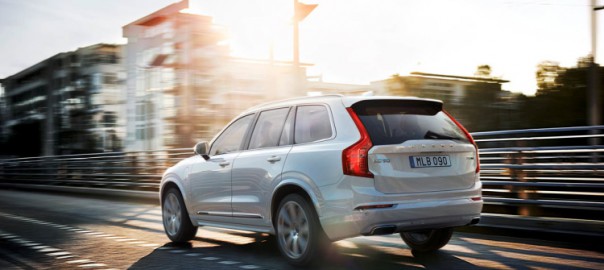
Volvo XC90 T8 PHEV (Image: Volvo)

Volvo XC90 T8 hybrid runs 0-62 in 5.9 seconds

Volvo XC90 T8 hybrid runs 0-62 in 5.9 seconds, will get 59 MPGe

Volvo has shown us the new XC90. It’s even shown us its new every-trick-in-the-book twin-charged hybrid powertrain. It just hasn’t shown the two together… that is, until now.

Although the High Performance Drive-E Powertrain prototype it showcased a couple of months ago was rated as high as 450 horsepower, the production version that will power the flagship XC90 T8 has now been confirmed to produce 400 hp and 472 pound-feet of torque. That’s still pretty damn good – especially from a four-cylinder engine – and is now quoted to propel the big crossover from 0-62 miles per hour in 5.9 seconds.

That’s not bad for a four-cylinder crossover, but if you’re wondering how it stacks up against the competition – well, there isn’t much to speak of. The only other luxury three-row crossover currently on the market is the Infiniti QX60 Hybrid, which doesn’t plug in and offers only 250 hp and 243 lb-ft of torque and takes a good eight seconds to reach highway cruise. (Other luxury hybrid crossovers like the Porsche Cayenne, VW Touareg, Audi Q5, Lexus RX only offer five seats.)

To match the Volvo’s performance in a Mercedes GL, for comparison’s sake, you’d have to go up to the twin-turbo V8-powered GL550, which just edges out the XC90 T8 with 429 hp, 516 lb-ft and a 5.5-second 0-60 time. (One step down, the six-cylinder twin-turbo GL450 offers significantly less with 362 hp, 369 lb-ft and a 6.6-second sprint.) But the Volvo offers pure electric mode that’ll get you 25 miles down the road before firing up the internal-combustion engine.

Gothenburg is estimating that we can expect around 59 MPGe, still to be confirmed, from the XC90 T8, but that is using the lenient European NEDC testing method. Interestingly, Volvo is also quoting an emissions figure of 59 grams of CO2 per km (NEDC), which would be roughly 92 MPGe. We’ve asked Volvo for a clarification. Either one will easily make the XC90 the cleanest crossover on the market, at least until the Tesla Model X arrives in late 2015.

Source: Autoblog

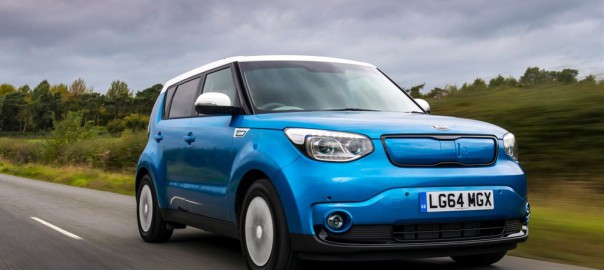
Kia Soul EV

Electric Kia Soul charges ahead

NOT LONG ago mention of the “compact crossover” would have drawn blank faces all round.

Now annual sales of these quasi SUVs are set to rise to more than 600,000 in Western Europe by next year, with more than 150,000 of sales in the UK. The Kia Soul joined the party in 2009 to be superseded by the second-generation 1.6-litre petrol or diesel versions this year. However, its funky, boxy styling has not been a hit in the UK, so it’s something of a niche model here.

Kia hopes to make a bigger splash with this new Soul EV, though, which is its first battery-powered electric vehicle. Running on electricity alone, it is sure to be even more of a niche car, although not even Kia is pretending the Soul EV will be high up the sales charts. There is a very limited global supply from the South Korean factory and it will be available only through 13 specially trained dealers in its first year, but this is a car with an eye on the future and Kia is keen to get ahead of its mainstream rivals.

The Soul EV exterior is similar to existing Souls; the most noticeable differences being its blanked-off front air intake (hiding two charging ports), low-drag lightweight alloys with super-low-rolling-resistance tyres plus redesigned light clusters and rear bumper. Under the bonnet lies a 81.4kw electric motor (equivalent to 109bhp) that drives the front wheels via a single speed CVT automatic gearbox.

Housed beneath the floor in a protective casing is an air-cooled lithium-ion polymer battery with a storage capacity of 27 kilowatt hours (which is more than the BMW i3, Nissan Leaf or VW e-Golf). The battery can be recharged either from a standard 13amp wall socket, via the Kia-branded wallbox supplied as standard, at a public fast charger, or from a public rapid charger.

The combination of the two is enough to get the Soul EV from 0 to 60mph in 10.8 seconds and on to a 90mph top speed but the delivery of the electric motor means it feels punchier than those figures suggest.

The motor and drivetrain are also fabulously smooth and the car really couldn’t be easier to drive. The steering feels light but suitably weighted, while pick-up from low speeds is instant with very swift acceleration.

Meanwhile the feel of the brake pedal is linear and has none of the low-speed inconsistency that blights the regenerative braking systems of some other electric and hybrid cars. Weighing just 8kg over the standard turbo-diesel Soul, there’s little discernible difference on the move either.

Thanks to the retuned suspension the little extra weight it carries does not detract from the car’s nimble handling or comfy ride.

On the move, too, it’s eerily quiet and has a Virtual Engine Sound system which at low speeds apparently alerts pedestrians and cyclists to its presence, although we weren’t aware of it inside the car.

As with any all-electric car though, its maximum range is a concern. Kia claims a full charge gives the Soul EV up to 132 miles subject to conditions and driving style. Although 130 or so miles is good for a pure electric car, in practical terms the Soul EV is really only suitable for city or local use.

LOGBOOK LOWDOWN

Price: £24,995 government grant) Electric – 81.4kw 0 to 60mph in 10.8 90mph top speed : up to 132 miles emissions: 0g/km Ford Focus Electric, Leaf, VW e-Golf, Prius Plug-In 8/10 A full recharge takes 10 to 13 hours from a 230v domestic power supply or about five hours from a wallbox or at a public fast-charge point and recharging at a public rapid charger to 80 per cent capacity takes about half an hour.

During our largely urban drive the battery range held up well despite having the air conditioning on (the climate control system has an energy-saving driveronly function) and without being in full Eco drive mode.

REAR LEGROOM is slightly reduced due to the battery’s underfloor location, while the 281-litre boot is lowered because of an undertray housing the recharging cables. A tyre inflation kit replaces a spare wheel and there’s an EV-specific instrument cluster, but otherwise the interior is much the same as a normal Soul. So fit and finish is high standard, there is ample space and practicality plus good front seats.

The Soul EV will come in one spec grade, retailing at £24,995, including a £5,000 government plug-in car grant. This makes it the priciest Soul by £3,445, and more than the 170bhp 100-mile-range BMW i3.

On the upside, the electric Soul has touch-screen sat nav (showing charge point locations), a reversing camera, air con, DAB digital radio, voice recognition and music streaming; plus there are no road tax costs and highly reduced company car tax. If you can cope with the Soul EV’s range, it’s an enticing prospect.

LOGBOOK LOWDOWN Price: £24,995 (after government grant) Engine: Electric – 81.4kw Power: 0 to 60mph in 10.8 seconds, 90mph top speed Range: up to 132 miles CO2 emissions: 0g/km Rivals: Ford Focus Electric, Nissan Leaf, VW e-Golf, Toyota Prius Plug-In Rating: 8/10

Source: Express
RSSKL Advent Fair

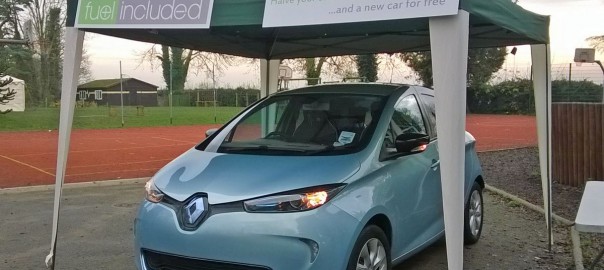
Fuel Included's first public event - the Steiner School Advent Fair
Fuel Included’s first public event – with a Renault ZOE at the Steiner School Advent Fair

We wanted to get the concept of Fuel Included to a different audience and so took a Renault ZOE to the Advent Fair at the Rudolf Steiner School in Kings Langley, Hertfordshire.

It was a mild day and so well suited to standing outside and talking to folks as they passed.

Everyone was in festive mood, and it was gratifying to hear the level of excitement about electric cars as well as the personal commitment people had to making changes and making a difference.

Our message of reducing your personal carbon footprint at the same time as saving money was well received, and after only a few hours, we had many solid leads for electric car leasing with fuel included – essentially fixed cost motoring.

All in all a most enjoyable start to the Christmas season.