Category Archives: Electric Cars

News and reviews of the latest electric cars (full electrics and plug-in hybrids).

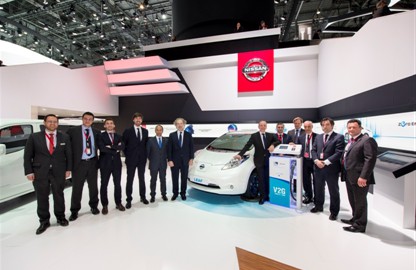
Power to spare - Nissan and Endesa sign pledge to promote Europe's first mass market vehicle-to-grid system (Image: Nissan)

Power to Spare – Nissan and Endesa Sign Vehicle to Grid Pledge

POWER TO SPARE – NISSAN AND ENDESA SIGN PLEDGE TO PROMOTE EUROPE’S FIRST MASS MARKET VEHICLE TO GRID SYSTEM

    • Nissan and Endesa, an Enel Group subsidiary, collaborate on bringing key technologies to market
    • Game-changing technology unlocks the potential of two-way charging and allows customers to reduce costs by selling power from electric vehicle batteries to the grid
    • First step towards integration of electric vehicles with the renewable energy sector
    • Madrid to host real-life demonstration of the system in March 2015

    Nissan and Endesa, an Enel Group subsidiary,  signed a ground-breaking agreement at the 85th Geneva International Motor Show that paves the way for a mass-market vehicle-to-grid (V2G) system.

    The two companies have pledged to work together to deliver a V2G system and an innovative business model designed to leverage this technology.

    Nissan- the world leader in EV sales with over 160,000 Nissan LEAF sold globally- is turning a page in zero emission mobility, and releasing the full potential of electric vehicle (EV) batteries with the Endesa two-way charging technology. It’s all part of Nissan’s commitment to support the entire EV ecosystem, not just the car..

    The two companies have agreed to collaborate on the following activities:

    • – Introduction of V2G services in the European market;
    • – Exploring the use of ‘second life’ EV batteries for stationary applications (including households, buildings, grid);
    • – Designing and evaluating potential affordable energy and mobility pack offers;

    Paul Willcox, Chairman of Nissan Europe, praised the innovative two-way charging system and the step-change towards a further acceleration of the EV market:

    We believe this innovation represents a significant development for Nissan Leaf and e-NV200 customers. Every Nissan electric vehicle battery contains a power storage capability that will prove useful in contributing towards smarter and responsible management of the power demand & supply of local power grids, thus reducing our EV total cost of ownership. Not only does this represent an opportunity for Nissan’s EV private and fleet owners, it could also support grid stability and fully demonstrate that each Nissan EV represents a tangible social asset.’

    Power to spare - Nissan and Endesa sign pledge to promote Europe's first mass market vehicle-to-grid system (Image: Nissan)
    Power to spare – Nissan and Endesa sign pledge to promote Europe’s first mass market vehicle-to-grid system (Image: Nissan)

    Indeed, one of the main challenges for electricity management systems is to assure grid stability. This situation is especially relevant in countries with a high level of renewable energy generation, and this will only increase in the future. The longer term zero-emission vision is for EVs to be at the center of a fully integrated system whereby owners can participate in wholesale energy markets using the power stored in the batteries of their electric vehicles, and thus significantly reduce their cost of operation. In a not-so-distant scenario, the EV user not only decides when and where they want to charge their EV, but how best they spend and re-sell the energy stored in their EV; receiving tangible financial benefits in terms of energy savings, while at the same time maximizing the use of green energy.

    The flexibility offered by V2G implementation in terms of storing and releasing green energy into the grid will further enhance the already significant and tangible benefits of electric mobility. This is why Endesa, together with its parent company Enel and partner Nissan, have decided to join efforts in promoting this technology.” said Javier Uriarte, Head of Market Iberia at Endesa.

    For Information

    This Vehicle to Grid (V2G) system consists of the Endesa two-way charger and an energy management system that can also integrate such off-grid, and renewable, power generation as solar panels and wind turbines. Using this equipment, a Nissan LEAF or e-NV200 owner can connect to charge at low-demand, and cheap tariff periods, with an option to then use the electricity stored in the vehicle’s battery at home when costs are higher, or even feed back to the grid with a net financial benefit. Electricity generated by solar panels or wind turbines can be used to charge a vehicle, to power the home or business, or to feed back to the grid.

    This unprecedented agreement between Nissan and Endesa means that European countries can now review their current energy management policies in order to respond to the technological innovation of the V2G system.

    Endesa has developed the ultimate low-cost V2G technology ready for the mass market after years of real-life testing. The company first showcased its V2G technology in 2008 in Smartcity Malaga, the Enel Group testing ground for smart cities. Later on, in 2012, Endesa presented the evolution of such technology at the ZEM2ALL demonstrator.

    On March 12, 2015, as the culmination of the V2G system development, together with Nissan as automotive partner, Endesa will host a full demonstration of the market-ready and low cost system in Madrid.

    ENDS

    About Nissan in Europe

    Nissan has one of the most comprehensive European presences of any overseas manufacturer, employing more than 17,600 staff across locally-based design, research & development, manufacturing, logistics and sales & marketing operations. Last financial year Nissan plants in the UK, Spain and Russia produced more than 675,000 vehicles including award-winning crossovers, small cars, SUVs, commercial vehicles and electric vehicles, including the Nissan LEAF, the world’s most popular electric vehicle with 96% of customers willing to recommend the car to friends. Nissan now offers a strong line-up of 23 diverse and innovative models in Europe under the Nissan and Datsun brands.

    About Nissan Motor Co.

    Nissan Motor Co., Ltd., Japan’s second-largest automotive company, is headquartered in Yokohama, Japan, and is part of the Renault-Nissan Alliance. Operating with approximately 236,000 employees globally, Nissan sold more than 4.9 million vehicles and generated revenue of 9.6 trillion yen (USD 116.16 b

    illion) in fiscal 2012. Nissan delivers a comprehensive range of over 60 models under the Nissan and Infiniti brands. In 2010, Nissan introduced the Nissan LEAF, and continues to lead in zero-emission mobility. The LEAF, the first mass-market, pure-electric vehicle launched globally, is now the best-selling EV in history.

    Source: Nissan Newsroom
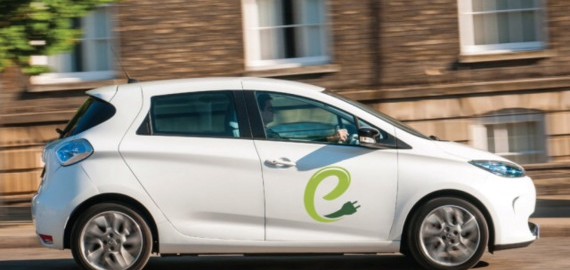
    E-Car Club Renault ZOE (Image: E-Car Club)

    UK’s 1st EV Car Club Adding ~100 New Vehicles By Mid-2015

    The first all-electric car club in the UK — the E-Car Club — is going to be experiencing some rapid growth this year, based on recent reports.

    The club is apparently now set to increase its fleet by roughly 100 vehicles before the middle of 2015 — which means that the car club will have grown its fleet numbers more than 7-fold in just ~18 months.

    To be exact, the E-car club is within the very near future going to be increasing the fleet from 15 vehicles to 60 — with another 50 expected to be added sometime during the next ~6 months, across its locations in the South East, London, and the Midlands.

    For those that haven’t heard of the club/company before — it launched in October 2013 in east London. At the time of launch, it was offering only Renault ZOE and Fluence electric vehicles (EVs) to residents & businesses.

    The company now offers higher end models such as the Nissan LEAF as well — and is planning to start offering “light commercial vehicles” such as Nissan eNV200s and Renault Kangoo ZEs sometime in the near future as well.

    The club currently has roughly ~700 members (+ 15 business customers) based on figures that it has publicly shared. Members pay from £5.50 an hour and up to use EVs parked in dedicated charging spots.

    The company has so far been pretty successful, hence the upcoming expansion — which is being funded by more than £1 million raised via investors. This figure reportedly includes a £500,000 investment from the Centrica-backed social impact fund Ignite.

    The latest influx of vehicles is being provided by fleet services company Alphabet, which is supplying 35 electric vehicles — 23 Renault ZOEs, 5 Nissan LEAFs, and 7 Renault Kangoo ZE vans.

    Publication: EV Obsession
    Article: UK’s 1st EV Car Club Adding ~100 New Vehicles By Mid-2015
    © 2015 EV Obsession

    Tesla Shares Rise as New Safety System is Launched

    Tesla Motors Inc., of Palo Alto, California announced in the early hours of 1st April the launch of its latest electric car safety system, causing its share price to rise substantially as soon as the stock market opened, Fuel Included (http://fuelincluded.com/news/press-release/) can exclusively reveal.

    Tesla has been in the forefront of many safety developments since the launch of its original Roadster and has enhanced them significantly during the development of the Model S. In NHTSA safety testing in 2013 it achieved a 5 star rating, and it did the same in 2014 in the European NCAP system. Following some issues with collisions with road debris the Model S was the first car to be retrofitted with a titanium undershield. At the end of 2014 it was announced that any Model S manufactured from September 2014 would get auto-pilot features including automatic steering, adaptive cruise control and lane departure warning.

    The latest Tesla safety system solves a known susceptibility of electric cars to water ingress into the electrical systems. It builds on earlier work begun by other manufacturers. One of the earliest of these was developed by Mercedes-Benz (part of the Daimler group) for its Smart ForTwo Electric Drive. This protected the vehicle from water ingress even during a heavy rainstorm. It was ground-mounted, however, which limited its use to the owner’s home.

    Smart Car Rain Protection System (Image Credit: M. Stanley/TrendHunter.com)
    Smart Car Rain Protection System (Image Credit: M. Stanley/TrendHunter.com)

    When Toyota followed up the success of its Prius hybrid with the launch of the Prius Plug-In electric car it produced an enhanced rain protection system. Like the Smart system it was deployed to shield the car’s electrical systems from water ingress but unlike that system it could be transported in the car. Therefore at any time that it was required the driver was able to pull over and deploy the system without the need to return home to shelter.

    The Tesla system, however, is significantly more advanced than any previous system. It is fully integrated into the Model S and can be deployed at speed without restriction. Its umbrella configuration allows it to fully protect the car’s electrical system from even a powerful rainstorm.

    Toyota Rain Protection System Deployed on a Prius Plug-in (Image Credit: WITHCOMBEM/Photobucket.com)
    Toyota Rain Protection System Deployed on a Prius Plug-in (Image Credit: WITHCOMBEM/Photobucket.com)

    In one impressive step forward Tesla has demonstrated that it can achieve the ‘holy grail’ of deploying an electric car that can be driven in severe environmental conditions. In this way Tesla has become the first electric car manufacturer to eliminate ‘rain anxiety’.

    Automatically Deployed Tesla Rain Protection System (Image Credit: FuelIncluded.com)
    Automatically Deployed Tesla Rain Protection System (Image Credit: FuelIncluded.com)

    Those familiar with the company’s plans have suggested that Tesla may build on this success by adding a kite-deployed conductor to the next-generation Model X and so produce an electric car that can charge itself in a thunderstorm.

    Driving school: your children will learn to drive with Renault Zoe

    Renault has introduced a special version of “driving school” Zoe. It’s to allow learner drivers to familiarize themselves with the electric car in their first hours of driving.

    Available since January, the Zoe dedicated to driving schools had been formalized in October, since the Paris Convention of Network driver education centers (RECs). Fitted directly in Renault factories, it has double pedals and double interior and exterior mirrors.

    Read more: Automobile-Propre

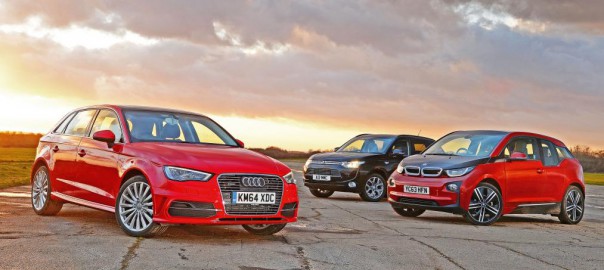
    Audi A3 e-tron, Mitsubishi Outlander and BMW i3 plug-ins

    Audi A3 e-tron vs BMW i3 & Mitsubishi Outlander PHEV

    Plug-in cars promise great efficiency, but is Audi’s new A3 e-tron hybrid a better bet than range-extending i3 and Outlander?

    Eco-friendly plug-in models are slowly gaining in popularity, so it’s no real surprise that after decades of experimentation Audi has finally decided to jump on the petrol-electric bandwagon.

    The new A3 e-tron is based on the classy A3 Sportback, and packages together a 1.4-litre petrol turbo and 75kW motor, while a compact lithium-ion battery pack sits under the back seat. Its raw statistics certainly look compelling, with a 31-mile claimed electric range, CO2 emissions of 37g/km and 176.6mpg economy.

    Just as importantly, Audi says these figures don’t come at the expense of the standard Sportback’s space, refinement and upmarket appeal.

    However, there are many different ways to package the perfect plug-in, as our other contenders here prove. Mitsubishi’s rugged Outlander PHEV claims to deliver all the practicality of the standard model, but – with a 30-mile electric range – city car-humbling costs.

    Completing our trio is BMW’s daring i3 Range Extender, which sets the class standard for efficiency, design and driving dynamics.

    Read more: AutoExpress

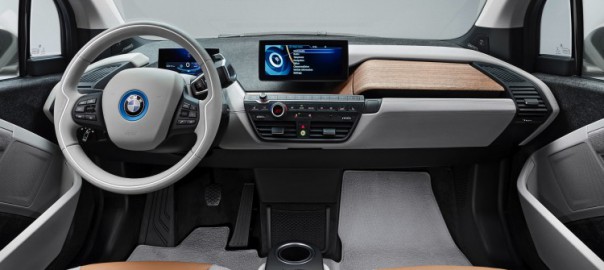
    BMW i3 Interior (Image: BMW)

    BMW’s i3 interior is a winner

    The i8 interior is very good, but the BMW i3 interior to me is the real winner. It’s just so different and refreshing and inspired.

    Interiors are one of the most important aspects of an automobile. It’s the place where you will spend 90 percent of the time with your car. So the interior must be a nice place to be. A good interior is one that is comfortable, ergonomic, and aesthetically pleasing all at the same time. But the really special ones are the kind that are able to do all of those things as well as being very different and shaking things up a bit.

    The interior that I think does this best is the BMW i3.

    BMW i3 Interior (Image: BMW)
    BMW i3 Interior (Image: BMW)

    The i8 is very good too, but the i3 to me is the real winner. It’s just so different and refreshing and inspired. With its exposed carbon fiber, funky recycled seats, eucalyptus wood and incredibly open design, the i3 is like no other interior on the market. Which perfectly suits the i3, a car like no other on the market. It’s also so unlike any other BMW on the inside. The i8 sorta kinda feels like a typical sporty BMW from within those swan doors. But the i3 feels different. It feels happy and serene, not at all sporting, which was the idea to begin with.

    Car and Driver recently sat down with the head of BMW i design, Benoit Jacob, and asked him some questions about its design. What he shared on designing the i3’s interior was quite interesting. When asked if there was an overall theme to the interior design of the i3, Jacob had this to say

    “What if the interior would inspire a more relaxed driving behavior? It’s Zen, in a way. From a higher design level, that was quite an interesting challenge.”

    Jacob also spoke about the use of the wood on the dash and how it pays homage to older BMW’s, such as the 2002 —

    “I’m very passionate about cars, and I believe there is no future without history. Sometimes, if there’s a way to echo the past a little bit­—without any sort of retro design, because that’s absolutely not the point—why not? It just came by chance.”

    It’s so refreshing to hear a designer trying to inspire a driver with the interior. Too often, these days, car interiors are so flooded with buttons and mobile phone connectivity that the car feels so detached, like a computer. They feel like they’re just there as vessels for the driver to control the car. While that is, technically, what a car interior is, I like an interior to give the car a mood. The i3’s does that better than any other. And I applaud BMW for straying from its sporting roots to try a different genre. It’s refreshing and I hope there’s more to come.

    Source: BMW Blog

    “UK’s first eco town” to run EV initiatives

    Dubbed “the UK’s first eco town”, the NW Bicester development in Oxfordshire will run a range of ultra-low emission vehicle initiatives including an electric car club for the first phase of its development.

    The NW Bicester project is being developed by A2Dominion, which is teaming up with ultra-low emission vehicle leasing company Fleetdrive Electric to encourage sustainable travel choices at NW Bicester.

    The aim is to get some 10% of residents switching to ULEVs by 2017.

    These initiatives include subsidised electric vehicles (EVs) for champions within the community to share their experiences of using EVs, pop-up neighbourhood test drive events and “try before you buy” flexible leasing options through Fleetdrive Electric.

    As well as boasting an electric car club, car charging points will be available communally and optionally available to all homes on the first Exemplar phase. Cycle stores will come as standard for each home and the development will have safe, segregated cycle-ways and pedestrian routes linking directly into the town’s existing network.

    The partnership is being launched at a special event on Thursday 26 February at the John Paul II Centre in Bicester that will enable Bicester stakeholders and residents to find out more and also test-drive a range of ultra-low emission electric vehicles including the Tesla Model S, BMW i8 and i3, Audi e-tron, VW e-Up!, e-Golf, Mitsubishi Outlander PHEV and Nissan LEAF.

    Louise Caves, strategic partnership manager for NW Bicester, said:

    ‘Travel accounts for some 32% of a typical UK carbon footprint with private car use alone accounting for 18% of this. As lead developers of the UK’s first eco town, A2Dominion is committed to shaping a range of options and initiatives designed to encourage people’s choice of travel to be as environmentally friendly as their home.

    ‘We’ve planned for a range of alternative modes of travel to minimise CO2 emissions and enable residents to make sustainable transport choices and built features into the design to make travel by foot, public transport, bike or electric car an easy option.’

    Source: EVFleetWorld

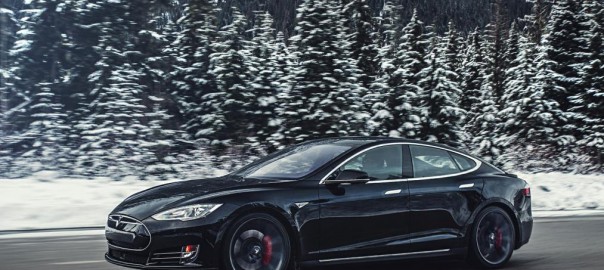
    Tesla Model S P85D (Image: AutoExpress)

    Tesla Model S P85D review

    Tesla’s P85D uses dual motor, four-wheel drive technology to deliver a supercar-smashing 682bhp in ‘Insane’ mode. Wow!

    Verdict – 5 stars
    The Tesla P85D is an all-electric car and that means it has one big flaw: the UK’s electric car charging network is still under-developed. But with four-wheel drive and 682bhp in ‘Insane mode’, the P85D is such an incredible feat of technology it’s impossible not to be amazed by it. The flagship Model S offers immense power, Mercedes-like levels of luxury, lots of space and the promise of more Tesla-dedicated ‘Supercharger’ charging points in the near future. The Tesla P85D really pushes the boundaries of electric car motoring and is arguably the first fully-electric car a petrolhead can get excited about without feeling guilty.

    Tesla may be a small car company compared to the likes of Ford, Volkswagen or Toyota but it has big ideas. And one of those ideas of founder Elon Musk’s is to prove that electric cars can have supercar-rivaling performance and still deliver all the benefits of zero emissions motoring.

    This is the latest product from that vision; the Tesla Model S P85D – an electric car that has 682bhp and can rocket to 60mph in 3.2 seconds. Supercar fans will notice the P85D is as quick to 60mph as a McLaren F1, a car which Musk stated was used as the benchmark when it came to fast acceleration times. And yet, the P85D has a theoretical range of 300 miles, seats five (or even seven if the two boot seats are specified) and has Mercedes-levels of luxury.

    The secret to the P85D’s immense power lies with its dual motor technology. A 464bhp electric motor on the back axle powers the rear wheels while up front Tesla has added a smaller motor with 218bhp on the front axle to drive the front wheels.

    It makes the P85D four-wheel drive and capable of traveling on all road conditions including snow and ice – just like an Audi RS6. Tesla’s system can adjust the torque between all four wheels 100 times per second thanks to its electric powertrain, giving superb levels of grip.

    Tesla Model S P85D (Image: AutoExpress)
    Tesla Model S P85D (Image: AutoExpress)

    Hop in, pull down the Mercedes-derived column gear change selector to ‘D’ and you’re good to go – there’s no need to start the car as carrying the key fob in your pocket both opens the doors and switches the ignition on. Touch the throttle and you’re thrown back in your seat with the only noise being a high-pitched whistle from the electric motors.

    Once you’ve had enough of that, it’s time to experience the neck-snapping acceleration. A few prods on the tablet screen in the centre of the dash and the driver can change the ride height, control how severe the brake regeneration is and tweak a multitude of other functions. It’s also here where you can switch the P85D’s acceleration from ‘Sport’ to ‘Insane’ mode.

    Do that and you’re not only flung back into your seat but your neck snaps into the headrest as you ride on the twin electric motors’ full power. As you race to 60mph your body is put through 1g – such is the severity of the dual motors unleashing their arsenal.

    The sensation is made all the more ‘insane’ by there being no engine noise to accompany it. While a Nissan GT-R can get to 60mph a few tenths quicker, that car’s wailing V6 and rapid-fire gearchanges make it very clear what’s happening. With the Tesla, though, there’s just an eerily quite cabin and uninterrupted acceleration courtesy of the single-speed gearbox.

    Straight-line speed isn’t the Tesla’s only forte, though. Thanks to that four-wheel drive system that’s continually shuffling the power to whichever wheel that needs traction the most, the P85D handles well too. The car’s natural style is to stay flat through corners; carry too much speed into a bend and the front washes wide but it’s only natural for a car that weighs more than 2.2 tonnes. The steering is weighty – it can be made unnecessarily heavy in ‘Sport’ mode – and while it misses out on being the last word in precision, the P85D is a credible sports saloon.

    Read more: AutoExpress

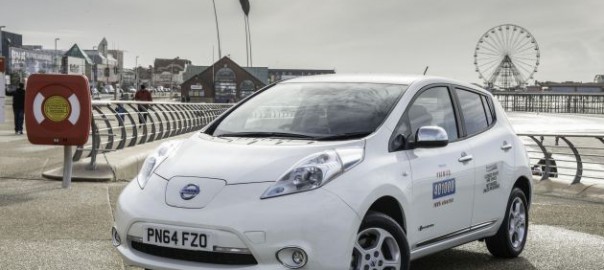
    Premier Cabs expect the LEAF to drastically reduce fuel costs

    Nissan LEAF taxis arrive in Blackpool

    A new fleet of 100% electric Nissan LEAF taxis has gone into service in Blackpool 130 years after the tourist resort introduced one of the world’s first electric tramways.

    The 12-strong fleet of LEAFs has been introduced by local firm Premier Cabs and will operate in and around Blackpool and neighbouring Lytham St Annes on a 24-7 basis.

    The company, which ordered the cars through leading North West Nissan dealer Chorley Group, expects to replace more of its 170-strong fleet with the British-built models and its sister vehicle, the e-NV200 Combi in the months ahead.

    Each vehicle will cover up to 55,000 miles a year in the course of covering around 200 fares per week. They will be supported by a dedicated network of five rapid chargers that can charge the vehicles from zero to 80 percent in as little as half an hour.

    The move will double the existing charging network in the Blackpool area. However, it is not clear whether these points will be available to the public.

    Premier Cabs expect the LEAF to drastically reduce fuel costs
    Premier Cabs expect the LEAF to drastically reduce fuel costs

    With running costs from two pence per mile, the LEAFs will allow Premier Cabs to drastically reduce its biggest single expense, fuel. And these savings will be passed on to the drivers, who will take home between £80-£120 per week extra by driving a LEAF. This, in turn, will allow the company to tackle one of its biggest challenges: driver recruitment.

    Managing Director, John Cutler, said:

    “We’ve done the maths and we know the LEAFs will save the business money but that wasn’t the main factor in our decision. We wanted to do something special for our customers and for the town and this really fits the bill.

    “This gives Blackpool a fleet of clean, green and very comfortable taxis that passengers will love and the town can be proud of.”

    The move to electric taxis has already been made by a few forward thinking companies. Last May, St Austell-based C&C Taxis clocked up 150,000 miles and more than 37,000 individual fares in its fleet of electric Nissan LEAF taxis.

    In December, it also took delivery of one of the first all-electric Nissan e-NV200 Combi models to arrive in the UK.

    Source: Newspress

    General Electric Watt Station Charge Post (Image: GE)

    £43m plug-in vehicle funding announced

    A wave of charge points to support the fast-growing popularity of plug-in vehicles will be installed across the UK after the government set out £32 million of infrastructure support up to 2020.

    Homes, hospitals, train stations and A-roads will be some of the locations for further charge points to maintain Britain’s position as a global leader in this cutting-edge technology.

    The support compliments the fast-growing popularity of ultra low emission vehicles (ULEVs) with grant claims rising 4 fold in 2014 compared to the previous year as take-up of plug-in car grants continues to rise.

    The Office for Low Emission Vehicles also recently announced changes to the Plug-in Car Grant. From 1st April 2015, buyers of eligible electric cars will be able to claim 35% of the vehicle’s OTR price as opposed to the 25% currently offered.

    General Electric Watt Station Charge Post (Image: GE)
    Public Charge Post (Image: GE)

    In addition, another £11 million of funding has been announced to boost the UK’s position as a world leader in low emission vehicle technology innovation. The funding will be provided to 50 organisations, ranging from small businesses to major universities, working together on 15 research and development projects.

    Transport Minister Baroness Kramer said:

    “The funding announced today marks another milestone in the government’s support for ultra low emission vehicles as their popularity takes off.

    “The public will find it even easier to charge their cars when they are out and about thanks to our £8 million commitment to support new charge points across key locations in our towns and cities. Today we have also announced another £15 million to continue the rollout of convenient home charge points across the country.”

    The £32 million infrastructure commitment will include:

    • £15 million to continue the Electric Vehicle Homecharge Scheme. ULEV drivers will receive a 75% grant of up to £700 towards installation from 13 April 2015.
    • £8 million to support public charging infrastructure across the UK which, alongside £15 million Highways Agency funding announced in Autumn 2014, will deliver charge points on major roads and across towns and cities- bidding for these schemes will open in May 2015.
    • £9 million to address other infrastructure priorities, for example, ensuring that the UK’s world-class charge point network remains accessible and open for users – further details will be announced later this year

    The government and industry are also working closely on the Go Ultra Low campaign to increase consumer and fleet uptake. Seven major vehicle manufacturers and the government are backing Go Ultra Low to highlight the increasing variety and benefits of ULEVs.

    Source: Department for Transport