Category Archives: Electric Cars

News and reviews of the latest electric cars (full electrics and plug-in hybrids).

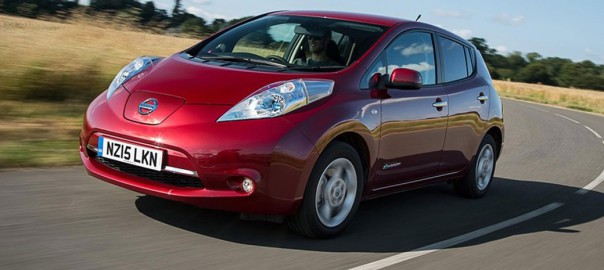
Nissan Leaf 30kWh Tekna (2016) review

The electric Nissan Leaf now has a greater range thanks to a boosted 30kWh battery pack. But is a bigger charge enough to tempt you away from cheaper, conventional petrol and diesel hatchbacks that don’t suffer from range anxiety in the first place?

0_nissan_leaf01_CM

Read our first drive review to find out whether – five years after becoming the first credibly mainstream EV – it can still make a viable argument for the silent but saintly genre.

What’s new on the 2016 Nissan Leaf?

The Leaf has evolved slowly since launch in 2010, gaining a tidier interior here, cleverer electronics there, and now a bigger charge capacity to stretch the (theoretical) range by as much as a quarter. Nissan claims the 30kWh battery pack means you can now drive up to 155 miles on a single charge.

The battery is the same size as the old one, but weighs around 21kg more, thanks to a different cell architecture inside and uprated power management systems on top. Buyers can still choose the cheaper 24kWh Leaf if they prefer.

There’s a refreshed 7in touchscreen multimedia system, too, and Nissan has overhauled its smartphone app, rebranding it NissanConnect EV and adding new features such as guidance to the nearest unused charging stations. You can still remotely warm your Leaf up from the breakfast table – handy for those cold winter mornings. Relying on electricity for heat means it defrosts in a jiffy.

How does the new Leaf EV drive?

The Leaf hasn’t changed much since we first drove it earlier this decade; the car is still a paragon of saintly silence – wafting quietly around city streets, the soft, floaty ride smothering away the worst road acne rolling under those eco-tilted Dunlop Enasave 215/50 R17 tyres. There are few more relaxing cars to drive.

Read more: Car Magazine
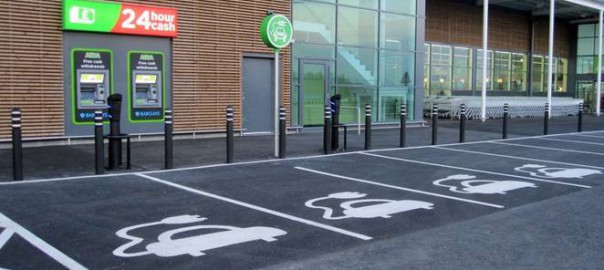
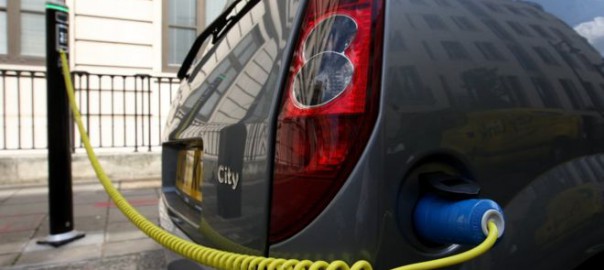
Electric car charging and parking (Image: G. Wallace)

Free parking, bus lane access for electric cars

This is becoming a perennial topic here on TreeHugger. The Guardian reports that eight UK cities are being awarded funds to provide major electric vehicle (EV) perks in an effort to increase adoption.

Electric car charging and parking (Image: G. Wallace)

Those perks will include a solar-powered charger at a York park-and-ride, free parking in Bristol and Milton Keynes, as well as bus lane access in Milton Keynes and Derby.

Cue the environmentalist handwringing.

On the one hand, I am sure Lloyd will be worrying about electric cars making it harder to fix our cities. After all, cars driving in bus lanes will inevitably impact public transit. And free parking for private automobiles seems to be the antithesis of reclaiming the ridiculous amount of space we devote to the motor car. With a demographic shift away from the car apparently underway, we do need to keep an eye on where we spend our resources.

In the other hand, I tend to be a part of the “it’s not this or that” crowd. Given our current dependence on private vehicles, and British’ cities on-going battle against life threatening smog, I’d suggest that speeding up the transition to emission-free cars is a significant step in the right direction.

The only caveat to that is the fact that the £40m pot being shared between these eight cities should not detract from other, non-car based efforts to slash emissions. From electric buses to treating cycling as mass transport, we must also continue our shift away from the car.

But surely, if done right, increased use of EVs should help us on this front too? As our streets get quieter, and as our air gets cleaner, it becomes easier and more pleasant for us to walk and cycle. And that can only be a good thing for everyone.

Read more: Treehugger

Sales of alternatively fuelled vehicles rose by 40% in 2015, according to figures from the Society of Motor Manufacturers and Traders (Image: D. Lipinski/PA Wire)

Electric cars to be allowed in bus lanes

Electric car drivers will be allowed to travel in bus lanes as part of plans to boost usage of low-emission vehicles in England.

Free parking spaces for plug-in car owners and streetlight charging points are also set to be introduced.

The government awarded cash to four areas which successfully bid for a share of £40m funding.

Transport secretary Patrick McLaughlin said the councils had shown “exciting, innovative ideas” for electric cars.

Nottinghamshire and Derby, Milton Keynes, Bristol and London qualified for a share of the cash.

‘World leader’

Bus lanes in Milton Keynes will be re-branded as low emission lanes giving plug-in vehicles the same priority as buses at traffic lights.

The town, which has been awarded £9m, will also build an advice centre offering short-term loans for electric car purchases.

It is also proposing to open all its 20,000 parking bays for free to electric cars.

Nottingham City Council will also open up some of its bus lanes, and use part of its £6m grant to install 230 charge points.

Read more: BBC

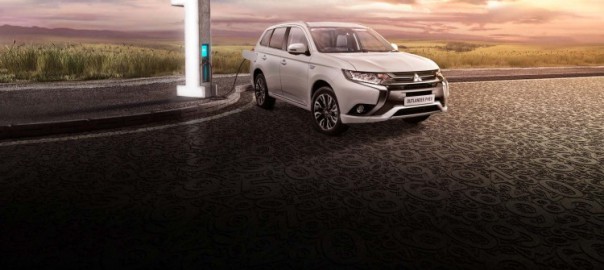
2016 Mitsubishi Outlander PHEV

Mitsubishi Outlander PHEV Was Top Selling Plug-In Car In Europe In 2015

Mitsubishi did it again – their Outlander PHEV was the best selling plug-in electric car in Europe for 2015, just like it was in 2014.

2016 Mitsubishi Outlander PHEV

Mitsubishi stated that 30,873 Outlander PHEV (up 55% year-over-year) were sold in 2015, which is some 59% of all Outlander sales in Europe. The conventional version accounted for just 41% (obv).

But even more amazing is that nearly 18% of total Mitsubishi sales in Europe were plug-ins.

In total, some 59,000 Outlander PHEVs have been sold in Europe to date, including over 6,000 in December 2015, according to our estimations. The Outlander PHEV arrives in the US (finally) in August of this year.

Source: Inside EVs

Ultra-low emission registrations up 386% on first quarter of 2014 (Image: OLEV)

Govt announces winners of Go Ultra Low Cities funding

Four UK cities have been awarded funds from a £40 million government project today (Monday 25th January) as the Go Ultra Low City Scheme has been launched to encourage the uptake of plug-in cars. Bristol, London, Milton Keynes and Nottingham each successfully bid for a share of the funds, with new technology and policies set to be trialled in each city.

https://youtu.be/Z_2KbeWTrSA

Transport Secretary Patrick McLoughlin announced the winners, saying:

“These Go Ultra Low Cities have proposed exciting, innovative ideas that will encourage drivers to choose an electric car. I want to see thousands more greener vehicles on our roads and I am proud to back this ambition with £40 million to help the UK become international pioneers of emission cutting technology.

“The UK is a world leader in the uptake of low emission vehicles and our long-term economic plan is investing £600 million by 2020 to improve air quality, create jobs and achieve our goal of every new car and van in the UK being ultra-low emission by 2040.”

London has been awarded the largest proportion of the money with £13 million allocated to create “Neighbourhoods of the future”, prioritising ultra low emission vehicles (ULEVs) in a number of boroughs across the city. Plans include installing car-charging street lighting in a number of streets in Hackney to improve access to charging points, while Harrow will develop its own low emission zone with parking and traffic priorities given to owners of plug-in vehicles.

These projects will aim to help London have around a quarter of a million ULEVs on the capital’s roads by 2025 and plans to use ideas and incentives to encourage uptake. Similar plans put in place in Norway have seen the country become one of the most successful in the world in terms of ULEV uptake for residents.

Milton Keynes will use its £9 million fund to open an Electric Vehicle Experience Centre in the city centre. This will provide a one-stop shop for both potential and existing ULEV customers, with advice, and short term vehicle loans available. The city will also set-up all 20,000 parking spaces for free use by electric vehicle owners, and allow ULEVs the use of bus lanes too.

Bristol has been awarded £7 million for its plans to offer residents free residential parking for ULEVs in the city, along with access to three car pool lanes across the centre to improve traffic flow and air quality. More than 80 rapid and fast chargers across Bristol will also be available for use and a scheme to allow residents to lease a plug-in car for up to four weeks is intended to allow potential customers to see what they are like to live with day to day.

Read more: Next Green Car

Ultra-low emission registrations up 386% on first quarter of 2014 (Image: OLEV)

EV buyers encouraged to place orders before end of February

Car buyers wanting to purchase a plug-in hybrid electric vehicle (PHEV) should be aware that some OTR prices may increase from 01 March 2016 due to new grant levels coming into effect in the new financial year.

Ultra-low emission registrations up 386% on first quarter of 2014 (Image: OLEV)

The prices changes are due to forthcoming changes to the Plug-in Car (and Van) Grants (PiCG). From 01 March 2016, two new grant rates will be introduced with the level of subsidy for PHEVs falling by 50 per cent from a maximum of £5,000 to £2,500. All-electric models may also be affected, although to a lesser extent than for PHEVs, with the PiCG for full EVs reducing by £500 to a maximum of £4,500.

The new PiCG rates will be awarded using a new EV classification system, each EV being classed depending on the level of CO2 emissions and the EV-only capable range.

• Category 1: CO2 emissions <50g/km and a zero emission range of at least 70 miles
• Category 2: CO2 emissions <50g/km and a zero emission range between 10 and 69 miles
• Category 3: CO2 emissions of 50-75g/km and a zero emission range of at least 20 miles

Category 1 vehicles will benefit from the full £4,500 grant while Category 2 and 3 vehicles will receive £2,500. The current grant scheme will run until March 2018 or until a certain number of each grant has been awarded.

A price cap will also be introduced in March 2016. Category 2 and 3 models with a list price of more than £60,000 will not be eligible for the PiCG, though all Category 1 vehicles will be able to have the full PiCG no matter what their cost.

Read more: Next Green Car

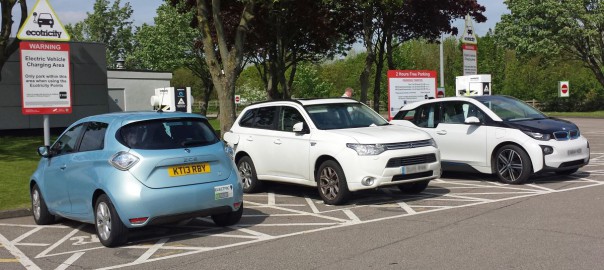
My ZOE plus an Outlander PHEV and i3 charging at London Gateway (Image: T. Larkum)

Electric cars will become as ubiquitous as the internet

Growth in popularity of electric cars is akin to the spread of the internet in the 1990s, minister claims

My ZOE plus an Outlander PHEV and i3 charging at London Gateway (Image: T. Larkum)
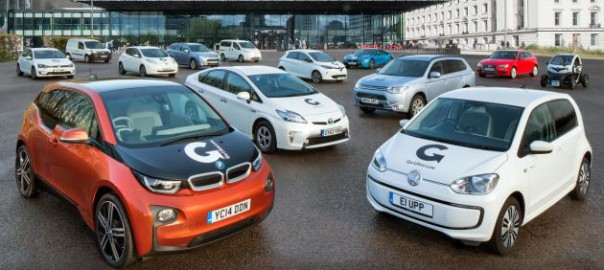
Renault ZOE plus a Mitsubishi Outlander PHEV and BMW i3 charging at London Gateway (Image: T. Larkum)

Electric cars are on track to become as ubiquitous as the internet, the transport minister has said, claiming plug-in vehicle technology was reaching a “tipping point”.

Andrew Jones, the roads minister, said sales of ultra-low emissions vehicles (ULEVs) were “rocketing”, with 28,188 new ULEV cars on the road in 2015 – almost double the number in 2014, and more than the previous five years combined.

Although this remains a tiny fraction of the overall car market – with a record 2.6 million new vehicles sold last year – the Government believes by 2050 it can get “virtually every car and van on the road to be zero emission”.

In a speech this week, Mr Jones said:

“The shift we are seeing reminds me of the spread of the internet in the 1990s.

“The internet started small, as a niche interest, but then it snowballed, and now it’s hard to imagine being without it.

“I think we are seeing a similar picture emerging for ultra-low emission vehicles in Britain today.

“ULEV sales are not just growing rapidly, they are rocketing.”

Read more: Telegraph

Electric vehicle sales to boom in 2016

2015 proved to be an interesting year for energy and climate issues both globally and in the UK. Will 2016 hold more of the same?

Forecasting is a dangerous business, but here are six predictions you should keep an eye on.

1) The showdown on oil prices between Saudi Arabia and the US will intensify, and the Saudis will eventually break.

It looks like oil and gas prices are going to remain low for the foreseeable future, panicking both the oil industry in Saudi Arabia and the shale gas industry in the US.

The big question is whether Saudi Arabia can keep production high and prices low long enough to bankrupt enough of the American shale industry. The answer may come by the end of 2016 and several factors point to the Saudis breaking first.

For one, despite losses for the oil industry, low oil prices benefit many sectors in the US, especially as consumers now have more spending money in their pockets. However for Saudi Arabia, an oil-dependent economy, low prices are a clear loser.

4) Hybrid sales will fall; electric vehicle sales will boom and become the hot energy news item of 2016.

etron-statics-258_Etron_i3-Outlander_AutoExpress

More so than renewables, low-carbon vehicles are an area where you might expect low oil prices to present a difficulty as they will encourage more people to stick with their regular car.

Sales of hybrid vehicles, which many people do compare to standard combustion vehicles in purchasing decisions, will likely fall. Conversely, electric vehicle purchases tend to be made by consumers who are less sensitive to price changes, evidenced by increased EV sales in 2015 despite low oil prices. In addition, a significant portion of EV sales are in industrial, commercial and public sectors where EV mandates play a strong role.

This prediction, like most others included here, differs significantly from OPEC’s delusional World Oil Outlook. On EVs it forecasts only a moderate increase in sales all the way out to 2040. OPEC dismisses EVs as a threat because it says it will take until 2040 for battery costs to fall by 30-50%, enough to make them viable options. It’s a particularly bold prediction as battery costs have fallen by about 50% in last five years alone.

Expect to see media interest in head-to-head races between the silent rockets and a lot of interest in three big 2016 releases: the Chevy Volt, the Nissan LEAF and the Tesla Model X.

Read more: New Economics