Category Archives: Electric Cars

News and reviews of the latest electric cars (full electrics and plug-in hybrids).

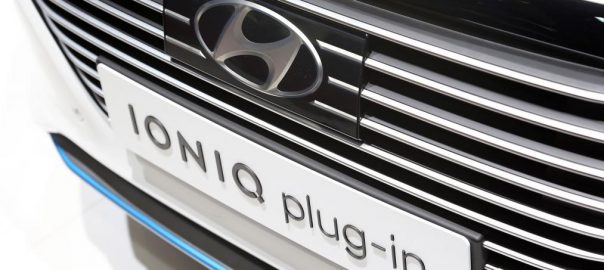
Hyundai IONIQ Plug-in hybrid revealed at Geneva 2017

Plug-in hybrid version of Hyundai’s bespoke EV manages 26g/km of CO2 emissions

Hyundai has completed its line-up of bespoke electric and hybrid vehicles by launching the Ioniq Plug-in at the 2017 Geneva Motor Show.
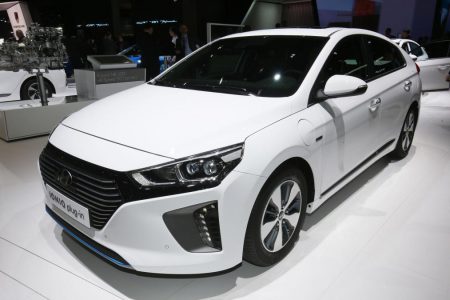
Hyundai IONIQ Plug-In Hybrid, Geneva 2017 (image: Auto Express)

The Ionig Plug-in joins the Ioniq Hybrid and Ioniq Electric in the Hyundai range. The new model uses a 1.6-litre petrol engine producing 103bhp and 147Nm, and an electric motor offering 45kW. Hyundai claims the combination can deliver pure-electric range of up to 63km, and drops CO2 emissions to just 26g/km. By comparison, the standard Ioniq Hybrid emits 79g/km – but Toyota’s latest Prius Plug-in manages 22g/km.

As with the Ioniq Hybrid, the Ioniq Plug-in uses a six-speed dual-clutch automatic transmission instead of a CVT or torque converter. It also gets the same suspension configuration as its stablemates, with a multilink set-up at the rear. Hyundai says that despite the Plug-in’s efficiency mantra, it will offer different driving settings, including a Sport mode that will alter the power steering and transmission software.
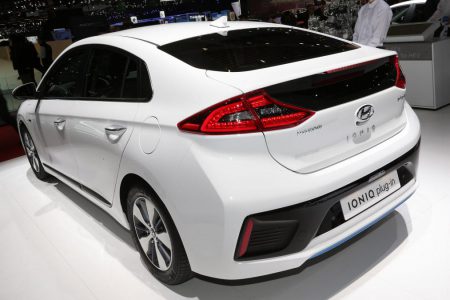
Hyundai IONIQ Plug-In Hybrid, Geneva 2017 (image: Auto Express)

The exterior design of the Plug-in is, in effect, the same as the regular Hybrid, so it retains that car’s ultra-slippery shape, with an aerodynamic drag co-efficient (Cd) of just 0.24. There’s an additional flap on the front wing, allowing the car to be refuelled as well as recharged – and the Plug-in gets a flash of blue material at the base of its front bumper, instead of the regular Hybrid’s dark grey finish.

Hyundai has not confirmed how long the Ioniq Plug-in will take to complete a full charge – or issued any performance data. Nor has it released a price, but the car is expected to slot in between the Hybrid and the Electric in the line-up – so we’d expect a starting figure of around £24,000

Source: Auto Express 
What IS ‘one-pedal driving’ in an electric car?

One-pedal driving is rather like the experience of owning an electric car: it can be hard to appreciate until you’ve spend time doing it.

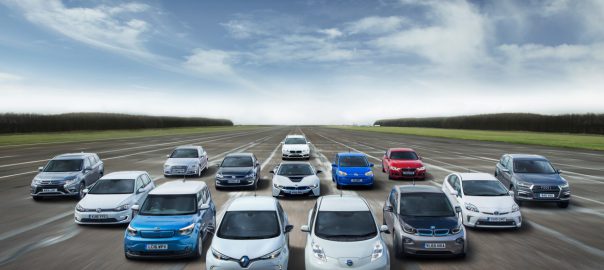
The phrase “one-pedal driving” refers to the ability of some electric cars to be driven almost entirely with the accelerator pedal alone.

It’s a feature much prized by owners of Teslas, BMW i3s, and most recently the Chevy Bolt EV.

And it’s something that everyone should know about, even if you don’t own an electric car. Even if perhaps you won’t completely understand why it would be appealing until you experience it.

One-pedal driving combines conventional acceleration, using the right-hand pedal, with a much higher degree of deceleration than in a conventional car.

That means that when a driver lifts off the pedal, the car slows down more quickly than an internal-combustion-powered car would.

It’s not found in every electric car. Some makers give their electric cars an identical driving experience to conventional vehicles, meaning they drive like an automatic-transmission car that never actually shifts.

Once you’ve acclimatized, the only times you hit the brakes is for emergency situations.

It may sound a little strange, but trust us: once you try it, you’ll never go back.

And then you’ll start to wonder why all cars don’t work that way.

Full article: Green Car Reports

Nissan Electric Vehicles for a more resilient world

Nissan Intelligent Mobility is the brand’s blueprint for the future of motoring, targeting zero emissions and zero fatalities. It was first announced exactly a year ago, at the 2016 Geneva Motor Show. Since then, significant progress has been made under all three of its pillars – Intelligent Driving, covering advances on how cars are driven; Intelligent Power, which guides developments on how they are powered; and Intelligent Integration, a wider investment strategy on the role vehicles play in society.


The Charge Point Being Installed for my First EV, a Renault ZOE (Image: T. Larkum)

Installing a Charge Point for your Electric Car

There can be a significant lead time in arranging the installation of a charge point so it is best if this gets underway as soon as possible after your new electric car is ordered.


If the car is a new Renault ZOE or Nissan Leaf on PCP (Personal Contract Purchase) then installation of the charge point will be organised by the manufacturer. As part of this deal the manufacturer will specify their preferred charge point.

In most other cases you will need to arrange the installation yourself. We can help you through the process with advice and guidance:

  1. We provide details of the main installation companies below.
  2. Our guide to selecting the most suitable charge point for you is here: Choosing a Charge Point.
  3. Our guide to check on your eligibility for a government grant for the charge point is here: Government Grant for Electric Car Home Charge Point.

If you are a Fuel Included customer then you can of course call or email us at any time for more detailed advice.

Note you may find that a charge point is occasionally referred to by its more technical name ‘Electric Vehicle Supply Equipment’ or EVSE.

Charge Point Installers

The biggest companies making and installing domestic charge points  – let’s call them the ‘Big 3’ – are the following (with links to their website and to our news feed with articles about them):

  1. Chargemaster PLC: Chargemaster website, Chargemaster news items.
  2. POD Point: POD Point order page, POD Point news items.
  3. Rolec EV (part of Rolec Services Ltd): Rolec website, Rolec news items.

However, there are many other smaller manufacturers and installers; here’s a brief (not definitive) list:

  1. Andersen order page, premium charge points.
  2. ChargedEV, nationwide installation partners for Rolec, based near Sheffield.
  3. Charging Solutions Ltd, partner with Chargemaster, based in Wales.
  4. The Phoenix Works, nationwide installers, based near Leeds.
  5. SOL Electrical, install POD Point and Rolec charge points in the South West of England.
  6. EV Charging Solutions, based in the Midlands.
  7. API Electrical Ltd, install in the North West of England.
  8. Armstrong Renewables Ltd, install in the North East of England.
  9. New Motion EVSE Ltd, based in London and part of a Dutch group, the largest provider in Europe.


Installation Process

In most cases the installation company is likely to contact you for information on your property, including asking for photographs of your main consumer unit (‘fuse box’) and the preferred location for the charge point. Usually a dedicated cable will be run from the consumer unit to the charge point so sometimes the installer may also ask for information on, and photographs of, the route between the two. Generally an isolator switch will be installed in this new circuit.

The Charge Point Being Installed for my First EV, a Renault ZOE (Image: T. Larkum)

Typically a standard installation will allow for cabling of up to 20m in length. If the distance is greater than this then there may be an additional cost to the customer (of perhaps £5 per metre). Similarly there may be additional costs if the installation is complex (e.g. passing a cable over a walkway or under a path); these issues are likely to be highlighted by the installer ahead of the installation visit. Sometimes the electrical system in the house will lack a mains isolator switch and this may need to be installed in advance by your electricity supplier; again the installer should flag this ahead of their visit.

The installation itself will take less than a day (it can be as little as an hour). You will need to be in attendance and the electricity supply will be turned off for much of the work.

After the installation is complete you will likely be asked to sign off on the work (and will be given a set of keys to the charge point if it is key protected). You should test the charge point as soon as possible by connecting your car, ideally while the engineer is still present in case it shows up any issues.

PS: I have previously described the installation of my charge point in detail here and here.

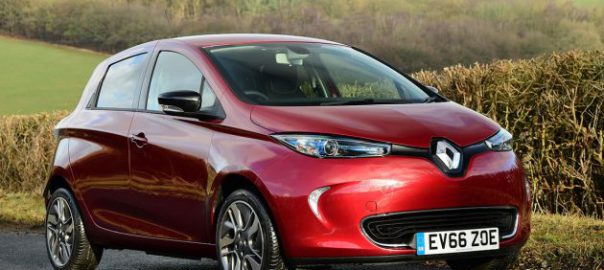
Taster test of the new Renault ZOE

While the LEAF from sister brand Nissan continues to grab all the headlines associated with it being first to the party, the ZOE has built itself a loyal following since the car’s launch in 2012 and was the best-selling electric car in Europe in 2015.

What is it? The latest version of the Renault ZOE electric supermini.
Key features: New battery increases official range to 250 miles. New top trim level, updates across range.
Our view: The Renault ZOE is a definite contender amongst its electric rivals, particularly considering its versatile purchase options and now its range.
Type of review: Taster test.

For 2017 Renault has introduced a facelift for the ZOE, the major headline of which is a new 41kWh battery. This is almost double the capacity of the original 22kWh battery and pushes the ZOE’s official range to 250 miles.

Longest range

While Renault claims that this gives the ZOE the longest range of any mainstream electric vehicle, we are also told that the car’s ‘real-world’ range between charges is now between 124 miles in extreme cold and 186 miles in ‘temperate’, in other words typical, conditions. This of course makes the ZOE a very practical car indeed – how often does the average motorist clock up more than 186 miles in a day?

Renault ZOE – the look

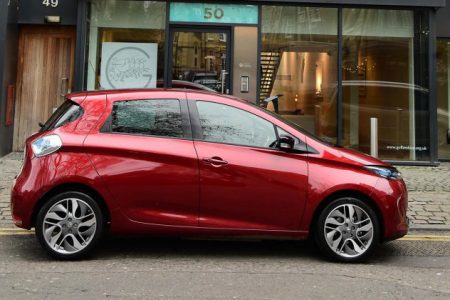
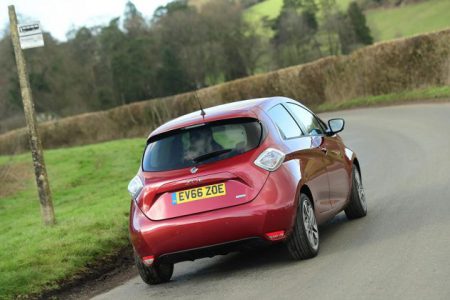
The biggest difference between the Renault ZOE and its great rival the Nissan LEAF, in this writer’s opinion, is in exterior looks. The LEAF, with its squared-off, slanted rear end, looks different enough to be identified as such, an electric car. The ZOE, however, looks just like any other supermini – it could just as easily be a traditional petrol/diesel sister to the Clio and Twingo and is very closely related to the former.

On the road

This is not a fast car, its 0-62mph time over 13 seconds, but it feels nippy in its natural environment of urban streets. At speeds under around 40mph the torque of the electric motor is at its most efficient, and the ZOE reaches 30mph in a mere four seconds.

It’s much less fun at high speeds, on a motorway for example, because above 60mph it seriously struggles for pace. Steep gradients cause similar issues, it will get up them, but not in any hurry.

Buying a ZOE

Electric cars are not cheap and on the surface the ZOE is no different, but there is a way to spread the cost. Renault offers the option of either buying the car and battery outright, or leasing the battery and paying a monthly fee that varies based on one’s expected mileage. This also answers those concerned about the staying power of the battery, though Renault does offer a five-year/60,000-mile warranty that includes the battery retaining at least 75 per cent of its original capacity.

Verdict:

The Renault ZOE won’t write headlines for its roadholding and handling but in the urban environment that electric cars are excepted to populate it becomes a leading contender. With its practical purchase options it should be considered by anyone wanting to go electric.

Read more: The Car Expert

UK breaks solar energy record on sunny March weekend

Last weekend’s sunny weather was not only good for beers, barbecues and bees, but also drove solar power to break a new UK record.

For the first time ever, the amount of electricity demanded by homes and businesses in the afternoon on Saturday was lower than it was in the night, because solar panels on rooftops and in fields cut demand so much.

National Grid, which runs the transmission network, described the moment as a

“huge milestone”

The company sees the solar power generated on the distribution networks – or local roads of the system – as reduced electricity demand.

The sunshine meant that solar power produced six times more electricity than the country’s coal-fired power stations on Saturday.

Continued good weather saw solar power generate significant amounts of power on Sunday and Monday too, when it was providing around 15% of electricity generation. Demand on Sunday afternoon was also lower than on Sunday night.

Duncan Burt, who manages daily operations at National Grid, said:

“Demand being lower in the afternoon than overnight really is turning the hard and fast rules of the past upside down. It’s another fascinating sign of the huge changes we are seeing in Britain’s energy scene”.

Electricity demand usually peaks around 4pm to 6pm at this time of year, as people return home from work, with demand lower still at weekends. But the early hours of the morning are usually the quietest for the Berkshire control centre that monitors the grid, so a reversal is dramatic.

For the first time, on Saturday 25 March 2017, electricity demand in Great Britain was lower during the afternoon than it was overnight due to high solar generation.

Read more: The Guardian

Can an electric van work for your business?

An electric van could be the perfect opportunity to cut running costs, but do they make sense for your business? We look at the key issues

There’s something of a revolution going on in the UK van market. While diesel definitely isn’t dead, manufacturers are branching out to provide alternative fuels for buyers. That means petrol vans are making a comeback, while hybrids are in the pipeline, too. But perhaps the most intriguing option that’s available in the UK today is the electric van.

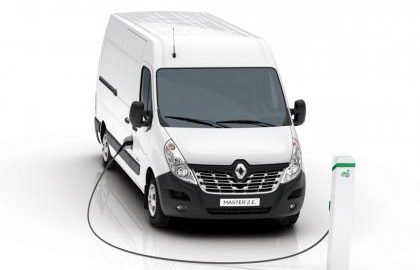
Renault Master Z.E 39

If you need a van to keep your business moving, then the running costs for that vehicle will be a key factor in your monthly outgoings. While the latest diesel vans can deliver running costs on a par with large MPVs that will help to reduce your running costs, there is another way to help slash your outgoings, and that’s by plumping for an electric van.

Battery range

The distance that you can travel on a single charge is going to be a major factor in deciding whether an electric van is right for you. At the moment, the two leading electric vans on sale in the UK are the Nissan e-NV200 and Renault Kangoo ZE. As both models use a similar electric drive system, they both have a claimed range of up to 106 miles.

Charging

The second major factor when evaluating electric van ownership is whether you have the ability to charge it up. The first thing you need is a convenient place to park the van so that you can access a charging point, whether it’s in a garage or an off-street parking space near an electricity supply.

The best way to charge a van is by using a wall box, as this can deliver a faster charge than if you plug into a conventional plug socket. Do this, and whenever you leave your van parked up overnight, you can plug it in and have a fully charged van ready to go in the morning.

Payload

Adding weight to any van has a negative effect on energy consumption, whether it’s powered by a diesel engine or an electric motor. However, just because a van runs on electricity, it doesn’t mean it’s any poorer at carrying big loads.

Price

One area where electric vans are competitive is on list price, and that’s because the Government’s Plug-in Van Grant is bigger than it is for electric cars. You can get £8,000 off the list price of an electric or hybrid van that is able to travel at least 10 miles on zero emissions electric power alone. That means the Nisan e-NV200 starts from around £15,000, which is about £400 less than the NV200 with a 1.5 dCi diesel.

Running costs

Another factor to consider is the overall running costs of an electric van. While you’ll never be at the mercy of fuel station prices, you won’t be accessing free energy. If you’re charging a van overnight, then the cost is estimated to be around £1.50 to fully charge a flat battery. As a rough estimate, you’d need to spend around £15 on diesel to cover 100 miles, so the savings an electric van can deliver are plain to see. If you’re registered as a company, you should also be able to write off some of your household energy bills against VAT, as the energy used to recharge your electric van is a legitimate business cost.

Read more: Auto Express

Vattenfall wind farms to use BMW energy storage

Sweden’s state-owned utility Vattenfall will use 1,000 lithium ion batteries supplied by BMW Group to provide energy storage at some of the power company’s wind power facilities.

The batteries, which are of the same type the auto maker uses in its BMW i3 electric car, will have a capacity of 33 kWh. They will function as back-up energy storage for when the wind power resource isn’t available.
Vattenfall will build the first 3.2 MW energy storage at the Princess Alexia wind energy project near Amsterdam, which generates 122 MW.

A larger 22 MW energy storage project will be built at the 230 MW Pen y Cymoedd wind farm in South Wales.
In August, Vattenfall won a contract with UK-based National Grid under which it will supply electric balancing services for the Pen y Cymoedd wind farm.

Source: Electric Light & Power

Is 2017 THE year of the Electric Car?

Electric Car Sales Boom As UK Vehicle Sales Hit a 12-Year High

The popularity of the electric car has increased exponentially in recent years, with projections of 2 million electric cars shortly on the world’s roads (Guardian, 2016). This in turn has seen many adaptations such as charging points at service stations and even fast-food chains – benefiting those already owning an electric car, as well as attracting those thinking about making the switch. Further evidence of this rise is the news of the record sales of vehicles and a 12 year high in car registrations – which was aided by the surge of purchases in electric vehicles.

January 2017 saw 174,564 cars being registered across the UK, up 2.9 per cent when compared with the previous year, and the highest monthly level since 2005 (Guardian, 2017). The Society of Motor Manufacturers and Traders (SMMT) also announced that electric vehicles took a record share in the sales market. Looking at the underlying figures, it is clear to see how alternative fuel cars are helping with this surge, especially electric cars like the new Nissan Leaf. This increased by a fifth and reached its greatest share of new vehicles registrations at 4.2 per cent, passing its previous 3.6 per cent high of November last year (Guardian, 2017).

“With the fluctuating cost of fuel, it is clear to see why motorists are opting for alternative fuel vehicles, where electricity prices are more stable”

There are a multitude of reasons why electric vehicles are leading the charge and steadily growing in the overall sales market. One of the main reasons, and alluded to earlier with the Nissan Leaf, is that no longer are electric cars a simplistic eyesore, but instead have increased in both style and scope. Drivers are now more attracted to alternative fuel cars as their appearance has evolved to be more like that of standard cars, as well as being cleaner and cheaper to run.

Almost mirroring the persistent rise in the cost of fuel is a further advantage to those thinking about purchasing an electric car: battery costs are down by 65 per cent from prices 5 years ago (CityAM).

As well as being cheaper, cleaner and more environmentally friendly, electric cars outclass internal combustion vehicles on a multitude of levels. Electric cars run more smoothly and have improved acceleration over their fuelled counterparts, as well as having significantly lower maintenance needs, and the scope for manufacturer modifications to be completed via software updates.

With four major world cities now actively moving to ban diesel vehicles by 2025 (BBC, 2016), and London looking increasingly likely to join this, alternative fuel vehicles will certainly continue to grow their share in the market. Major car companies are already altering their strategies to put electric vehicles at the center of their ranges, with Volkswagen planning to invest $11.2 billion over the course of the next decade to make electric cars 25 per cent of its total sales (CityAM, 2016). These latest trends and figures suggest that the sales of electric cars will continue to rise, with Bloomberg New Energy Finance (BNEF) forecasting that the sales of electric vehicles will account for 35 per cent of all new car sales by 2040.

Source: TryMyEV