Category Archives: Mitsubishi

News and reviews of Mitsubishi electric cars (including plug-in hybrids).

Plug yourself in and enjoy the ride

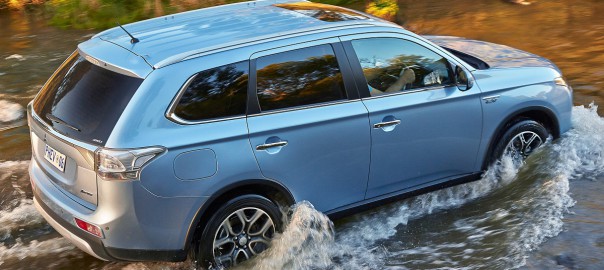
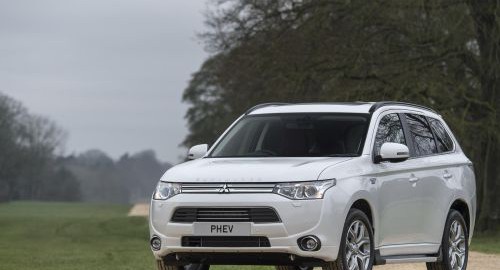
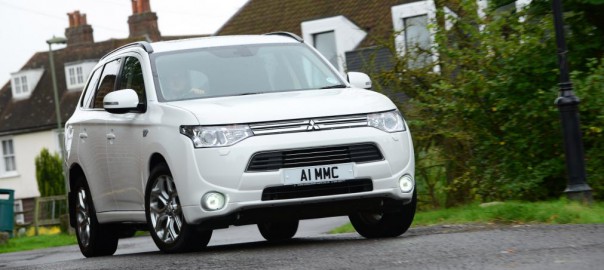
The Outlander PHEV is a plug-in hybrid SUV that gives Mitsubishi a real edge in this corner of the market.

We liked the Outlander diesel when we tried it recently but the PHEV uses very different mechanicals. This one features a 2.0-litre petrol engine and a pair of electric motors on each axle, giving all wheel drive and a combined power output in the region of 220bhp. So as you might imagine, it’s pretty sprightly when you bury the throttle, although Mitsubishi’s quoted sprint to 62mph of 11 seconds sounds strangely slow. Driven in full electric mode, you’ll feel the huge torque of the motors and be able to cruise at motorway speeds on electric power alone, although not for too far. Refinement is very good, even without the sound of an engine to drown out wind and tyre noise.

There’s a very handy feature included where you can request the battery holds a particular level of charge and you can also use the petrol engine as a generator, to drive battery power back up to 70% of its capacity. There is also a sophisticated five-level regenerative braking system that the driver can select using the wheel-mounted paddles or what you would otherwise take to be the gear lever.

You might well need to be the judge when it comes to the Outlander’s styling. We’re not fans of the beaky front end and slab sides but there will be some who doubtless feel that the sharp suit makes a welcome change to the usual cuddly Nissan Qashqais and Mazda CX-5s. The front and rear overhangs are quite long as well, so don’t be to tempted to go charging off road just because you’ve got drive going to each axle.

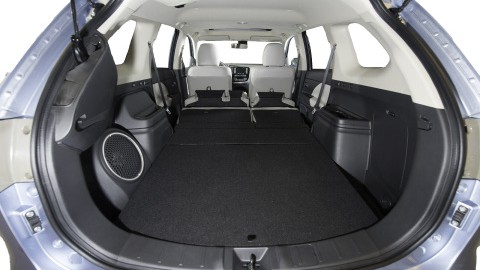
The cabin is very nicely executed. Mitsubishi is usually a company you can rely on for old-school hard grey plastics and mismatched fonts but this Outlander has clearly had some thought put into look and feel. Although you won’t think you’re in an Audi Q5, the Outlander offers plenty of soft-touch finishes and a clean, architectural fascia design. There’s a small increase in the vehicle’s weight due to the floor-mounted battery pack, a paltry reduction of 14-litres in boot space and rear legroom is a touch more pinched due to the raised floor height. The 577-litre boot is still more than adequate for most requirements and the luggage bay is well shaped.

0514Int2_Mitsubishi_OutlanderPHEV_unk

Prices look very competitive, starting at just over £28,000 after subtraction of the government grant – so the same money as a conventional Outlander GX3 diesel auto. That’s for the entry-level GX3h version: there are also two other PHEV models, the GX4h costing about £33,000 and the top GX4hs costing about £35,000. Expect a decently high spec to come as standard across the range, with a tally that’ll run to dual-zone air-conditioning, power-folding mirrors, privacy glass, alloy wheels, cruise control, four powered windows, remote locking, seven airbags and stability control. Niceties include things like leather and dual-zone climate control, satellite navigation, a parking camera and a high-end audio system, along with advanced safety systems including lane departure warning, radar cruise control and a collision mitigation system (which applies the brakes automatically if it senses an impending crash).

The official fuel consumption figure of 148mpg merely serves to remind us that we have an urgent need for a new European fuel consumption test which more closely mirrors everyday driving conditions.

Likewise, the 44g/km emissions figure the Outlander PHEV records won’t be something you’ll be managing day in, day out. As an exercise in taking advantage of a flawed testing procedure, it’s remarkable.

This plug-in hybrid can drive for over 32 miles on a full electric charge and can be fast charged to 80% in 30 minutes. This means that for some drivers, they’ll be able to pop the car on charge in the evening, do the commute and bring it home without using any petrol at all. Mitsubishi reckons that if you cover more than 100 miles between charges, the diesel is going to work out more cost-effective. Charge the Outlander PHEV more frequently and the numbers swing in its favour. Residual values ought to be strong, as the trade has quite taken to the Outlander and this plug-in hybrid is the first example of its type in the sector.

As long as you get on with the styling and don’t have a pressing need to seat seven people, we’ve got nothing but good things to say about the Mitsubishi Outlander PHEV. It’s one of those rare vehicles that is massively better than you expect it to be. The calibration of the hybrid powertrain, the options it gives its driver and the sheer depth of engineering that’s apparent in the way it’s been built all point to a car that deserves all the acclaim it’s now getting.

Being first to market improves the chances of success. Being first with a product so strong that it will have many rivals going back to the drawing board ought to guarantee success. This one deserves a big stage.

Source: Aberdeen Press and Journal
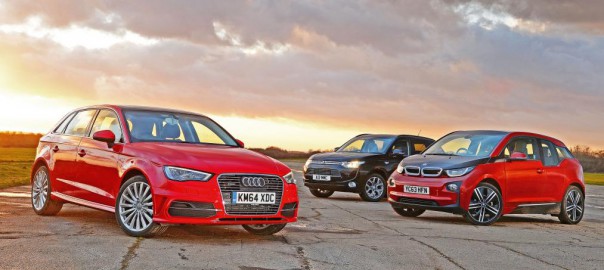
Audi A3 e-tron, Mitsubishi Outlander and BMW i3 plug-ins

Audi A3 e-tron vs BMW i3 & Mitsubishi Outlander PHEV

Plug-in cars promise great efficiency, but is Audi’s new A3 e-tron hybrid a better bet than range-extending i3 and Outlander?

Eco-friendly plug-in models are slowly gaining in popularity, so it’s no real surprise that after decades of experimentation Audi has finally decided to jump on the petrol-electric bandwagon.

The new A3 e-tron is based on the classy A3 Sportback, and packages together a 1.4-litre petrol turbo and 75kW motor, while a compact lithium-ion battery pack sits under the back seat. Its raw statistics certainly look compelling, with a 31-mile claimed electric range, CO2 emissions of 37g/km and 176.6mpg economy.

Just as importantly, Audi says these figures don’t come at the expense of the standard Sportback’s space, refinement and upmarket appeal.

However, there are many different ways to package the perfect plug-in, as our other contenders here prove. Mitsubishi’s rugged Outlander PHEV claims to deliver all the practicality of the standard model, but – with a 30-mile electric range – city car-humbling costs.

Completing our trio is BMW’s daring i3 Range Extender, which sets the class standard for efficiency, design and driving dynamics.

Read more: AutoExpress

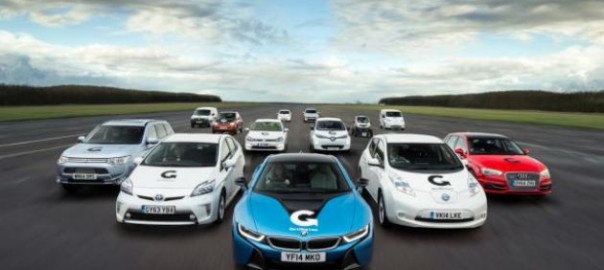
Go Ultra Low members boast 15 ULEVs across a range of segments (Image: OLEV)

New manufacturers join Go Ultra Low

Three new car manufacturers have joined Go Ultra Low, the campaign to increase awareness of ultra-low emission vehicles (ULEVs) among British car buyers.

Audi, Mitsubishi and Volkswagen have joined BMW, Nissan, Renault and Toyota to work with government to raise awareness of the benefits of ULEVs including low running costs and government incentives.

Between them, the seven Go Ultra Low members boast 15 ULEVs across a wide variety of model sizes and performance attributes, from family cars and vans, to SUVs and high performance sports cars. This broader scope of products has increased the appeal of ULEVs to more buyers, and increased uptake.

Go Ultra Low members boast 15 ULEVs across a range of segments (Image: OLEV)

With the recent announcement from OLEV that 23,083 claims have been made through the Plug-in Car Grant scheme, the number of electric cars and vans in the UK now exceeds 24,500 vehicles for the first time.

Hetal Shah, spokesperson for Go Ultra Low, said:

“More UK car-buyers are realising the advantages of owning an ultra-low emission vehicle, and the aim of the newly-expanded Go Ultra Low consortium is to share the multiple benefits with a wider audience.

“We’ve discovered that once people learn more about the benefits of these cars and vans, they’re keen to take action and once they’ve tried them, they’re hooked.”

With pure-electric vehicles able to travel around 100 miles on a single charge and other plug-in ULEVs boasting ranges of up to 700 miles, these efficient cars are a viable, low-cost option for millions of motorists across the country.

As well as tax benefits, government currently offers up to £5,000 of the price of ULEVs and the cost of driving them is as little as 2p per mile, compared to at least 10p per mile for a typical petrol or diesel car.

The Go Ultra Low campaign is the first of its kind, bringing together the Department for Transport, the Office for Low Emission Vehicles, SMMT and the consortium of seven car manufacturers.

Source: Newspress

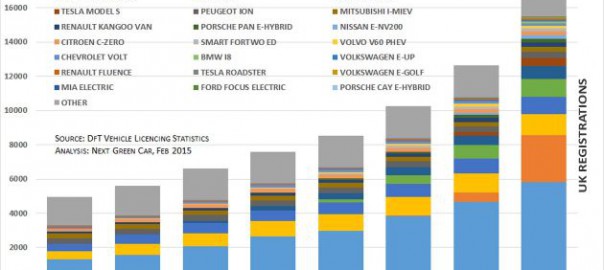
UK electric vehicle registrations UK (Image: Next Green Car)

Nissan LEAF most popular electric car in UK

Figures recently released show that the Nissan LEAF maintains its position as the most popular electric car or van in the UK, with at least 5,838 vehicles registered by the third quarter of 2014, representing over a third of all EV sales.

The registration data also shows the new Mitsubishi Outlander PHEV has made a dramatic entry to the UK market; the electric SUV is already in second position with over 2,706 sales less than a year after its UK release.

In third and fourth places are two more established plug-in hybrids, the Toyota Prius PHEV (with 1,226 registrations) and the Vauxhall Ampera (1,039 vehicles). The BMW i3 now ranks fifth with at least 1,029 UK registrations (454 all-electric and 575 range-extender variants).

The Renault ZOE and Tesla Model S are also selling well in the UK with over 775 and 474 sales respectively; the two models in fourth and fifth sales positions across Europe as a whole (YTD October 2014).

UK electric vehicle registrations UK (Image: Next Green Car)

With the recent announcement from OLEV that 23,083 claims have been made through the Plug-in Car Grant scheme, the number of electric cars and vans in the UK now exceeds 24,500 vehicles for the first time.

Another indicator that the EV market is gaining momentum is the number of fully electric and plug-in hybrid models available in the UK. While only 9 EVs were available for the major manufacturers in 2011 (excluding quadricycles), this increased to 18 models in 2013, and now stands at 24 high-quality cars and vans (in 2014) with more models due for launch in 2015.

Dr Ben Lane, Director of Next Green Car said:

“The strong growth of the EV market in the UK as elsewhere provides yet more evidence that the light-duty vehicle market is undergoing a radical change with consumer preferences changing from petrol and diesel models to electric power-trains. With sales growing exponentially, the EVs are set to become commonplace on UK roads within the next few years.”

Source: Next Green Car

2015 Mitsubishi Outlander PHEV Review

The 2015 Mitsubishi Outlander PHEV is the first affordable full size SUV plug-in hybrid from Mitsubishi and is an ambitious car that moves the game forward in the electric power stakes.

In combination with a 2.0 litre four-cylinder petrol engine that acts primarily as a generator, two electric motors propel the Mitsubishi, mostly in silence and with reasonable urgency.

Electric only range is limited to around 50km, but with some planning, it is possible to carry out most of your day-to-day activities with out the need to engage the petrol motor.

Priced at $52,490 plus on road costs it’s not exactly cheap. It does however posses a full suite of bells and whistles in addition to the advanced hybrid drive train.

To put it to the test I loaded up the fully charged Outlander with kids, dogs and luggage and headed to the picturesque Mornington Peninsula for a few days.

It was a silent run out of the city but within 30km the battery level indicator began to flash low and it was time to hit the charge button located on the centre console.

The charge button does exactly that…it fires up the coarse four-cylinder petrol engine to charge the batteries. Mitsubishi claim a full charge can be achieved using 3.0 litres of standard unleaded.

By the time we reached our destination the trip computer was reading 11 litres per 100km – far from impressive. The petrol engine was at times called on to help power the front wheels. Under full throttle load, on high speed overtaking maneuvers for instance, the combustion engine assists the electric motors to send the full combined power of 87kw to the driving wheels. So with the extra power assistance and the charging of the batteries the petrol engine was a constant companion for about 100km of the 130km trip.

Once at our destination it was time to plug the Outlander in via an adapter to convert regular 10-amp household power into the 15-amp power the Mitsubishi likes. Done this way a full charge could take up to 20 hours, however 80% of the charge happens in under a couple of hours.

If you were to buy an Outlander PHEV I’d suggest factoring in the cost of installing a 15-amp power supply at home, which provides a full charge in less than 8 hours.

Once the battery levels were a bit over three quarters full, a trip to the beach and the pub, then home again saw the batteries as the only power source.

Back in the garage, the Outlander was plugged in again; a routine kept up over four days…when the Outlander wasn’t on the road it was hooked up to the power grid. With no trips over 40km, it was four days of completely silent motoring – the petrol engine wasn’t required and the performance of the electric only drivetrain was impressive with full torque available instantly.

A coasting mode helps convert the energy generated under braking or coasting down hills into power that is fed back into the batteries.

With the battery pack in the floor, the handling characteristics of the Outlander PHEV are far superior to that of the combustion only Mitsubishi SUV’s thanks to a low centre of gravity, although don’t expect sports car like dynamics, this is after all a high riding SUV.

The return trip back to the city saw identical performance as the trip to the beach, and once home the routine of keeping the Mitsubishi plugged in while not on the road produced exceptional results.

Over two weeks and 750km the total fuel consumption was 3.1 litres per 100km, and days would go by where the petrol engine was never heard.

If you lived within 20km of your daily work destination, it is entirely possible to expect to get away with electric only motoring…only the big trips highlight the weaknesses of the Mitsubishi Outlander PHEV limited range.

In every other way the Mitsubishi Outlander PHEV performs just like a regular SUV. Unlike the other Outlanders in Mitsubishi’s range no seven-seat option is available, that’s it though, everything else is just the same.

Blind spot monitoring, reverse camera, radar controlled cruise control, satellite navigation, a decent sound system and electric drivers seat, along with a full leather interior and plenty of space for passengers and cargo alike make the Mitsubishi Outlander PHEV a very useable family vehicle with virtually no option boxes left to tick.

Read more: BehindTheWheel.com.au

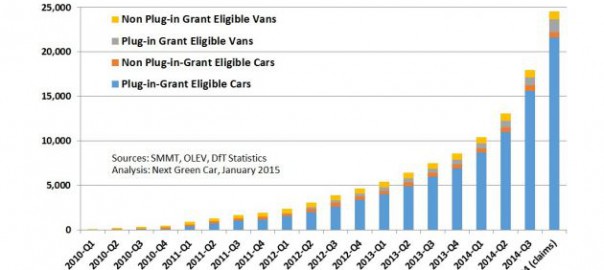
UK electric fleet passes 24,500 mark

With the recent announcement from Office for Low Emission Vehicles (OLEV) that 23,083 claims have been made through the Plug-in Car Grant scheme, the total number of electric cars and vans in the UK is about to exceed 24,500 vehicles for the first time.

uk-registered_ulevs_2010-2014-3_NGC

These figures are supported by the Society of Motor Manufacturers and Traders (SMMT) which reports that 19,972 plug-in cars were registered in the UK by the end of 2014.

Taken together with the fact that at least 1,467 electric cars and vans which are not eligible for the Plug-in Grant scheme have also been registered, the total UK light-duty electric fleet will number at least 24,550 in the coming weeks as vehicles are delivered and formally registered for use on UK roads.

Given that the figure for the number of non-OLEV eligible registered EVs takes longer to become publicly known, it is highly likely that the total number of registered ULEVs in the UK now surpasses 25,000 vehicles in total (cars and vans).

Another indicator that the electric market is growing in strength is the number of fully electric and plug-in hybrid models available in the UK. While only 9 EVs were available for the major manufacturers in 2011, this increased to 18 models in 2013, and now stands at 29 high-quality, fully crash tested cars and vans with more models due for launch in 2015.

Dr Ben Lane, Director of Next Green Car said:

“The number of EVs registered in the UK continues to grow exponentially demonstrating that UK car buyers are continuing to embrace the EV revolution.

“Reports from new EV owners suggest that, rather than economic or environmental arguments, it is the dramatic improvement in driving experience that it really starting to change perceptions about electric power-trains.

“Recent research from Nissan also shows that driving range is much less of an issue than previously thought with European owners of Nissan LEAFs travelling more than 50% further per year (10,307 miles) than the European average for a petrol/diesel vehicle (6,721 miles).”

The latest EV model entrants include the Tesla Model S and Mitsubishi Outlander PHEV which have already made their mark in the UK market. Other high-quality models now available include the Kia Soul EV (which NGC range-tested in December 2014) and the Nissan e-NV200, the latter bringing all the benefits of electric to the small van market.

Source: Next Green Car

Mitsubishi go premium with Outlander GX5h

Sumptuous leather seats that are individually hand crafted, low level mood lighting, a sound system dynamically optimised with the vehicle’s interior acoustics and all-essential multiple USB charging ports are prerequisite in a luxury company car – and standard in the newly launched Outlander GX5h and GX5hs plug-in hybrid electric vehicle.

Externally the new models have full length side steps for easier access and the addition of a rear spoiler.

Moreover the new Outlander GX5h and GX5hs invite very little interest from HM Revenue and Customs. The top of the range GX5hs priced at £44,999 attracts just £75 a month in personal benefit-in-kind tax and is exempt from road tax.

The vehicle has phenomenal environmental and economy credentials. It emits just 44g/km of CO2 and the official combined fuel consumption figure is 148mpg. It is eligible for the Government’s plug-in car grant and companies can offset 100 per cent of the purchase value against profits in the first year.

Clive Messenger, Head of Corporate Sales, Mitsubishi Motors in the UK, says:

“The GX5h and GX5hs plug-in hybrid Outlanders offer such a fantastic package of benefits for both companies and company car drivers – high specification, luxury feel, low running costs, strong environmental credentials. We are expecting it to quickly populate company car choice lists UK-wide.”

Interior

  • Sumptuous high-line Nappa leather seats, dash, door and console lining in Porcelain Beige, Claret Red or Gunmetal Grey.
  • Acoustically optimised audio system – seven speaker 420W premium Alpine Hi-Fi system, with silk dome tweeters to provide accurate and smooth highs, powerful 16.5cm midrange drivers and 20cm subwoofers for deep lows. The audio system has been specifically tuned for the Outlander GX5h and GX5hs interiors, in a soundproofed audio chamber and using sophisticated sound measurement equipment.
  • Floor level, front and rear mood lighting, LED interior lights and ‘puddle’ lamps.
  • Front and rear heated seats.
  • Twin rear USB charging port.

Exterior

  • Integrated side steps.
  • Rear spoiler.
  • Outlander bonnet badge.
  • LED Fog lamps and DRLs with chrome surrounds.

Colours

The new Outlander PHEV GX5h and GX5hs will be available in all five Outlander PHEV colours:

  • Atlantic Grey (Metallic)
  • Glacier Blue (Metallic)
  • White Pearl (Pearlescent)
  • Frost White (Solid)
  • Amethyst Black (Pearlescent)

Read more: Diesel Car Magazine

Mitsubishi Outlander PHEV (Image: AutoExpress)

Mitsubishi Outlander PHEV review

Game-changing Mitsubishi Outlander PHEV plug-in hybrid SUV can deliver 148mpg and CO2 emissions of just 44g/km

Verdict: 4 stars
The Mitsubishi Outlander PHEV is a refined SUV with some impressive economy figures that cars of a similar size simply cannot match. It’s not a particularly scintillating drive and the ride is a bit unsettled, but Mitsubishi have built something worth looking at if you’re after a 4×4 with plenty of space and ultra-low running costs.

The Mitsubishi Outlander PHEV became the world’s first plug-in hybrid SUV when it went on sale early in 2014. With a high-tech powertrain and headline economy figures of 148mpg and 44g/km of CO2, it’s made a big impact on the UK car market, particularly among company car drivers.

Thanks to the £5,000 Government plug-in car grant, the Outlander PHEV prices range from just over £28,000 for an Outlander GX3h to £40,000 for the top-spec GX5hs. With the GX4h and GX4hs in the middle of the line-up, overall prices for the PHEV are largely the same as for the equivalent diesel Outlanders, giving buyers an interesting decision.

Further efficiency and economy benefits from owning an Outlander PHEV include exemption from road tax and the London Congestion Charge. Although, electric cars have previously enjoyed a zero per cent Benefit in Kind (BIK) company car tax rate, as of April 2015 rates are going up. Owners of cars such as the Outlander PHEV will still only be liable for the five per cent tax bracket.

On the road, it’s no surprise that the Mitsubishi Outlander PHEV is much quieter than the regular diesel Outlander, no matter which mode the car is operating in. Be it petrol engine and electric motors working in sync, or as a pure EV, the PHEV is extremely hushed.

The impressive refinement of this Mitsubishi hybrid is due to enhanced sound deadening throughout the car, but also thanks to the hybrid powertrain, which favours running in all-electric mode. The petrol engine is noticeable when you start the car up, but it’s never overly loud or intrusive.

Read more: Auto Express

Tesla Model X (Image: Tesla)

Top 10 Electric Vehicles Coming Soon in 2015

Last year marked a big breakthrough for electric cars; the majority of major manufacturers invested heavily in developing electric drive-trains and subsequently added an array of appealing battery-electric (BEV) and plug-in hybrid (PHEV) models to their rosters.

By the end of 2014 there were over 17,000 plug-in cars and vans on UK roads with that number expected to more than double by the end of this year.

As noted by Dr Ben Lane, Managing Editor of Next Green Car: “2015 will see a continuing roll out of battery electric and plug-in hybrid models as UK motorists become more accustomed to electric drive-trains. This year will be the year when EVs start to considered as ‘normal’.”

The future is only looking bright for electric mobility and there a number of exciting EV prospects expected to feature prominently this year. Below is Zap-Map’s list of top 10 electric vehicles coming soon in 2015:

1. Tesla Model X – BEV

Tesla Model X (Image: Tesla)

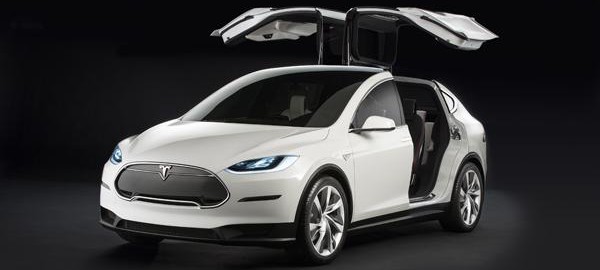
Originally scheduled for 2013, Tesla recently announced that the eagerly anticipated Model X crossover will be launched in the third quarter of 2015. Despite being larger than the Model S, the all-wheel electric drive will give the Model X a similar level of performance (that’s 0 to 60 mph in around 5.9 seconds!). With 10% additional weight, the expected driving range will be slightly less; around 170 miles for the 60 kWh battery pack or 230 miles for 85 kWh battery. One the striking features of the next Tesla will be its rear ‘Falcon’ doors which open upwards instead of swinging outward. Final pricing has yet to be announced. Although it’s been a while coming, with the new Model X, Tesla is unlikely to disappoint.

2. Volkswagen twin-up! – PHEV

Volkswagen twin-up! PHEV (Image: VW)

The twin-up!’s 55kW powertrain consists of a 0.8 litre TDI diesel engine working in conjunction with a 35kW electric motor. The energy storage system includes a lithium-ion battery (energy capacity: 8.6 kWh), a conventional 12V battery for on-board electrics, and a 33 litre capacity fuel tank. On the official test cycle, the twin-up! delivers a combined fuel economy of over 250 MPG with a CO2 emissions of just 27 g/km. In zero-emission operation the PHEV can cover a range of 31 miles and is anything but a slouch: the twin-up! accelerates up to 62 mph in 15.7 seconds and has an all-electric top speed of 80 mph. Pricing to be announced.

3. Mercedes-Benz B-Class Electric Drive – BEV

Mercedes B Class Electric (Image: Mercedes-Benz)

The Mercedes-Tesla relationship is evident (and welcome) in the B-Class ED with the drive-train and battery pack coming from the California-based company. Capable of 125 miles per full charge, the B-Class ED provides electric motoring in a quality package with more reserved styling than some other brands such as the BMWi range. While the motors can deliver up to 179 bhp (Sport mode), two other driving modes are available: ‘Economy’, where power is limited to 131 bhp; and ‘Economy Plus’ with just 87 bhp and a maximum speed of 70 mph. Expected to be priced from around £27,000.

4. Volvo XC90 plug-in hybrid – PHEV

Volvo XC90 PHEV (Image: Volvo)

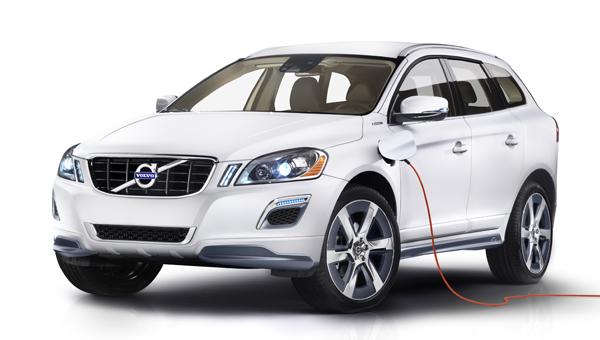
No doubt encouraged by the huge success of the Mitsubishi Outlander PHEV, Volvo will bring its own plug-in SUV to market in 2015, in addition to the usual range of petrol and diesel engines. While all will offer four-wheel drive, for the first time there will also be a front-wheel drive option. The XC90 PHEV will also feature a collection of entertainment and safety technology including a 9.3 inch screen compatible with Apple’s new CarPlay interface and Volvo’s new collision avoidance system. The XC90 range is priced from £45,750.

5. Volkswagen Passat GTE plug-in hybrid – PHEV

Volkswagen Passat GTE PHEV (Image: VW)

Now in its eighth incarnation, the new Passat range includes the GTE, the first Passat with a plug-in hybrid drive. Powered by a turbocharged direct injection petrol engine (TSI) and an 85kW electric motor, the GTE is capable (on the official test) of over 141 MPG (petrol) and 13.0 kWh/100km (electric) with CO2 emission of under 45 g/km. On a full tank and fully recharged 9.9 kWh lithium-ion battery, the new PHEV has a total driving range of over 620 miles. In ‘E-Mode’, the Passat GTE can also cover a distance of up to 31 miles with zero emissions. AC charging options include standard (or ‘slow’) charging at 2.3 kW from a domestic socket in 4.25 hours or an optional a home 3.6 kW charger which provides a full charge in 2.5 hours. Anticipated pricing from around £20,000.

6. BMW X5 e-drive – PHEV

BMW X5 e-Drive PHEV (Image: BMW)

The BMW X5 e-drive concept was first unveiled at the 2013 Frankfurt International Motor Show and is seen as the logical next step for the successful X5 series. Combining a four-cylinder combustion engine with BMW TwinPower Turbo technology and lithium-ion battery, the plug-in hybrid can driver approximately 19 miles solely on electric power. There is a choice of three driving modes, depending on requirements and situation – the intelligent hybrid drive option for a balance between sportiness and efficiency; pure electric and therefore emission-free driving; or Safe Battery mode to maintain the current battery charge. According to BMW, the X5 e-drive is capable of 74.3 mpg and on average emits 90g of CO2 per kilometre. Estimated to be priced at £55,000 – £60,000, the X5 e-drive is on course to directly compete with the Volvo XC90 PHEV.

7. Renault Zoe 2015 (new battery) – BEV

Renault ZOE EV
Renault ZOE EV

Renault’s battery-electric Zoe, the second best-selling EV after the Nissan LEAF, will be revitalised by a smaller and more efficient electric motor in 2015. By reducing the motors size, Renault expects a 10% increase in the Renault Zoe’s official 130 mile range. Renault also claims the improvements will reduce charging time by 20-30 minutes when using low-level power supply such as a 3kW 3-pin slow charging unit. The upgrades to the Zoe will be added to all new models from Spring 2015 Renault say.

8. Mitsubishi Outlander PHEV S – PHEV

Mitsubishi Outlander PHEV-S (Image: Mitsubishi)

Following on from the successful Outlander PHEV launch in 2014, Mitsubishi plans to release the Outlander PHEV-S. Power for the Outlander PHEV-S is expected to come from the same four-cylinder 2.0-litre petrol and twin electric motor system that drives the original car. This will see up to 204bhp sent to all four wheels, resulting in a 0-62mph time of 11 seconds and a 106mph top speed, whilst offering 148mpg and emissions as low as 44g/km CO2. The main difference will be in appearance, offering a refined interior and exterior design that will magnify the Outlander PHEV’s unique driving experience. Pricing to be announced.

9. Audi Q7 Quattro plug-in hybrid – PHEV

Audi Q7 e-tron Quattro (Image: Audi)

The Audi Q7 e-tron quattro, which will be launched soon after its conventionally powered counterparts in the spring, is the first plug in hybrid from Audi with a diesel engine. It is also the world’s first diesel PHEV with quattro all-wheel drive in the premium SUV segment. It returns the equivalent of up to 166.1mpg, which corresponds to less than 50 grams of CO2 per kilometre and can travel just under 35 miles on battery-electric power alone. Pricing to be announced.

10. Peugeot Quartz – PHEV

Peugeot Quartz PHEV (Image: Peugeot)

The Quartz plug-in hybrid concept mixes elements of a crossover vehicle and a saloon, to bring a new take on the SUV segment. It uses a plug-in hybrid drive train comprising of a 1.6-litre petrol engine supplemented by two 85kW electric motors, driving each axle. When the vehicle is in ZEV mode, it utilises the electric motor only and can cover up to 31 miles on a single battery charge. Peugeot have estimated the vehicle will not reach production until 2016; it will be interesting to see if the striking design mellows between now and then.

Source: Zap-Map