Category Archives: Outlander PHEV

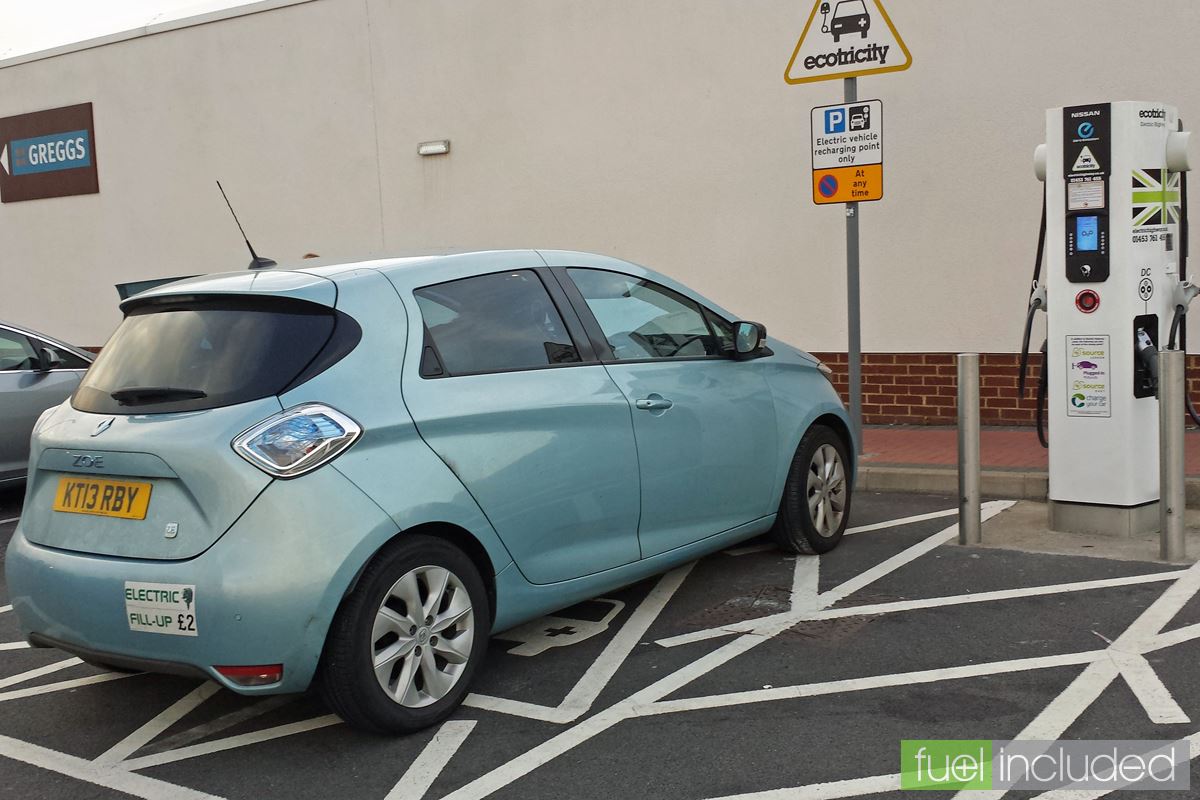
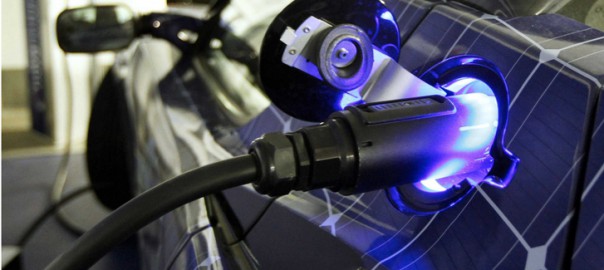
Electric Car Recharging

Is now the time to buy an electric or hybrid car?

Best cars and options explored

The future of driving appears to be electric, with Formula E in full effect, supercars adopting hybrid drive systems and range getting further all the time. Fuel powered engines may have their days numbered. But is it time to make the change to electric?

Now that the big car manufacturers are creating hybrid and electric cars we can be assured that it’s the future. And thanks to infrastructure improving all the time for charging stations range isn’t becoming such a big issue. But last year’s Tesla owners won’t get updated with the latest self-driving tech of this year’s Tesla, not a very nice reward for early adopting.

So is it still too early to adopt? Are batteries in cars suddenly going to improve to make current models a joke? We’ve looked at what going on to help give you a clearer idea of what to do.

Pure electric cars right now

The selection of pure electric cars right now isn’t huge, but it’s more than ever before and range is now good enough for day-to-day use. Prices, in the UK at least, are kept reasonable thanks to government assistance taking £5,000 off the price and offering free tax. If you offset petrol costs too you’re saving even more.

At the top end there’s Tesla with its Model S boasting all wheel drive and self-driving smarts starting at around the £50,000 mark. But this is in a league of its own with sports car performance, plus the latest model is not actually going to be in the UK until July 2015, even if you can buy yours now.

Then there are established brands like BMW, Ford, VW, Nissan and Renault all making fully electric cars at affordable prices right now.
Range, charging times, price and power

When going electric most people will be juggling these few key numbers: range, charging time, price and power.

PRICE: Firstly there’s price, at which the Renault Zoe wins by a fair margin starting at £14,000. Nissan’s Leaf can be bought from £16,500, Kia’s Soul EV is £25,000, the VW e-Golf is from £26,000, and BMW with its i3 is from £31,000.

RANGE: The range winner, from the reasonably priced cars, is the Kia Soul EV with 135 miles. In close second is the Nissan Leaf with 124 miles. Coming in behind them is the BMW i3 with a 118 mile range along with the VW e-Golf also sporting a 118 mile range, followed by the Renault Zoe with 93 miles.

Of course if you include the Tesla Model S that wins with its base model eeking out an impressive 240 miles on a charge and its top end offering 312 miles a go. But you get what you pay for.

CHARGE: This is a fairly even playing field with the cars all offering a rapid charge to 80 per cent in half an hour. Across the board it’ll cost you to upgrade your home charger for faster charging but this can result in as fast as a 3-hour charge to full.

POWER: Electric cars deliver all their torque instantly and the engine directly powers the wheels, this means they feel really nippy pulling away. The Nissan Leaf utilises 107hp to do 0-60mph in just 7 seconds making it the quickest of the lot off the mark.

The BMW i3 has 170hp for a 0-60mph time of 7.2 seconds, the Renault Zoe has 83hp for a 0-60mph time of 8 seconds, and the VW e-Golf manages 0-62mph in 10.4 seconds thanks to its 114hp motor. In last place is the Kia Soul EV with its 108bhp delivering a 0-60mph time of 10.8 seconds.

So for price the Renault Zoe wins it, but for range and power the Kia Soul EV comes out on top.

Plug-in hybrid electric cars right now

Hybrids have been around for years with the Toyota Prius leading the way with its dual-drive system. These are now more common than ever with Uber drivers using Prius as the car of choice.

But the market has grown, especially recently, with plug-in hybrids that allow drivers to charge at home so they may never need to use the fuel engine, instead reserving that for long distance journeys only.

From the Volvo V60 Plug-in and Ford Mondeo Titanium Hybrid to the Golf GTE or the BMW i3 with range extender, hybrids are fast becoming viable alternatives to single engine cars. The extra you may spend on the new technology can soon be made back in the petrol and tax savings they offer.

Range, charging times, price and power

Plug-in hybrid cars mean less of a worry about range than pure electric while also offering power and a reasonable price.

As with the Tesla we’re not going to include the likes of the McLaren P1, BMW i8, Porsche 918 and Ferrari LaFerrari as they’re all reserved for the super rich. And we’re only using plug-in hybrids as straight hybrids are fast becoming outdated in favour of the electric only options and extended range of plug-in hybrids.

PRICE: The plug-in hybrid range have all arrived at a similar time with manufacturers savvy to the government’s £5,000 contribution. For this reason they’re all very similarly priced.

The winner, by a narrow margin is the Ford Mondeo Titanium Hybrid from £25,000, with Mitsubishi PHEV GX3h from £28,250 in second and closely followed by the Toyota Prius Plug-In Hybrid from £28,395.

Then we have the Vauxhall’s Ampera from £29,000, Audi A3 Sportback e-tron from £35,000, BMW i3 Range Extender from £34,000 and Volvo V60 Plug-in hybrid from £45,000.

RANGE: Winning with an impressive 967 mile range is the Ford Mondeo Titanium Hybrid but it only manages around 20 miles on electric alone. Closely behind that is the BMW i3 with range extender that offers a 930-mile top end with pure electric for 105 miles, making it overall cheaper to run than the Ford. The Toyota Prius Plug-In Hybrid can manage up to 700 miles in one journey but loses on electric alone with just 15 miles on a charge.

Audi’s A3 Sportback e-tron can last for 585 miles with 31 of those miles on electric alone. Despite its size the Mitsubishi PHEV GX3h manages 500 miles with 32 on electric alone. Vauxhall’s Ampera eeks out 310 miles with between 20 and 50 of those miles on battery.

CHARGE: As in pure electric cars this is a fairly even playing field with the cars all offering a rapid charge to 80 per cent in half an hour. Across the board it’ll cost you to upgrade your home charger for faster charging but this can result in as fast as a 3-hour charge to full.

POWER: The Audi A3 Sportback e-tron, as the name suggests, wins this with a 0-62mph time of 7.9 seconds thanks to 204hp. The BMW i3 Range Extender model is second offering 170hp for 0-60mph in 7.9 seconds.

The Vauxhall Ampera does 0-60mph in 8.7 seconds with 148hp, despite having 178hp the Ford takes 9.2 seconds to get from 0-62mph, the Toyota Prius Plug-In Hybrid gets from 0-60mph in 11 seconds from 134hp, the Mitsubishi PHEV GX3h does 0-60mph in 11 seconds and has 186hp.

The winner for price is the Ford Mondeo Titanium Hybrid but the BMW i3 takes it for range with the Audi offering the most power.

Future electric and hybrid cars

The future of electric cars and hybrid machines is looking positive. Charging infrastructure is cropping up all over the country with Tesla’s Elon Musk promising to install his Supercharger network UK wide by the end of next year.

Crucially, right now, it’s possible to drive pure electric all the way from the top of Scotland to the bottom of England thanks to fast chargers along the way. It might take a little longer than petrol cars since you have to stop for half an hour to recharge, but it won’t cost as much by a long shot. So adopting right now, especially if you’re going for a hybrid, isn’t as risky as it once was.

Another issue is batteries. Developments are being made more and more regularly as car manufacturers pour money into research. But worrying about having an older battery shouldn’t be an issue as, hopefully, manufacturers will be able to swap out old for new future-proofing any car you buy now.

Next year Tesla hopes to offer a car which is nearly completely self-driving. But since that’s out of the price range of most people current electric car offerings are plenty futuristic.

If you’re already driving a car and the cost of petrol and tax are proving too much then electric or hybrid could be your way out.

Source: Pocket Lint
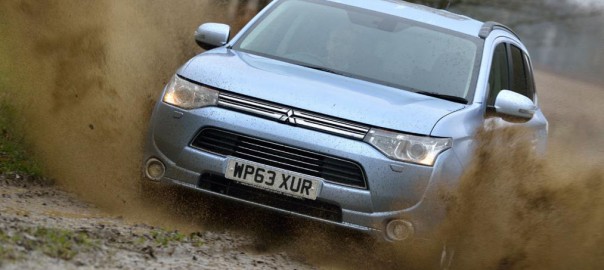
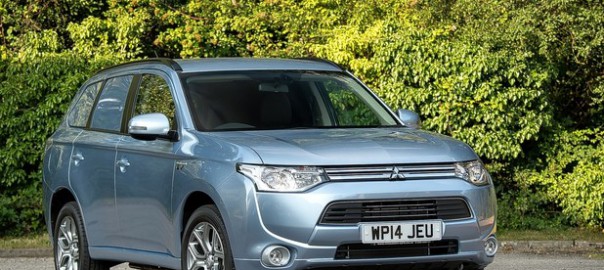
Mitsubishi Outlander PHEV (Image: AutoExpress)

Mitsubishi Outlander PHEV 2014 review

First-ever plug-in hybrid SUV promises to save owners thousands of pounds

Verdict:

SUV owners – and company car users in particular – can save serious cash with the Outlander PHEV, especially if they don’t drive mega miles. That’ll make rival plug-in hybrid manufacturers sit up, take notice and, hopefully, react. There’s plenty of space and kit on offer, too. The only shame is that the Outlander isn’t more engaging to drive or better quality.

Once in a while a game-changer comes along – a car that proves a hit with buyers and makes rivals rush to copy the concept. The Mitsubishi Outlander PHEV is one of those cars.

On the face of it, it’s a pretty good plug-in hybrid based on a pretty average SUV. But Mitsubishi has chosen to break with tradition and price this PHEV model exactly the same as its diesel equivalent.

To put that into context, the most expensive Volvo V60 diesel estate costs £35,505, while the plug-in hybrid version costs £44,275. The Outlander PHEV starts from just £28,249 (after the Government’s kind £5,000 grant) for the nicely equipped GX3h model, but even our top-spec GX4hs is still hugely tempting at £34,999.

For that you get a stylish SUV with a good-sized boot (436 litres) and plenty of space for five, at a price that’s the same as an Outlander diesel auto.

But while the diesel claims 48.7mpg, the PHEV claims 148mpg. Even Mitsubishi will tell you that’s unlikely, but we still managed an impressive 92mpg. If you plug in regularly and do less than the 32-mile electric range each day, you’ll barely see a filling station.

The savings don’t stop there – with emissions of 44g/km you’ll save thousands on company car tax compared to diesel SUVs, the road fund licence is free and there’s no Congestion Charge to drive into London.

The only compromises when driving are due to the Outlander’s dynamics. Whether on EV or petrol power or any combination of the two, performance is smooth if not scintillating.

The ride is a bit too firm for our liking, but there’s the reassurance of four-wheel drive for light off-roading or to help with towing.

With good visibility, light controls and decent practicality, the PHEV is an easy car to live with.

You’ll need a PhD to understand the infotainment system, though, and the quality inside is a bit of a letdown. But when you’re saving so much cash, there’s more to like than not.

Source: AutoExpress

Mitsubishi Outlander GX4hs 2.0 PHEV Auto

MITSUBISHI believes it’s a game-changing SUV, but does the part electric Outlander spark our interest?

https://www.youtube.com/watch?v=-Wm_stGjr7k

On the road

THIS particular Outlander may look like any other 4×4 from the outside, but it’s much more than that on the inside.

And while the name might not exactly trip off the tongue, the technology under the skin comes across loud and clear.

The PHEV is a plug-in hybrid with all the capabilities of a serious off-roader.

With a two-litre petrol engine allied to an electric motor it offers the best of both worlds and what’s more it seamlessly shifts between the two.

The additional weight that comes with carrying two forms of propulsion feels like a benefit rather than a hindrance, in terms of body control, as the Outlander isn’t as ungainly as some cars of its ilk.


On the inside

THE interior of the Outlander strikes a balance between function and form.

I found it easy to get comfortable and all the things you need on a regular basis come easily to hand.

As you might expect, views from all angles are very good and while you are sat higher than much of the rest of the traffic, it is not so tall as to cause vertigo in the nervous driver. A negative comes in the form of the touchscreen satellite navigation, audio and information system, which isn’t the most intuitive and often requires you to negotiate a number of screens to get to where you want to be.


What do you get

ALONG with the usual adornments, our PHEV came with a rear view camera, powered boot, keyless ignition, dual zone climate control, DAB radio, leather seats, electric sunroof, electric folding and heating mirrors, 18ins alloys and Bluetooth. There was also privacy glass, steering wheel audio controls, cruise control and a – highly sensitive – lane departure warning function.


How practical is it

THERE are a couple of areas of practicality to consider when evaluating the PHEV. Obviously, space is one, given that this is a fully functioning SUV. There’s more than enough room for five and when you need to transport more passengers, there’s the addition of two seats stowed away in the boot floor. Perhaps better suited to the younger or more agile among us, they were nevertheless a welcome option.

The boot isn’t the biggest at 463 litres, but it’s more than capable of carrying an average sized payload for the sector. On the technological front, on a full charge – which takes the best part of a day unless you have the benefit of a quick charger – you can get around 30 miles of fully electric running. That’s enough for those faced with an average daily commute and means you may never have to visit the petrol station. Not only that but it can also charge while underway or idling.

If you need to cover more miles, on a weekend say or in an emergency then there’s the reassurance of that tank of petrol.


Running costs

The Outlander PHEV is competitively priced, is eligible for the Government’s £5,000 plug-in car grant and the entry level model costs the same as its diesel counterpart, which makes for a refreshing change.

As mentioned before, theoretically, you may never need to refuel again but when or if you do, you should be pleasantly surprised by the return you get. Mitsubishi states a theoretical high of 148mpg, but even an average of 50mpg in a real world driving scenario is a figure you wouldn’t baulk at from a diesel, never mind a petrol powered vehicle. CO2 emissions are incredibly low, from just 44g/km meaning no car tax.

Verdict: A BIG car that promises big savings.

Source: Northern Echo

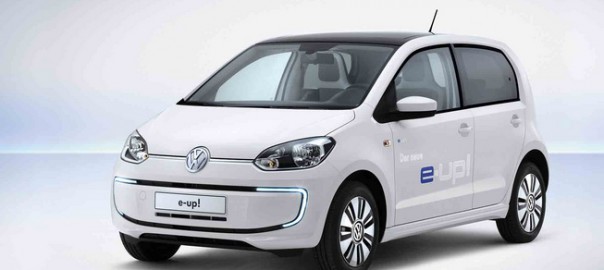
Volkswagen e-UP (Image: VW)

2014 Next Green Car Awards fetes VW e-Up!, Tesla Model S

The California-made Tesla Model S was one of about a dozen models given props by the Next Green Car Awards. And the prizes ran the gamut between conventional, diesel, plug-in and battery-electric powertrains because who doesn’t like variety?

Leading off in the Next Green Car awards was the Volkswagen e-Up!, which took home the City Car award:

“With the e-up!, Volkswagen has produced a high quality, practical and affordable electric city car which is perfect for zero-emission urban driving where space is a premium.”

Americans may associate “Family Estate” cars with huge, fake-wood-paneled station wagons of the ’70s and ’80s (and with Clark Griswold), but NGC gave the Family Estate award to the far-more-fun Audi A3 Sportback e-tron plug-in hybrid.

“As the first plug-in hybrid estate car, the A3 Sportback e-tron perfectly combines conventional fuel practicality for long distance driving with zero-emission motoring for urban trips.”

The Mitsubishi Outlander Plug-in Hybrid, Nissan e-NV200 Combi and Mercedes-Benz B-Class Electric were also all given props.

“The Outlander PHEV sets the SUV bar high offering plug-in capability for the price of a diesel. With a 5% BIK rate, you can see why the Outlander is the UK’s most popular plug-in hybrid.”

“With the e-NV200, Nissan has broken new ground offering an affordable and practical zero-emission alternative to the ubiquitous diesel van.”

“Powered by Tesla know-how, the Mercedes electric B-Class brings electric mobility to the compact MPV class for the first time. High on quality, long on range, and zero on emissions.”

Finally, the Tesla took home the top-of-the-line “Executive” prize.

“Simply the most beautiful and technologically advanced electric car on the market, the Model S combines a gadget-packed interior with an exhilarating electric driving experience.”

Read more: Autoblog, Next Green Car

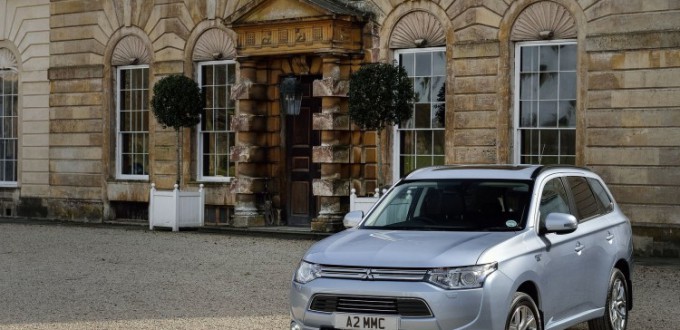
Mitsubishi Outlander PHEV

Mitsubishi Outlander PHEV’s Winning Turn

MITSUBISHI’S hugely successful Outlander plug-in hybrid SUV has picked up yet another trophy after the company was voted the best plug-in hybrid electric vehicle manufacturer at the recent Green Fleet Awards.

The awards recognises the manufacturer of either a commercial or consumer plug-in hybrid electric vehicle (PHEV) that demonstrates the best performance and best suitability for purpose in its class. Short-listed alongside the Mitsubishi Outlander was the Toyota Prius and the Volvo V60.
Advertisement

Clive Messenger, head of corporate sales at Mitsubishi UK said:

“We are absolutely delighted that we have won PHEV Manufacturer of the Year at the GreenFleet Awards. The Outlander is an exciting new vehicle, at the forefront of a new era in fleet and company car use.”

The car is a full-sized family 4×4 SUV that uses both electric and petrol power.

However, it boasts an impressive range in zero-emission mode, being capable of doing more than 32 miles on a charge – more than the average commute. That means if an owner only uses it for shorter trips and tops up the battery overnight at home, in theory, it should be able to run almost without petrol.

Such an impressive electric range gives the vehicle phenomenal environmental credentials. It emits just 44g/km of CO2 and the official combined fuel consumption figure is 148mpg.

Source: Stoke Sentinel

Outlander PHEV wins towcar award

The Outlander PHEV won the judges' Innovation Award (Image: NGC)
The Outlander PHEV won the judges’ Innovation Award (Image: NGC)

The Caravan Club, formed in 1907 and now representing over 375,000 members, has honoured Mitsubishi Motors with its ‘Award for Innovation’ for the Outlander Plug-in Hybrid Electric Vehicle (PHEV). The award was made at The Caravan Club’s Towcar of the Year presentation at the Royal Automobile Club, London.

The Outlander PHEV is a full-sized family 4×4 SUV. It uses both electric and petrol power to propel itself. Unlike many other traditional hybrid vehicles, the Outlander PHEV can travel 32.5 miles without using any petrol. It emits just 44g/km of CO2 and the official combined fuel consumption figure is 148mpg.

Stewart Mckee, Mitsubishi Motor’s General Manager for Press, Public Affairs and Events received the award from Nick Lomas, Director General of the Caravan Club. Stewart said:

‘We are very grateful to the Caravan Club for recognising the plug-in Outlander with its special award for innovation.’

The annual Towcar of the Year Competition tells members which is the best towcar to buy in 2015. The judging is carried out by caravan journalists, national motoring journalists and Caravan Club members at Millbrook Proving Ground in Bedfordshire and attracted 39 entries this year.

Vehicles are evaluated using the same criteria; acceleration, braking, reversing, ergonomics, hill-starting, visibility, traction and the suitability of the gear box.

Source: Next Green Car

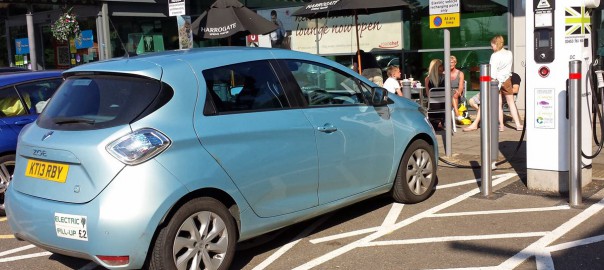
My Renault ZOE fast charging at Rothersthorpe Services (Image: T. Larkum)

My Longest Trip in the Renault ZOE

Mitsubishi Outlander fast charging at Rothersthorpe Services (Image: T. Larkum)

During the summer we took our longest ever single trip in the ZOE, from our home in Northampton down to Brighton and back in a weekend. We went down for a gymnastics competition on the Saturday in which my daughter was taking part. After the event was over, we had a good time walking around the town on the Saturday and lazing on the beach on the Sunday.

My Renault ZOE fast charging at Rothersthorpe Services (Image: T. Larkum)

We started out Friday evening. I had been at work in Milton Keynes as usual that day so by the time I got back to Northampton I was already 40 miles down on range. I therefore went home via the Northampton Rothersthorpe motorway services to top up at an Ecotricity rapid charger. I initially tried the northbound side but the chargepoint there was occupied by a Mitsubishi Outlander PHEV. Instead I hopped over to the southbound side, and filled up without incident so getting home (about 10 miles further on) nearly full. I plugged in the ZOE while we packed to leave so it would be 100% full on leaving.

Fast charging at Toddington Services (Image: T. Larkum)

We left home a little before 8pm and headed down the M1. We pulled in at Toddington to recharge only to find the charge point broken. Not a major emergency, however, as we had had this occur before and knew what to do. I got permission from the service station manager and drove across the service road to the northbound side. There we plugged in, charged up and had some food.

Taking a break at Cobham Services (Image: T. Larkum)

We continued our journey down the M1 and then around the M25 to the new services at Cobham. There we had our second charge, after which we headed down the M23 towards Brighton. This was the longest leg of the journey and although we had just about enough charge to get to Brighton, I wasn’t confident that we could easily get a charge once we arrived. We therefore popped into the Pease Pottage services as we went past and just had a five minute top-up (enough for an extra 15 miles driving) while sitting in the car.

A brief top-up in a rather dark corner of Pease Pottage Services (Image: T. Larkum)

We needn’t have worried though, as we didn’t use the car much once we were in Brighton. It had comfortably enough charge to get us to the gymnastics venue and back. The competition went well, and my daughter was awarded a gold medal in her category.

Gymnastics medal event (Image: T. Larkum)
Gymnastics medal ceremony (Image: T. Larkum)

After the event we spent Saturday afternoon walking along the promenade and around the town. On the Sunday we had a great time on the beach, and then it was time to head home.

Mitsubishi Outlander Plug-in Scoops BusinessCar Green Award

Mitsubishi Outlander PHEV

CIRENCESTER – Mitsubishi Motors in the UK is celebrating the news that the all-new Outlander Plug-in electric 4 x 4 is to receive the ‘Green Award’ at this year’s BusinessCar magazine’s Techie Awards.

Lance Bradley, Managing Director of Mitsubishi in the Motors UK, said:

“We are delighted that the Mitsubishi Outlander PHEV has won the ‘Green Award’ at the BusinessCar Techie’s. The Outlander PHEV is an exciting new vehicle, at the forefront of a new era in fleet and company car use.”

The BusinessCar Techie’s are the industry’s only technology-specific awards which celebrate clever use of technology that makes company car and fleet operation easier, cheaper, cleaner, safer and more straightforward. Now in the sixth year, the Techies are judged by BusinessCar’s expert and experienced editorial panel, covering all the major sectors of the corporate marketplace.

Paul Barker, Group Editor said:

“The Outlander PHEV is, as Mitsubishi claims, genuinely a game-changer in terms of opening up ultra-low emission vehicles to a wider audience, thanks to the car’s practicality and post-grant pricing against an equivalent diesel. Plug-in technology is going to form part of fleet mobility in the near future, and Mitsubishi is showing that, with the right deployment, it can make great financial sense as well as helping enforce a firm’s green credentials.”

Read more: Mitsubishi Media

Diesel Car Selects Mitsubishi Outlander PHEV As 2014 “Best Alternative Fuel Vehicle”

Mitsubishi Outlander PHEV

Mitsubishi Motors in the UK happily announced that the Outlander PHEV was awarded Diesel Car’s ‘Best Alternative Fuel Vehicle’ for 2014.

“Mitsubishi Motors’ new and exciting Outlander PHEV wowed the judges, impressed them most thanks to its advance plug-in hybrid technology, practicality and its affordable purchase price [starting at £28,249 (post plug-in car grant)].”

Diesel Car’s road test team, after evaluating more than 200 models, decided that the Japanese PHEV is ahead of:

  • the Vauxhall Ampera in the petrol hybrid category,
  • the BMW i3 from the electric car category,
  • and Mercedes E-Class from the diesel hybrid category.

Ian Robertston, Editor of Diesel Car, stated:

“The Outlander PHEV is one of the most significant cars of 2014 thanks to its plug-in hybrid technology. There’s generous space for five people, including their luggage, and best of all, it costs the same as the regular diesel Outlander to buy.”

Lance Bradley, Managing Director of Mitsubishi Motors UK responded:

“The Mitsubishi Outlander PHEV is very different to other hybrids in the market and we are delighted that it has won an award by such a well-respected publication such as Diesel Car, just weeks after its UK launch.”

“Having one of the first plug-in hybrids in the UK market that boasts 4×4 capability with an EV range of 32.5 miles and emissions as low as 44 g/km puts Mitsubishi at the forefront of a new era in the automotive industry.”

Source: Inside EVs