Category Archives: Soul EV

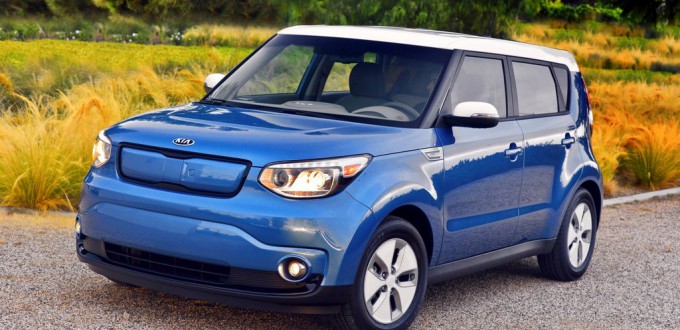
Kia Soul EV (2015) first drive review

Are electric cars the future? It’s a subject that’s very much open to debate. Some drivers are absolutely sold on the idea, while others question their limited range and how green they really are.

The same is true with manufacturers. A few are jumping head first into the electric car revolution, while others are avoiding it in favour of small capacity, turbocharged petrol engines, or even hydrogen power. Some, like Kia, are being cautious, dipping their toes in the water and seeing what happens.

This explains why the Korean carmaker has electrified its Soul mini-SUV, but plans to sell it in very small numbers. There’s no fancy new production line – all Soul EVs are made on the same line as the regular Soul, in an attempt to keep costs down, and just 5,000 a year are expected to be built. And here’s the clincher: no more than 200 are expected to come to the UK in the first year of production.

The reason for this? “Some manufacturers are flooding the market,” says Kia. “They’re selling electric cars to people whose lifestyles aren’t suited to electric cars, and it’s damaging their reputation.” This leads to tales of range-anxiety, and poor residual values, which Kia wants to avoid.

What’s the Kia Soul EV like to drive?

Central London isn’t an obvious place for a car launch, but it really flatters the Soul EV. Threading it through traffic, instant torque available whenever you press the accelerator, it’s hard to deny an electric car is second only to a jetpack in conditions like this.

While adapting a ‘regular’ car might seem an easy way of offering an electric vehicle, it does present some challenges. For a start, there are the big, heavy batteries that need putting somewhere. In this case, they’re hidden under the floor. And then refinement can be tricky. A combustion engine does a great job of drowning out noises – remove that, and even the slightest noise can prove irritating.

But Kia’s done a commendable job. There are no battery whines sometimes associated with electric cars, and road noise is minimal (although, as hard as we tried, we couldn’t get near to the Soul’s 90mph top speed in central London). What’s really impressive is how well the Kia Soul EV rides. The extra 274.5kg from its batteries could easily result in a crashy ride, but Kia’s tweaked the springs to take the extra weight into account, and it deals with bumps and potholes exceptionally well.

Charging using a domestic power supply takes 10 – 13 hours from empty to full, but this can be reduced to five hours using a public fast-charge point. Alternatively, using a public rapid charger, it can be boosted to 80 per cent charge in just over half an hour. From a full charge, expect to get a range of around 132 miles – less than a petrol or diesel car, obviously, but enough for most urban journeys.

Read more: Motoring Research
Kia Soul EV

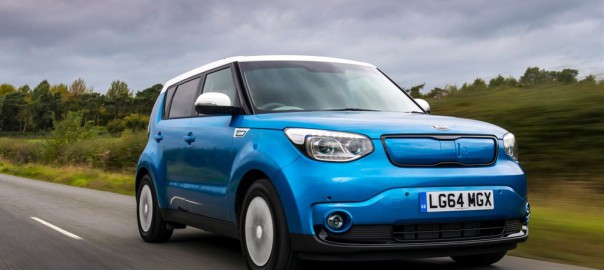
Kia Soul EV arrives in the UK

Kia’s new electric Soul has gone on sale in the UK, priced from £24,995 after a government grant of £5,000.

That places it £3,445 above the price of the range-topping model of the existing combustion Soul range, with the Soul 1.6 CRDi Maxx priced at £21,550.

Despite being one of the least aerodynamic electric cars we’ve yet seen, Kia says its new battery-powered crossover can deliver a range of 132 miles per charge – 8 miles more than the official range of rival model, the Nissan LEAF.

Developed in co-operation with SK Innovations, the Soul EV’s 27kWh lithium-ion polymer batteries are a high energy density solution, delivering 200 watt-hours per kilogram of weight, helping it to deliver that outstanding range.

The Soul EV is also spritely for its vehicle class, with its electric motor developing 81.4 kilowatts – the equivalent of 109bhp in a combustion-engined model – with 285 Nm of torque available immediately upon drive-away.

That gives the car a 0-60mph time of 10.8 seconds and a top speed of 90mph, comparable with the rest of the Soul range.

Recharging takes 10-13 hours for a full charge from a standard UK domestic supply although this can be reduced using a branded wallbox which comes with the Soul EV as standard.

The Soul EV can also be rapid charged in 30 minutes to 80 per cent battery capacity.

To fit in a new battery drivetrain beneath the floor, Kia has slightly compromised the rear-seat legroom by 80mm and lost 31 litres of boot space, bringing its total luggage capacity to 281 litres.

The Soul EV is well equipped though with standard equipment including eight-inch touch-screen with European mapping, reversing camera and charging point locator, automatic air conditioning with the driver-only function, heated front seats, a smart key with a motor start-stop button, projection headlights with LED daytime running lamps, privacy glass on the rear windows and tailgate and 16-inch lightweight alloy wheels.

In-car entertainment includes a DAB RDS radio with MP3 compatibility, steering wheel-mounted controls, USB and AUX ports and Bluetooth with voice recognition and music streaming. Safety is taken care of by Anti-lock Brakes with Emergency Brake Assist, Electronic Stability Control, Vehicle Stability Management, Hill-start Assist, Emergency Stop Signalling, a Tyre Pressure Monitoring system and six airbags.

Kia is likely to supply no more than 200 Soul EVs in the UK, already reporting that supply from its factory in Korea will be ‘extremely limited’.

A network of 13 specially trained UK dealers will sell the Soul EV.

Source: Green Car Website

Kia Soul EV (Image: Kiam Motors America)

Late, but Fashionably So, to the Electric Ball: Kia Soul EV Review

BERKELEY, CALIF. — Laggards rarely garner praise. But the foot-dragging way that Kia went about producing the 2015 Soul EV, the company’s first all-electric model in the United States, was a stroke of slacker genius.

The battery-powered Soul went on sale in California last week, its arrival trailing more than 20 other electric and plug-in hybrid cars that have been offered to American customers.

Unlike Nissan, for example, which made a multibillion-dollar all-in gamble on E.V.s, Kia held back, watching and carefully tallying the progress. More important, perhaps, Kia took note of the missteps of major automakers and the many stumbling E.V. start-ups as it readied battery-powered cars for the road.

Kia’s good decisions started with the choice of the Soul as a platform. It’s not only that the trademark groovy design of the gas-powered Soul is a proven success, on track for some 150,000 sales in 2014. And it’s not just that the hamsters in the ads are so cute, or that the Soul served as an appropriately modest limo for Pope Francis on his visit to South Korea in August.

What’s important is that for a relatively small car, the Soul can carry a hefty 27 kilowatt-hour load of batteries.

“We actually would have preferred a little bit more,” said Steve Kosowski, manager for long-range strategy at Kia Motors America. “But there’s no more room under there.”

Read more: NY Times