Category Archives: V2G

OVO Vehicle-to-Grid (V2G) charging (Image: T. Larkum/Fuel Included)

V2G has ‘huge potential’ beyond financial benefits

Vehicle-to-grid (V2G) technology has been “reduced down” to making revenue from energy trading despite having a “range of opportunities” and benefits.

Vehicle-to-grid (V2G) technology has been “reduced down” to making revenue from energy trading despite having a “range of opportunities” and benefits.

This is according to a new review of nine European V2G projects by Cenex. The review, which was funded by Innovate UK, found that the traditional model for V2G of generating revenue through energy trading is only one of a number of opportunities for the technology, highlighting key value propositions such as resilience, the benefits to society, enhanced battery management and self sufficiency.

OVO Vehicle-to-Grid (V2G) charging (Image: T. Larkum/Fuel Included)

According to the review, V2G can significantly reduce energy system greenhouse gas emissions, as well as ensure resilience in the event of power outages and prolong the battery life of an EV.

Battery degradation is a contentious topic when discussing V2G technology, as increased cycling takes place for arbitrage, which is likely to increase a battery’s degradation.

However, the review states that whilst V2G for revenue generation is often associated with increased battery degradation, using V2G for grid services that are based on power availability but have low energy usage will “have a limited impact on battery degradation”.

In fact, it outlined how “based on current evidence”, V2G could extend the life of an EV battery by about 10%, which would allow customers to use the EV for longer and therefore reduce the total cost of ownership as well as help to reduce end-of-life waste and the demand for mining of new materials.

Read more: Energy Storage News

It’s Time to Go Green!

If you would like to know more about Solar Panels and the PowerBanx range of home battery systems, and get a free instant quote, please complete our online form:

OVO Vehicle-to-Grid (V2G) charging (Image: T. Larkum/Fuel Included)

Electric vehicles could turn solar households into autonomous energy units

Many discussions abound on how Australia can reach renewable energy targets of 50 per cent and much more. Many experts believe achieving this goal will depend on the availability of a low cost, bulk energy storage infrastructure.

Pumped hydro has received much attention in this regard. While technically feasible, bulk storage still requires transmission and distribution infrastructure that is not only costly but will take considerable time to implement.

A far simpler and cost effective route is the bottom-up approach of turning each house into an autonomous energy unit.

OVO Vehicle-to-Grid (V2G) charging (Image: T. Larkum/Fuel Included)

The use of solar panels in homes and small industry has proven to be remarkably successful. The uptake of rooftop solar has been so good that the grid, as well as losing a portion of their market to solar, is becoming unable to use all of the exportable household solar energy generated during clear days.

Without some form of energy storage, solar panels can provide only around 30% of daily household energy, leaving the grid to supply the rest. Solar hot water systems can bring the total solar contribution to around 45% of energy requirements.

However, to reach greater household energy autonomy requires storage.

The missing element to achieving high levels of renewable energy has emerged in the form of the Electric Vehicle (EV). EVs not only provide transportation, but also have significant battery storage capacity.

Read more: The Driven

It’s Time to Go Green!

If you would like to know more about Solar Panels and the PowerBanx range of home battery systems, and get a free instant quote, please complete our online form:

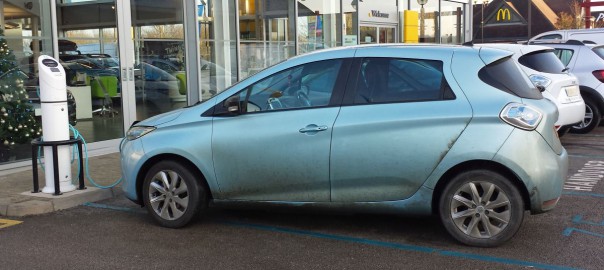
Catching a quick charge at the local Renault dealer (Image: T. Larkum)

Tested: Renault Zoe can grid-balance

In the Netherlands, Jedlix and Elaad say the Zoe is good for the smart grid

Dutch smart charging specialist Jedlix and the Elaad Competence Centre have concluded that Renault Zoe can be used in a balancing capacity of TenneT in the Netherlands.

National grids must be able to balance electricity production and consumption and when this is disrupted, Transport System Operators (TSOs) are forced to activate secondary options to prevent imbalance, which often come from fossil-fuelled power plants.

Catching a quick charge at the local Renault dealer (Image: T. Larkum)
ZOE on charge (Image: T. Larkum)

To use Renault Zoe for network balancing, the car’s charging process had to be able to react to real-time signals. At Elaad’s test centre in Arnhem, in the Netherlands, the two partners conclusively proved that the Zoe is able to respond to TenneT signals within seconds. According to Jedlix, this kind of suitability is further proof that electric vehicle batteries can be efficient and competitive resources that contribute to increasing the flexibility requirements of national grids.

What the company has not mentioned in their press release, however, is whether the charging is bidirectional, i.e. whether electricity from the car’s battery can also be fed into the grid. Certainly, the Renault electric car does not come ex-works supporting bi-directional charging, only being designed to take up electricity. What is possible to help balance the grid, is that the charging power can be reduced if necessary – which can reduce peak loads and thus contribute to grid stability.

Two years ago, Jedlix and Elaad made the same tests with Tesla cars. “In a previous study with Jedlix, we also found a positive effect on the distribution network when we respond to transmission network signals, which is crucial for the long-term introduction of electric vehicles,” says Elaad Director Onoph Caron. “We invite all OEMs to implement similar programs here in the Netherlands.”

Read more: Electrive

OVO Vehicle-to-Grid (V2G) charging (Image: T. Larkum/Fuel Included)

Pricing dilemma pivotal to unlocking V2G potential

There is “brilliant” potential for vehicle-to-grid charging technologies to sweep the UK, but only if the industry can bring prices down.

That’s the view of Tom Pakenham, director of electric vehicles at OVO and Kaluza, who said that V2G technologies could “unlock the potential of the car in ways smart charging just doesn’t”.

Kaluza parent company OVO is one of a select few energy companies in the UK currently installing domestic V2G chargers in the UK and currently has around 30 installed, forming part of a major government-backed competition to help boost the technology.

OVO Vehicle-to-Grid (V2G) charging (Image: T. Larkum/Fuel Included)

Pakenham says that expanding these technologies to a mass market of a million cars had the potential to be brilliant but, on top of ensuring that customers had the “right habits” and the right relationship with their supplier, technology costs would have to come down.

Read more: Current News

OVO Vehicle-to-Grid (V2G) charging (Image: T. Larkum/Fuel Included)

V2G tech soon to be economically viable, ready to deliver millions in consumer benefits

Vehicle-to-grid (V2G) EV chargers could be economically viable in the near term and save hundreds of millions of pounds in grid costs, but only if the industry can deliver specific conditions.

That is the principal finding from a new report on the technology, published this week on the back of a government-funded competition surrounding the nascent technology.

The ‘Vehicle to Grid Britain’ report, led by Element Energy, forms part of the V2G competition funded by both the Office for Low Emission Vehicles (OLEV) and the Department for Business, Energy and Industrial Strategy (BEIS) and supported by Innovate UK.

OVO Vehicle-to-Grid (V2G) charging (Image: T. Larkum/Fuel Included)

It has garnered insight from consortium members including Nissan, Energy Systems Catapult, Cenex, WPD, National Grid ESO and Moixa, and produced a series of conclusions that it says uncovers both near-term niches and longer term opportunities for V2G.

Crucially, the report concludes that residential V2G charging could make economic sense in the near term, but only if a set of ideal operating conditions are met.

Read more: Current News

Renault rolling-out V2G trials across Europe

First vehicle-to-grid projects live in the Netherlands and Portugal.

Renault has launched the first large-scale bi-directional charging pilot projects in Europe, starting in Utrecht, the Netherlands and on the Portuguese island of Porto Santo. Similar projects will follow in five more European countries with the aim to develop services and gather learnings for future harmonisation.

In concrete terms, Renault intends to introduce a fleet of 15 Renault Zoe vehicles with vehicle-to-grid functionality in Europe during the course of the year, in order to develop new bi-directional charging offers together with partners and lay the foundations for future standards. The aim is to get to the bottom of feasibility and potential benefits, according to a press release by the French. It is interesting to note that Renault is using alternating current technology, which is apparently based on the type 2 connector.

More than a year ago, the carmaker announced that, together with the energy supplier Empresa de Electricidade da Madeira, it wanted to turn the Atlantic island of Porto Santo into an “electric island” including electric cars, second-life batteries and V2G in combination with “smart” charging. While this trial is going ahead, not as much is known about the second project in the Dutch town of Utrecht. Renault only mentions that it is a pilot project in an ecosystem developed by We Drive Solar.

Read more: Electrive

OVO Vehicle-to-Grid (V2G) charging (Image: T. Larkum/Fuel Included)

EDF Energy prepares launch of V2G offer following agreement with Nuvve

EDF Energy is to offer its business customers vehicle-to-grid (V2G) chargers, as well as using them on its own sites, after partnering with charger supplier and technology developer Nuvve.

The supplier is expecting the partnership to result in up to 1,500 installations of V2G chargers, while hoping to unlock 15MW of additional energy storage capacity at its own sites.

This represents the largest planned deployment of V2G technology in the UK, overtaking Nissan and OVO Energy’s plans to install 1,000 chargers under a government-backed innovation project.

OVO Vehicle-to-Grid (V2G) charging (Image: T. Larkum/Fuel Included)
Vehicle-to-Grid (V2G) charging (Image: T. Larkum/Fuel Included)

Using the V2G chargers, idle EVs are able to be used to participate in the energy services markets at times, or be used to power onsite demand.

EDF Energy expects its business customers to utilise their fleet or workforce vehicles to tap into these revenues and energy savings using its new offer, taking advantage of the expected increase in EVs entering the commercial sector.

Read more: Current News

OVO Vehicle-to-Grid (V2G) charging (Image: T. Larkum/Fuel Included)

Nissan Leaf gets approval for vehicle-to-grid use in Germany

So-called vehicle-to-grid (V2G) technology is a connection between the EV and the grid through which power can flow from the grid to the vehicle and vice-versa. That potentially enables car owners to sell energy to the network, while utilities could use electric cars as a backstop if demand rises.

Nissan said it would initially target corporate clients with fleets of more than 60 electric vehicles, adding that services based on V2G technology would be offered in Germany from next year onwards.

OVO Vehicle-to-Grid (V2G) charging (Image: T. Larkum/Fuel Included)
Leaf Vehicle-to-Grid (V2G) charging (Image: T. Larkum/Fuel Included)

There will be 280 million electric vehicles by 2040, according to estimates by the International Energy Agency, compared with more than 3 million last year.

“We strongly believe in an emission-free future,” Guillaume Pelletreau, Vice President and Managing Director, Nissan Center Europe, said. “Leaf batteries could make an important contribution to energy transition in Germany and a sustainable future.”

Read more: Reuters