Category Archives: Charging

A map highlighting the nine locations of the new electric vehicle charging points (Image: ITV Border)

Electric vehicle charging points go live in Cumbria

Cumbria County Council is launching a series of charging points for electric vehicles in the county.

A map highlighting the nine locations of the new electric vehicle charging points (Image: ITV Border)

Nine sites have been commissioned and are available for use by residents, visitors and businesses.

They are located in Carlisle, Kendal, Workington, Whitehaven, Keswick, Ulverston, Kirkby Stephen, Kirkby Lonsdale and Ambleside.

The project was made possible after Cumbria County Council secured funding of £438,000 to create a countywide electric vehicle infrastructure.

The Government’s Office of Low Emission Vehicles has supplied 75% of the funding through its Local Authority Rapid and Public Sector Estate Chargepoint schemes and 25% match funding has been secured from a private investor.

Charging points for electric vehicles are at the following locations:

  • Carlisle – Lowther Street (opposite Rural Payments Agency)
  • Kendal – Car park at County Offices, Busher Walk
  • Workington – Car park at Allerdale House, Griffin Street
  • Whitehaven – Car park Senhouse Street
  • Keswick – Central Car Park, Heads Road
  • Ulverston – Brewery Street car park
  • Kirkby Stephen – Christian Head car park
  • Kirkby Lonsdale – New Road car park
  • Ambleside – Low Fold car park, Lake Road

I’m absolutely delighted that charging points for electric vehicles are up and running in the county, providing a low carbon transport solution. I’d like to thank our district council partners who played a key role in providing locations within their car parks for the chargers, ensuring they’re easily accessible to the public. This has been a complex project and it’s taken a while to get everything in place but it’s been well worth the wait.

“Up until now there have been limited charging facilities in Cumbria. I’m sure this project will help open up the county to more electric vehicle drivers and make a real difference, both in Cumbria and nationally.”

– COUNCILLOR JANET WILLIS, CUMBRIA COUNTY COUNCIL CABINET MEMBER RESPONSIBLE FOR ENVIRONMENT

Source: ITV.com

Electric car chargers spread across Scotland as pumps dwindle

The number of rural petrol stations is about to be overtaken by electric chargers, with plug-in points replacing pumps in some villages.

Plug-in points will replace pumps in some villages. Picture: Steven Scott Taylor

There are more than 550 charging points across Scotland but fewer than 700 non-supermarket filling stations.

There were virtually no chargers five years ago, while petrol forecourts have declined by a quarter over the last decade.The Petrol Retailers Association said one third of independent filling stations, many rural, had closed.

By contrast, the Electric Vehicle Association Scotland (Evas) said the number of rapid chargers, which take around 20 minutes, had doubled in the last year alone to around 150.

Carplus, which promotes car-sharing clubs, said one in five of their vehicles were electric – the highest in the UK.

Spokeswoman Beate Kubitz said:

“Many rural filling stations have disappeared, so people living in remote areas have to plan and make detours to fill up with petrol and diesel.

“The charge point network is growing rapidly and makes driving an electric car longer distances possible.”

Read more: Scotsman

Evolt wins a place on the new Scottish Framework to install EV charge points

Evolt, the electric vehicle (EV) charge point supplier, has been selected by the Energy Saving Trust Limited (EST) as one of the companies to provide EV charging solutions on a new Scotland-wide framework agreement.

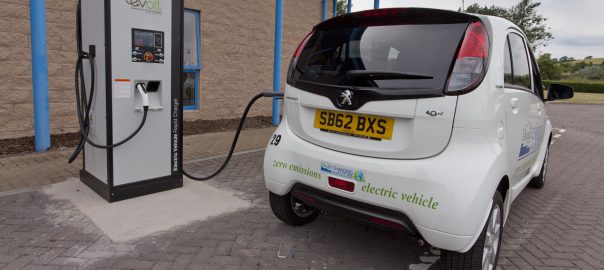
Evolt_Rapid_Charger_Evolt

The new framework includes the right to tender, be selected, or quote for the installation of rapid, commercial and domestic charging units on the mainland and in the Highlands and Islands. The announcement follows a full tender and is effective immediately to an initial expiry date of December 2018.

Having established itself as a significant player on the Scottish EV charge point supplier market over the past five years, Evolt has supplied in excess of 1,100 charging points to 24 local councils and many private businesses in Scotland.

Justin Meyer, General Manager at Evolt, says its commercial charge points’ reliability was a key factor in being selected for the new framework:

“Our equipment is installed in both urban and rural environments, including on remote islands such as the Shetlands, and has helped to drive forward Scotland’s sustainability agenda over the past five years.

“As a part of the new framework agreement we remain in a strong position to encourage and facilitate the ever-increasing take up of EVs in Scotland.”

Included in the 1,100 Evolt charge points installed in Scotland are 85 of the top-of-the-range Evolt Rapid chargers. Each unit can efficiently charge two EVs to 80% of their battery life within 30 minutes through a 50Kw DC and 43Kw AC outlet.

Justin adds that the units are user-friendly, tamper proof, simultaneous charging functionality on both fast and rapid charge points and contain a built in 3G communications modem enabling remote monitoring of the charging process and charging data collection:

“This functionality enhances our strong reputation for offering a high quality charging solution that is backed up by an efficient and effective service support.

“It is a testament to the durability of our technology that we have been able to successfully install and maintain our equipment in the testing weather conditions experienced in the highlands and on remote islands.”

Source: Evolt press release

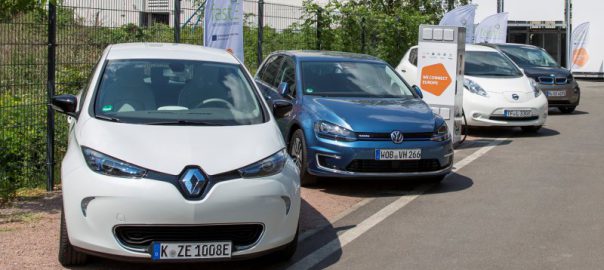
Renault is a partner of the European fast-charging project Fast-E in Germany (Image: Renault)

Renault is a partner of the European fast-charging project Fast-E in Germany

  • Official launch of Fast-E project co-financed by the European Union and nine companies, including Renault, in Berlin and Brussels.
  • 241 charging stations installed in Germany and 37 in Belgium by the end of 2016.
  • A sister project between the Czech Republic and Slovakia adds another 30 charging stations.
Renault is a partner of the European fast-charging project Fast-E in Germany (Image: Renault)

The 278 charging points set up every 80 km along Germany and Belgium’s main motorways, will allow drivers of electric vehicles to “refuel” and extend their car’s range. The total investment of the EU-funded cooperation is approximately €18 million.

Every one of the multi-standard fast-chargers spread out over four countries have AC and DC connections, allowing drivers to charge their vehicles’ batteries easily and quickly. Electric vehicles can be charge up to 80% on the charging stations within an hour.

RENAULT IS NUMBER ONE IN ELECTRIC VEHICLES IN EUROPE

Renault sells more electric vehicles in Europe than any other car manufacturer and had a market share of over 23 percent in 2015. Indeed, nearly one out of every four electric vehicles sold in Europe comes from the French manufacturer. The Renault electric vehicle product range includes the compact five-door hatchback ZOE, the Kangoo Z.E. and Kangoo Maxi Z.E. vans, the agile two-seater Twizy and the compact carrier Twizy Cargo.

About Fast-E:
Under the leadership of the charging station operator Allego, the project Fast-E brings together nine companies in the industry, including three charging station operators (RWE Effizienz, enviaM and Allego) as well as four car manufacturers (Volkswagen AG, BMW AG, RENAULT SAS, NISSAN CENTER EUROPE), DB Energie GmbH, a subsidiary of DEUTSCHE BAHN and the Hamburg-based company hySOLUTIONS, which, as a competence centre in several charging infrastructure projects, is responsible for the integration of new drive technologies in urban transport. The quick-charging stations installed as part of the project employ the Combined Charging System (CCS) and CHAdeMO, each with up to 50 kW power output, as well as a type 2 connector with 43 kW power output. The project is expected to end in December 2017 with the completion of the accompanying studies; the charging infrastructure will continue to operate commercially thereafter.

About Allego:
Allego operates a charging infrastructure network for electric vehicles in Germany, the Netherlands and Belgium. The company, headquartered in Arnhem and having subsidiaries in Germany and in Belgium, has a neutral market position as a pure operator and is independent from suppliers in regards to charging technology. This helps Allego ensure maximum flexibility and a high degree of reliability in the availability of charging facilities. The special focus in the development and operation of charging technology for electric vehicles lies in the creation of a comprehensive network of normal and quick chargers. For this purpose, the company has already installed 86 quick chargers on Dutch, German and Belgian motorways.

Source: Renault Media

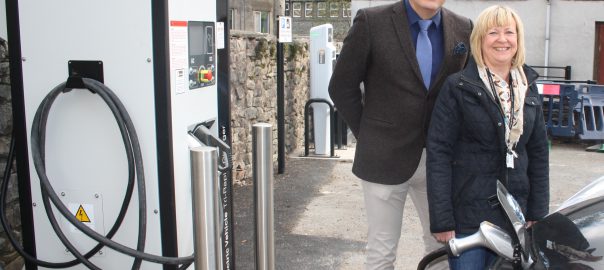
John Osorio of Evolt and Cllr Janet Willis, Cumbria County Council Cabinet member for Environment, at the charging site in Kendal (Image: Evolt)

Evolt’s Rapid Charging network for EVs sparks the Cumbrian ‘black spot’

Evolt, the Electric Vehicle (EV) charge point supplier, has completed the installation of Cumbria’s first publicly accessible EV Rapid charging network, which is now available for public use.

John Osorio of Evolt and Cllr Janet Willis, Cumbria County Council Cabinet member for Environment, at the charging site in Kendal (Image: Evolt)

Nine locations across the county now benefit from a top-of-the-range Evolt 50Kw Rapid Charger that can efficiently charge an EV within 30 minutes. A further Evolt 7Kw Fast Charger, ideal for quick ‘top-ups’ during short stay visits, has also been installed at four of those sites (Carlisle, Kendal, Workington and Keswick). The other five sites are comprised of Whitehaven, Ulverston, Kirkby Stephen, Kirkby Lonsdale and Ambleside.

Evolt, which is a division of the APT Controls Group, won a competitive tender to supply its charge points from Cumbria County Council in November 2015.

Councillor Janet Willis, Cumbria County Council Cabinet member responsible for Environment, explains that Cumbria now provides a low carbon transport solution:

“Up until now there have been limited charging facilities in Cumbria,” she says. “I’m sure this project will help open up the county to more electric vehicle drivers and make a real difference, both in Cumbria and nationally.”

The installation process included three stages: firstly, initial civil works including excavation and inserting power cables, ensuring the power infrastructure is in place; secondly the physical charge points’ installation; and finally their connection to a back office management system that remotely monitors each charge point. After testing, the charge points have been made ready for public use.

Justin Meyer, General Manager of Evolt, explains its chargers will positively impact the lives of EV and Hybrid drivers in and around Cumbria:

“The new network will drive forward EV activity in the region, with the infrastructure actively supporting the ambitions of an ever-increasing industry.”

Suzanne Burgess of Solway Renewables initially proposed that the Council should seek funding from OLEV:

“There has been significant interest surrounding the charging network, and it will make a substantial difference to individuals, small business and the tourist industry that is hugely important for Cumbria,” she says. “It’s time to get the word out that Cumbria is open to electric vehicle drivers.”

Source: Evolt Press Release

The use of electric vehicle charging points in St Albans has quadrupled in a year

Electric vehicle charging quadruples in St Albans

With air pollution posing a continuing threat to health and the environment, there has been applause at the quadrupling of the use of electric vehicle charging points.

The use of electric vehicle charging points in St Albans has quadrupled in a year

St Albans Green councillor Simon Grover said that figures obtained from Evalu8, which provides electric vehicle charging points across the city, showed local charging points were used 1,329 times last year, delivering 8,414 kWh of electricity.

It is the third year in a row of rapid growth.

The figure is over four times the previous year’s total of 1,944 kWh, which was more than three times up on the year before that.

However Cllr Grover has called for more charging points to be installed, saying motorists will only buy electric cars, or drive them to St Albans “if we have lots of charging points”.

The network opened in 2012, when it delivered just 100 kWh of electricity, which is about the energy a freezer uses in a month.

Cllr Grover explained that 8,000 kilowatt hours,

“is equivalent to about 15,000 miles of driving an ordinary petrol car around town.

“So these electric vehicles are really starting to make a difference. Air pollution is an increasingly serious problem in St Albans, and electric vehicles are definitely part of the solution.”

However, he said that several residents

“have spoken to me about electric cars they’ve bought, and how there’s a need for more charging points round the district”.

There are currently four district council-run charging points with dedicated bays in St Albans, which were installed by Herts county council in partnership with Evalu8. There are also two bays at the city station.

The statistics show that Charter Close is the most popular charging point – although it was used just seven times in 2012, it was used about 700 times last year, up from 149 times in 2014. Upper Dagnall Street was the next most popular point with usage increasing from 13 times in 2014 to 283 times in 2015.

Cllr Grover added:

“Now we know the uptake is rising so fast, it’s vital that we install more charging points around the city and the district.”

The average charging time was 2.2 hours per electric vehicle.

Source: Herts Advertiser

Ecotricity acquires SunEdison UK solar business

Ecotricity, Britain’s leading green energy company, today announced that it has acquired the home rooftop solar business of SunEdison.

ecotricity-acquires_sunedison_uk-solar-business_ecotricity

Before exiting the UK, SunEdison had built a portfolio of nearly a thousand rooftop solar installations, a product known as the Energy Saver Plan.

The news comes on the day SunEdison Inc. filed for bankruptcy in the U.S.

Dale Vince, Ecotricity founder, said:

“This is an exciting and important step for Ecotricity. As a company, we want to help more people generate their own power at home.

“The government’s cuts to the feed-in tariff, and its broader attack on the renewables industry, have caused a significant problem for companies like SunEdison: we have seen some go bust and others quit the UK market as a result, losing a lot of jobs as a result.

“This is our first step into the domestic solar market, and as the price of the technology continues to fall, we’re confident that it’s only a matter of time before we can resume the work SunEdison started and help more homes take advantage of solar power.”

Ecotricity, who now supply approaching 200,000 customers from a fleet of wind and sun parks, last made an acquisition in 2014 when they rescued small windmill company Evance from administration – uniting Evance with other supply chain companies, Ecotricity formed a new small windmill company called Britwind.

Dale said:

“We see a big future for renewable technology of this scale in Britain – small wind and rooftop solar will allow more people to generate their own power at home, decentralising the energy sector and putting power in the hands of the people.”

Source: Ecotricity

Hammersmith Installs New Charging Points

The first of Hammersmith & Fulham’s new electric vehicle charging points has gone live as the council seeks to transform the borough and drive down harmful emissions.

electric_top_edit_unk
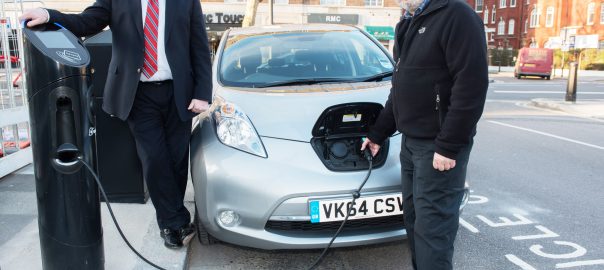
Three of the first phase of new, on-street charging points are now available for residents to use in Standish Road, Hammersmith, Gayford Road, Shepherds Bush and Farm Lane, Fulham. The remaining first phase bays will be coming online shortly.

Each charging location has two bays where plug-in hybrids and fully electric vehicles can park while recharging their batteries.

“We are committed to improving air quality and driving-down harmful emissions in H&F by leading the charge in availability of charging bays for low and zero emission vehicles,” said Cllr Stephen Cowan, Leader of Hammersmith & Fulham Council.

“As more residents take up electric vehicle use, these first few bays going live are just the beginning. We will continue to look for areas where residents tell us there is need and will investigate opportunities to expand our network wherever we can.

“More residents using electric cars will help to reduce CO2, NOx and particulate matter emissions that have detrimental effects on health and the environment.

“We are determined to become the greenest, most environmentally-friendly council in the country.”

The remaining four sites are due to go live on Wednesday 6 April and will be marked with an official launch by Source London, who own and operate the network on behalf of H&F.

A further twelve charging locations are being prepared for August, creating a total of 40 new on-street parking bays, in addition to the 40 charging bays in the car park of the Westfield shopping centre.

This total of 80 parking bays means by 2017 residents will have access to, on average, a charging point for every square kilometre of the borough.

Source: LBHF.gov.uk

Erik Fairbairn, CEO (Image: POD Point)

How to start a business in an industry that doesn’t exist

New technology is not just disrupting existing industries, it’s creating entirely new ones. Today we speak with Erik Fairbairn, the man behind POD Point, the UK’s leading provider of electric car charging points…

Erik Fairbairn, CEO (Image: POD Point)

Fairbairn founded POD Point in 2009, two years before electric vehicles were even on the market. Since then it has shipped more than 20,000 chargepoints to over 15 counties – charging 10 million miles of electric vehicle driving in the process. In 2014, and then again in 2015, POD Point turned to crowdfunding, where it raised a total of £3.7 million and the company has recently been featured in the Tech Track 100.

Freshly created sectors such as this present CEOs, like Fairbairn, with handfuls of risk, opportunity and challenges. So what advice would he give to start-ups trying to make their mark in such unexplored territory?

What challenges have you faced in getting POD Point up and running?

We launched POD Point in 2009. Unfortunately there weren’t any electric cars available then; in fact the first widely available electric car, the Nissan Leaf, didn’t arrive until 2011. It was then another three years until electric vehicles started to take off.

As you can imagine, selling electric vehicle charge points into a market which had no electric cars was quite a challenge!

Of course today the electric vehicle (EV) seems like a forgone conclusion, but back in 2009 it was quite a wild statement to suggest 85 per cent of us would all be driving EVs within 20 years. This meant that persuading people to join the POD Point team was immensely difficult.­ We were asking staff to take quite a risk on what was a rather outlandish prediction about the imminent arrival of the electric car!

Read more: Virgin

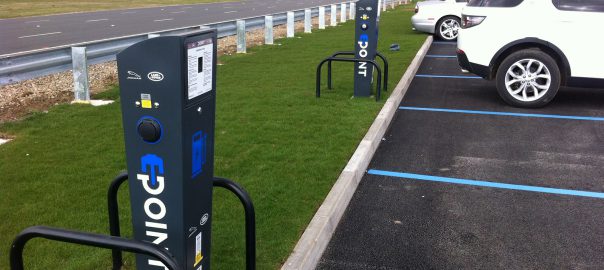
Jaguar LandRover GroupManager Install (Image: Rolec)

Rolec Launches EV GroupManager

Rolec has announced the launch of its new EV GroupManager system, which has been designed to provide full management control of private Electric Vehicle (EV) charging networks. According to Rolec, the EV GroupManager system has been developed to allow the operator easy management of their entire private EV charging network from a single central computerised location.

Cloud Based System

The system operates by issuing nominated EV drivers with their own secure personal RFID card/fob, containing the driver/vehicle ID. The driver then presents their card/fob to the charging point, which authenticates the card/fob and via GPRS, WiFi or Ethernet communicates with the cloud based back office management system, requesting authorisation to initiate the charging cycle.

Jaguar LandRover GroupManager Install (Image: Rolec)

Upon authorisation from the management cloud, which takes only seconds, charging will commence with the cloud recording the driver/vehicle ID, charging start time, the kWh used and the charging end time. This charging information is always hosted in the cloud and can be accessed at anytime, from anywhere, by the system operator to compile management reports, benefit in kind data and billing information. Kieron Alsop, Rolec’s Managing Director, commented,

“EV GroupManager has been designed to enable private enterprises to have full control over their own private EV charging network and is ideally suited to almost any corporate location – or for housing developments, fleet management, staff vehicles, etc.

The introduction of EV GroupManager eliminates the necessity to engage with the public facing charging networks, which are heavily subscription based and operated via third parties. In effect EV GroupManager gives the operator complete control over their own EV charging network and provides them with the flexibility to accommodate both their own, and their EV drivers’, charging needs.”

Read more: Autovolt