Pivot Power’s maiden 50MW battery and electric vehicle charging hub could be set for Southampton after the first planning documents appeared for the company’s proposed 2GW nationwide network.
But despite presenting the plans to the market last month as a combined energy storage and EV solution to accelerate the take-up of low carbon transport, the first documents to appear in Test Valley Council’s planning database includes no mention of charging infrastructure.
The battery storage facility, if approved, will be located on National Grid land adjacent to the existing 400kV Nursling Substation, where it will be connected directly to the transmission grid.
The 49.9MW site, just off Station Road to the south of the M27, will comprise 25 containerised batteries that will seek to utilise the advantages of the higher level connection to provide frequency response and other ancillary services to National Grid.
In place of specific mention of EV chargers connected to the site, the documents merely state that the site, as part of a “programme of installed batteries”, will provide “significant opportunities for councils” to implement their EV strategies.
Milton Keynes has delivered the first charging point under the council’s ‘MK Promise’, which sets out to provide overnight electric vehicle (EV) charging within a short walk of a new EV owner without off-street parking facilities.
The Chargemaster Fastcharge unit has been installed at Wavendon House, a 17th-century Grade II-listed former outpost of Bletchley Park, following an application on behalf of the residents by John Zlotnicki.
“Whilst it is important to us to preserve and maintain our buildings, landscape and grounds in their historical setting, we recognise the need to ensure that our residents have the opportunity to choose to have environmentally-friendly vehicles.
“The MK Promise scheme enables us to look to the future whilst retaining the best of the past,” he said.
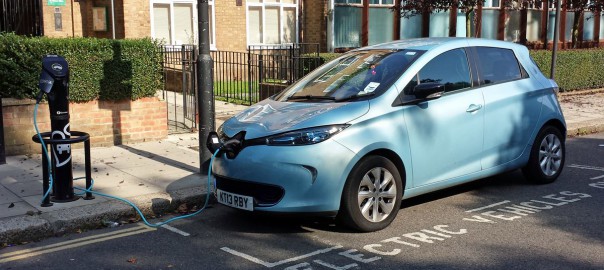
Slow Charging a ZOE on the street (Image: T. Larkum)
Funded partly through the £9 million Go Ultra Low investment awarded to Milton Keynes by the government in 2016, the ‘MK Promise’ sets out to provide charging solutions to drivers without a dedicated off-street location to charge, such as a driveway or garage.
Milton Keynes residents can submit their application once the process of purchasing or leasing an electric car is underway, at which point the council identifies potential locations within walking distance of their homes.
New technologies to create safer, high-powered electric car batteries have been supported by £22 million of industrial strategy funding.
A new pioneering technology to ensure a next generation of safer, high-powered electric car batteries can be charged by drivers in ultra-fast time is just one of 12 innovation projects to receive the green light from the government’s Faraday Battery Challenge.
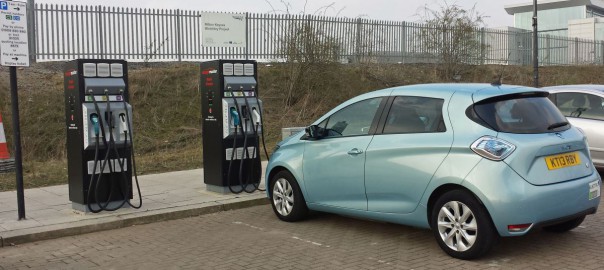
Rapid Chargers next to Milton Keynes Central railway station parking (Image: T. Larkum)
The PowerDrive Line project being led by Southampton-based company Ilika is focusing on sold state battery cell development, in particular how to manufacture at scale in the UK and how to build in ultra-fast charging technology of less than 25 minutes for a vehicle as is seen in some current battery systems.
In total £22 million grants are being rewarded to consortia across the UK as part of the latest round of funding through the Faraday Battery Challenge, part of the government’s Industrial Strategy Challenge Fund.
The funding is key to realising the government’s ambitions for innovative energy solutions as set out in our modern Industrial Strategy. The Faraday Battery Challenge brings together world-leading research and business to accelerate the research needed to develop battery technologies.
Octopus Energy has launched a new “time of use” energy tariff especially designed for bringing down the charging cost for electric vehicle (EV) owners.
The new tariff, called Octopus Energy Go, lets EV owners charge their cars for only 5p per kilowatt hour for four hours each night, which could make owning an EV 10 times cheaper than having a car running on fossil fuels.
Other existing initiatives to bring down the power cost for EV owners include the Economy 7 tariff, also known as the differential tariff, which has reduced rates for seven hours per night. However, the Go tariff could be up to 25 per cent cheaper.
Rebecca Dibb-Simkin, director of product for Octopus Energy, said:
“Octopus is passionate about driving the UK’s switch to electric vehicles.”
“We’re delighted to use our innovative tech both to offer the cheapest kWh charge in the market and enable your car to automatically charge itself, a brilliant way to unlock those electric car savings.”
“We run POLAR, the UK’s biggest public charging network. It links over 5,000 public charging points, not limited to just Chargemaster units, giving EV drivers a convenient and reliable nationwide charging system. The POLAR network is growing all the time, making the future of electric motoring possible for more and more drivers.
POLAR Plus is our unique subscription service that offers members better value and special benefits. With the first three months’ membership free, you pay just £7.85 per month thereafter. Members enjoy unlimited access to over 5,000 charging points, most of which are then free to use. For the others, they just pay for the electricity consumed (at only 9p per kWh, which is cheaper than the average cost at home). There’s no long term contract or nasty notice period to worry about. If you decide for any reason to cancel, you can do so. Immediately. It’s as simple and painless as that.
POLAR Plus members earn ‘POLAR Points’ when they charge in a different town each month. Points can be used to borrow one of our fleet of 20 EV Experience cars for free for a week, including our BMW i8 and i3, Tesla Model S and Nissan Leaf.
POLAR Plus Ts & Cs: To receive three months’ free POLAR Plus membership, you must first sign-up for the scheme and provide your Direct Debit details. From the start of month four you will automatically be charged £7.85 each month for membership on an ongoing basis, until you cancel. New customers only. You can see whether a charging post is free or chargeable using our live map. Please note that during the free membership period you will still be charged for any electricity used.
Close-up of POLAR charge point (Image: J. Pegram-Mills)
POLAR Instant is a smart phone app that is available for both iPhone and Android smart phones that enables you to use hundreds of charging points across the country directly from your smart phone without the need for a RFID card or pre-registration to a “scheme”. iPhone App will be available from Mid April,2014 and Android from early May.
You can view where all the charging points are across the country, check if they are free to use in or what tariff they are charging, see what type of socket and output they have, see if they are available for use in real time, get directions to the charging point and then simply start and stop the charge from your phone with simple instructions.
POLAR Instant Ts & Cs: All charges are subject to a £1.20 admin fee which is deducted from your balance once the charge is complete. Some chargepoints will also incur a cost for the electricity used. To check the costs of individual chargepoints, please view our map. You may set up your account, make credits, view charging point check locations and tariffs as well as check your charging history and account balance on line at www.POLARinstant.com in the same way as on your smartphone app. If you need any assistance when charging call the POLAR Instant Help line on 0845 5280 289.”
Our View
POLAR is the biggest network of chargepoints around England. If you have seen chargepoints around your town, at supermarkets, town centres, car parks and public buildings, then chances are they are part of the POLAR network. Most of the points are low power and will charge an electric car in 3-8 hours (for these you will need to provide your own Type 2 cable – there is usually one supplied with each car). However, some are rapid chargers that can charge to 80% in about half an hour (these have their own tethered cables); the majority are manufactured in-house by Chargemaster.
POLAR rapid chargers (Image: T. Larkum)
There are two ways to pay – by subscription on POLAR Plus or Pay As You Go (PAYG) on POLAR Instant. The POLAR Plus subscription costs £7.85 per month (including VAT) which gets you an RFID access card. Most charging is then free, though some is charged per unit of electricity (kWh). On POLAR Instant you use a Smartphone App and you prepay into your account. There is a £1.20 ‘administration fee’ per charge and most charging is then either free or charged per hour (for example, £1.50 per hour on the ones I use in Milton Keynes). Note, however, outside Milton Keynes the majority of Chargemaster rapid chargers are only available on POLAR Plus. If you charge regularly on POLAR, more than a few times a month, or you want access to all the rapids, it’s generally worth joining the POLAR Plus scheme; you will also get additional benefits such as ‘POLAR Points’ allowing you to borrow from Chargemaster’s pool of electric cars.
Reliability of the POLAR charge points is generally good, and as the maps are real-time you can check in advance if a particular one you want is working. Further, you can check to see if it’s actually in use.
The POLAR network continues to expand and develop. In January 2017 Chargemaster completed the acquisition of Elektromotive and its Charge Your Car network (though access is not available via Polar Instant). In March 2017 it took on some parts of the Source East network. In July 2017 it announced that it was switching to 100% renewable energy.
We’re in Skegness for the aquarium, our youngest is diving with the sharks! While she waits to go in I’m off to get the car charged.
The i3 has plenty enough range to get back to the Peterborough services. In fact it’s suggesting we could get 160 miles out of this charge which theoretically could get us all the way back to Northampton.
However Zap-map.com says there’s a free POD Point charger in Skegness so I’m going to investigate.
It’s in the Aura Business Park and it turns out to be easy to find. I plug in and it’s charging immediately, nothing else required.
While in the Aquarium the car gets fully charged. The dive has just finished and we’ll be heading back to the car in a minute. There’s a Pizza Hut next to it so I suspect that’s what we’ll be having for dinner tonight!
Update: We did eat in Pizza Hut. We also got home all the way from Skegness to Northampton without needing to charge (in fact, with about 40 miles left on the clock) – and for free!
We’ve just had A1 Service from Ecotricity. We’re on our way from home in Northampton to the Skegness Aquarium and charged up at the A1 Services at Peterborough.
We used an Ecotricity CCS rapid charger. There was no queuing and it worked first time.
It was quick, with the i3 fully charged in half the time it took us to have lunch. A1 service!
OXFORD is set to lead the world into a petrol-less future.
eMotor feeding (Image: T. Heale)
Electric vehicle charging points are being installed across the city this month and how motorists use them will be reported to the Government by Oxford University.
The trial, already thought to be the largest on-street charging pilot in the world, could see drivers in Oxford help shape international policy, with university chiefs saying the scheme had ‘global scientific significance’.
Oxford City Council, in a project alongside Oxfordshire County Council, has this month begun installing the 100 electric charging stations in residential streets across the city to encourage drivers to go electric.
It is starting with 30 stations which will come online in October and be available to use for 12 months.
Ten of these will be available for the general public, 10 for Oxford’s Co-wheels Car Club vehicles, and the remaining ten for individual households.
This first phase of the trial will be monitored by researchers from the University of Oxford’s Transport Studies Unit (TSU).
Two of the green guinea pigs are husband and wife Yousaf and Ruby Mehmood of Littlemore.
Mr Mehmood bought the couple’s first hybrid electric car – a Mitsubishi Outlander – last October.
He was partly influenced by the heavy pollution when he was growing up in Pakistan.
He said:
“People are causing these problems and I felt as an individual it was something I should do, and it might motivate other people as well.”
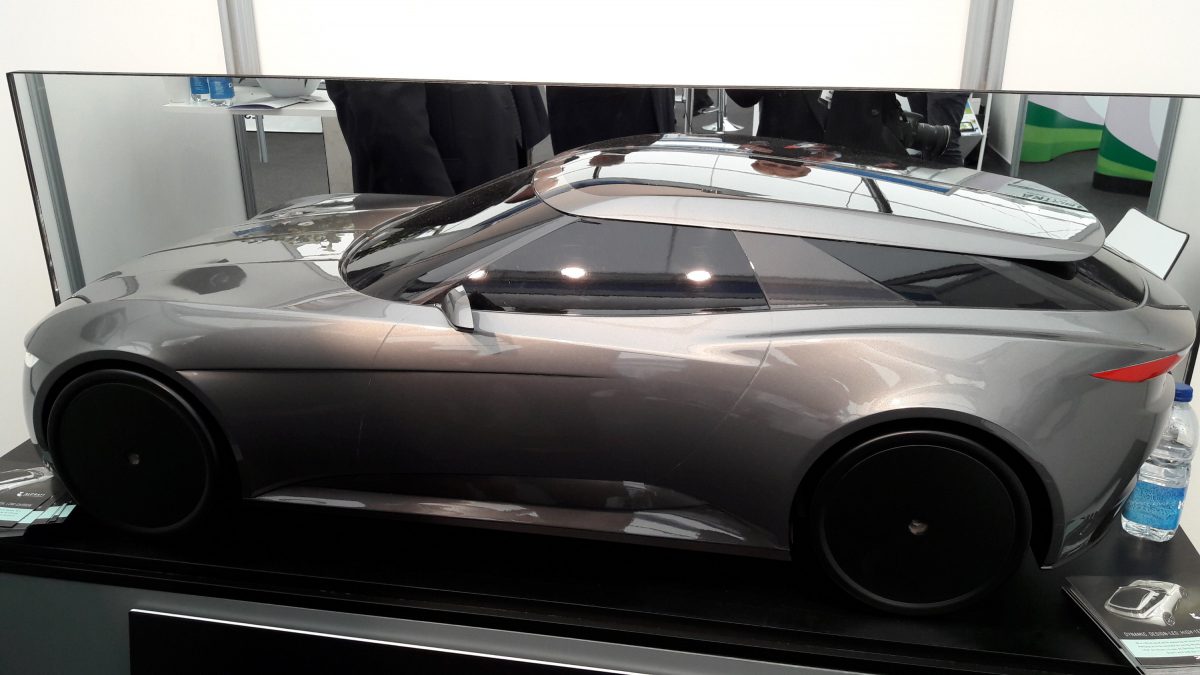
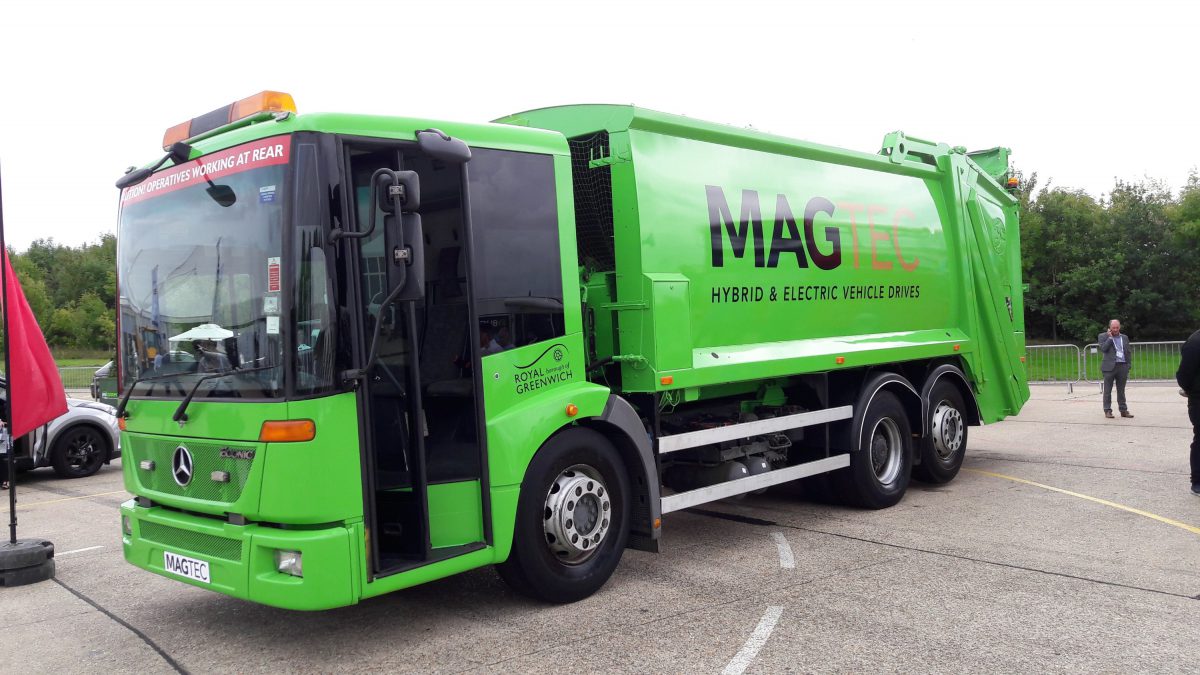
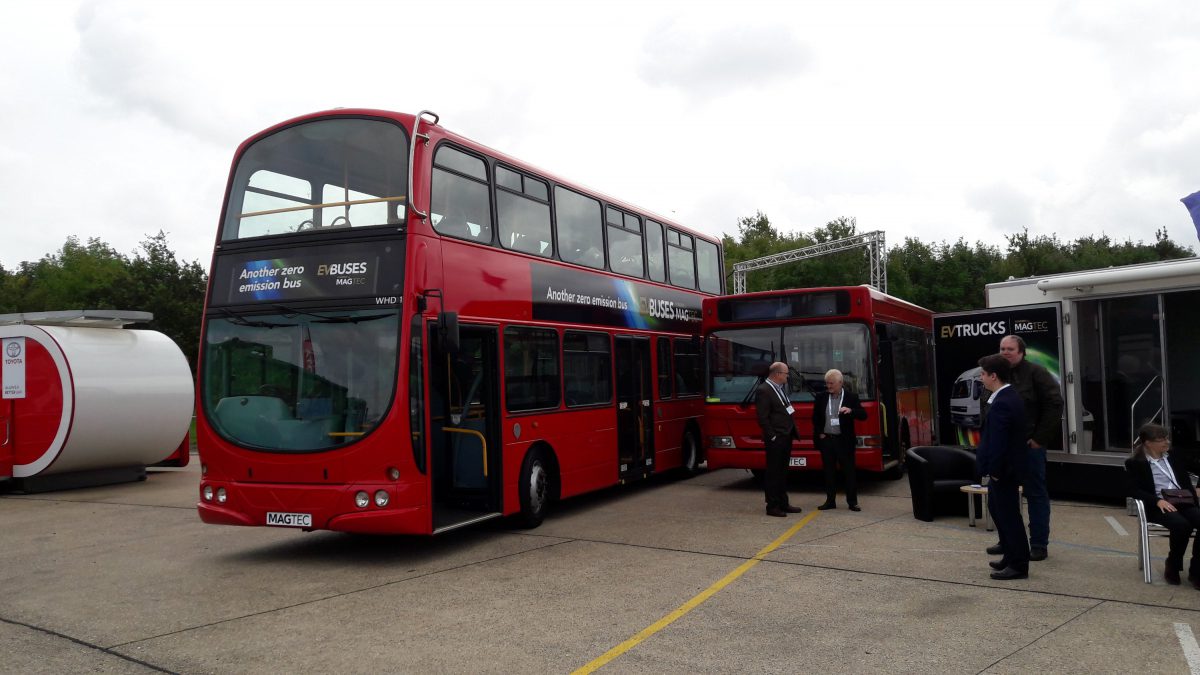
Just arrived at the Cenex LCV 2017 event and having a first look around. There are lots of interesting innovations on show, here are just a few examples.
National Grid has moved to dispel various misconceptions over its projections for extra power demand triggered by an electric vehicle revolution in the UK.
Electric cars charging in Milton Keynes (Image: T. Larkum)
Earlier this summer the UK government pledged to ban the sale of all new conventional petrol and diesel cars and vans by 2040, promoting a wider switch to hybrid and pure electric vehicles.
That announcement coincidentally followed the publication of National Grid’s Future Energy Scenarios (FES), within which the system operator established various scenarios of EV uptake and how they would impact on overall power demand.
But while National Grid had the best intentions for including such estimates, today’s ‘myth buster’ document argues that they have been “cited incorrectly and sometimes out of context” by national media outlets.
National Grid appears to have been particularly irked by a number of articles which claimed that it had said that a mass uptake of EVs would require as much as 30GW of new generating capacity. One report in particular went as far as to suggest that this would require “ten new nuke plants” to be built in the UK.
The SO has thus moved to stress that the FES document is not to be regarded as an accurate forecast, but a “set of four credible pathways” for electricity demand out to 2050. EV peak demand in those four scenarios ranged between 4 – 10GW, with the “best fit” scenario placed at around 5GW.
This, National Grid stressed, would equate to an 8% increase on today’s peak demand value and far from the “ten new nuke plants” some media outlets had claimed.
National Grid indicated that the 30GW figure appeared to have been spun out of a more extreme scenario included in the FES document for the first time, dubbed ‘High EV’, which was designed to be an outlier and was based on a number of outlying predictions, typically that conventional vehicle sales would have been stopped by 2025 and that society was prosperous enough to allow 85% of people to charge their vehicles at peak time.