Category Archives: Charging

Connected Kerb on-street charging (Image: Connected Kerb)

Connected Kerb and Vattenfall unveiled as partners in project to ‘revolutionise’ on-street charging

Vattenfall and Connected Kerb have been unveiled as partners for a new project that utilises Virgin Media’s infrastructure for on-street electric vehicle (EV) charging.

The Virgin Media Park & Charge project is being run by a consortium consisting of Vattenfall, Connected Kerb, SMS, Cenex, Ginger Town, Fully Charged, DETA and Loughborough University.

Connected Kerb on-street charging (Image: Connected Kerb)

Several local authorities also form part of the consortium, including the West Midlands Combined Authority and councils in Oxfordshire, Liverpool, Southend on Sea, Worcestershire, Wandsworth, Croydon, Northamptonshire, Hammersmith & Fulham and Belfast.

Virgin Media’s 40,000 powered street cabinets and 170,000km of ducts will be used as part of the project, which will see 1,200 charging sockets deployed across the country over the next 18 months.

The sockets will be operated by Virgin Media’s parent company, Liberty Global. The project aims to build a fully scalable EV charging network, having received a share of a £37 million government fund in July. The Innovate UK-backed project aims to encourage greater EV uptake and support the government in moving closer to net zero.

Read more: Current News

SWARCO eVolt is supplying 45 charging units, including 11 of its Rapid Chargers capable of charging two vehicles simultaneously in 30 minutes, across 28 sites in East Lothian (Image: eVolt)

Good Energy launches EV charging service ‘One Point’

Good Energy has become the latest supplier to launch an EV charging service, after having EVs in its sights for a long time.

The ‘all-in-one’ EV charging service, dubbed ‘One Point’, will be for businesses looking to offer destination or workplace charging.

The green energy supplier will recommend, install and maintain the charging services, having agreed partnerships with Swarco and RAW Infrastructure. The charge points will be supplied with 100% renewable energy by Good Energy.

SWARCO eVolt is supplying 45 charging units, including 11 of its Rapid Chargers capable of charging two vehicles simultaneously in 30 minutes, across 28 sites in East Lothian (Image: eVolt)
SWARCO eVolt Rapid Chargers (Image: eVolt)

Four chargers have been installed at the Watergate Bay Hotel in Cornwall in the pilot of the scheme. The chargers are embedded with smart, load balancing technology, Good said, enabling smart charging

Lessons from the pilot are to be used to expand the full offering to businesses across the UK, and hopefully simplify the installation of chargers for businesses.

As EV uptake increases, destination and workplace charging will be important for “large numbers of drivers”, Good said, providing an important opportunity for businesses as well as helping to decarbonise transport.

Tim Wynn-Jones, head of energy solutions at Good Energy, said: “The EV market is currently fragmented and complex, but it will soon be essential for UK businesses to offer charging — to their employees, visitors and customers.”

Read more: Current News

BP Chargemaster Rapid Charger at Milton Keynes Charging Hub (Image: T. Larkum)

BP Chargemaster lauds first 150kW ultra rapid charging hub in London

BP Chargemaster is laying claim to the first 150kW ultra-rapid charging hub in London as its nationwide roll out continues.

Four 150kW chargers have been installed at BP’s retail site in Hammersmith in London, making the site the first ultra-rapid charging hub in London.

The chargers join the rest of BP Chargemaster’s Polar network and are currently available on Free Vend for a limited time.

The chargers have both CHAedMO and CCS connectors.

BP Chargemaster Rapid Charger at Milton Keynes Charging Hub (Image: T. Larkum)
BP Chargemaster Rapid Charger (Image: T. Larkum)

The installs come as part of a wider roll out of ultra-rapid chargers, with a goal of 400 to be installed across the UK by 2021. The project was first announced at an industry event in May by Tufan Erginbilgic, CEO of downstream at BP.

The first two chargers were installed at a BP retail site, BP Cranford in Hounslow, in August.

BP Chargemaster’s Tom Callow said ultra-rapid charging will become “increasingly important” as EV adoption accelerates, particularly in urban areas due to fleets and private motorists without access to off-street parking at home.

“While our first two ultra-fast charging locations are within the M25, by the end of the year, we expect to have started to establish a nationwide network, with sites in England, Scotland and Wales.”

Read more: Current News

Nissan Leaf 3.Zero e+ (Image: Nissan)

Free fuel for life: Nissan and CSIRO launch solar-powered EV charging station trial

Nissan is conducting a 200-day trial to find out if you can run an electric car on the power of the sun.

It’s the dream of any motorist: free fuel for life – and Nissan Australia is poised to find out if it’s possible and practical.

Nissan has unveiled three electric-car charging stations at its head office in Melbourne powered by solar panels on its roof.

They are part of a 200-day trial to find out if solar-powered charging stations can provide truly emissions-free motoring.

Nissan Leaf 3.Zero e+ (Image: Nissan)
Nissan Leaf (Image: Nissan)

The charging station is the first of its type in Australia because it can be programmed to draw energy from a range of sources at certain times.

The charging stations can source energy from solar panels or the traditional coal-powered electricity grid.

Those sources of energy can then be used to charge the station’s built-in 6kWh battery pack – or send energy directly to an electric vehicle.

It means that depending on weather conditions, an electric car can be recharged using solar power only – or energy in the battery can be generated purely by solar power.

Read more: Car Advice

Government EV charging fund to help ‘unleash the power of the market’

The government’s EV charging fund is to have a broad scope, looking at “all geographical areas” of the UK, all charging speeds and a variety of use cases.

The £400 million Charging Infrastructure Investment Fund (CIIF), which is managed by Zouk Capital, was formally launched today (7 October 2019). The government is providing £200 million, with the rest to come from private investment.

The maiden investment of £35 million, then matched by the government, was put forward by Masdar last month, helping finance the installation of 3,000 rapid chargers.

However, it’s not only rapid chargers that will be funded.

Samer Salty, managing partner of Zouk Capital, confirmed that the fund intends “to cover as much as possible of the UK’s geography” to ensure that drivers have confidence to travel anywhere.

This was echoed by Philippa Eddie, commercial specialist at the Infrastructure and Projects Authority, who said that from a policy perspective, the plan is to look at “all geographical areas” and “all speeds”, despite the initial investment into rapid chargers. However “ultimately its for Zouk Capital to decide” on where the investment goes and where the remaining private investment comes from.

Read more: Current News

Kia e-Niro EV (Image: Kia)

Is it just laziness that stops me from switching to an electric car?

The practical reasons against electric are disappearing – and now councils are stepping in to help

This feels like one of the “You’re the expert” questions that appear in Guardian Money every week. I have an old-ish petrol-fuelled car, sitting parked outside my terraced home, which I use only at weekends. And I have a brother-in-law who is evangelical about his Nissan Leaf. I’d like to be more like him. Yet the closest charging point for me is a 10-minute walk away, and often busy. Is it just too early to ditch my old car and go electric?

The question marks over electric vehicles used to be about battery technology and the cost. But “range anxiety” has largely been conquered. The first Nissan Leaf batteries took you about 80-85 miles without needing a charge; the latest ones do 150 miles. The new Kia e-Niro family car manages 300 miles, while at the Frankfurt Motor Show, Mercedes was showing off its Vision EQS model with a “comfortable” range of 435 miles. Given that the average car journey in the UK is just 10 miles, according to the RAC, fears over the usability of electric cars are fading fast.

Kia e-Niro EV (Image: Kia)

Sadly, prices for new electric cars remain higher significantly higher than for petrol or diesel, with the eGolf at about £30,000 compared with petrol ones starting at about £20,000. But as we highlight this week, a used market is now developing in electric vehicles, with entry-level prices as low as £5,000 – with no annual tax, and low servicing charges to boot. What’s more, driving costs are a fraction of the cost of petrol, without even mentioning the enormous benefit to the environment, especially in cities.

So why aren’t we all switching over? The knee-jerk response is now about charging times, for city dwellers like me without the luxury of a drive or garage. Who in their right mind is going to spend half an hour queuing for a charge point, then sit there for an hour or so while it fills up? Or faff around finding the only on-street overnight charge point available, then walk home in the rain for half an hour? It’s not going to happen.

The correct response is that the climate crisis means we will have to live without the hyper-convenience we became accustomed to. If the average journey is just 10 miles, why not take the bus or use an e-bike? And if you must insist on a private car, is a 10- or 15-minute walk to a charging point really such a sacrifice to save the environment?

Read more: The Guardian

GeniePoint Network Joins North Devon to Major Routes

Rapid EV Charging for Torridge District Council

ChargePoint Services has been working alongside Torridge District Council to link them with the national GeniePoint Network. Four GeniePoint rapid chargers have been installed at strategic locations across the area, ensuring drivers living and working in Torridge, visiting the area or just passing through, have easy access to reliable, rapid electric vehicle charging facilities.

The GeniePoint Network chargers provide the latest in EV charging technology with access via the GeniePoint Network mobile web app (www.geniepoint.co.uk) or RFID card, for easy usability, payment and operation.
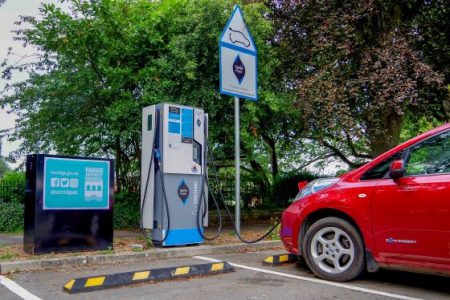
Torridge District Council are aiming to be carbon neutral by 2030, and encouraging residents to purchase electric vehicles is a part of enabling them to achieve this goal. The provision of easy to use, reliable charging facilities is designed to motivate the take-up of EVs in the area, both for residents and local businesses, demonstrating EVs are a cost effective, convenient and beneficial asset to their community, their business and to themselves reducing pollution and improving air quality.

Alex Bamberg, Managing Director, ChargePoint Services team, said:

“We recognise that managing the transition to electric powered transport requires investment and cooperation across multiple industries. The recent acquisition of ChargePoint Services by ENGIE gives us the strength and capability to meet the needs of the explosive EV infrastructure requirements across the UK, and we are working hard with our chosen partners to provide this facility nationally and become the number one provider of electric vehicle charging across the UK.”

Councillor Bob Hicks, Leader Member for the Economy, said:

“The Council have chosen to install this technology as we recognise and understand the importance of creating an infrastructure capable of supporting the rise in popularity in electric vehicles. The arrangements we have in place will allow us the flexibility to adapt our approach as the technology advances. The publicly accessible and popular locations mean that both visitors and residents will have a convenient option to recharge their vehicles while visiting local shops and leisure facilities at the same time. It is no secret that finances are tight in Local Government at present and partnering with ChargePoint Services helped provide a cost neutral implementation option. Being able to deploy the latest technology allowing two cars to be charged at once to 80% full in 30 minutes was also attractive.”

Drivers are offered free parking whilst using the chargers, and following the installation Torridge DC have received a plethora of positive comments from the public. The GeniePoint Network chargers have provided a physical presence to help promote the use of sustainable vehicles, and as more residents see that electric vehicles aren’t as inconvenient as they first believed, they foresee ownership of electric vehicles undoubtedly continuing to rise in the Torridge area.

ChargePoint Services is an ENGIE Company

Source: GeniePoint

Charging Station in Sunderland (Image: Fastned)

First oil-free gas station in US opens, only charging electric vehicles

Maryland petrol station swaps oil for electric as statewide electric vehicle fleet climbs to 20,000

A petrol station in Maryland is the first of its kind to completely transition from traditional pumps to electric vehicle charging stations.

RS Automotives in Washington DC is the US’s first fully petrol-to-electric refuelling station, exclusively for electric vehicles, when it opened earlier this week.

It can charge up to four vehicles at once within 20 to 30 minutes.

Charging Station in Sunderland (Image: Fastned)

The conversion was supported by the Electric Vehicle Institute, which received a $786,000 Alternative Fuel Infrastructure grant from the Maryland Energy Administration in 2018.

Read more: Independent

Milton Keynes 'Mushrooms' Charging Hub (Image: T. Larkum)

Labour unveils ‘mammoth’ multi-billion offshore wind and EV charging pledges

A Labour government would take the UK’s offshore wind capacity to 52GW within the next 10 years and invest billions in EV charging infrastructure, the party has said.

Ahead of shadow energy secretary Rebecca Long Bailey’s speech at the party’s conference today, the party unveiled a raft of clean energy pledges designed at ramping up the country’s renewables portfolio and enabling a widespread adoption of electric vehicles.

Milton Keynes 'Mushrooms' Charging Hub (Image: T. Larkum)
Milton Keynes ‘Mushrooms’ Charging Hub (Image: T. Larkum)

The pledges feed into previously-announced plans to overhaul the UK’s power system, starting with the “immediate” renationalisation of transmission and distribution grids.

The plans also feed into a wider policy agenda, spoken of by Labour deputy leader John McDonnell yesterday, focusing on a UK equivalent of the Green New Deal to tackle climate change, which McDonnell described as the primary political question of today.

Offshore wind and a People’s Power Plan

Labour has pledged to create a ‘People’s Power Plan’, wherein the government will take a 51% stake in as many as 37 new offshore wind farms, to be built in the UK. Those offshore wind farms would swell the country’s offshore wind capacity to 52GW by 2030, marking a significant contribution towards renewable output.

It said the intent for the public to own a majority stake in new developments was designed to prevent private and foreign public firms dominating deployment of offshore wind as they are now. Last week’s offshore wind CfD results, wherein the asset class clinched record low strike prices of £39.65/MWh, saw the third round principally won by companies including SSE, Equinor, Innogy and Statkraft.

Speaking at the conference today, Long Bailey also said that the country could not “rely on the market to act fast enough”.

Labour has also committed that 80% of all profit generated from the public’s stake in new offshore wind would be redirected to new renewable generation, wider energy system improvements and to aid the “climate transition”.

Read more: Current News

Charging Hub with eVolt Rapid Chargers (Image: SWARCO eVolt)

Electric vehicle charging hub opens in Dundee

A new charging hub for electric cars has opened in Dundee.

The city has one of the highest concentrations of electric vehicles (EVs) in the UK.

The new hub, situated on top of Greenmarket car park, is the first of three planned in Dundee. It uses solar canopies and a battery storage system to charge up 20 vehicles at a time.

Charging Hub with eVolt Rapid Chargers (Image: SWARCO eVolt)

Currently, vehicles can be charged for free but the city council plans to bring in phased tariffs from November.

Dundee has more than 130 electric taxis and the city council says its own fleet of electric cars and vans is the largest of any local authority in the UK.

The new hub, along with two more planned for the Bell Street and Olympia multi-storey car parks, will provide an extra 300 charge point connections across the city.

Read more: BBC