Category Archives: BMW

News and reviews of BMW electric cars (including plug-in hybrids).

BMW Group: More Than 50% Of Electricity Use Worldwide From Renewables

BMW Group is now, for the first time in its history, receiving more than half of its electricity worldwide from renewable energy infrastructure, based on comments made by company representatives at the recent 2015 Annual Account Press Conference.

Bmw“More than half” in this case means 51%. 🙂 So, just above half. Still, considering where the company was only a few years ago, and compared to most other companies that is commendable. The company is reportedly aiming to receive around 100% of its electricity via renewable energy infrastructure over just the next few years, which could put it in competition with IKEA.

8-2411p_i8_wind_NewEnergyNews

That goal will be achieved via a step-by-step plan that will see the company first greatly improve energy efficiency at its various facilities around the world. After this step is completed, the company will then oversee a renewables generation buildout, and then, finally, a third step involves purchasing the remainder of its needed electricity from various energy companies.

The Head of Sustainability & Environmental Protection at the BMW Group, Ursula Mathar:

“We have a clear objective and a concrete plan for the transition to renewable energy. However, economic viability is essential for implementation. Only under the right framework conditions can we put our plans into action step by step in individual markets worldwide.”

A recent press release provides further details:

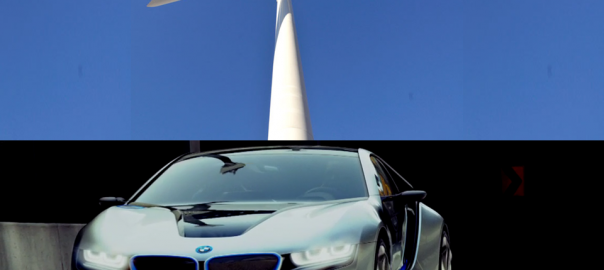
Some 51% of the electricity supplied to the BMW Group worldwide is already being drawn from renewable energy sources. In Leipzig, Germany, the BMW Group is using wind power. In mid-2013, four wind turbines started operation on the premises of the plant, with 100% of the power produced going into the production of the BMW i3 and BMW i8. At the Spartanburg plant in South Carolina, USA, a methane gas system provides around 50% of the energy required for production. At the Rosslyn plant in South Africa, the foundation stone for a combined heat and power unit fired by biogas was laid at the end of 2014. The gas used is sourced from the waste products created on cattle and chicken farms. Commissioning of this system will already enable the company to cover over 25% of the energy required by the production plant this year.

Good steps, for sure. It’ll be interesting to see how long it’ll take BMW Group to achieve its goal.

Source: Clean Technica
TTAC Video Review Of BMW i3 REx

The Truth About Cars (or TTAC if you will) are not known for holding their tongue when it comes to anything automotive that doesn’t ring true to themselves, so it was with heightened interest we saw the online magazine had done a review on BMW’s most “love it or hate it” plug-in offering – the i3 REx.

Which way would review Alex Dykes take us, and the i3? Will the plug-in BMW be the worst offering the Bavarian company has unleashed on humanity this decade, or one of the better ones?

Surely in TTAC-style there could be no in between right? Wrong. Overall the review is quite comprehensive and balanced – even when testing the infamous “battery exhaustion going up a hill” chestnut we have all been subjected to quite often.

Source: Inside EVs

BMW i3 Wins One More Award (Image: Wheels)

BMW i3 Wins One More Car Of The Year Award

The awards just don’t stop coming for the BMW i3.

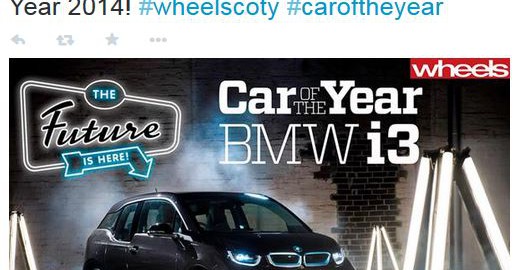
The latest, from Wheels Australia, is one more “Car of the Year” award for 2014.

BMW i3 Wins One More Award (Image: Wheels)

This adds to numerous awards the i3 has received over the past year and a half.

Deservedly so, the i3 is quickly becoming one of the most awarded electric cars of all time.

Source: Inside EVs

2015 BMW i3 Interior

2015 BMW i3 Video Road Test


If there were ever a brand-reset button in the automotive business, the BMW i3 electric car is it.

It’s both a compact hatchback and an all-electric car, from the brand that claims to build ultimate driving machines.

How does it measure up to that lofty standard? Hi, I’m Joel Feder, and I’ll give you our verdict on the BMW i3 in our latest video road test.

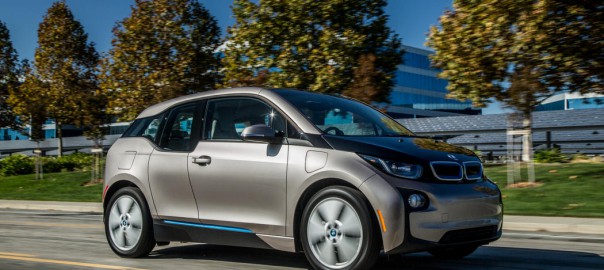
Strip away the simulated twin-kidney grills and roundel badges, and you’d really never know the i3 is a BMW. It has skinny tires, and an odd side view with a dipped window line.

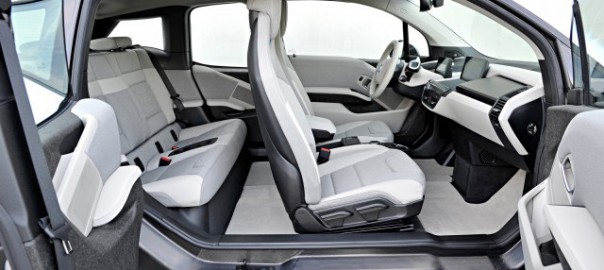
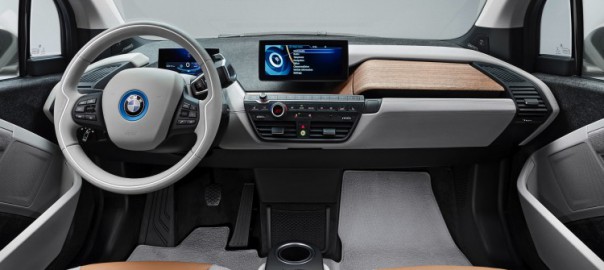
Inside, it’s unlike any BMW you’ve seen before—it’s more like a loft living room than a cockpit.

It’s dominated by a big screen that displays infotainment functions, controlled via the iDrive knob on the console. A smaller screen behind the steering wheel provides all the other driving information, including the speedometer.

Overall the interior is elegant and well put together, except for the renewable-fiber kenaf material. It’s fine on the far part of the dashboard, but the door panels look like they’ve been stripped of their covering. It’s the one sour note in the car.

This interior is far more spacious than you’d think. While the front seats have extremely thin backs, they’re comfortable and bolstered well. The seating position is upright and higher than some other small cars, and you get good view of the road.

The rear seats are a bit tight for full-sized adults, and it’s awkward getting in and out because the rear passengers can’t open their own doors. The front-seat passenger has to open the front door first.

The i3 breaks completely new ground in its drivetrain. It’s a battery-powered electric car with a 22-kilowatt-hour lithium-ion battery pack mounted under the floor. That powers a 125-kilowatt (170-horsepower) electric motor in the rear that sends up to 184 pound-feet of torque to the rear wheels.

The EPA rates the i3 at 81 miles of electric range with an efficiency rating of 124 MPGe. That makes it the most efficient car of any kind sold in the U.S. today. BMW says you’ll see a real-world range of 75 to 90 miles.

Have range anxiety? Want another 80 miles as a safety net (give or take)? You can opt for the range-extending REx engine, as fitted to our test car. It’s a little two-cylinder gasoline-powered generator in the rear of the i3, next to the electric motor.

It kicks in to act as a generator when you deplete the battery, but it’s not connected to the drive wheels. You should know that opting for the REx model drops your battery range rating to 73 miles – and it’s only rated at 34 mpg while the range extender is on.

Read more: Green Car Reports

2015 BMW i8 Video Road Test

The BMW i8 is sleek and stunning, but it’s no V-8-powered supercar. Is it the car that will give plug-in hybrids sex appeal?

First, you need to know what makes the i8 go. This is no straightforward supercar: The i8 gets power in a complex way–it can be front-wheel drive, rear-wheel drive, or all-wheel drive, depending on the situation.

Here’s how: Between the front wheels there’s a 96-kilowatt electric motor–the equivalent of 131 horsepower. It sends power to the front wheels through a two-speed transmission.

That electric motor taps into a 5.1-kilowatt-hour lithium-ion battery mounted in the tunnel between the seats. It can run the car’s front wheels in its electric-only “Max e-Mode” up to 75 mph.

In the back, there’s a turbocharged 1.5-liter three-cylinder gasoline engine producing 231-horsepower. That power goes to the rear wheels through a six-speed automatic transmission.

Combine them, and you have 362 horsepower, and a 0-62 mph time of 4.4 seconds when using both powertrains together.

Put the BMW i8 into Comfort mode, and the i8 behaves like a hybrid, blending gas and electric power as needed. Go faster than 40 mph, and it sends power to every wheel, for all-wheel drive.

Flip into Sport mode, and the gauges glow red, a tachometer replaces the power meter, and the powertrains go into beast mode.

Can the i8 really be an eco-friendly sports car? The EPA says it can run in pure electric mode for 15 miles; in hybrid mode, the i8 earns ratings of 28 mpg combined and 76 MPGe.

Drive it like a sports car, and you might only see 50 mpg on average. But when you do, you’ll get attention. A lot of it.

Let’s be clear: The i8 really isn’t a track car. It strikes a nice balance between sporty performance and high efficiency. It has really neutral handling, and precise electric power steering with decent simulated feedback.

It also has what we call “engineered” noise: BMW pipes in simulated power noises to make the i8 sound more sporty. Those noises get louder in Sport mode…but the i8 never is really, truly, blindingly fast. It’s just quick.

The drivetrain is exotic, but the i8’s shape is truly outrageous. Sure, there’s a BMW grille and something like a 6-Series shape, but it’s all swept up in huge futuristic swoops and scoops and wings–which all help smooth out its aero profile.

It’s something of a chore to get into the i8, but once you’re in, the usual iDrive controller and infotainment screens will be familiar.

The climate control and stereo both feature actual knobs, which is nice, and the gauge cluster is an LCD screen, which reconfigures itself based on the driving mode you’ve chosen.

These front seats are very comfortable, with heavy contouring. You sit low in the car, but visibility is just fine. BMW may say the i8 is a 2+2, but don’t expect to put average-sized humans back there if an actual adult sits up front.

The BMW i8 hasn’t been crash-tested yet, and frankly we want to see it happen–its bodyshell is made of carbon-fiber-reinforced plastic on an aluminum rolling chassis, and little crash-test data exists for cars made that way.

The i8 gets the standard suite of safety tech, from six airbags to the usual electronic safety systems, plus such active safety systems as a forward-collision warning system and surround-view cameras.

Priced from about $135,000, the i8 comes well-equipped, with iDrive and a 10.2-inch screen, navigation, BMW’s i Remote App, six-way power front seats, heated seats, LED headlights, and satellite radio. There are few options other than color.

So what’s the bottom line with the BMW i8? It’s a ground-breaking sports coupe with an advanced hybrid powertrain that has super economy and style, if not quite supercar performance.

Source: Green Car Reports

BMW i3, selected as Yahoo Autos 2015 Green Car of the Year (Image: Kerian/Yahoo)

Video Review: The BMW i3 Offers a Glimpse of the Future

Generally, there have been two approaches to creating electric automobiles: Stuff batteries and an electric motor into existing gas-power cars, or start from scratch and create a new design. Not satisfied with either of those methods, BMW in a sense used a time machine.

Its new i3 is a deep dive into what the car of the future should be: efficient and sustainable. It’s transportation to be sure, but the i3 is also just as much an environmental think tank on wheels.

Its passenger cell is made from lightweight carbon fiber and reinforced plastic manufactured in a hydroelectric-power factory in Washington State. Interior panels use renewable Asian kenaf plants. It’s all assembled in a German plant amped up by wind power. It would be no surprise to find that the i3 is organic. And edible.

The motor provides 170 horsepower and 184 pound-feet of instant torque. While the i3 can be purely electric, drivers seeking more range will insist on the model with the 2-cylinder gasoline-power generator for $3,850 more. At 1.9 gallons, the gas tank adds about 60 miles of range. At speeds over 25 miles an hour, road noise masks the engine drone. Pedestrians may think you’re mowing the lawn. With the generator, i3 weighs just 2,900 pounds.

BMW claims 80 to 100 miles on battery power alone. My average was 65 using the midlevel efficiency mode Eco Pro. My range was confirmed by a couple in a grocery store parking lot who have owned their i3 for a few months.

Rear-wheel drive, 50-50 weight distribution and a spunky 0-to-60 time of 7.5 seconds seem a God-given right for BMW (it’s slower in Eco modes and in range-extender operation). But a stiff ride and lack of any road feel should prevent the Bavarians from using the Ultimate Driving Machine tagline here. Tires not much wider than my foot don’t help much.

The brake pedal is seldom needed in urban driving. Power regeneration is so aggressive that lifting off the throttle slows things strikingly. One-pedal driving activates the brake lights. At higher speeds, the i3 coasts with less resistance.

Inside, the car makes me wary of the future. The power button location is awkward, and the unusual drive selector takes practice. Creative and renewable materials used on the base Mega World model — one of three, along with Giga World and Tera World — give off an office cubicle vibe. Nearly all my passengers viewed the kenaf fiber panels as trunk liner material. That couple at the grocery store bought the Giga World model with leather and eucalyptus wood trim. It’s highly preferable to the Mega’s budget plastic look (and sometimes feel) and adds a larger data screen. It’s a bargain at $1,500 more.

At $47,050 as tested (without tax incentives), navigation is standard; heated seats add $550. Note: A huge medical-grade electric heating pad can be found on Amazon for under $50. I’ll once again gripe that BMW’s rearview camera is part of a $1,000 grouping. Who knew that the future, and safety, was about option packages?

Getting to the two rear seats requires using cumbersome rear-hinge coach doors. Average adults will fit fine, and the i3’s floor is delightfully flat, though feet in back will be cramped.

Looking like the avant-garde offspring of BMW’s classic Isetta and 2002, people instantly know if they love or hate the i3’s design. Comparably equipped, the Nissan Leaf and Chevy Volt are easily $11,000 less than the i3. All of them will get you to work; the i3 takes owners into the future.

Source: NY Times

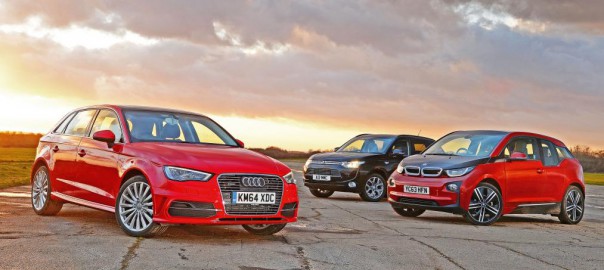
Audi A3 e-tron, Mitsubishi Outlander and BMW i3 plug-ins

Audi A3 e-tron vs BMW i3 & Mitsubishi Outlander PHEV

Plug-in cars promise great efficiency, but is Audi’s new A3 e-tron hybrid a better bet than range-extending i3 and Outlander?

Eco-friendly plug-in models are slowly gaining in popularity, so it’s no real surprise that after decades of experimentation Audi has finally decided to jump on the petrol-electric bandwagon.

The new A3 e-tron is based on the classy A3 Sportback, and packages together a 1.4-litre petrol turbo and 75kW motor, while a compact lithium-ion battery pack sits under the back seat. Its raw statistics certainly look compelling, with a 31-mile claimed electric range, CO2 emissions of 37g/km and 176.6mpg economy.

Just as importantly, Audi says these figures don’t come at the expense of the standard Sportback’s space, refinement and upmarket appeal.

However, there are many different ways to package the perfect plug-in, as our other contenders here prove. Mitsubishi’s rugged Outlander PHEV claims to deliver all the practicality of the standard model, but – with a 30-mile electric range – city car-humbling costs.

Completing our trio is BMW’s daring i3 Range Extender, which sets the class standard for efficiency, design and driving dynamics.

Read more: AutoExpress

BMW i3 Interior (Image: BMW)

BMW’s i3 interior is a winner

The i8 interior is very good, but the BMW i3 interior to me is the real winner. It’s just so different and refreshing and inspired.

Interiors are one of the most important aspects of an automobile. It’s the place where you will spend 90 percent of the time with your car. So the interior must be a nice place to be. A good interior is one that is comfortable, ergonomic, and aesthetically pleasing all at the same time. But the really special ones are the kind that are able to do all of those things as well as being very different and shaking things up a bit.

The interior that I think does this best is the BMW i3.

BMW i3 Interior (Image: BMW)

The i8 is very good too, but the i3 to me is the real winner. It’s just so different and refreshing and inspired. With its exposed carbon fiber, funky recycled seats, eucalyptus wood and incredibly open design, the i3 is like no other interior on the market. Which perfectly suits the i3, a car like no other on the market. It’s also so unlike any other BMW on the inside. The i8 sorta kinda feels like a typical sporty BMW from within those swan doors. But the i3 feels different. It feels happy and serene, not at all sporting, which was the idea to begin with.

Car and Driver recently sat down with the head of BMW i design, Benoit Jacob, and asked him some questions about its design. What he shared on designing the i3’s interior was quite interesting. When asked if there was an overall theme to the interior design of the i3, Jacob had this to say

“What if the interior would inspire a more relaxed driving behavior? It’s Zen, in a way. From a higher design level, that was quite an interesting challenge.”

Jacob also spoke about the use of the wood on the dash and how it pays homage to older BMW’s, such as the 2002 —

“I’m very passionate about cars, and I believe there is no future without history. Sometimes, if there’s a way to echo the past a little bit­—without any sort of retro design, because that’s absolutely not the point—why not? It just came by chance.”

It’s so refreshing to hear a designer trying to inspire a driver with the interior. Too often, these days, car interiors are so flooded with buttons and mobile phone connectivity that the car feels so detached, like a computer. They feel like they’re just there as vessels for the driver to control the car. While that is, technically, what a car interior is, I like an interior to give the car a mood. The i3’s does that better than any other. And I applaud BMW for straying from its sporting roots to try a different genre. It’s refreshing and I hope there’s more to come.

Source: BMW Blog

New versus old (Image: P. Norby)

Top 10 Reasons Electric Cars Will Make ICE Obsolete

Breaking the Inertia of the Status Quo

“You never change things by fighting the existing reality.

To change something, build a new model that makes the existing model obsolete.”

― Buckminster Fuller

In 2007 I began to drive a Gem e4 Neighborhood electric vehicle (NEV) powered by roof top solar, It was a personal experiment connecting affordable solar PV “sunshine” to transportation.

In 2009 I began to drive the BMW Mini-E, a full electric car capable of around 90 miles of driving between charges.

At that time, in 2009, there were just the Mini-E and the Tesla Roadster drivers with no charging infrastructure, aiming at the goal of a better future for transportation.

That hopeful vision of the future was far from assured.

We had been down this road before, about a decade earlier with the GM EV1 and the Toyota Rav4EV and a few other smaller production run cars. That episode in the development of EV’s ended in disaster, and potentially our era would follow, arriving at the the same destiny.

The inertia of the status quo is a powerful foe of change. Its strength and certainty comes from the common knowledge of today and yesteryear.

By 2011 Chevy, Nissan, Tesla and others were in the EV game for good. No longer an R&D exercise, billions of dollars of plant development were green lighted for full production of the electric car. The future of the EV was almost certainly going to go forward with no chance of the stalled effort of the GM EV1 and Toyota Rav4EV.

Today, in 2015, we are looking at dozens of manufacturers and an ever growing number of plug in cars. From those first days of 2009 and less than 1000 cars on the road, to now, just five years later and 300,000 cars with plugs on the road. Amazing exponential growth.

New versus old (Image: P. Norby)
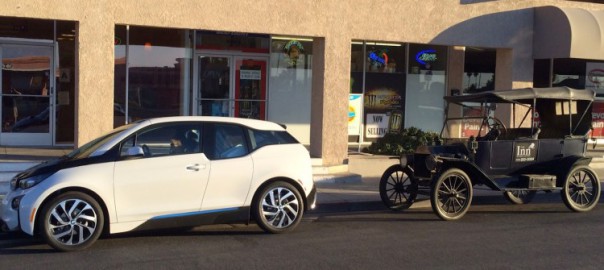
New (BMW i3) versus old (Image: P. Norby)

2017 looks to be the tipping point where the average electric car will improve to 150-200 miles per charge with both battery density and cycle duration increasing, with many manufacturers offering high volume electric cars. There ends the main obstacle of electric cars, range anxiety.

It’s possible, I would say predictable, that we will see a perfect storm in favor of EV’s in this 2017-2020 time frame. Extremely high gas prices and several models of 150-200 mile EV’s powered mostly by renewable energy.

It would not be surprising to see 30% of all cars sold being a hybrid or better with roughy 10% being pure electric by 2017. Exponential growth will continue. By 2020, a true revolution takes hold in transportation, the replacement of the gasoline vehicle feet will be underway en-masse.

Below is my view on why the electric vehicle will replace the gasoline powered car, and why it will do so very soon:

Top Ten reasons why the electric car will make the existing gasoline car obsolete.

1. They’re quicker.

2. They’re quieter.

3. They’re more fun to drive.

4. They’re connected to your home, instead of connected to oil.

5. You charge your car at home, not at the gas filling station. (just like your laundry is done at home and not at the Laundromat)

6. They’re up to 5 times more efficient and1/5th the cost to operate over the lifetime of the car. (energy conservation is wealth creation)

7. You can make your own fuel on the roof of your home.

8. They clean our air. Every EV that replaces a gasoline car makes every breath we take, cleaner and healthier.

9. They’re technologically superior, yet far simpler machines.

10. They will usher in a new transportation future including multiple mobility choices for our cities.

Bet on it!

Source: Peder Norby’s blog via Inside EVs