Category Archives: i3

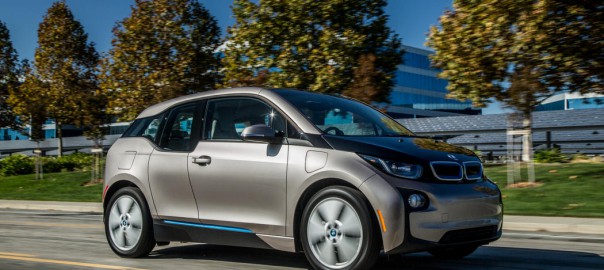
BMW i3, selected as Yahoo Autos 2015 Green Car of the Year (Image: Kerian/Yahoo)

Video Review: The BMW i3 Offers a Glimpse of the Future

Generally, there have been two approaches to creating electric automobiles: Stuff batteries and an electric motor into existing gas-power cars, or start from scratch and create a new design. Not satisfied with either of those methods, BMW in a sense used a time machine.

Its new i3 is a deep dive into what the car of the future should be: efficient and sustainable. It’s transportation to be sure, but the i3 is also just as much an environmental think tank on wheels.

Its passenger cell is made from lightweight carbon fiber and reinforced plastic manufactured in a hydroelectric-power factory in Washington State. Interior panels use renewable Asian kenaf plants. It’s all assembled in a German plant amped up by wind power. It would be no surprise to find that the i3 is organic. And edible.

The motor provides 170 horsepower and 184 pound-feet of instant torque. While the i3 can be purely electric, drivers seeking more range will insist on the model with the 2-cylinder gasoline-power generator for $3,850 more. At 1.9 gallons, the gas tank adds about 60 miles of range. At speeds over 25 miles an hour, road noise masks the engine drone. Pedestrians may think you’re mowing the lawn. With the generator, i3 weighs just 2,900 pounds.

BMW claims 80 to 100 miles on battery power alone. My average was 65 using the midlevel efficiency mode Eco Pro. My range was confirmed by a couple in a grocery store parking lot who have owned their i3 for a few months.

Rear-wheel drive, 50-50 weight distribution and a spunky 0-to-60 time of 7.5 seconds seem a God-given right for BMW (it’s slower in Eco modes and in range-extender operation). But a stiff ride and lack of any road feel should prevent the Bavarians from using the Ultimate Driving Machine tagline here. Tires not much wider than my foot don’t help much.

The brake pedal is seldom needed in urban driving. Power regeneration is so aggressive that lifting off the throttle slows things strikingly. One-pedal driving activates the brake lights. At higher speeds, the i3 coasts with less resistance.

Inside, the car makes me wary of the future. The power button location is awkward, and the unusual drive selector takes practice. Creative and renewable materials used on the base Mega World model — one of three, along with Giga World and Tera World — give off an office cubicle vibe. Nearly all my passengers viewed the kenaf fiber panels as trunk liner material. That couple at the grocery store bought the Giga World model with leather and eucalyptus wood trim. It’s highly preferable to the Mega’s budget plastic look (and sometimes feel) and adds a larger data screen. It’s a bargain at $1,500 more.

At $47,050 as tested (without tax incentives), navigation is standard; heated seats add $550. Note: A huge medical-grade electric heating pad can be found on Amazon for under $50. I’ll once again gripe that BMW’s rearview camera is part of a $1,000 grouping. Who knew that the future, and safety, was about option packages?

Getting to the two rear seats requires using cumbersome rear-hinge coach doors. Average adults will fit fine, and the i3’s floor is delightfully flat, though feet in back will be cramped.

Looking like the avant-garde offspring of BMW’s classic Isetta and 2002, people instantly know if they love or hate the i3’s design. Comparably equipped, the Nissan Leaf and Chevy Volt are easily $11,000 less than the i3. All of them will get you to work; the i3 takes owners into the future.

Source: NY Times

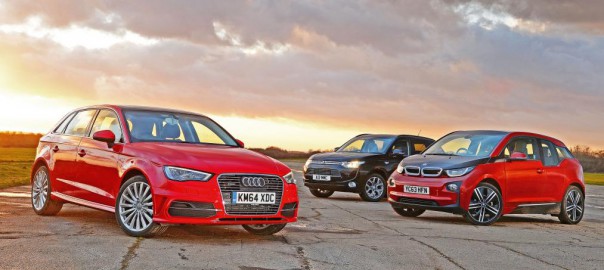
Audi A3 e-tron, Mitsubishi Outlander and BMW i3 plug-ins

Audi A3 e-tron vs BMW i3 & Mitsubishi Outlander PHEV

Plug-in cars promise great efficiency, but is Audi’s new A3 e-tron hybrid a better bet than range-extending i3 and Outlander?

Eco-friendly plug-in models are slowly gaining in popularity, so it’s no real surprise that after decades of experimentation Audi has finally decided to jump on the petrol-electric bandwagon.

The new A3 e-tron is based on the classy A3 Sportback, and packages together a 1.4-litre petrol turbo and 75kW motor, while a compact lithium-ion battery pack sits under the back seat. Its raw statistics certainly look compelling, with a 31-mile claimed electric range, CO2 emissions of 37g/km and 176.6mpg economy.

Just as importantly, Audi says these figures don’t come at the expense of the standard Sportback’s space, refinement and upmarket appeal.

However, there are many different ways to package the perfect plug-in, as our other contenders here prove. Mitsubishi’s rugged Outlander PHEV claims to deliver all the practicality of the standard model, but – with a 30-mile electric range – city car-humbling costs.

Completing our trio is BMW’s daring i3 Range Extender, which sets the class standard for efficiency, design and driving dynamics.

Read more: AutoExpress

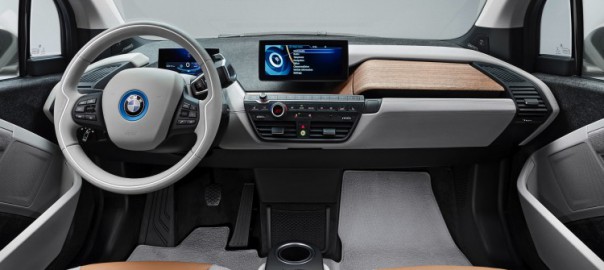
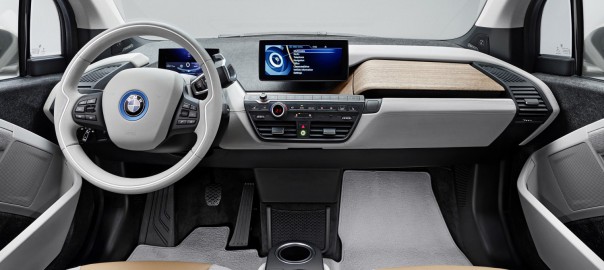
BMW i3 Interior (Image: BMW)

BMW’s i3 interior is a winner

The i8 interior is very good, but the BMW i3 interior to me is the real winner. It’s just so different and refreshing and inspired.

Interiors are one of the most important aspects of an automobile. It’s the place where you will spend 90 percent of the time with your car. So the interior must be a nice place to be. A good interior is one that is comfortable, ergonomic, and aesthetically pleasing all at the same time. But the really special ones are the kind that are able to do all of those things as well as being very different and shaking things up a bit.

The interior that I think does this best is the BMW i3.

BMW i3 Interior (Image: BMW)

The i8 is very good too, but the i3 to me is the real winner. It’s just so different and refreshing and inspired. With its exposed carbon fiber, funky recycled seats, eucalyptus wood and incredibly open design, the i3 is like no other interior on the market. Which perfectly suits the i3, a car like no other on the market. It’s also so unlike any other BMW on the inside. The i8 sorta kinda feels like a typical sporty BMW from within those swan doors. But the i3 feels different. It feels happy and serene, not at all sporting, which was the idea to begin with.

Car and Driver recently sat down with the head of BMW i design, Benoit Jacob, and asked him some questions about its design. What he shared on designing the i3’s interior was quite interesting. When asked if there was an overall theme to the interior design of the i3, Jacob had this to say

“What if the interior would inspire a more relaxed driving behavior? It’s Zen, in a way. From a higher design level, that was quite an interesting challenge.”

Jacob also spoke about the use of the wood on the dash and how it pays homage to older BMW’s, such as the 2002 —

“I’m very passionate about cars, and I believe there is no future without history. Sometimes, if there’s a way to echo the past a little bit­—without any sort of retro design, because that’s absolutely not the point—why not? It just came by chance.”

It’s so refreshing to hear a designer trying to inspire a driver with the interior. Too often, these days, car interiors are so flooded with buttons and mobile phone connectivity that the car feels so detached, like a computer. They feel like they’re just there as vessels for the driver to control the car. While that is, technically, what a car interior is, I like an interior to give the car a mood. The i3’s does that better than any other. And I applaud BMW for straying from its sporting roots to try a different genre. It’s refreshing and I hope there’s more to come.

Source: BMW Blog

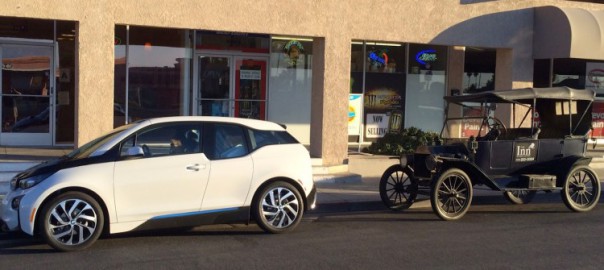
New versus old (Image: P. Norby)

Top 10 Reasons Electric Cars Will Make ICE Obsolete

Breaking the Inertia of the Status Quo

“You never change things by fighting the existing reality.

To change something, build a new model that makes the existing model obsolete.”

― Buckminster Fuller

In 2007 I began to drive a Gem e4 Neighborhood electric vehicle (NEV) powered by roof top solar, It was a personal experiment connecting affordable solar PV “sunshine” to transportation.

In 2009 I began to drive the BMW Mini-E, a full electric car capable of around 90 miles of driving between charges.

At that time, in 2009, there were just the Mini-E and the Tesla Roadster drivers with no charging infrastructure, aiming at the goal of a better future for transportation.

That hopeful vision of the future was far from assured.

We had been down this road before, about a decade earlier with the GM EV1 and the Toyota Rav4EV and a few other smaller production run cars. That episode in the development of EV’s ended in disaster, and potentially our era would follow, arriving at the the same destiny.

The inertia of the status quo is a powerful foe of change. Its strength and certainty comes from the common knowledge of today and yesteryear.

By 2011 Chevy, Nissan, Tesla and others were in the EV game for good. No longer an R&D exercise, billions of dollars of plant development were green lighted for full production of the electric car. The future of the EV was almost certainly going to go forward with no chance of the stalled effort of the GM EV1 and Toyota Rav4EV.

Today, in 2015, we are looking at dozens of manufacturers and an ever growing number of plug in cars. From those first days of 2009 and less than 1000 cars on the road, to now, just five years later and 300,000 cars with plugs on the road. Amazing exponential growth.

New versus old (Image: P. Norby)
New (BMW i3) versus old (Image: P. Norby)

2017 looks to be the tipping point where the average electric car will improve to 150-200 miles per charge with both battery density and cycle duration increasing, with many manufacturers offering high volume electric cars. There ends the main obstacle of electric cars, range anxiety.

It’s possible, I would say predictable, that we will see a perfect storm in favor of EV’s in this 2017-2020 time frame. Extremely high gas prices and several models of 150-200 mile EV’s powered mostly by renewable energy.

It would not be surprising to see 30% of all cars sold being a hybrid or better with roughy 10% being pure electric by 2017. Exponential growth will continue. By 2020, a true revolution takes hold in transportation, the replacement of the gasoline vehicle feet will be underway en-masse.

Below is my view on why the electric vehicle will replace the gasoline powered car, and why it will do so very soon:

Top Ten reasons why the electric car will make the existing gasoline car obsolete.

1. They’re quicker.

2. They’re quieter.

3. They’re more fun to drive.

4. They’re connected to your home, instead of connected to oil.

5. You charge your car at home, not at the gas filling station. (just like your laundry is done at home and not at the Laundromat)

6. They’re up to 5 times more efficient and1/5th the cost to operate over the lifetime of the car. (energy conservation is wealth creation)

7. You can make your own fuel on the roof of your home.

8. They clean our air. Every EV that replaces a gasoline car makes every breath we take, cleaner and healthier.

9. They’re technologically superior, yet far simpler machines.

10. They will usher in a new transportation future including multiple mobility choices for our cities.

Bet on it!

Source: Peder Norby’s blog via Inside EVs

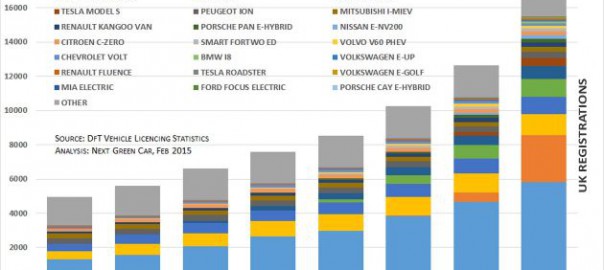
UK electric vehicle registrations UK (Image: Next Green Car)

Nissan LEAF most popular electric car in UK

Figures recently released show that the Nissan LEAF maintains its position as the most popular electric car or van in the UK, with at least 5,838 vehicles registered by the third quarter of 2014, representing over a third of all EV sales.

The registration data also shows the new Mitsubishi Outlander PHEV has made a dramatic entry to the UK market; the electric SUV is already in second position with over 2,706 sales less than a year after its UK release.

In third and fourth places are two more established plug-in hybrids, the Toyota Prius PHEV (with 1,226 registrations) and the Vauxhall Ampera (1,039 vehicles). The BMW i3 now ranks fifth with at least 1,029 UK registrations (454 all-electric and 575 range-extender variants).

The Renault ZOE and Tesla Model S are also selling well in the UK with over 775 and 474 sales respectively; the two models in fourth and fifth sales positions across Europe as a whole (YTD October 2014).

UK electric vehicle registrations UK (Image: Next Green Car)

With the recent announcement from OLEV that 23,083 claims have been made through the Plug-in Car Grant scheme, the number of electric cars and vans in the UK now exceeds 24,500 vehicles for the first time.

Another indicator that the EV market is gaining momentum is the number of fully electric and plug-in hybrid models available in the UK. While only 9 EVs were available for the major manufacturers in 2011 (excluding quadricycles), this increased to 18 models in 2013, and now stands at 24 high-quality cars and vans (in 2014) with more models due for launch in 2015.

Dr Ben Lane, Director of Next Green Car said:

“The strong growth of the EV market in the UK as elsewhere provides yet more evidence that the light-duty vehicle market is undergoing a radical change with consumer preferences changing from petrol and diesel models to electric power-trains. With sales growing exponentially, the EVs are set to become commonplace on UK roads within the next few years.”

Source: Next Green Car

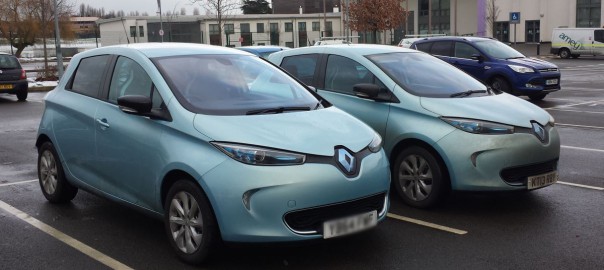
ZOE Twins (Image: T. Larkum)

EV Spotting

ZOE Twins (Image: T. Larkum)

It turns out my Renault ZOE is no longer the only one in my local area, around Northampton. An almost identical but newer Dynamique Intens has turned up, and I’ve seen it in Northampton and nearby Wellingborough. It’s even the same Energy Blue colour. I’m embarrassed to say I can always tell which one is mine, it’s the dirtiest one!

Catching a quick charge at the local Renault dealer (Image: T. Larkum)

While catching a charge recently at the Renault dealership in Bletchley I spotted a ZOE with the rather neat registration number of “EV13 ZOE” (where, of course, EV is ‘Electric Vehicle’).

ZOE with custom number plate (Image: T. Larkum)

Meanwhile I saw the first BMW i3 in my home town of Northampton recently. It was just sitting outside the local shopping centre/health centre looking entirely at home. For sure it will be the first of many.

The first BMW i3 spotted in Northampton (Image: T. Larkum)
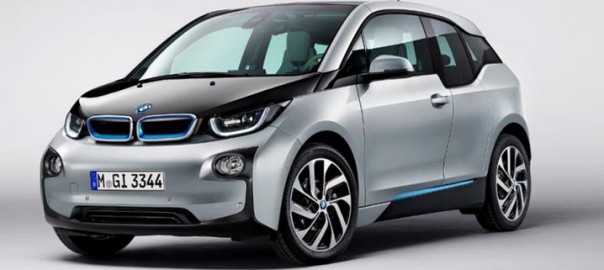
Bmw i3 (Image: BMW)

All-electric BMW i3 wins Wheels magazine’s car of the year award

The BMW i3 has overcome strong resistance to become the first all-electric car to take out the Wheels magazine car of the year award.

German manufacturer BMW bettered fossil-fuelled rivals including last year’s winners Volkswagen, who have taken out the honour three times in the last six years, to be crowned for the first time in the award’s 52-year history.

Wheels editor Glenn Butler said the i3’s victory serves notice to its combustion-engined competitors that the electric cars are here to stay.

“This year the future has arrived in the form of a seriously good motor vehicle … that just happens to run on electricity,”

he said.

“There is no novelty factor involved here either.

“It ushers in a new era of eco-performance for millions of families and urban commuters around the world, and in Australia.”

Judges described the i3 as innovative and praised BMW’s “bravery” to produce the electric-engined car.

“Other brands surely possess the know-how to have created something equally visionary; all they lacked was BMW’s bravery,” they said in a statement.

“This innovative and compact electric car combines expressive design, impressive engineering, exceptional efficiency and persuasive practicality with a good deal of driver appeal.”

“It is both admirable and desirable.”

The Wheels award has been running since 1963, when the Renault R8 took out the prize.

The last Australian-built car to win the award was the Holden VE Commodore in 2006.

Read more: 9 News

BMW i3 Interior

2,500+ Miles on One Gallon of Gas

Finally in the spring, I saw my first i3, and it is absolutely a head turner; you have never seen a car like it; because there has never been a car like it. The first models I saw on the street were in an orange/pumpkin-like color combination, which, as my mother used to say, would not be my choice. I saw a pretty good looking one in white with black trim. The i3 in my driveway is, I love these lofty official color names, Laurel Grey Metallic with the BMWi frozen blue accent. I generally don’t like dark colors on a car; but I like this; and I love the hint of blue in the front grille and on the lower side door panels.

The BMWi series, the i3 I am driving and the space-age i8, are electric cars built from the ground up. 100% new. They didn’t just take a 3 series and put a new engine in; instead BMW designed an entirely new manufacturing process for what may be my favorite part of the entire car; what they call the “life module,” and I would simply call the interior or the cabin.

On the outside, I would say the BMW i3 has the footprint of a small car; around the same size as the Prius or the Leaf. But on the inside, the full cabin space has the similar total interior volume of a BMW 3 series. There is ample room and comfort from the single most important position; the driver’s seat.

Let me get all-superficial for a moment. The interior cabin looks great. I have the, more official names now, Giga Cassia Natural Leather & Carum Spice Grey Wool Cloth. It’s light, modern, and beautiful. The remaining trim in the cabin is all made from recycled woods and carbon fiber. I wish I had a study or man cave in my own home that looked as nice as the i3 does from the inside.

The easily adjustable heated seat has a great driving position; and there is, I don’t know a better way to describe it, a vastness to the front windshield. BMW says the car is equipped with super-ergonomic controls; I don’t know what that means, but what it means to me, is everything is easy to find and where it is supposed to be. The center console screen is right-sized, not at all tiny, and not too big; so the Sirius/XM/FM radio is easy to see and operate, as are all the maps and various ways the car communicates with the driver.

Prior to my i3 experience, I spent a few weeks behind the wheel of the BMW 6 series M, with every single bell and whistle imaginable. I don’t find that I am missing anything at all behind the wheel of the i3.

A few last interior notes. The car features what has long been colloquially described as suicide doors. Where the front doors open in traditional fashion and the smaller rear doors open out from the center. I find this actually easier in getting the kids in and out of the backseat. Speaking of the back seat, it is perfectly serviceable. My most frequent passengers are my kids and their friends. You can easily have yourself plus 3 passengers in the car. If you are taking the entire soccer team, this isn’t the right car for you. But I have never been stymied by lack of interior space. The rear hatch opens big and wide and has a perfectly fine amount of trunk space; and the back seat folds down flat if you are the type that takes your boogie board with you everywhere.

Now, to what matters most. How does the i3 drive? Perhaps I can engage you in a little demonstrative exercise. Please, indulge me. Snap your fingers. How long does it take from the moment you snap your fingers to the moment you hear the sound? That’s how fast the i3 is. Officially timed at 0–30 MPH in 3.5 seconds, my car is faster than that. You press on the accelerator and off you go. Boom. Real quick. Freeway acceleration shows absolutely no strain, and the i3 can keep up with and/or pass anything. It is a good thing that I drive to work at 5 a.m. in the morning. The steering is tight and responsive. The i3 is all electric AND all BMW.

Some EV drivers are very interested in wringing out every last watt of energy and translating that to mileage. If you are into those sorts of range games; the i3 has three driving modes. I am a “comfort” person all the way, there is also ECO PRO, and if Ed Begley Jr. were driving the car, ECO PRO+. The car features a brake energy regeneration system; oh, and at 124 MPGe, the EPA lists the i3 as the most efficient electric car sold in the U.S.

Many people have asked me for the years I have been driving electric, “what if you run out of juice and there are no charging stations around?” This fear has now been given an official psychological term; it is called “range anxiety,” and since the father of modern psychology Sigmund Freud was born in Austria, leave it to his German neighbors at BMW to cure this ill. My i3 has, as an option, something called a “range extender.” Basically, it is a small gasoline powered engine; and a super small gas tank; that in the event you absolutely run out of electric power, will provide power to the batteries of the i3 to keep you going. This device is pure Prozac to those who worry about these kinds of things. I never do worry; and in my 2500 mile test drive, I have purchased all told; one gallon of gas. O N E. Not going to the gas station is the single greatest reliever of most the anxieties I deal with.

A little bit more about range. The EPA says the i3 can travel 81 miles on a single charge, and a total of 150 miles if the range extender is used as well. In my own experience, and I like to go fast, I think those estimates are probably a little high if you drive like I do. On any given day I probably drive about 30 miles a day. Brentwood into Hollywood; an errand somewhere, some trip with the kids; and back home. I have more than enough pure electric power to last all day. I have taken the i3 on longer drives; from Brentwood to Hollywood, to Costa Mesa, to Diamond Bar and back home, all in one day, and I was fine. If you have a massively long daily drive, the i3 may not be for your needs.

Now the bottom-line about the bottom-line. Our pals at the EPA say “going electric” can save more than $9,000 in fuel costs if you drive an electric car for 5 years. We all know that gas is fairly inexpensive right now; but do you sincerely believe it will always stay that way?

The i3 represents a far cleaner, far more efficient, far better way to drive; both now and into the future. Before I accept my own award from Greenpeace, you should also know that the 2013 World Green Car of the Year was the Tesla Model S; the 2014 World Green Car of the Year is the BMW i3.

There are dozen of other features, including the self-parking feature of the i3, I didn’t dwell on because, to be honest, I haven’t used them yet.

What I want the most is the get from “A” to “B” with speed, style, safety and comfort. I was already sold on electric cars before I experienced the i3. Maybe I love the i3 so much because it just reinforces my own opinion that I was right to begin with. All that, and some amazing and impressive engineering breakthroughs that you really have to drive yourself to experience.

Source: Medium