Category Archives: Audi

News and reviews of Audi electric cars (including plug-in hybrids).

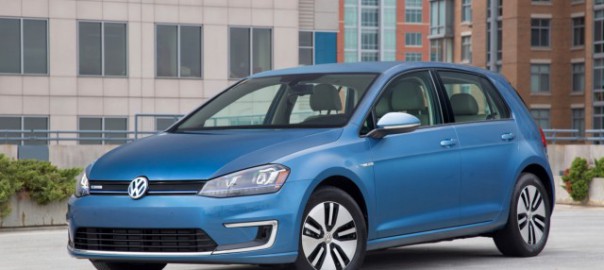
2016 Volkswagen e-Golf

VW scandal pushes diesel cars into the slow lane

Buyers are turning away from all diesel models, and cleaning up the technology will be a long and expensive business

The 2016 VW e-Golf is a spirited runabout that makes almost no compromises in terms of performance, comfort or cargo space (Image: Volkswagen of America Inc.)

Since the Volkswagen emissions test scandal in September, it is not just the German carmaker that has suffered a blow to its image. Diesel automotive technology also faces a battle to regain public trust.

There are already some signs of demand for diesel cars shrinking since VW was forced to apologise for installing “cheat devices” in 11 million vehicles. In Germany, Europe’s largest car market, demand for diesel cars was down 11% by the end of October compared with the average level this year, according to data from car buying website MeinAuto. The decline for VW diesel cars was even steeper, down 14%.

“The slump in demand has surprised us,” said MeinAuto’s managing director, Alexander Brugge. “It’s interesting that it’s not only VW customers who are reluctant to buy diesel vehicles but customers of other brands, too.”

In the UK, official registration numbers of for diesel cars seem to be holding up. Diesel made up 51% of new car sales in both October and November, according to Society of Motor Manufacturers and Traders (SMMT). That is in line with last year and above this year’s average of 48%. However, there could still be a decline, because of the three-month wait between car order and delivery.

VW chief executive Matthias Müller has promised that the company will increase spending on alternative technologies such as electric and hybrid vehicles by €100m next year.

Read more: The Guardian
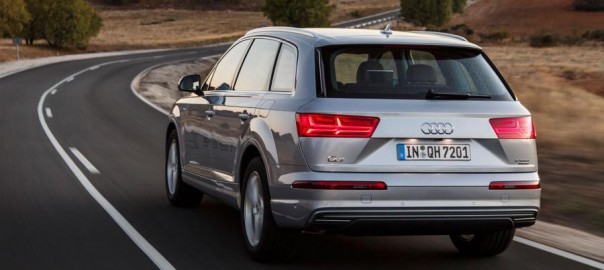
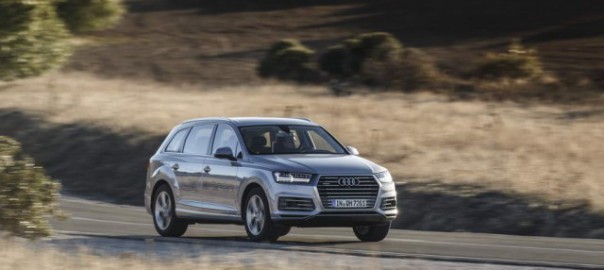
Audi Q7 e-tron PHEV (Image: Audi)

2015 Audi Q7 e-tron Autocar Review

The Q7 e-tron combines the standard SUV’s big cabin and sumptuous finish with plug-in hybrid technology. Does it make a good package?

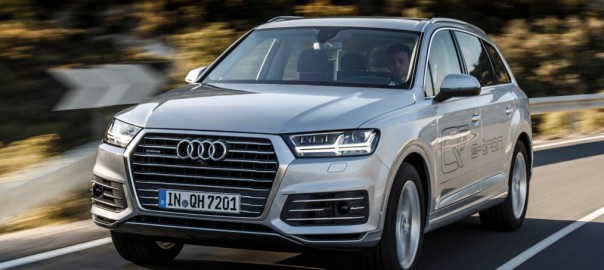
Audi Q7 e-tron PHEV (Image: Audi)

What is it?:

It’s the plug-in hybrid version of Audi’s new Q7 large SUV. It’s based on the standard-issue 3.0 TDI quattro model, using a V6 diesel engine under the nose (mounted longways, as is demanded by Audi’s bespoke MLB platform), from where it drives the front and rear wheels through an eight-speed automatic gearbox.

The hybrid conversion includes a new version of the transmission, into which is sandwiched a fairly punchy electric motor that’s good for 258lb ft. The electric motor’s battery pack is mounted above the independent rear suspension.

The Q7 e-tron also gets a clever heat pump system, which uses waste heat from the electronic systems to help warm the interior. Using this, instead of electrical energy from the battery pack when running in hybrid and EV modes, significantly reduces the drain on the battery and, says Audi, extends the car’s electric range. Audi claims to be the first car maker to use a heat pump on a production plug-in hybrid.

It also says there’s an EV-only range of 34 miles from the battery pack, plus, thanks to a substantial 75-litre fuel tank, another 835 miles’ range from the combustion engine. This car also gets Audi’s Virtual Cockpit, a digital instrument cluster that is configurable to show different screens and graphic displays.

But the big advance on this car is the way Audi’s Navigation Plus system and the in-car internet hot spot are both connected to the hybrid drivetrain’s management system. When the driver enters a new destination, the nav system uses route and live traffic information – via the web – to automatically switch the drivetrain between internal combustion, hybrid and pure EV modes depending on the driving conditions.

Read more: Autocar

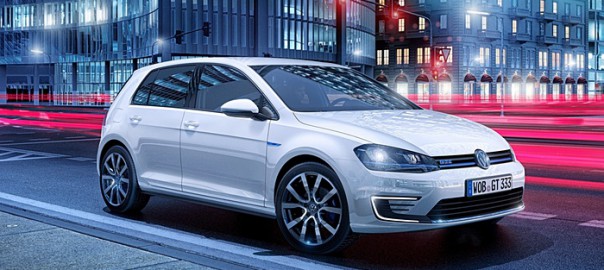
Turn it on: Golf’s GTE is part electric and part petrol, with a promise of 166 miles to the gallon

Huge plug-in investment by VW

The Volkswagen Group will invest an additional 100 million Euros (£70 million) in alternative drive technologies in 2016. Group CEO Matthias Müller announced the plans today (Friday 20th November) at the company’s headquarters in Wolfsburg.

2016 Volkswagen e-Golf

The move comes as the VW Group is planning on limiting its spending on capital expenditure to 12 billion Euros, down from the previously planned 13 billion Euros. These cuts will impact projects such as the proposed new design centre in Wolfsburg, which will save around 100 million Euros. The all-electric Phaeton which was announced in mid-October has been put on hold too, but remains in the pipeline rather than being cancelled indefinitely.

Most of the projects that will not be affected by cuts involve new products and modular toolkits. Money will continue to be spent on the next-generation VW Golf, the Audi Q5 and the new Crafter van plant in Poland. Crucially, the modular electric toolkit (MEB), announced at the same time as the all-electric Phaeton, will still be developed.

The MEB will work in a similar fashion to the current MQB, which is the architecture that underpins a large number of models in the VW Group, including those in the VW, Seat, Skoda and Audi ranges. This common platform keeps costs low and allows the group to offer a variety of models without encountering huge engineering costs for each.

The plan is that the MEB will do the same thing for the VW Group as the MQB did, namely dramatically increase the number of models available – with the difference being that MEB models will all feature plug-in drivetrains of one sort or another. This will help bring the VW Group’s plans to have 20 electric and plug-in hybrid models on sale by 2020 to fruition.

Read more: Next Green Car

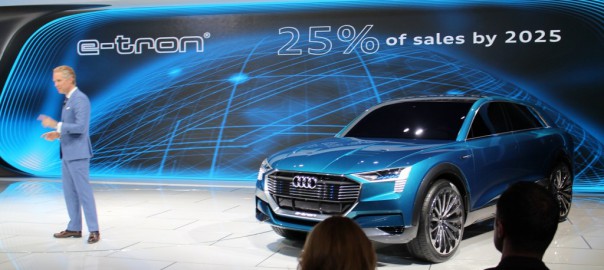
Audi of America president Scott Keogh with Audi e-Tron Quattro Concept, 2015 Los Angeles Auto Show

One-Quarter Of All Audis To Be Electric In 10 Years

It was an audacious statement, but there it was.

Audi of America president Scott Keogh with Audi e-Tron Quattro Concept, 2015 Los Angeles Auto Show

Audi expects that 25 percent of the cars it sells just 10 years hence will be either battery-electric or plug-in hybrid models.

And it came directly from Scott Keogh, president of Audi of America, in front of a packed media audience at the Los Angeles Auto Show.

Audi sold 1.7 million cars globally in 2014, of which 182,000 went to U.S. buyers. Assuming at least 2 million vehicles by then, that means the company would sell half a million electric or plug-in hybrid vehicles a year in 2025.

The public projection culminated an intensive week of activity by Audi to talk more openly and candidly about the addition of plug-in vehicles to its portfolio, and how it intends to roll them out over the next few years.

The media events were planned well before the Volkswagen diesel-emission scandal broke in mid-September, executives say, and reflect a public commitment by the second of Germany’s luxury brands to commit to a broad program of electrified vehicles.

Read more: Green Car Reports

Audi Q7 e-tron PHEV (Image: Audi)

First drive: Audi Q7 e-tron plugin hybrid

The large SUV marketplace is quickly becoming awash with plugin hybrid options for savvy buyers that want to reduce their tax bill without sacrificing performance. The latest, Audi’s refined new Q7 e-tron, is brimming with clever technology, plus it takes a different path to most others in the segment by pairing a diesel engine with the electric componentry. Is it a game-changer?

Audi Q7 e-tron PHEV (Image: Audi)

What’s this?

Audi’s latest stepping stone on its path to full range electrification. It’s called the Q7 e-tron and it’s a diesel-electric plugin hybrid electric vehicle (PHEV) based on the company’s range-topping SUV. That’s right, diesel. Unlike all other hybrids in the segment (BMW X5, Lexus RX 450h and Porsche Cayenne), the Q7 stops at the black pump for fuel. It’s a 3.0-litre V6 engine producing 258hp and 600Nm. Boosting that is a 94kW electric motor, mounted within the casing of the eight-speed automatic gearbox, producing 350Nm of torque from zero rpm. It’s fed by a large 17.3kWh battery pack sitting above the rear axle, which can be recharged from an external source by various means and the total system outputs are 373hp and 700Nm. The electric-only range is quoted at just under 35 miles, while recharging takes as little as 2.5 hours from an industrial outlet. Official figures peg the Q7 e-tron at 166.2mpg and 46g/km, meaning zero annual road tax and large grants. When it arrives in the UK in 2016 the on-the-road price is expected to be about £65,000.

Read more: Car Enthusiast

Audi Q7 e-tron PHEV

Audi Q7 e-tron 2016 Honest John Road Test

In future-proofing its big Q7 SUV, Audi has lost the 6th and 7th seats but, with an NEDC CO2 rating of 46g/km, has gained the Freedom the City of London for many years to come.

Audi Q7 e-tron PHEV
Audi Q7 e-tron PHEV

Losing the Congestion Charge involves charging a 17.3kWh liquid cooled lithium-ion battery that takes two and a half hours from a 400-volt industrial socket (or 8-12 hours from a domestic charging point).

But, driven sensibly, like the Volkswagen Passat GTE plug-in hybrid, it conserves and regenerates its energy very cleverly.

Depending on the circumstances, the Q7 e-tron can boost, coast and recuperate. The car drives off solely on electric power and normally most braking uses electric motor retardation that generates electricity. Set for hybrid mode, the MMI navigation system works with the hybrid management system using real time traffic data to become your “predictive efficiency assistant’ and compute an ideal driving strategy.

Read more: Honest John

Audi Q7 e-tron PHEV

Audi Q7 e-tron 2015 AutoExpress review

New plug-in hybrid Audi Q7 e-tron will cost a lot to buy, but not a lot to run

Verdict 4 stars

Like any plug-in hybrid, you’ll need regular access to a charge point to realise the efficiency claims of the Audi Q7 e-tron. That said, it’s unlikely to consume considerably more fuel than a standard 3.0-litre TDI even without charging the batteries. It still drives well and gets the same exquisitely finished cabin, meaning the only real sticking point is the price. For many, however, the lure of rock-bottom running costs in such a practical and well-engineered package will be too hard to ignore.
This is the plug-in hybrid Audi Q7 e-tron. Everyone’s at it: from pioneers Nissan to latecomers like Volvo, almost every manufacturer has an electric or hybrid model in its range.

Audi Q7 e-tron PHEV
Audi Q7 e-tron PHEV

It comes as no surprise, then, that Audi’s e-tron family is expanding. The popular A3 e-tron appeared only late last year, and there’s already an electric R8 supercar in the pipeline.

But the latest model to bear Audi’s plug-in moniker is the big and brash Q7 SUV. Using a 254bhp 3.0-litre TDI diesel engine mated to a 94kW electric motor, total power for the Q7 e-tron stands at 368bhp. It’s got a sizeable 700Nm of torque, too – which comes in handy when you’re lugging around 202kg of lithium-ion batteries.

From the outside, you’ll struggle to tell this apart from a standard Q7. Our car came with loud e-tron stickers down the side, but (sadly) these aren’t an option on customer cars. There are some subtle badges on the wings and bootlid, but aside from the additional filler cap it’s business as usual.

Read more: Auto Express

2015 Audi A3 e-tron Video Review

Here is a swell review of the Audi A3 e-tron from the UK.

The first plug-in hybrid Audi will be available in the US soon, and priced from $37,900, or $34 657 after deducting tax credit.

You’ll find a more detailed description of the A3 e-tron here.

All-electric range under EPA testing is expected to be just over 20 miles.

https://youtu.be/bRpm96XtX80

Source: Inside EVs

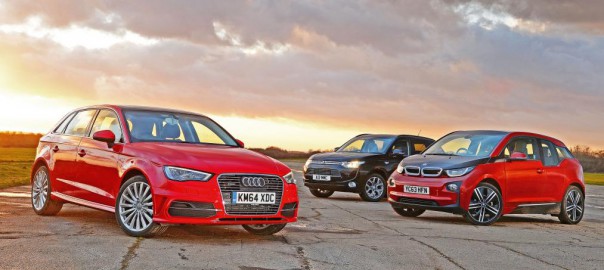
Audi A3 e-tron, Mitsubishi Outlander and BMW i3 plug-ins

Audi A3 e-tron vs BMW i3 & Mitsubishi Outlander PHEV

Plug-in cars promise great efficiency, but is Audi’s new A3 e-tron hybrid a better bet than range-extending i3 and Outlander?

Eco-friendly plug-in models are slowly gaining in popularity, so it’s no real surprise that after decades of experimentation Audi has finally decided to jump on the petrol-electric bandwagon.

The new A3 e-tron is based on the classy A3 Sportback, and packages together a 1.4-litre petrol turbo and 75kW motor, while a compact lithium-ion battery pack sits under the back seat. Its raw statistics certainly look compelling, with a 31-mile claimed electric range, CO2 emissions of 37g/km and 176.6mpg economy.

Just as importantly, Audi says these figures don’t come at the expense of the standard Sportback’s space, refinement and upmarket appeal.

However, there are many different ways to package the perfect plug-in, as our other contenders here prove. Mitsubishi’s rugged Outlander PHEV claims to deliver all the practicality of the standard model, but – with a 30-mile electric range – city car-humbling costs.

Completing our trio is BMW’s daring i3 Range Extender, which sets the class standard for efficiency, design and driving dynamics.

Read more: AutoExpress

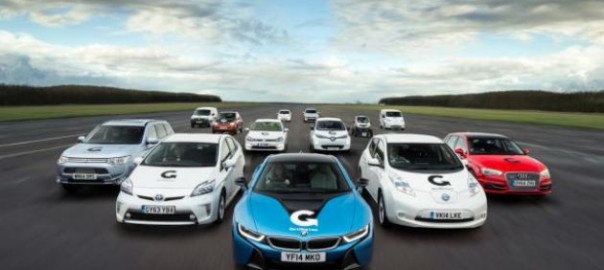
Go Ultra Low members boast 15 ULEVs across a range of segments (Image: OLEV)

New manufacturers join Go Ultra Low

Three new car manufacturers have joined Go Ultra Low, the campaign to increase awareness of ultra-low emission vehicles (ULEVs) among British car buyers.

Audi, Mitsubishi and Volkswagen have joined BMW, Nissan, Renault and Toyota to work with government to raise awareness of the benefits of ULEVs including low running costs and government incentives.

Between them, the seven Go Ultra Low members boast 15 ULEVs across a wide variety of model sizes and performance attributes, from family cars and vans, to SUVs and high performance sports cars. This broader scope of products has increased the appeal of ULEVs to more buyers, and increased uptake.

Go Ultra Low members boast 15 ULEVs across a range of segments (Image: OLEV)

With the recent announcement from OLEV that 23,083 claims have been made through the Plug-in Car Grant scheme, the number of electric cars and vans in the UK now exceeds 24,500 vehicles for the first time.

Hetal Shah, spokesperson for Go Ultra Low, said:

“More UK car-buyers are realising the advantages of owning an ultra-low emission vehicle, and the aim of the newly-expanded Go Ultra Low consortium is to share the multiple benefits with a wider audience.

“We’ve discovered that once people learn more about the benefits of these cars and vans, they’re keen to take action and once they’ve tried them, they’re hooked.”

With pure-electric vehicles able to travel around 100 miles on a single charge and other plug-in ULEVs boasting ranges of up to 700 miles, these efficient cars are a viable, low-cost option for millions of motorists across the country.

As well as tax benefits, government currently offers up to £5,000 of the price of ULEVs and the cost of driving them is as little as 2p per mile, compared to at least 10p per mile for a typical petrol or diesel car.

The Go Ultra Low campaign is the first of its kind, bringing together the Department for Transport, the Office for Low Emission Vehicles, SMMT and the consortium of seven car manufacturers.

Source: Newspress