Category Archives: Prepping and Collapse

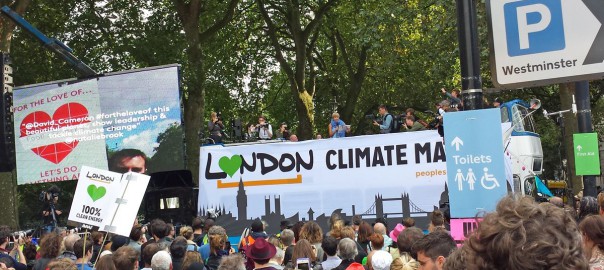
London Climate March - the Rally (Image: T. Larkum)

This Guy Studies the ‘Global Systems Death Spiral’ That Might End Humanity

Could climate change get so bad that it leads to our extinction? A few researchers are trying to answer that question.

Simon Beard has a career that most people would consider depressing and terrifying. He is part of a team of researchers trying to figure out if, how, and when climate change could cause the human species to go extinct. The stakes of his research—a potential annihilation of 7.7 billion humans and all the unborn people who come after them—couldn’t be any higher.

The idea that a heating planet will doom humanity is the subject of a lot of public speculation and anxiety, yet there are very few experts studying the existential impacts of climate change with any sort of academic rigor. Beard, who does this work at the Cambridge Center for the Study of Existential Risk, described it as “a field with next to no data” and a lot of unsupported hypotheses. “Under what circumstances could climate change cause a collapse of global civilization?” he said. “When you start asking that question, then your already quite-limited literature gets even more scarce.”

London Climate March - the Rally (Image: T. Larkum)
London Climate March – the Rally (Image: T. Larkum)

By bringing scientific precision to the doomsday scenario that wipes us off the planet, Beard hopes to convince world leaders to actually do something about it. “That’s really what we’re aiming for at the moment,” he said. “I think this could be genuinely transformative—firstly for the science but also by implication for the policy and the way that these things are discussed in society.”

The starting point for Beard’s research is that humans are incredibly resilient: We have found a way to survive in tropical rainforests, blistering deserts, icy tundra, and even for a brief time on the moon. But that says more about our collective strength than our skills as individuals. Shut down the grocery stores, turn off the taps, disband the government and very few of us, perhaps apart from a small number of rugged survivalists, would be able to stay alive for long.

“And so every one of us as an individual, I think, is very vulnerable, and relies upon these massive global systems that we’ve set up, these massive global institutions, to provide this support and to make us this wonderfully adaptable generalist species,” Beard recalled earlier this year on the Future of Life Institute podcast,

Those systems—the ones that put broccoli and frozen pizzas in our fridges and keep our streets from becoming Mad Max war zones—are themselves way more vulnerable and interconnected than we appreciate. The greenhouse gas emissions that humans are pumping into the atmosphere at record levels are changing the climate in ways that make it harder for us to grow and distribute food. This also increases pressure on our political system—as we saw with drought and crop failures in the lead-up to the Syrian civil war.

Read more: Vice

It’s Time to Go Green!

If you would like to know more about Solar Panels and the PowerBanx range of home battery systems, and get a free instant quote, please complete our online form:

Tesla showroom in Milton Keynes (Image: T. Larkum)

Tesla owners weather PG&E’s power outage as gas stations across CA shut down

Tensions are rising in up to 34 counties in California as residents begin feeling the effects of Pacific Gas and Electric Co’s decision to cut power to around 800,000 customers as a way to avoid potential wildfires in the area.

Amidst the chaos, Tesla owners who have installed rooftop solar and Powerwall 2 batteries are reporting that they are weathering the widespread power outage with no problems.

PG&E’s shutdown has received widespread criticism among CA residents and officials alike. In a statement to The San Francisco Chronicle, Rep. Jared Huffman described the power provider’s strategy as a “lousy set of choices.” Michael Wara, director of the climate and energy policy program at Stanford University, added that the widespread outage shows that the company cannot operate their system safely during challenging times. CHP officers have even started looking into an incident involving a PG&E vehicle in Colusa County that appeared to have been shot at by a disgruntled resident on Wednesday morning.

Tesla showroom in Milton Keynes (Image: T. Larkum)
Tesla showroom (Image: T. Larkum)

This is particularly prominent among gas stations in the state, many of which require power to function. Only a few gas stations remain operational in CA amid the power outage, resulting in long lines of vehicles as owners attempt to acquire fuel. Ali Alezzani, a manager of an Exxon station on San Pablo Avenue in El Cerrito, noted to the Chronicle that tensions are currently so high, some gas car owners almost got into fights while they were waiting for their turn at the pump. Videos taken of gas stations across the state hint at extremely long wait times as large numbers of car owners line up for a chance to acquire fuel.

Read more: Teslarati

Here’s Why Grid-Down Preppers Should Buy Electric Cars: Video

Are EVs right for preppers?

The end is near. Will you survive if you own an electric car? For preppers, the end is always right around the corner. Therefore, you should be ready to bug out in the post-collapse world.

Would you better off in an electric car in such a situation. Or is gas the answer? Maybe some other means of transport entirely? Like, say a bicycle.

With the rise of Rivian and its rugged R1T and R1S electric off-roaders, there’s seem to be a new interest in electric vehicles among preppers and for good reason. Most noteworthy, EVs don’t rely on gasoline, which in a grid-down scenario, becomes scarce immediately. Additionally, EVs can be charged by the sun.

Read more: InsideEVs

UK used car market follows new vehicle sales with Q2 decline

According to the latest data released by the Society of Motor Manufacturers and Traders (SMMT), the UK’s used car market declined in the second quarter of 2017, following record results in the previous year.

The figures suggest that 1,832,400 used vehicles changed hands during the period between April and June 2017, a drop of 13.5%.

The society puts this down to the strong results of Q2 2016 being hard to match and turbulence in the new car market following the introduction of new vehicle excise duty (VED) rates introduced in the country on 1 April. This follows the trend of UK new car sales, which experienced another drop in August 2017.

Overall, for the first half of the year, the number of used car sales fell by 5.1%, with 3,966,356 sales in total. Most of this drop was seen in the petrol market, which declined by 5.1%, whereas the diesel market, which has been much maligned in recent months and will soon see the introduction of manufacturer-backed trade-in incentives in the UK, only declined by 0.1% year on year in the first half of 2017.

Demand for alternatively fuelled vehicles (AFVs) rose 24.2% with electric cars enjoying particularly strong growth – up 79.3%. However, volumes remain low with AFVs currently accounting for just 1.2% of the used car market.

Read more: Autovista Group

The Uninhabitable Earth

Famine, economic collapse, a sun that cooks us: What climate change could wreak — sooner than you think

I. ‘Doomsday’

Peering beyond scientific reticence.

It is, I promise, worse than you think. If your anxiety about global warming is dominated by fears of sea-level rise, you are barely scratching the surface of what terrors are possible, even within the lifetime of a teenager today. And yet the swelling seas — and the cities they will drown — have so dominated the picture of global warming, and so overwhelmed our capacity for climate panic, that they have occluded our perception of other threats, many much closer at hand. Rising oceans are bad, in fact very bad; but fleeing the coastline will not be enough.

Indeed, absent a significant adjustment to how billions of humans conduct their lives, parts of the Earth will likely become close to uninhabitable, and other parts horrifically inhospitable, as soon as the end of this century.

Even when we train our eyes on climate change, we are unable to comprehend its scope. This past winter, a string of days 60 and 70 degrees warmer than normal baked the North Pole, melting the permafrost that encased Norway’s Svalbard seed vault — a global food bank nicknamed “Doomsday,” designed to ensure that our agriculture survives any catastrophe, and which appeared to have been flooded by climate change less than ten years after being built.

The Doomsday vault is fine, for now: The structure has been secured and the seeds are safe. But treating the episode as a parable of impending flooding missed the more important news. Until recently, permafrost was not a major concern of climate scientists, because, as the name suggests, it was soil that stayed permanently frozen. But Arctic permafrost contains 1.8 trillion tons of carbon, more than twice as much as is currently suspended in the Earth’s atmosphere. When it thaws and is released, that carbon may evaporate as methane, which is 34 times as powerful a greenhouse-gas warming blanket as carbon dioxide when judged on the timescale of a century; when judged on the timescale of two decades, it is 86 times as powerful.

Read more: New York Mag

Severe Flooding, Against a Background of Wind Turbines: November 2012, Tyringham, Bucks. (Image: T. Larkum)

Arctic stronghold of world’s seeds flooded after permafrost melts

No seeds were lost but the ability of the rock vault to provide failsafe protection against all disasters is now threatened by climate change

Severe Flooding, Against a Background of Wind Turbines: November 2012, Tyringham, Bucks. (Image: T. Larkum)

It was designed as an impregnable deep-freeze to protect the world’s most precious seeds from any global disaster and ensure humanity’s food supply forever. But the Global Seed Vault, buried in a mountain deep inside the Arctic circle, has been breached after global warming produced extraordinary temperatures over the winter, sending meltwater gushing into the entrance tunnel.

The vault is on the Norwegian island of Spitsbergen and contains almost a million packets of seeds, each a variety of an important food crop. When it was opened in 2008, the deep permafrost through which the vault was sunk was expected to provide

“failsafe” protection against “the challenge of natural or man-made disasters”.

But soaring temperatures in the Arctic at the end of the world’s hottest ever recorded year led to melting and heavy rain, when light snow should have been falling.

“It was not in our plans to think that the permafrost would not be there and that it would experience extreme weather like that,”

said Hege Njaa Aschim, from the Norwegian government, which owns the vault.

“A lot of water went into the start of the tunnel and then it froze to ice, so it was like a glacier when you went in,”

she told the Guardian. Fortunately, the meltwater did not reach the vault itself, the ice has been hacked out, and the precious seeds remain safe for now at the required storage temperature of -18C.

Read more: The Guardian

Earth could hit 1.5 degrees of global warming in just nine years, scientists say

‘The full impacts will take decades to play out, but once set in motion they could be hard to reverse’

The Earth could be 1.5 degrees Celsius warmer than the late 1800s in just nine years, according to new research which suggests the aspirational Paris Agreement target is unlikely to be achieved.

A paper in the journal Geophysical Research Letters said natural climate variations in the Pacific which change over a period of decades may have provided a “temporary buffer” to the effects of greenhouse gas emissions, reducing extreme events such as heatwaves.

But this cycle, called the Interdecadal Pacific Oscillation (IPO), could be about to flip or may have already done so, sending temperatures higher for the next 10 to 20 years.

Under the Paris Agreement, the world decided to

“pursue efforts to limit the temperature increase to 1.5C above pre-industrial levels”.

However, the researchers said the combination of a natural warming phase and human carbon emissions could see temperatures reach this point by 2026.

Last year, the hottest on record for the third time in a row, was 1.1 degrees Celsius warmer than the average between 1850 and 1900, according to separate research by the Met Office and Nasa. That prompted Professor Gabi Hegerl, a world-leading climatologist at Edinburgh University, to warn that it was

“getting tight for avoiding dangerous climate change”.

Read more: The Independent

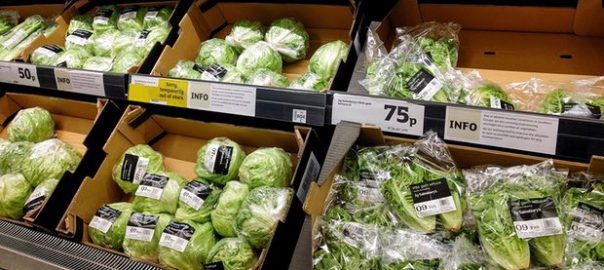
‘The shelves looked wonderful, perfect, almost clinical, as though invented in a lab in my absence; but there was no smell.’ (Image: A. Britton/PA)

The Supermarket Food Gamble May Be Up

Brexit, migration and climate pressures mean our ‘too big to fail’ global food chain could unravel

The UK’s clock has been set to Permanent Global Summer Time once more after a temporary blip. Courgettes, spinach and iceberg lettuce are back on the shelves, and the panic over the lack of imported fruit and vegetables has been contained. “As you were, everyone,” appears to be the message.

But why would supermarkets – which are said to have lost sales worth as much as £8m in January thanks to record-breaking, crop-wrecking snow and rainfall in the usually mild winter regions of Spain and Italy – be so keen to fly in substitutes from the US at exorbitant cost?

Why would they sell at a loss rather than let us go without, or put up prices to reflect the changing market? Why indeed would anyone air-freight watery lettuce across the whole of the American continent and the Atlantic when it takes 127 calories of fuel energy to fly just 1 food calorie of that lettuce to the UK from California?

‘The shelves looked wonderful, perfect, almost clinical, as though invented in a lab in my absence; but there was no smell.’ (Image: A. Britton/PA)

The answer is that, in the past 40 years, a whole supermarket system has been built on the seductive illusion of this Permanent Global Summer Time. As a result, a cornucopia of perpetual harvest is one of the key selling points that big stores have over rival retailers. If the enticing fresh produce section placed near the front of each store to draw you in starts looking a bit empty, we might not bother to shop there at all.

But when you take into account climate change, the shortages of early 2017 look more like a taste of things to come than just a blip, and that is almost impossible for supermarkets to admit.

Add the impact of this winter’s weather on Mediterranean production, the inflationary pressures from a post-Brexit fall in the value of sterling against the euro, and the threat of tariffs as we exit the single market, and suddenly the model begins to look extraordinarily vulnerable.

Read more: The Guardian

“You Can’t Handle the Truth!”

Movie buffs will recognize this title as the most memorable line from “A Few Good Men” (1992), spoken by the character Colonel Jessep, played by Jack Nicholson (“You can’t handle the truth!” is #29 in the American Film Institute’s list of 100 top movie quotes).

I hereby propose it as the subtext of the recently concluded Republican and Democratic national conventions.

At this point most people appear to know that something is terribly, terribly wrong in the United States of America. But like the proverbial blind man describing the elephant, Americans tend to characterize the problem according to their economic status, their education and interests, and the way that the problem is impacting their peer group.

blind_menelephant-itcho

So we hear that the biggest crisis facing America today is:

  • Corruption
  • Immigration
  • Economic inequality
  • Climate change
  • Lack of respect for law enforcement
  • Institutionalized racism
  • Islamic terrorism
  • The greed and recklessness of Wall Street banks
  • Those damned far-right Republicans
  • Those damned liberal Democrats
  • Political polarization

The list could easily be lengthened, but you get the drift. Pick your devil and prepare to get really, really angry at it.

In reality, these are all symptoms of an entirely foreseeable systemic crisis. The basic outlines of that crisis were traced over 40 years ago in a book titled The Limits to Growth. Today we are hitting the limits of net energy, environmental pollution, and debt, and the experience is uncomfortable for just about everyone. The solution that’s being proposed by our political leaders? Find someone to blame.

The Republicans really do seem to get the apocalyptic tenor of the moment: their convention was all about dread, doom, and rage. But they don’t have the foggiest understanding of the actual causes and dynamics of what’s making them angry, and just about everything they propose doing will make matters worse. Call them the party of fear and fury.

The Democrats are more idealistic: if we just distribute wealth more fairly, rein in the greedy banks, and respect everyone’s differences, we can all return to the 1990s when the economy was humming and there were jobs for everyone. No, we can do even better than that, with universal health care and free college tuition. Call the Democrats the party of hope.

But here’s the real deal: a few generations ago we started using fossil fuels for energy; the result was an explosion of production and consumption, which (as a byproduct) enabled enormous and rapid increase in human population. Burning all that coal, oil, and natural gas made a few people very rich and enabled a lot more people to enjoy middle-class lifestyles. But it also polluted air, water, and soil, and released so much carbon dioxide that the planet’s climate is now going haywire. Due to large-scale industrial agriculture, topsoil is disappearing at a rate of 25 billion tons a year; at the same time, expanded population and land use is driving thousands, maybe millions of species of plants and animals to extinction.

Read more: Post Carbon Institute

The Pain You Feel is Capitalism Dying

1-pPDKvJZiZH5uEz3QTkSSUg_hang_head_unk

It can be very confusing to know that you won’t find a decent job, pay off student loans or put in a down payment on a house in the next few years — even though you may have graduated from a top-tier university or secured glowing references from all those unpaid internships that got you to where you are today.

Even if you are lucky enough to have all of this going for you, you’ll still be one among hundreds of applicants for every job you apply for. And you’ll still watch as the world becomes more unequal, with fewer paid opportunities to do what you feel called to do in your work or for your life path.

What’s more, you won’t find much help from your friends because most (if not all) of them are going through the same thing. This is a painful and difficult time that is impacting all of us at once.

There will be people who tell you it’s your fault. That you aren’t trying hard enough. But those people are culprits in perpetuating a great lie of this period in history. The standard assumptions for how to be successful in life a few decades ago simply do not apply anymore. The guilt and shame you feel is the mental disease of late-stage capitalism. Embrace this truth and set yourself free.

To see how broken things have become you’ll have to think systemically. Take note of the systems built up to create this situation and understand how it came to be — so you’ll see why it cannot possibly continue on its current path.

First, a diagnosis of the problem:

A Global Architecture of Wealth Extraction has been systematically built up to rig the economic game against you. This is why a tiny number of people (current count is 62) have more wealth amongst them than half the human population.

Read more: Medium