London’s Mayor Sadiq Khan has announced that London’s new Ultra Low Emission Zone (ULEZ) could be introduced as early as 2019 in the latest attempt to reduce air pollution across the capital.
Fully electric vehicles will be exempt from paying the future ULEZ charge
This will be a year earlier than previously anticipated, with the roll-out initially focused on inner London, before expanding to both the North and South Circular starting from 2020.
Mr Khan stated:
“Just as in the 1950s, air pollution in London today is literally killing Londoners. But unlike the smoky pollution of the past, today’s pollution is a hidden killer.
“The scale of the failure to tackle the problem is demonstrated by the failure of the Government and the previous Mayor to meet legal pollution limits. Urgent action is now needed to ensure Londoners no longer have to fear the very air we breathe.”
Dr Ben Lane, Director of Next Green Car added:
“If we are to significantly improve air quality in our country’s cities and towns, we need just this type of bold and visionary measure. It is for this reason that we fully back the new London Mayor’s announcement to both widen the area of the planned Ultra Low Emission Zone and also to implement it well before 2020.
“We do, however, raise on note of caution as the proposed ULEZ standards are highly complex and may lead to confusion as to which vehicles are exempt from paying the charge. In addition, it is not immediately clear on TfL’s information website that all fully electric vehicles will be exempt from paying the ULEZ charge as they are for the existing Congestion Charge.”
Personal automobiles have given hundreds of millions of people the great luxury of a convenient and comfortable mode of transportation.
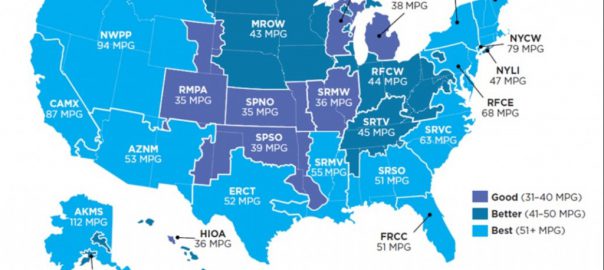
Electric-car wells-to-wheels emission equivalencies in MPG, Sep 2015 (Image: Union of Concerned Scientists)
But there’s no escaping that manufacturing these vehicles, driving them for 10 years or more, and then disposing of them creates pollution that has a wide range of negative impacts.
As advocates and some governments push for more plug-in electric cars, that poses a valid question: what’s the total emission impact of driving a vehicle that plugs into the grid for its energy?
Over the last five years, electric vehicles have become a target for some who are not convinced that they will lead to less pollution.
Two different types of emission need to be considered. First, there is carbon dioxide (CO2), a climate-change gas.
Second are what the EPA calls criteria pollutants: other toxic substances that come out of the tailpipes of vehicles with combustion engines—and out of the smokestacks of any electric powerplant that burns any hydrocarbon fuel.
The CO2 question is more easily answered. Studies by numerous groups indicate that electric vehicles recharged on most North American grids are, at minimum, cleaner than almost any gasoline or diesel vehicle.
The Government must disincentivise diesel vehicles with a view to phasing them out altogether if air quality is to meet guidelines, a new report finds.
The report finds that even if London returned to the lowest recorded level of diesel car ownership in the UK, it would still not comply with World Health Organisation guidelines and UK law by 2025
The ‘Lethal and Illegal’ research, published by Greenpeace, in partnership with the Institute for Public Policy Research (IPPR), uses new modelling based on transport emissions and air pollution data undertaken by King’s College which reveals that, even if London were to return to the lowest recorded level of diesel car ownership in the UK (around 10% of the car fleet in 1995), it would still not reach compliance with World Health Organisation guidelines and UK law by 2025.
In response, the authors say that to tackle pollutants such as NO2 and PM2.5 the UK government would need to progressively reform Vehicle Excise Duty (VED) to disincentive diesel vehicles. Also, a scrappage scheme should be put in place for older diesel cars across the UK or in areas of non-compliance with air pollution laws.
Alan Andrews, lawyer for ClientEarth, which is taking the government to court over air pollution, said:
“This report should send a clear message to the UK government that an ambitious and bold Clean Air Act is needed for the whole country. It should phase out diesel across the country and accelerate the shift to zero emission transport. This would help our cities clean up their air and achieve legal limits as soon as possible. The new government must now step up and deal with this public health crisis so that the whole country can breathe cleaner air.”
Pollution from many popular diesel cars is much worse when it is colder than 18C outside, new research suggests.
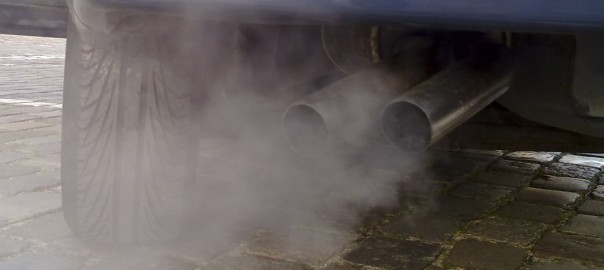
Car exhaust pollution (Image: Wikipedia)
Testing company Emissions Analytics told the BBC it has measured a significant rise in poisonous gas emissions from a wide range of models as the temperature drops.
It found the problem is worst among the Euro 5 category of cars, which became mandatory in 2011.
The firm tested 213 models across 31 manufacturers.
The finding means millions of vehicles could be driving around much of the time with their pollution controls partly turned off.
But it seems many cars are deliberately designed that way and it is all perfectly legal.
Taking advantage
European rules allow manufacturers to cut back on pollution controls as long as it is to protect the engine.
Engineers agree that hot and cold weather can damage components.
But some suggest car companies are taking advantage of the rule to switch things off, even in mild weather, because it improves the miles per gallon of the car.
“I would say from the Euro 5 generation of cars, it’s very widespread, from our data. Below that 18 degrees [Celsius], many have higher emissions… the suspicion is, to give the car better fuel economy,” Emissions Analytics CEO Nick Molden told the BBC.
“If we were talking about higher emissions below zero, that would be more understandable and there are reasons why the engine needs to be protected. But what we’ve got is this odd situation where the [temperature] threshold has been set far too high, and that is a surprise”.
Drivers of diesel cars face the world’s toughest air pollution penalties under plans for London that could be extended to other cities.
The mayor of London announced his proposals at Great Ormond Street Hospital where he visited children who are being treated for respiratory problems exacerbated by poor air quality (Image: S. Rousseau/PA)
A £10 daily “toxicity charge” will be imposed next year on petrol and diesel cars and vans made before 2005 entering central London. This will be added to the £11.50 congestion charge, Sadiq Khan, the mayor of London, said.
By the end of the decade the fee will be extended to pre-2015 diesel cars and the charging zone will become ten times bigger, affecting 210,000 drivers a day, according to projections by the mayor’s office.
Mr Khan said that he was planning the
“toughest emission standards of any major city in the world”
to help reduce the 9,500 premature deaths a year that are linked to air pollution in the capital.
The government pledged last year to penalise older taxis, buses and lorries in new “clean-air zones” in Birmingham, Leeds, Southampton, Nottingham and Derby. At the time ministers said that cars would be exempt from restrictions, but the environment group Client-Earth is bringing a High Court challenge calling for the government to take tougher action.
Under Mr Khan’s plans the ultra-low emission zone will be expanded from central London to the North and South Circular roads. The charge will be in place at all times. Thousands more roadside cameras will be installed to catch and fine drivers who fail to pay.
The scheme will penalise thousands of drivers who bought a diesel car believing that it produced fewer emissions. Mr Khan said that older diesel cars produced up to 20 times as much air pollution per mile as petrol cars. The mayor urged the government to work with him to launch a national scrappage scheme under which a driver trading in a highly polluting vehicle could receive a discount on a cleaner car.
All new cars registered in Germany need to be emissions free by 2030 at the latest to help meet pollution reduction goals, a senior government official said.
Car exhaust pollution (Image: Wikipedia)
Germany’s pledge to cut carbon dioxide output by 80 percent to 95 percent by 2050 will be in jeopardy unless the country radically reduces transportation pollution, said Deputy Economy Minister Rainer Baake. Since cars typically have a 20-year lifespan, registrations of new diesel and gasoline cars needs to be cut over the next 15 years, he said.
“Fact is there’s been no reduction at all in CO2 emissions by transport since 1990,” said Baake at a Tagesspiegel newspaper climate forum in Berlin. “We don’t have any answers to cut truck emissions right now but we do have answers for cars.”
Germany is lagging behind cuts to greenhouse gas that transportation emits, which according to the Environment Ministry account for a fifth of the country’s carbon dioxide pollution. The sector needs to cut some 10 million metric tons of carbon dioxide over the next 5 years from a tally of about 165 million tons last year. While the country has committed to reducing emissions 40 percent by 2020 compared with 1990 levels, its adoption of electric cars has been sluggish.
Chancellor Angela Merkel’s government pledged subsidies this year to speed e-car sales, a move that was accelerated by Volkswagen AG’s emission-manipulation scandal. Buyers of all-electric and hybrid vehicles can claim cash incentives, moves already in operation in countries including China, Norway and France. The program may spark sales of about 500,000 electric cars by 2020, according to the Environment Ministry.
With soaring pollution levels, the mayor of Paris wants diesel cars out of the French capital by 2020, and other cities could well follow
Pollution in Paris
Not so long ago, it seemed as though everyone thought diesel cars were the saviours of the motoring world. They tend to be much more efficient than the equivalent petrol, with much better fuel economy and CO2 figures. With this in mind, governments across the world have incentivised the running of oil-burning cars, particularly France, where the fuel is significantly cheaper than unleaded, and 80 per cent of cars run on the ‘devil’s fuel’.
However, it turns out the French government has properly shot itself in the foot over this, as they – and others – are now realising there’s a little more to being eco friendly than just focusing on reducing CO2 emissions. The issue with diesels is they puff out all sorts of nasty things from their tail pipes, including nitrogen oxides (NO2) and particulate matter, and the modern crop of oil-burning vehicles simply haven’t cleaned up their act enough.
They’re still letting out far more NO2 – which can cause respiratory issues plus heart and lung disease – than petrol cars, and the filters designed to catch the particulate matter can cause running issues, leading to many owners removing them altogether. As a consequence of the former, numerous European cities experienced levels of NO2 far beyond the limit set by the European Union.
Mayor of Paris (a city no stranger to drastic emissions-cutting measures) Anne Hidalgo has extreme plans to clean up the French capital’s air quality, saying recently
“I want diesel cars out of Paris by 2020.”
For a country with so many diesels on the road, that’s a rather big deal.
It’s not just Paris, either. London Mayor Boris Johnson plans to raise the congestion charge for diesel vehicles from £10 to £20. Drivers of petrol cars built before 2006 will also bit hit by the higher charges. Some campaigners think that as in Paris, an eventual outright ban for diesels is on the cards in the British capital.
The tide seems to be turning against diesel cars, so unless manufactures can find ways to drastically curb the contents of their exhaust pipes, the future for motors powered by the stuff from the black pump looks decidedly dicey.
The four main political parties in Norway are debating a ban on fuel-powered cars; we look at how other countries are tackling harmful car emissions
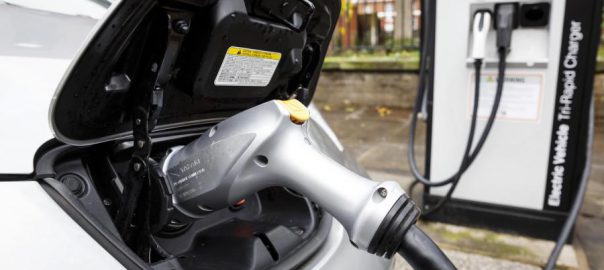
Charging at a rapid charger (Image: Go Ultra Low)
Norway is considering a ban on petrol and diesel cars by 2025 with the four primary political parties debating the action, according to Norwegian newspaper Dagens Næringsliv.
The new law has not officially been passed, but it has been put forward in a white paper, which calls for new private cars, buses and light commercial vehicles to be zero-emission after 2025.
Electric car sales account for around 24% of Norway’s new car market, making it one of the leading countries for electric car sales, but it’s also one of the world’s largest oil exporters.
The Dutch Labour party PvdA is also pressing for a ban on petrol and diesel cars in the Netherlands from 2025.
European leaders have been talking about such a ban for many years – insiders have suggested Paris will be the first city to implement a zero-emissions-vehicle-only zone within its boundaries – but if they were to be introduced, the Norwegian and Dutch policies would be the first complete ban on combustion-engined vehicles.
If implemented, weakened proposal means 14,000 people could die prematurely across Europe each year from 2030
EU states have agreed to water down a proposed law aimed at halving the number of deaths from air pollution within 15 years, after intense lobbying from the UK that cross-party MEPs have condemned as “appalling”.
Some 14,000 people will die prematurely every year across Europe from 2030 as a result, if the weakened proposal is implemented, according to figures cited by the environment commissioner, Karmenu Vella.
The revised proposal is likely to be rejected by the European parliament next week, setting the scene for a public row on 20 June, when Europe’s environment ministers meet to thrash out a compromise.
But EU diplomats said that the UK had been a key player in crafting a blocking minority to kill a more ambitious proposal to bring in measures that would result in a 52% improvement in pollution-related health impacts for citizens around Europe. This translates as a reduction in deaths from conditions such as stroke, heart disease and asthma.
One diplomat said:
“They [the UK] gathered some of the environmental attaches in Brussels who they thought would be most willing to follow their line and weaken the directive. They talked to big countries, such as France and Italy, and I think they also discussed with the strongest ones in eastern Europe, like Poland.”
Seb Dance, the Labour parliamentary group’s environmental lead, said the UK was
“a leading proponent of watering down the proposed target and [also] seems to be playing a leading role in the coalition of the unwilling”.