Category Archives: Pollution

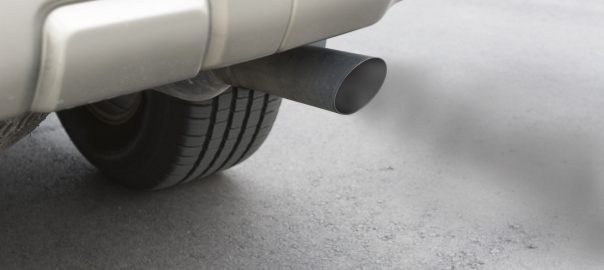
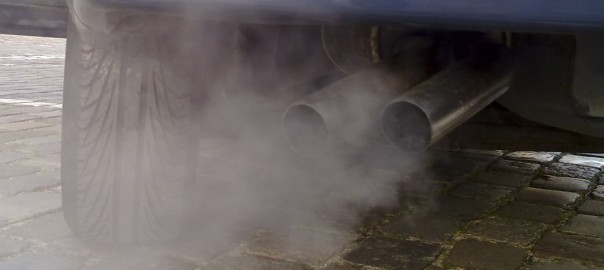
Car exhaust pollution (Image: Wikipedia)

Paris tries something different in the fight against smog

Under a new French scheme cars are labelled according to the pollution that they emit. This allows the worst offenders to be banned when necessary.

Last week Paris suffered its fourth smog of the winter and tried a new idea to protect its residents from the worst effects. Like many European cities, the Paris region has a well-established system of emergency actions that escalate if smog persists. Initial steps include health warnings, reduced speed limits and restrictions on lorries in the city centre. Final steps include cheaper public (€3.80 for a day pass), and bans on half of cars, using an odd/even number plate system.

Car exhaust pollution (Image: Wikipedia)

Despite gradual long-term improvements in air pollution across Europe, in the last month Oslo and Madrid restricted traffic to protect their residents during smog but there is little evidence on the effectiveness of these schemes. The odd/even car ban during the Paris smog of March 2014 reduced the particle pollution alongside major roads by around 20% in the rush hour, but this was less effective in December 2016 as fewer people left their car at home.

This time, instead of taking half of the cars from the roads, Paris banned the oldest diesels. This was made possible by a new French scheme to label cars according to the pollution that they emit. Electric ones get a green sticker. A petrol car made between 1997 and 2003 gets an orange sticker. The new smog scheme banned the most polluting diesels, those more than 16 years old.

Read more: The Guardian

Car exhaust pollution (Image: Wikipedia)

Petrol and diesel cars could be banned in Scottish cities within eight years

Drivers could be forced to give up their vehicles and switch to electric cars in some urban areas.

Car exhaust pollution (Image: Wikipedia)

Radical new plans have been drawn up which could see petrol and diesel vehicles banned in some parts of Scotland within eight years.

The Scottish Government have pledged to cut emissions by 80 per cent by 2050.

Academics and industry experts on Scotland’s future energy taskforce say some tough changes are required for targets to be met.

They have published a strategy suggesting ministers should start introducing a phasing out of petrol and diesel vehicles in 2025, with urban areas and cites facing the ban first.

The taskforce, convened by WWF Scotland, also suggested central and local government should make sure they buy and lease only low carbon vehicles that produce fewer emissions.

The report backs the development of low carbon energy sources, highlighting the need in particular for carbon, capture and storage (CCS) technology.

It also suggests a programme be put in place for all homes to be brought up to a minimum energy efficiency standard by 2025, where practicable to do so.

With the Scottish Government expected to publish its draft energy strategy in the coming week, Dr Keith MacLean, the chair of the UK Energy Research Centre advisory board, and taskforce facilitator said there was

“an excellent opportunity for the Scottish Government to assert overall leadership and control over the nation’s energy future”.

Read more: Daily Record

Electric cars can be a very effective way to save you money on motoring (Image: Go Ultra Low)

Electric vehicles feature in ‘post-Brexit’ strategy

The government has placed electric vehicles at the heart of a green paper outlining its ‘post-Brexit’ Industrial Strategy for the UK today (23 January).

Car exhaust (Image: BBC)

Launched by Prime Minister Theresa May, the Strategy focuses on designing a smart grid and the roll out of public charging points for the vehicles to bring about ‘affordable energy and clean growth’.

The government’s Industrial Strategy will be overseen by the Department for Business, Energy and Industrial Science (BEIS) and is founded on ’10 pillars’ which the government’s evidence shows will drive growth in UK business.

In her foreword, the Prime Minister confirms the Industrial Strategy is a ‘critical part’ of the government’s plan for ‘post-Brexit Britain’ and will see ministers take on a ‘new, active role’ rather than ‘leaving businesses to get on with the job’.

Electric Vehicles

The report cites battery technology in the automotive sector as one of the main focuses of the Strategy – with the government’s chief science advisor, Sir Mark Walport, to review the case for a new research institution by early 2017.

It states:

“Electric vehicles are less polluting and cheaper to run, and have the potential to provide electricity storage and demand flexibility that could provide benefits to consumers and our electricity system. Drawing together these battery, energy storage and grid technologies is sensible because step-changes in innovation will likely involve all of them.

“For example smart grids that respond to the demands of consumers could potentially use new battery technologies, particularly storage in electric vehicles, to deliver power efficiently and at lower cost.”

The paper goes on to note the government is already testing the use of new grid technologies in various locations around the country ‘in preparation for the shift to electric vehicles’, and is investing £600 million in support to accelerate the transition to ultra low emission vehicles.

Low Emission Vehicles (LEV)

On changes to energy infrastructure, the paper notes:

“The Office for Low Emission Vehicles is leading work across the Government to improve our understanding of the system impacts and opportunities of the shift to electric vehicles.

“We are also exploring the potential opportunities offered by hydrogen fuel technologies across multiple applications, including heating, energy storage and transportation.”

The government will consult with businesses over its proposed Industrial Strategy in the weeks to come.

Source: Air Quality News

Electric cars charging in Milton Keynes (Image: T. Larkum)

Mass adoption of electric cars will send diesel extinct in UK

The plan is to invest in the technology needed for battery electric vehicles

Electric cars charging in Milton Keynes (Image: T. Larkum)

Diesel technology is set to be a thing of the past, UK car industry executives believe.

The plan is to invest in the technology needed for battery electric vehicles over the next five years, according to 93% of executives while 62% felt that diesel is losing its importance for manufacturers.

Figures from KPMG’s annual global automotive executive survey also show that 90% of executives expect battery electric vehicles to dominate the marketplace by 2025.

John Leech, of KPMG, said:

“Improvements in the cost and range of battery technology, coupled with growing concern over the emission of both carbon dioxide and nitrogen oxides from diesel engines, means that almost the whole automotive industry believes that the mass adoption of electric cars will happen during the next decade.”

Senior executives working for vehicle manufacturers, suppliers, dealers, financial and mobility service providers plus car users took part in the survey.

Some 74% of executives thought more than half of car owners today would not want to own a vehicle.

Researchers believe there will be fewer cars and therefore less money to be made from building vehicles in the future as people may opt to use, rent or pay for a car service rather than to own a car.

This was not feared as a looming problem because 85% of executives were convinced their company might make more money by providing new digital services than by selling cars alone.

Mr Leech said:

“Carmakers plan to sell a myriad of new digital services to vehicle users. Today car makers already make substantial profits from the sale of consumer finance and annual vehicle insurance but this will grow in the future as innovative services such as remote vehicle monitoring and the integration of the car as a focal point in people’s ever more connected lifestyles are demanded by consumers.”

Source: Independent

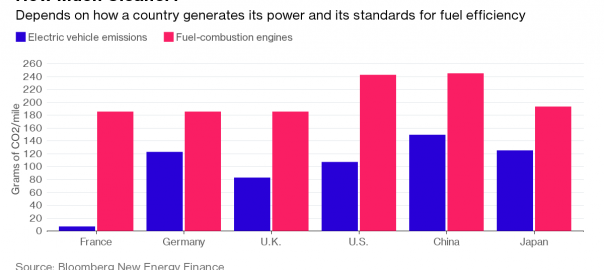
How Much Cleaner Really Is a Tesla? Depends on Where You Are (Image: Bloomberg)

How Much Cleaner EVs Are Over Gas Depends On Country/Electricity Source

A new study of CO2 emissiosn per mile driven in both a regular and electric car to find out the average differences between countries has been undertaken by Bloomberg New Energy Finance

How Much Cleaner Really Is a Tesla? Depends on Where You Are (Image: Bloomberg)

The indirect EV emissions put out are near-zero in countries like Norway and France, where (respectively) renewable energy sources, or nuclear, provides near clean electricity.

While in other countries, average CO2 emission differences obviously varies, but in general are still significantly lower taking into consideration the energy mix.

“The London-based research arm of Bloomberg LP and the Union of Concerned Scientists both have analyzed the ultimate contribution that electric cars make to emissions and found that on average they’re 40 percent to 50 percent cleaner than those that fuel from gasoline or diesel.

Those estimates — and the forward view on where emissions from the power generation industry are going — are crucial to understand how much global-warming pollution will come from transportation in the decades ahead.”

Source: Inside EVs

Many car brands emit more pollution than Volkswagen, report finds

Diesel cars by Fiat, Suzuki and Renault among makers emitting up to fifteen times European standard for nitrogen oxide

Car exhaust pollution (Image: Wikipedia)

A year on from the “Dieselgate” scandal that engulfed Volkswagen, damning new research reveals that all major diesel car brands, including Fiat, Vauxhall and Suzuki, are selling models that emit far higher levels of pollution than the shamed German carmaker.

The car industry has faced fierce scrutiny since the US government ordered Volkswagen to recall almost 500,000 cars in 2015 after discovering it had installed illegal software on its diesel vehicles to cheat emissions tests. But a new in-depth study by campaign group Transport & Environment (T&E) found not one brand complies with the latest “Euro 6” air pollution limits when driven on the road and that Volkswagen is far from being the worst offender.

“We’ve had this focus on Volkswagen as a ‘dirty carmaker’ but when you look at the emissions of other manufacturers you find there are no really clean carmakers,” says Greg Archer, clean vehicles director at T&E.

“Volkswagen is not the carmaker producing the diesel cars with highest nitrogen oxides emissions and the failure to investigate other companies brings disgrace on the European regulatory system.”

Read more: The Guardian

Car exhaust pollution (Image: Wikipedia)

Renault considers killing off diesel engines

Renault, the French car maker, may stop offering diesel engines in most of its cars sold in Europe.

Pollution in Paris

The move is a reaction to the cost of ensuring that diesel engines comply with tighter emissions regulations.

The crackdown follows last year’s diesel emissions scandal involving German car maker Volkswagen.

Renault’s move was reported by Reuters and has not yet been officially announced.

Senior Renault executive Thierry Bollore has said that tougher emissions standards and testing methods would make diesel engines uneconomic to make.

He told a meeting of Renault bosses in July that diesel engines had already been removed from the company’s smallest cars, such as the Twingo, even before the Volkswagen scandal.

By 2020, when more stringent EU emissions standards come into force, larger Renault cars such as the Clio and the Megane are unlikely to have diesel engine variants.

More than 60% of the 1.6 million cars Renault sold in Europe last year were diesels.

Volkswagen’s chief executive, Matthias Mueller, said in June that his company was now wondering

“whether it still makes sense to invest a lot of money in further developing diesel”.

Read more: BBC

At these prices, who can refuse? (Image: G. Osodi/Bloomberg)

Fuel Subsidies Are the World’s Dumbest Policy

Many things have gotten harder as the world settles into a protracted spell of low oil prices and sluggish growth — from avoiding deflation to creating jobs. One thing has gotten easier, as well as more urgent: eliminating fossil-fuel subsidies.

At these prices, who can refuse? (Image: G. Osodi/Bloomberg)

Governments have long paid lip service to this idea. The G-20 has been promising to phase out fuel subsidies since 2009, but the measures remain widespread and resilient.

Nations from the U.S. to the U.K. to Russia continue to spend billions on tax breaks and other subsidies for the production of oil, gas and coal. Japan, South Korea and China support massive fossil-fuel projects outside their borders. For years, many countries — including some of the world’s biggest energy producers — have also used subsidies to lower gasoline and diesel prices, supposedly to help the poor.

The sums involved are huge. The International Energy Agency estimates that countries spent $493 billion on consumption subsidies for fossil fuels in 2014. The U.K.’s Overseas Development Institute suggests G-20 countries alone devoted an additional $450 billion to producer supports that year.

These ridiculous outlays would be economically wasteful even if they didn’t also harm the environment. They fuel corruption, discourage efficient use of energy and promote needlessly capital-intensive industries. They sustain unviable fossil-fuel producers, hold back innovation, and encourage countries to build uneconomic pipelines and coal-fired power plants. Last and most important, if governments are to have any hope of meeting their ambitious climate targets, they need to stop paying people to use and produce fossil fuels.

Read more: Bloomberg

Eiffel Tower in Paris, France (Image: Rijin/Wikimedia)

Paris weekday ban on pre-1997 cars takes effect

Beginning this week, drivers will not be able to take older cars into the center of Paris on weekdays.

Eiffel Tower in Paris, France (Image: Rijin/Wikimedia)

The ban encompasses most cars made before 1997 and motorcycles made before 2000, and was enacted to combat rampant air pollution in the French capital.

Older cars and motorcycles now face fines for entering the city between 8:00 am and 8:00 pm on weekdays, although they are still free to drive into Paris on weekends.

Announced last year, the ban is one of the toughest measures taken by a European city to curb air pollution so far.

In order to enforce the ban, cars will be required to display colored stickers corresponding to one of six levels of exhaust emissions.

After an initial grace period extending to October, drivers who violate the ban will be fined 35 euros ($39).

The amount of the fine is expected to rise over time, starting with an increase to 68 euros ($75) early next year.

Paris has issued temporary car bans before, but this permanent ban of older cars has incited protests from groups expecting to be impacted by the new policy.

Driver groups initially expressed concern that classic cars—including iconic Citroën 2CVs commonly used to shuttle tourists—would no longer be allowed on Paris streets.

However, the Fédération Française des Véhicules d’Epoque (FFVE) collector-car organization recently met with government officials to secure an exemption for what are deemed “historic vehicles,” according to Hemmings Motor News.

Cars more than 30 years old that display a “Carte Grise de Collection” sticker—as opposed to the “Carte Grise de Normale” sticker issued to normal cars—will be excused from the ban.

FFVE officials reportedly hope to extend the exemption to newer cars that still fall into the “collector” category as well.

Read more: Green Car Reports

APT Skidata launches new feature for creating emission-based tariffs

APT Skidata, the UK’s leading parking technology business, has launched a new feature that allows car park operators using an APT Skidata system to set individual parking tariffs according to the CO2 emissions of the vehicles.

32011833 - a car emits carbon monoxide gas from its exhaust tailpipe, showing how pollution is formed.
A car emits carbon dioxide gas from its exhaust tailpipe

The system uses automatic number plate recognition (ANPR) cameras to identify and record each vehicle as it enters a car park, and compare the license to a database that includes details around CO2 emissions.

Pete Brown, APT Skidata’s Managing Director, says that tariffs can therefore be set to reward those who are more environmentally friendly:

“Car park operators and local authorities are increasingly looking to address the environmental impact of cars on the local area,”

“By being able to charge customers according to CO2 emissions, they will be able to effectively reward users for driving more fuel efficient vehicles, especially in busy town and city centres.”

Mr Brown says that where surcharges are put in place for vehicles with the highest emissions, the additional revenue gained can be used to help offset the car park’s carbon footprint:

“It also allows tariffs to be set to allow free parking for drivers of Electric Vehicles (EVs),”

“All customers with a Skidata system will be able to access this new feature and tailor their tariffs according to their green strategy.”