Category Archives: Peak Oil

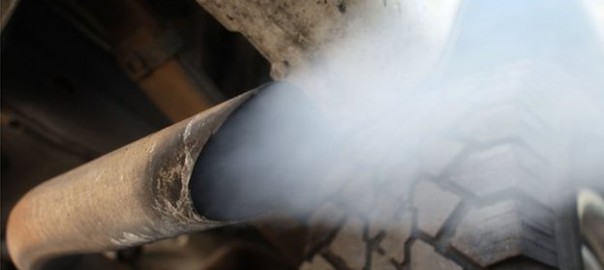
Car exhaust (Image: BBC)

‘Chelsea tractors are the most polluting cars in Britain’

The gas guzzling cars driven in the west London spiritual home of the “Chelsea tractor” are the most polluting in Britain, official figures reveal today.

Car exhaust pollution (Image: Wikipedia)

The 44,732 cars registered in Kensington & Chelsea belch an average of 177.7 grams of carbon dioxide for every kilometre driven, far higher than the London average of 163.5 grams.

The data – obtained from the DVLA through a Freedom of Information request – also reveal that more than a quarter of cars in the country’s most affluent local authority area exceed the 200g/km level.

This is [the] threshold of the three highest vehicle tax bands for the most polluting cars including the Land Rover Defender, Porsches, Ferraris and the BMW X5,.

Other wealthy central London boroughs where residents are more likely to afford sports cars or large SUV 4x4s also appeared near the top of the list. The City of Westminster was second with 173.6g followed by City of London on 168.4g.

The least polluting cars are driven in more suburban areas with Hillingdon at the bottom of the league table.

Its 142,455 cars only emitted 152.9 grams of the gas linked with global warming and climate change.

Fewer than 10 per cent of the borough’s cars fall into the tax brackets for the most polluting cars, according to the data, which was obtained by mapping software company Esri UK.

Simon Birkett, Founder and Director of campaign group Clean Air in London, said:

“These numbers show that Boris’ ‘car is king’ policy has protected his richest friends driving gas guzzlers.

“But we don’t need to punish people just because they want a big car sitting in the driveway. Instead we need Emissions-Based Road Charging that hammers or bans those wanting to drive large diesel cars, long distances in the most polluted parts of London at the busiest times of day.

“The next Mayor must embrace smart charging as better, fairer and essential to get London moving and clean its air.”

Read more: Standard

Living in interesting times: have CO2 emissions peaked?

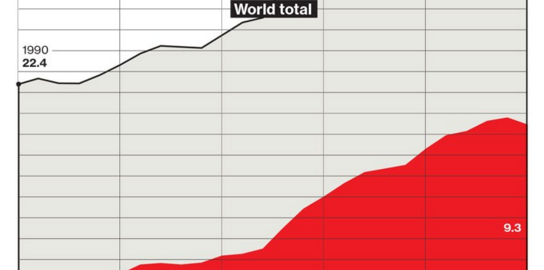
The projections that had been circulating during the past few months turned out to be correct. Now, it is official: the global carbon dioxide (CO2) emissions peaked in 2014 and went down in 2015. And this could be a momentous change.

World_Emissions_2015_unk
Don’t expect the emission peak, alone, to save us from the impending climate disaster, but, if CO2 emissions will start an irreversible decline, then we need to rethink several assumptions that we have been making on how to deal with climate change. In particular, depletion is normally assumed to be a minor factor in determining the trajectory of the world’s economy during the coming decades, but that may not be the case. Depletion is not a good thing in itself, but it might help us (perhaps) to stay within the “safe” limits and avoid a climate disaster.

CO2 emissions are mainly the result of the combustion of fossil fuels and of activities made possible by the combustion of fossil fuels. And, since we expect the production of fossil fuels to peak and decline as the result of depletion, it shouldn’t be a surprise that CO2 emissions should peak too. But it is surprising that we may be already seeing the peak. For instance, Laherrere had assumed the peak for all fossils to occur not before around 2025. And many people would have seen these projections as ridiculously catastrophistic. Most of the published scenarios for the future saw CO2 emissions increasing for at least a few decades in the future unless draconian economic or legislative measures to limit them were taken.

So, what we are seeing may be simply a fluctuation; not necessarily “the peak”. But, it might also be the big one: the point of no-return. From now on, we may find ourselves rolling down on the other side of the Hubbert curve. It would be the true vindication of the “base case” scenario of “The Limits to Growth” that had seen the combination of gradual depletion and pollution to cause the start of the terminal decline of the fossil based industrial system at some moment during the 2nd-3rd decade of the 21st century.

Read more: Cassandra’s Legacy

Superior electric cars wreck oil markets

Another Oil Crash Is Coming, and There May Be No Recovery. Superior electric cars are on their way, and they could begin to wreck oil markets within a decade.

It’s time for oil investors to start taking electric cars seriously.

In the next two years, Tesla and Chevy plan to start selling electric cars with a range of more than 200 miles priced in the $30,000 range. Ford is investing billions, Volkswagen is investing billions, and Nissan and BMW are investing billions. Nearly every major carmaker—as well as Apple and Google—is working on the next generation of plug-in cars.

This is a problem for oil markets. OPEC still contends that electric vehicles will make up just 1 percent of global car sales in 2040. Exxon’s forecast is similarly dismissive.

The oil price crash that started in 2014 was caused by a glut of unwanted oil, as producers started cranking out about 2 million barrels a day more than the market supported. Nobody saw it coming, despite the massively expanding oil fields across North America. The question is: How soon could electric vehicles trigger a similar oil glut by reducing demand by the same 2 million barrels?

That’s the subject of the first installment of Bloomberg’s new animated web series Sooner Than You Think, which examines some of the biggest transformations in human history that haven’t happened quite yet. Tomorrow, analysts at Bloomberg New Energy Finance will weigh in with a comprehensive analysis of where the electric car industry is headed.

Even amid low gasoline prices last year, electric car sales jumped 60 percent worldwide. If that level of growth continues, the crash-triggering benchmark of 2 million barrels of reduced demand could come as early as 2023. That’s a crisis. The timing of new technologies is difficult to predict, but it may not be long before it becomes impossible to ignore.

Source: Bloomberg

Peak Oil Returns: Why Demand Will Likely Peak By 2030

Will global oil demand peak by 2030? Is peak oil demand the new peak oil supply?

Many trends now point in the direction of this remarkable possibility:

  • In December the nations of the world agreed unanimously in Paris to leave most of the world fossil fuels in the ground.
  • Oil demand has been declining in developed countries for over a decade.
  • Electric vehicle sales are exploding around the world, especially China.
  • Battery prices are continuing their unexpectedly rapid price drop.
  • Tesla and Chevy now say their new 200-mile-range EV could cost Americans $30,000 — a game-changing price.

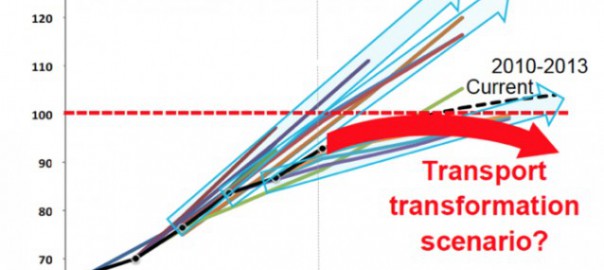
In November, a Bloomberg Business story, “The Oil Industry Has Been Put on Notice,” warned “the transformation of oil markets may be coming sooner than we think.” This recent Bloomberg New Energy Finance chart includes oil forecasts the International Energy Agency (IEA) has made since 1994:

16-638x497_BNEFoilpeak1_demand_IEA-BNEF_Bloomberg

Read more: Think Progress

Hedge Fund Manager Chanos: Pump Oil Now Because EVs Are Coming

Hedge fund manager and Kynikos Associates President, Jim Chanos was interviewed on CNBC on Thursday, and had a couple interesting (and uncharacteristic) observations worth noting.

CHR3696_1_nlm_Renault_c

The first being bullish on solar, but still maintaining a short position in Solar City (of whom Chanos says is not a tech company, but a finance company); despite the recent surge in PV stocks thanks to the pending 5 year renew of the 30% federal tax credit.

The second point of interest was a message to all the oil pumpers out there:

“I think if you were to look out five or 10 years, if I was a member of OPEC, I would be pumping as much as I could today while it’s worth something, because it might not be worth a whole lot by 2030.”

The reason? Electric vehicles.

Read more: Inside EVs

Tipping Points and Civilizational Survival

In mid-August, TomDispatch’s Michael Klare wrote presciently of the oncoming global oil glut, the way it was driving the price of petroleum into the “energy subbasement,” and how such a financial “rout,” if extended over the next couple of years, might lead toward a new (and better) world of energy. As it happens, the first good news of the sort Klare was imagining has since come in. In a country where the price of gas at the pump now averages $2.29 a gallon (and in some places has dropped under $1.90), Big Oil has begun cutting back on its devastating plans to extract every imaginable drop of fossil fuel from the planet and burn it. Oil companies have also been laying off employees by the tens of thousands and deep-sixing, at least for now, plans to search for and exploit tar sands and other “tough oil” deposits worldwide.

2342872_Oil_Well_shutterstock

In that context, as September ended, after a disappointing six weeks of drilling, Royal Dutch Shell cancelled “for the foreseeable future” its search for oil and natural gas in the tempestuous but melting waters of the Alaskan Arctic. This was no small thing and a great victory for an environmental movement that had long fought to put obstacles in the way of Shell’s exploration plans. Green-lighted by the Obama administration to drill in the Chukchi Sea this summer, Shell has over the last nine years sunk more than $7 billion into its Arctic drilling project, so the decision to close up shop was no small thing and offers a tiny ray of hope for what activism can do when reality offers a modest helping hand.

As Klare makes clear today, when it comes to the burning of fossil fuels, reality — if only we bother to notice it — is threatening to offer something more like the back of its hand to us on this embattled planet of ours. He offers a look at a future in which humanity, like various increasingly endangered ecosystems including the Arctic, may be approaching a “tipping point.”

Read more: Tom Dispatch

Getting Older After the Apocalypse

Every now and then the Internet serves up something perfectly pitched to what you assumed were your own very individual fears.

On Thursday, for me, that was Romie Stott’s “futurist vision of retirement planning” at The Billfold. Planning for the eventual end of paid work isn’t just difficult because life is expensive and saving money is hard, she points out — it’s also difficult because the world is ending.

Okay, that might be my fears talking. But Ms. Stott does note that climate change over the next several decades will, at the very least, affect certain popular retiree destinations: “If your retirement dream includes a beach house, lake house, Florida, or New Mexico, add four to 11 degrees to the daily forecast; that’s the EPA’s best prediction for 2100 AD.”

That may sound relatively tame, but she also mentions booming populations of disease-bearing insects, and increasingly catastrophic storms. It’s predictions like this that, for years, have made me think of retirement planning not just in terms of 401(k)s but in terms of learning to build a fire.

Read more: NY Times

Economy round up

There are a lot of doom-and-gloom messages going around at the moment – it’s hard to know which to believe. Here’s a smorgasbord of articles that caught my eye, though they’re only a small selection of what’s out there.


Biosphere collapse: the biggest economic bubble ever

Worried about debt, defaults and deficits? Save up your concern for the real problem, writes Glen Barry. The systematic destruction Earth’s natural ecosystems for short-term profit is the ‘bubble’ that underlies economic growth – and if allowed to continue its bursting will leave the Earth in a state of social, economic and ecological collapse.

“The human family will only avert biosphere collapse if we choose to live more simply, share more with others, go back to the land, have fewer kids, protect and restore ecosystems, grow more of our own food, end fossil fuels, and embrace social justice.”

The global environment collapses as in the pursuit of short-term growth, humanity overruns natural ecosystems including the atmosphere that make Earth habitable.

Together we urgently address inequity, climate change, overpopulation and natural ecosystem loss or alone we each face the horrors of economic, social, and ecological collapse.

Newspapers are full of disastrous warnings if economic growth does not return to Greece, or if it drops a couple points in China. Rarely in human history have so many been so fundamentally wrong about a matter of such importance as the desirability, and even the possibility, of perpetual economic growth.

The real threat to human well-being is not that there is too little economic growth. Rather, it is that there is too much, and that we have overshot how much growth can occur without collapsing our shared environment.

The industrial growth economy is ravaging natural ecosystems. Stocks of natural capital – including water, soil, old-growth forests, wild fish – are being pillaged to artificially inflate short-term economic growth numbers.

Modern industrial capitalism’s narrow focus upon GDP growth as a measure of a society’s well-being utterly fails to account for the very real and detrimental costs of liquidating Earth’s natural life-support systems.

Infinite growth on a finite planet is a recipe for disaster. Nothing grows forever and trying inevitably rips apart any system seeking to do so.

Continued ravaging of Earth’s natural ecosystems for short-term growth is the biggest economic bubble ever. Such a short-term, myopic focus upon economic growth can only end in social and ecological collapse.

Read more: The Ecologist

steamworkshop_webupload_previewfile_333389464

Deflationary Collapse Ahead?

Both the stock market and oil prices have been plunging. Is this “just another cycle,” or is it something much worse? I think it is something much worse.

Back in January, I wrote a post called Oil and the Economy: Where are We Headed in 2015-16? In it, I said that persistent very low prices could be a sign that we are reaching limits of a finite world. In fact, the scenario that is playing out matches up with what I expected to happen in my January post. In that post, I said

Needless to say, stagnating wages together with rapidly rising costs of oil production leads to a mismatch between:

  • The amount consumers can afford for oil
  • The cost of oil, if oil price matches the cost of production

This mismatch between rising costs of oil production and stagnating wages is what has been happening. The unaffordability problem can be hidden by a rising amount of debt for a while (since adding cheap debt helps make unaffordable big items seem affordable), but this scheme cannot go on forever.

Read more: Our Finite World


You Call This Progress?

One of the prevailing narratives of our time is that we are innovating our way into the future at break-neck speed. It’s just dizzying how quickly the world around us is changing. Technology is this juggernaut that gets ever bigger, ever faster, and all we need to do is hold on for the wild ride into the infinitely cool. Problems get solved faster than we can blink.

But I’m going to claim that this is an old, outdated narrative. I think we have a tendency to latch onto a story of humanity that we find appealing or flattering, and stick with it long past its expiration date. Many readers at this point, in fact, may think that it’s sheer lunacy for me to challenge such an obvious truth about the world we live in. Perhaps this will encourage said souls to read on—eager to witness a spectacular failure as I attempt to pull off this seemingly impossible stunt.

The (slightly overstated) claim is that no major new inventions have come to bear in my 45-year lifespan. The 45 years prior, however, were chock-full of monumental breakthroughs.

Read more: Do The Math


How our energy problem leads to a debt collapse problem

Usually, we don’t stop to think about how the whole economy works together. A major reason is that we have been lacking data to see long-term relationships. In this post, I show some longer-term time series relating to energy growth, GDP growth, and debt growth–going back to 1820 in some cases–that help us understand our situation better.

When examining these long-term time series, I come to the conclusion that what we are doing now is building debt to unsustainably high levels, thanks to today’s high cost of producing energy products. I doubt that this can be turned around. To do so would require immediate production of huge quantities of incredibly cheap energy products–that is oil at less than $20 per barrel in 2014$, and other energy products with comparably low cost structures.

Our goal would need to be to get back to the energy cost levels that we had prior to the run-up in costs in the 1970s. Growth in energy use would probably need to rise back to pre-1975 levels as well. Of course, such a low-price, high-growth scenario isn’t really sustainable in a finite world either. It would have adverse follow-on effects, too, including climate change.

Read more: Our Finite World


How the banks ignored the lessons of the crash

Ask people where they were on 9/11, and most have a memory to share. Ask where they were when Lehman Brothers collapsed, and many will struggle even to remember the correct year. The 158-year-old Wall Street bank filed for bankruptcy on 15 September 2008. As the news broke, insiders experienced an atmosphere of unprecedented panic. One former investment banker recalled: “I thought: so this is what the threat of war must feel like. I remember looking out of the window and seeing the buses drive by. People everywhere going through a normal working day – or so they thought. I realised: they have no idea. I called my father from the office to tell him to transfer all his savings to a safer bank. Going home that day, I was genuinely terrified.”

A veteran at a small credit rating agency who spent his whole career in the City of London told me with genuine emotion: “It was terrifying. Absolutely terrifying. We came so close to a global meltdown.” He had been on holiday in the week Lehman went bust. “I remember opening up the paper every day and going: ‘Oh my God.’ I was on my BlackBerry following events. Confusion, embarrassment, incredulity … I went through the whole gamut of human emotions. At some point my wife threatened to throw my BlackBerry in the lake if I didn’t stop reading on my phone. I couldn’t stop.”

Other financial workers in the City, who were at their desks after Lehman defaulted, described colleagues sitting frozen before their screens, paralysed – unable to act even when there was easy money to be made. Things were looking so bad, they said, that some got on the phone to their families: “Get as much money from the ATM as you can.” “Rush to the supermarket to hoard food.” “Buy gold.” “Get everything ready to evacuate the kids to the country.” As they recalled those days, there was often a note of shame in their voices, as if they felt humiliated by the memory of their vulnerability. Even some of the most macho traders became visibly uncomfortable. One said to me in a grim voice:

“That was scary, mate. I mean, not film scary. Really scary.”

Read more: The Guardian


IMF warns of stagnation threat to G7 economies

Fund’s latest World Economic Outlook cuts global growth forecasts saying emerging markets slowdown may entrench low inflation and promote stagnation in the west

The International Monetary Fund is warning that the weak recovery in the west risks turning into near stagnation after cutting its global economic growth forecast for the fourth successive year.

In its half-yearly update on the health of the world economy, the Washington-based fund predicted expansion of 3.1% in 2015, 0.2 points lower than it was expecting three months ago and the weakest performance since the trough of the downturn in 2009.

“Six years after the world economy emerged from its broadest and deepest postwar recession, a return to robust and synchronised global expansion remains elusive,”

said Maurice Obstfeld, the IMF’s economic counsellor.

Read more: The Guardian


The Stock Markets Of The 10 Largest Global Economies Are All Crashing

You would think that the simultaneous crashing of all of the largest stock markets around the world would be very big news. But so far the mainstream media in the United States is treating it like it isn’t really a big deal. Over the last sixty days, we have witnessed the most significant global stock market decline since the fall of 2008, and yet most people still seem to think that this is just a temporary “bump in the road” and that the bull market will soon resume. Hopefully they are right. When the Dow Jones Industrial Average plummeted 777 points on September 29th, 2008 everyone freaked out and rightly so. But a stock market crash doesn’t have to be limited to a single day. Since the peak of the market earlier this year, the Dow is down almost three times as much as that 777 point crash back in 2008. Over the last sixty days, we have seen the 8th largest single day stock market crash in U.S. history on a point basis and the 10th largest single day stock market crash in U.S. history on a point basis. You would think that this would be enough to wake people up, but most Americans still don’t seem very alarmed. And of course what has happened to U.S. stocks so far is quite mild compared to what has been going on in the rest of the world.

Read more: The Economic Collapse Blog


HSBC fears world recession with no lifeboats left


The world authorities have run out of ammunition as rates remain stuck at zero. They have no margin for error as economy falters.

The world economy is disturbingly close to stall speed. The United Nations has cut its global growth forecast for this year to 2.8pc, the latest of the multinational bodies to retreat.

We are not yet in the danger zone but this pace is only slightly above the 2.5pc rate that used to be regarded as a recession for the international system as a whole.

It leaves a thin safety buffer against any economic shock – most potently if China abandons its crawling dollar peg and resorts to ‘beggar-thy-neighbour’ policies, transmitting a further deflationary shock across the global economy.

Read more: Telegraph


The Crash of 2015: Going Global

Just in the past week, the headlines have been coming like triphammer blows: in Bloomberg News, “Something has gone wrong with the global consumer,” (according to JP Morgan); in International Business Times, “G7 Finance Ministers to address faltering global growth;” in London’s Telegraph, “HSBC fears world recession with no lifeboats left;” in OilPrice.com, “Clock running out for struggling oil companies;” and even in the mainstream vanilla Washington Post, a column by Robert Samuelson predicts “China’s coming crash,” then puts a question mark at the end to make sure we don’t worry too much.

When you add these concerns to longer standing ones about wild gyrations in the world’s stock and bond markets; the advent of peak oil in pretty much every oil-exporting country in the world; the onset of the effects of global climate change in California, the Middle East, North Africa, Brazil and elsewhere; it becomes apparent that optimism ought to be listed as a disorder requiring medical intervention.

Read more: Daily Impact


Global Financial Meltdown Coming? Clear Signs That The Great Derivatives Crisis Has Now Begun

Warren Buffett once referred to derivatives as “financial weapons of mass destruction“, and it was inevitable that they would begin to wreak havoc on our financial system at some point. While things may seem somewhat calm on Wall Street at the moment, the truth is that a great deal of trouble is bubbling just under the surface. As you will see below, something happened in mid-September that required an unprecedented 405 billion dollar surge of Treasury collateral into the repo market. I know – that sounds very complicated, so I will try to break it down more simply for you. It appears that some very large institutions have started to get into a significant amount of trouble because of all the reckless betting that they have been doing. This is something that I have warned would happen over and over again. In fact, I have written about it so much that my regular readers are probably sick of hearing about it. But this is what is going to cause the meltdown of our financial system.

Many out there get upset when I compare derivatives trading to gambling, and perhaps it would be more accurate to describe most derivatives as a form of insurance. The big financial institutions assure us that they have passed off most of the risk on these contracts to others and so there is no reason to worry according to them.

Well, personally I don’t buy their explanations, and a lot of others don’t either. On a very basic, primitive level, derivatives trading is gambling. This is a point that Jeff Nielson made very eloquently in a piece that he recently published…

No one “understands” derivatives. How many times have readers heard that thought expressed (please round-off to the nearest thousand)? Why does no one understand derivatives? For many; the answer to that question is that they have simply been thinking too hard. For others; the answer is that they don’t “think” at all.

Derivatives are bets. This is not a metaphor, or analogy, or generalization. Derivatives are bets. Period. That’s all they ever were. That’s all they ever can be.

Read more: The Economic Collapse Blog
See also: Why Are The IMF, The UN, The BIS And Citibank All Warning That An Economic Crisis Could Be Imminent?
Peak oil round up

There’s a lot of discussion in the ‘blogosphere’ of whether we’re starting to see the effects of peak oil in our economic woes – here are some highlights (and don’t forget my blog post).


2015 Could Be The Year Of Peak Oil


I am now more convinced than ever that 2015 will see the peak in world crude oil production. I have very closely studied the charts of every producing nation and my prognosis is based on that study. I see many nations in steep decline and most every other nation peaking now, or in the last couple of years, or very near their peak today. These include the world’s three largest producers, Russia, Saudi Arabia and the USA.

Read more: Oil Price

(Image: D. Bacon/Shutterstock/Economist)
Oil Mountain (Image: D. Bacon/Shutterstock/Economist)

China Peak Oil: 2015 Is the Year

Domestic production looks set to peak, with some profound implications for the world market.

Intense focus on the North American shale boom, Saudi Arabia, and ISIS obscures an important emerging energy trend: China’s oil production is peaking. This has profound implications for the world oil market, because China is not just a massive importer of crude; it is also among the world’s five largest oil producers, trailing only the U.S., Russia, and Saudi Arabia, and virtually neck-in-neck with Canada.

China’s oil industry has delivered impressive oil and gas production growth over the past decade. Yet a range of data and historical analogies increasingly suggest that, at global oil prices between $50-to-$100 per barrel, China’s oil supply capability is plateauing and may peak as soon as this year. Lower or higher prices would accelerate or extend this timing.

Read more: The Diplomat


US Oil Production Nears Previous Peak

The EIA’s Monthly Energy Review came out a couple of days ago. The data is in thousand barrels per day and the last data point is July 2015.

US consumption of total liquids, or as the EIA calls it, petroleum products supplied, reached 20,000,000 barrels per day for the first time since February of 2008.

Something I never noticed before, consumption started to drop in January 2008, seven months before the price, along with world production, started to drop in August 2008. This had to be a price driven decline. Could the current June and July increase in consumption be price driven also?

Read more: Peak Oil Barrel


Crashing Oil Prices Aren’t Due to an Oil Glut But to Demand Destruction

As I began to mention at the end of the first part of this three-parter, I’ve only just recently come to the conclusion that oil prices aren’t going to have a tendency to rise due to the tightening of supply imposed by peak oil, but to depreciate. This of course flies in the face of the common logic of supply and demand, but when factoring in the method by which the majority of our money is created, a deflationary effect can be seen to come into play. This has taken me an absurdly long time to clue into, for although I’d steadfastly amassed a bunch of pieces (various information), I hadn’t realized they were actually all part of the same puzzle.

With peak oil and fractional-reserve banking being the first two pieces of this puzzle, the third piece that I needed to factor in (which oddly enough I’d already written about) is the fact that money is a proxy for energy.

Read more: From Filmers to Farmers


Will declines in U.S. and Canadian oil production lead to a global decline?

At the beginning of this year I noted that all of the growth in world oil production* since 2005 has come from two countries: the United States and Canada. And, I suggested that since the growth in production in those two countries came from high-cost deposits–tight oil in the United States and tar sands in Canada–that the precipitous drop in oil prices would lead to declines in production in both countries.

I concluded that unless another area of the world suddenly started growing its oil production significantly that those declines would probably result in a worldwide decline in oil production.

Well, declines in the both the United States and Canada have arrived. It will be several months before we can know with any certainty whether those declines will translate into a persistent global decline.

Read more: Resilience


Support For OPEC Production Cut Is Increasing


Now the shale producers won’t willingly reduce output, as shale production is made up of many different companies, and not a national company like most global oil producers; but due to the economics of the current oil price environment, many shale oil producers will face bankruptcy next year, and as a result, will go out of business.

The reason being is that in 2016, most oil hedges will expire. These hedges have allowed shale oil companies to stay afloat and achieve cash flow neutrality, despite the decline in oil prices. These hedges have also helped shale oil companies gain access to credit, so they can raise the capital needed to put their wells into production. When these hedges expire, companies will not generate the cash flow needed to meet their covenants, which will in turn bankrupt them, and production from U.S. shale oil wells, will start declining rapidly. This will also dry up the credit markets and prevent any type of quick rebound in shale oil production.

This is why the IEA even estimates that U.S. oil output will start collapsing next year.

Read more: Oil Price


US Shale Oil too Expensive, Peaks 1H 2015

According to EIA data, monthly US crude oil production peaked in April 2015 at 9.6 mb/d.

Read more: Resilience


This is When Bonds Go Kaboom!


In the energy sector, the bond devastation is even worse.

California Resources – Occidental Petroleum’s spinoff of its oil-and-gas assets in California, a masterpiece of Wall Street engineering – has done nothing but burn investors in its 10 months as an independent company. When I last wrote about it ten days ago, its $2.25 billion of 6% notes due 2024, issued at par to QE-drunk investors in September last year, had plunged to 66 cents on the dollar. Now they’re at 59.5 cents on the dollar.

Chesapeake Energy, the second largest natural gas driller in the US, is also facing the music. Two of its brethren, Quicksilver Resources and Samson Resources, have already filed for bankruptcy. When I last wrote about Chesapeake a month ago, its $1.1 billion of 5.75% notes due 2023 – that in June 2014 had been at 112 cents on the dollar – had plummeted to 70. Now they’re at 67.

Read more: Wolf Street


And from last year:

Collapse is Inevitable

There has been considerable discussion lately as to whether or not total collapse of the world’t economies will happen in the relatively near future. I think that is the wrong question. Let me explain.

Ecological collapse of the world’s ecosystem is a lead pipe cinch. It is already well underway and instead of slowing down, it is gaining momentum fast.

Read more: Peak Oil Barrel

Peak oil will break economies

[From December 2013] Industry expert warns of grim future of ‘recession’ driven ‘resource wars’ at University College London lecture

A former British Petroleum (BP) geologist has warned that the age of cheap oil is long gone, bringing with it the danger of “continuous recession” and increased risk of conflict and hunger.

BPlogo_Logo_BP_EnergyVoice

At a lecture on ‘Geohazards’ earlier this month as part of the postgraduate Natural Hazards for Insurers course at University College London (UCL), Dr. Richard G. Miller, who worked for BP from 1985 before retiring in 2008, said that official data from the International Energy Agency (IEA), US Energy Information Administration (EIA), International Monetary Fund (IMF), among other sources, showed that conventional oil had most likely peaked around 2008.

Dr. Miller critiqued the official industry line that global reserves will last 53 years at current rates of consumption, pointing out that “peaking is the result of declining production rates, not declining reserves.” Despite new discoveries and increasing reliance on unconventional oil and gas, 37 countries are already post-peak, and global oil production is declining at about 4.1% per year, or 3.5 million barrels a day (b/d) per year:

“We need new production equal to a new Saudi Arabia every 3 to 4 years to maintain and grow supply… New discoveries have not matched consumption since 1986. We are drawing down on our reserves, even though reserves are apparently climbing every year. Reserves are growing due to better technology in old fields, raising the amount we can recover – but production is still falling at 4.1% p.a. [per annum].”

Read more: The Guardian