Category Archives: Energy and Climate Change

News and articles on climate change, vehicle pollution, and renewable energy.

Blades Being Installed on Turbine 5, Yelvertoft Wind Farm (Image: T. Larkum)

E.ON to quit gas and coal and focus on renewable energy

Germany utility firm to sell off most power generating units amid ‘dramatically altered global energy markets’

Blades Being Installed on Turbine 5, Yelvertoft Wind Farm (Image: T. Larkum)
Blades Being Installed on a Wind Turbine (Image: T. Larkum)

Germany’s biggest utility firm, E.ON, has announced plans to split in two and spin off most of its power generation, energy trading and upstream businesses, responding to a crisis that has crippled the European energy sector.

E.ON said it wanted to focus on its renewable activities, regulated distribution networks and tailor-made energy efficiency services, citing “dramatically altered global energy markets, technical innovation, and more diverse customer expectations”.

“E.ON’s existing broad business model can no longer properly address these new challenges,”

the chief executive, Johannes Teyssen, said in a statement.

Germany’s power sector has been in turmoil, hit by a prolonged period of weak demand, low wholesale prices and a surge in renewable energy sources which continue to replace gas-fired and coal-fired power plants.

E.ON said it would prepare next year for the listing of the new company created by its breakup, with the spin-off taking place after its 2016 annual general meeting.

The split will not be accompanied by job cuts, E.ON said, adding that about 40,000 employees would remain with the parent group, while the remaining 20,000 would join the new company.

E.ON did not provide an earnings breakup for the two future companies. E.ON’s generation, upstream and global commodities units, the last of which includes trading, accounted for about 35% of its €9.32bn (£7.4bn) in earnings before interest, tax, depreciation and amortisation in 2013. Renewables and regulated businesses alone accounted for 54%.

E.ON will hold a news conference on Monday about its plans, which will include investing more in wind and solar power.

In a first step, the firm said it would transfer a majority of the new company’s capital stock to its shareholders, avoiding the sale of new shares on the open market as is the case during an initial public offering. Instead, investors will receive shares in the new company in addition to holdings in the parent firm, in much the same way that Bayer shareholders received shares in speciality chemicals unit Lanxess. E.ON, which has €31bn in net debt, said it would dispose of its minority stake in the new company over the medium term to bolster its finances.

By choosing to spin off power generation, E.ON rids itself of a sector that has been hard hit by Germany’s decision to boost renewables at the expense of gas, coal and nuclear power plants.

The company also said it would post a substantial net loss for 2014 due to additional charges of about €4.5bn in the fourth quarter, citing its assets in southern Europe as well as loss-making power plants.

E.ON said its supervisory board had approved a proposal to pay a dividend of €0.50 per share for 2014 and 2015, down from €0.60 paid for 2013.

It said it had agreed to sell its businesses in Spain and Portugal to Australian energy infrastructure investor Macquarie for €2.5bn, adding that it was considering selling its business in Italy.

The group also said it would conduct a strategic review of its exploration and production business in the North Sea.

Source: The Guardian
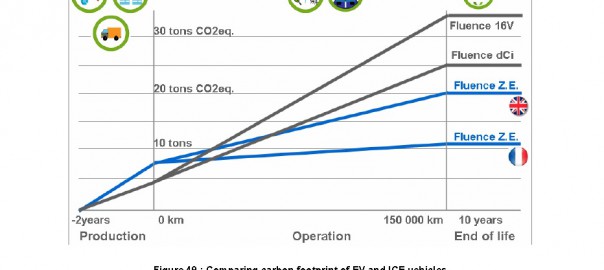
Fluence Emissions (Image: Renault)

Electric Car Life-Cycle Analysis

Renault Fluence ZE Vs Diesel, Gas Models

Fluence Emissions (Image: Renault)

The environmental impact of plug-in electric cars is a source for much debate these days. They use less energy on a wells-to-wheels carbon basis than the vast majority of new cars sold in North America, even if they’re recharged on coal-heavy electric grids.

But the manufacturing impact is greater–and the degree to which that is the case has been hotly debated for several years now. Proper life-cycle analyses of electric cars are hard to do, and expensive.

They require a great deal of careful investigation into the sources of the materials, the transportation of the raw materials and parts before they reach the assembly plant, and then the carbon impact of that assembly process.

Now, however, thanks to a tip from a reader, we’ve got a nice model of a comprehensive lifecycle analysis that compares the electric version of a car to its non-electric counterpart.

The car is the Renault Fluence ZE, the electric conversion of a French compact sedan not sold in North America. That analysis, titled “Fluence and Fluence ZE: Life Cycle Assessment” (PDF) is now three years old, but it remains an excellent model for looking at gasoline versus electric propulsion.

The Fluence ZE was developed specifically for the now-defunct Better Place project in Israel, which proposed to sell electric transportation by the kilometer, just as mobile-phone service is sold by the minute. That project collapsed into bankruptcy for a number of reasons, and the Fluence ZE is essentially a defunct model – although it lived on for a while longer in Korea as a Samsung vehicle.

But the analysis done by Renault concludes that the Fluence ZE has lower lifetime carbon emissions than either a diesel or a gasoline Fluence, not only on the French grid (which is substantially nuclear) but also the coal-heavy U.K. grid.

While the Fluence ZE is now gone, its legacy lives on in the form of an analysis – one that other automakers would do well to emulate.

Source: Green Car Reports

G20 nations had been spending almost $90bn a year on finding more oil, gas and coal

The moral issue of climate change

The politics of selfishness was embraced enthusiastically last week by Sen. Mitch McConnell. In dismissing President Obama’s deal with China to reduce carbon emissions, the incoming Senate majority leader said “carbon emission regulations are creating havoc in my state and other states around the country” by undermining economic interests.

For McConnell (Ky.) and other GOP critics, regulation of carbon emissions is a pocketbook issue where constituents’ short-term interests must prevail. They reject or minimize the arguments of leading scientists that such emissions are directly linked to global warming and climate change and could have catastrophic long-term consequences. The doubters question the data, to be sure. But their basic argument is political: Action to protect the environment will hurt “my state.”

But what if the climate change problem were instead treated as a moral issue — a matter like civil rights where the usual horse-trading logic of politics has been replaced by a debate about what’s right and wrong?

The case for treating climate change as an ethical problem is made subtly in “The Bone Clocks,” a new novel by David Mitchell. It portrays a dystopian future in which normal life has been shattered by environmental decay, rampant disease and global disorder. Mitchell’s book is long and complex, but it might just become the “1984” of the climate change movement. It dramatizes the consequences of our improvident modern economy in the way George Orwell’s novel awakened people to the “Big Brother” mentality of Soviet communism.

Mitchell imagines in the book’s concluding section an economic crash in 2039 that brings on an era he describes as the “Endarkenment.” Order breaks down as low-lying cities around the globe are flooded, communications networks collapse and transportation slows. The global economy declines as quickly as it rose during the past half-century. Chinese troops maintain control in a foreign outpost on the Irish coast, aided by a local government known simply as “Stability.” Ebola and “ratflu” ravage populations that are scavenging for food.

This is a novel, mind you, and it paints an extreme and unscientific picture. But in exaggerating the implications of current trends, it’s in the honorable tradition of similar works from Aldous Huxley’s “Brave New World” to Orwell’s masterpiece. Mitchell’s principal character, Holly Sykes, feels grief for what the world has become by 2043:

“It’s grief for the regions we deadlanded, the ice caps we melted, the Gulf Stream we redirected, the rivers we drained, the coasts we flooded, the lakes we choked with crap, the seas we killed, the species we drove to extinction . . . the comforting liars we voted into office — all so we didn’t have to change our cozy lifestyles. . . . My generation were diners stuffing ourselves senseless at the Restaurant of the Earth’s Riches knowing — while denying — that we’d be . . . leaving our grandchildren a tab that can never be repaid.”

Is this terrifying future really ahead of us? The honest answer is that nobody knows. Prominent scientists have become increasingly convinced that the connection between carbon emissions and rising temperatures is real, but skeptics have whole truckloads of studies to demonstrate the opposite. One simple way to make your way through the thicket is to ask yourself: What is the price of being wrong? If the doubters are wrong and the climate-change thesis is correct, the price is potentially catastrophic. The safe (and conservative) course is to assume the worst.

Take a stroll through the news archives of the past several months to get a sense of the possible consequences of what climate scientists say is a likely increase of at least 2 degrees Celsius through the end of this century. A Science magazine study last week forecast a 50 percent increase in lightning strikes in America. A U.N. report this month argued that recent progress against global hunger and poverty could be halted or reversed. An October Pentagon report warned of an immediate threat to national security due to increased risks from terrorism, infectious disease, poverty and food shortages.

Piers J. Sellers, a former astronaut and now the acting director of earth sciences at NASA’s Goddard Space Flight Center, wrote last week in the New York Times of what rapid temperature increase could mean by 2100:

“The impacts over such a short period would be huge. The longer we put off corrective action, the more disruptive the outcome is likely to be.”

Is this a moral issue? After reading Mitchell’s stark novel, and imagining the world of 2043, I am beginning to think the answer is yes. If the future quality of life around the world is at stake, people who resist action are not just misguided, they’re wrong.

Source: Washington Post

G20 nations had been spending almost $90bn a year on finding more oil, gas and coal

New report finds gas is uneconomic at home

[An Australian perspective]

A new study has found that it no longer makes economic sense for new houses or existing houses without a gas connection to bother with connecting to the gas pipeline network.

It also found that even houses already connected to gas should steadily withdraw from using gas for space heating in favour of using reverse-cycle air conditioners.

The study, entitled Are We Still Cooking with Gas? was prepared by the Alternative Technology Association supported by the energy market’s Consumer Advocacy Panel.

It looked at a range of different household situations to evaluate the economics of using gas relative to electricity for the purposes of space heating, water heating and cooking. This included taking into account household size, a range of location across the National Electricity Market including gas prices relative to electricity prices in these locations and climatic conditions, as well as whether the home was already connected to the gas network and whether replacement also involved completely avoiding fixed gas network connection charges.

The report busts pre-existing entrenched views that gas is a cheaper and more convenient option than electricity once you take into account the availability of highly efficient reverse-cycle air conditioners as well as affordable electric induction cooktops.

The report findings are ominous for owners of gas pipeline infrastructure serving the residential sector. It essentially finds that gas is finished in terms of expanding connections beyond existing customers, stating:

Installing new gas appliances and connections can no longer compete with installing efficient electric alternatives in any case.

The report also concluded that:

It is significantly more cost effective to replace gas heaters with multiple reverse cycle air conditioners (RCACs) for space heating, in any case.

The report found that in each of the 26 gas zone locations modelled, there were positive net present values  over 10 years for switching space heating from gas to RCAC, where the existing gas heater is within five years of end of asset life (based on home mortgage rates of interest on finance). It also found some of these geographic zones achieved less than five-year payback and particularly in warmer climates, switching space heating from gas to RCAC achieved positive economic returns regardless of the age and condition of the gas heater.

Given that space heating is probably the biggest driver of gas consumption in most homes connected to the gas pipeline network, the results suggest a death spiral is imminent for gas utilities. A very large proportion of the cost of gas supply to residential consumers is the fixed cost of the pipeline infrastructure. As homes switch over to air conditioners for heating, there will be a large loss of gas volume meaning significant prices hikes will be required to recover the fixed costs of the pipeline infrastructure. This is likely to only encourage further switching away from gas to electricity leading to a downward spiral for residential gas utilities’ revenue.

Thankfully for many of them they also own electricity businesses, so they should see some growth in electricity offsetting losses in gas. SP Ausnet, Jemena and Actew AGL for example all have electricity businesses. How this switch from gas to electricity will play out for their bottom line however is likely to be far more complicated than a simple one dollar of gain in electricity for every dollar lost from gas. Hopefully some enterprising equity stock analysts will soon have this worked out.

Source: BusinessSpectator.com.au

G20 nations had been spending almost $90bn a year on finding more oil, gas and coal

A 5 Minute History of Climate Politics

Today begins the UNFCCC’s COP20 which, since the failure of the Copenhagen Accord, will build on the Durban Platform which follows the Bali Roadmap and the Warsaw Outcomes to replace the Kyoto Protocol. Overwhelmed? Fair enough. Confused? Don’t be.

The world of international climate politics seems almost indulgently complex. Yet the negotiations that are about to take place in Peru are possibly the biggest thing ever to happen on climate change. So as a citizen of the world, we need you to know about it. In the next five minutes, let’s have a crash course on what it all means. It’s 20 years of complicated history coming up, so bear with me.

It all begins in 1992 when the world came together and realised there was a problem with the climate. The UN came up with its Framework Convention on Climate Change (UNFCCC) which remains the primary body through which climate negotiations take place. The UNFCCC receives advice of the Intergovernmental Panel on Climate Change (IPCC), a collection of the world’s top scientists who periodically compile the latest research on what’s happening with the climate (Disclaimer: the news is bad). The UNFCCC has the ultimate objective of stabilising greenhouse gas emissions at levels that prevent dangerous interference with the climate and that enable sustainable economic growth. This remains their basic aim to this day.

By 1995, it was pretty obvious that the emissions reductions originally proposed by the UNFCCC were not enough to halt climate change. So representatives from the world’s governments started negotiating a new agreement under the UNFCCC. When these representatives meet to talk about the UNFCCC, it is called the ‘Conference of the Parties’, abbreviated to COP. COP1 took place in 1995 in Berlin.

It took three years to sort out, but in 1997, COP3 announced the Kyoto Protocol. The Kyoto Protocol committed industrialised countries to cut emissions by 5% from 1990 levels by the year 2012. The USA and Australia refused to ratify it, most nations that did ratify ignored it, and besides, it was never enough to prevent climate change anyway. But it was a start.

In 2007, COP13 produced the “Bali Roadmap”. This paved the way for a new agreement for after 2012, when Kyoto was set to expire.

At the 2009 COP15 in Copenhagen, the world was hopeful about agreeing upon this new binding treaty. The time seemed ripe. However, at the Conference, infighting between the major powers (China, the US etc.) hindered the negotiations and so we ended up with non-binding ‘promises’ to cut emissions. The Copenhagen Accord decreed that we would hold warming to within 2 degrees Celsius. To do this, global emissions must peak in 2020, yet the individual pledges made under this accord, even if they were all realised, would miss this goal and see warming of 3 degrees Celsius by 2100. As a result, the accord was widely seen as a failure.

The big question since Copenhagen is how can we agree on a climate treaty for the post-2020 period? In Durban in 2011, the COP agreed on the “Durban Platform” which recognised that there was an increasing gap between what countries were promising in terms of action, and what was needed to avoid catastrophic climate change. In response, the Durban platform announced that a new agreement should be in place by 2015.

In 2012 in Doha, the COP extended the Kyoto Protocol until 2020. They also agreed on the “Doha Climate Gateway”, which emphasised the need for an agreement in 2015 to come into action by 2020.

At the last COP, in Warsaw in 2013, the UNFCCC agreed that the 2015 agreement must bind nations together to avoid the climate change ‘danger zone’ and stimulate faster action immediately. These are known as the Warsaw Outcomes.

This leads us to Lima. The savvier amongst you will have realised that it is not yet 2015. COP20 in Lima can be seen as the warm-up act to the main game in Paris next December. But you’ll also note that everything has been leading to this. The failure of Copenhagen in 2009 to produce a binding agreement has scared the climate world. We know we can’t rock up to Paris and hope for the best. That’s what happened in Copenhagen and everything fell apart. What we need out of Lima is agreement on a draft text to negotiate in Paris so that when COP21 starts, we have a reasonable chance of that text being adopted. If global emissions are to peak in 2020, action is needed now.

Source: The Verb

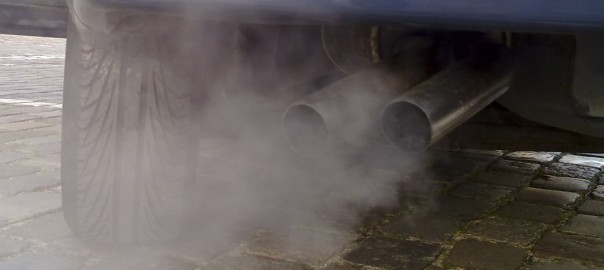
Car exhaust pollution (Image: Wikipedia)

Days Numbered For Dirtiest Diesels In Europe

For many European cities, diesel exhaust emissions have become a health as well as an environmental problem.

So in addition to promoting electric cars or alternative forms of transportation, lawmakers are beginning to crack down on the dirtiest diesels.

Next year, the French government will launch a car identification system that will rank vehicles by the amount of pollution they emit.

According to Reuters, this will allow local authorities to limit city access for the worst-polluting cars.

The move – announced in a speech by French Prime Minister Manuel Valls on Friday – is part of an effort to gradually phase out diesel fuel in the country.

In the 1960s, the French government and auto industry made the decision to move to diesel – which was viewed as less polluting than gasoline in the days before catalytic converters became standard.

Now, France is paying for that choice in the form of high levels of harmful particulate matter and other aftereffects of diesel-exhaust emissions from cars that don’t come close to meeting current diesel emission standards.

France has “long favored the diesel engine,” Valls said in his speech, but claimed that it was a “mistake” that must be undone with policy changes that could – in the long term – end diesel’s dominance.

Read more: Green Car Reports

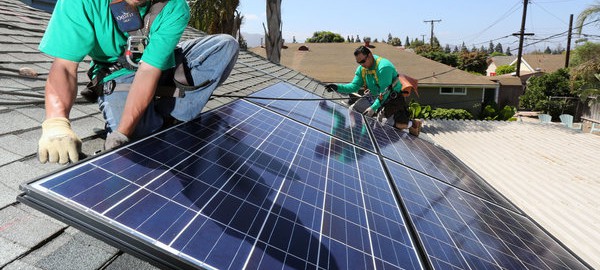
Workers for SolarCity installing solar panels (Image: JE Flores/NYTimes)

Why More Solar Panels Should Be Facing West, Not South

For years, homeowners who bought solar panels were advised to mount them on the roof facing south. That captures the most solar energy over the course of the day, which benefits the homeowner, but does so at hours that are not so helpful for the utility and the grid as a whole.

Mount them to catch the sunlight from the west in the afternoon, and the panels’ production over all would fall, but it would come at hours when the electricity was more valuable.

But that idea is slow to take hold. A new study of 110,000 California houses with rooftop solar systems confirmed that a vast majority of the panels were pointed south because most of the panel owners were paid by the number of kilowatt-hours the panels produced. Pointing them southward maximizes production over all, but peak production comes at midday, not in late afternoon, when it would be more helpful.

In late afternoon, homeowners are more likely to watch TV, turn on the lights or run the dishwasher. Electricity prices are higher at that period of peak demand.

“The predominance of south-facing panels may reflect a severe misalignment in energy supply and demand,”

said the authors of the study, Barry Fischer and Ben Harack. They work for Opower, a company that provides software that electric companies can use to manage their relationships with their customers.

Houses with solar systems consume less than half as much utility-delivered electricity as ordinary houses, the study found. But from about 4 p.m. through the night, they consume more, and they add to the system’s peak demand, which comes around 5 p.m.

Pointing panels to the west means that in the hour beginning at 5 p.m., they produce 55 percent of their peak output. So a 10-kilowatt system would make 5.5 kilowatts. But point them to the south to maximize total output, and when the electric grid needs it most, they are producing only 15 percent of peak, or 1.5 kilowatts.

Why wouldn’t everyone point the panels west? Some homeowners have their panels face south because that is the direction of the roof. While some solar panel owners are paid time-of-use rates and are compensated by the utility in proportion to prices on the wholesale electric grid, many panel owners cannot take advantage of the higher value of electricity at peak hours because they are paid a flat rate, the energy analysts said. So the payment system creates an incentive for the homeowner to do the wrong thing. The California Energy Commission recently announced a bonus of up to $500 for new installations that point west. A new solar installation is completed every 3.2 minutes, according to the authors of the analysis.

Solar panels do not have to be pointed in just one direction; a homeowner can buy a device called a tracker that will pivot them, over the course of the day, like a sunflower, so they always face the sun. A tracker can raise the output of a panel by 45 percent. But adding trackers can cost hundreds or thousands of dollars, and a cheaper way to get the same number of kilowatt-hours may be simply to buy a few extra panels.

Houses with solar panels are not necessarily efficient; during the hours when the sun is not shining, they use more electricity than houses without solar panels. It may be because the bigger users tend to install the panels in the first place. There may be another reason: People who own electric cars tend to also install solar panels, and their overall electricity consumption is higher. But from an environmental standpoint, it is still better to consume the energy as electricity rather than as gasoline.

Source: New York Times

Inconveniences of Gasoline 1: Gas Station (Image: Clean Technica)

The Inconveniences of Buying Gasoline

Thanksgiving weekend has historically been the biggest driving weekend of the year. What better time to discuss buying gasoline?

This article is intended to be a little bit of a light article, but with some food for thought included for consumption. It is not intended to be a full review of the pros and cons of buying an electric vehicle (EV) article. In short, some insights are being put forth here to contribute to the conversation about EVs. This article is a result of my own inner dialogue that has moved me in the direction of buying an EV. An EV will be my next car, but I’m still currently driving an anachronistic internal combustion engine (ICE).

Finding a Gas Station

How far out of our route do we have to drive to get to the gas station? For me, this varies from trip to trip. As an environmentalist, I do my best to get gas right on the road on which I’m already traveling, but that isn’t always possible. How many stop lights do we go through to get to a gas station while paying good money to burn gasoline, and polluting with CO2s, at those stoplights? How much gasoline do we pay for to get us to and from those gas stations? With EVs that charge at home and/or work, this issue is eliminated.

The Cost

The cost savings of using electricity instead of buying gasoline is commonly quoted as between $1,000 and $1,500 per year. This will vary based on one’s electricity rates, the cost of gasoline, and the number of kilometers (miles) someone drives per year.

Premium Gasoline

When we hear the price of gasoline on the news or radio, they are always quoting the price of regular gas as though that’s the only price of gasoline. Many cars such as all ICE Mercedes vehicles require premium petrol. The cost of premium gas varies, but is roughly 8% more costly currently and has cost as much as 20% more than regular in the past (in 1998). With EVs, this issue is eliminated.

Read more: Clean Technica

What does the UK public think about climate change? (Image: Crown Copyright)

Poll — Majority Of British Want Global Action On Climate Change

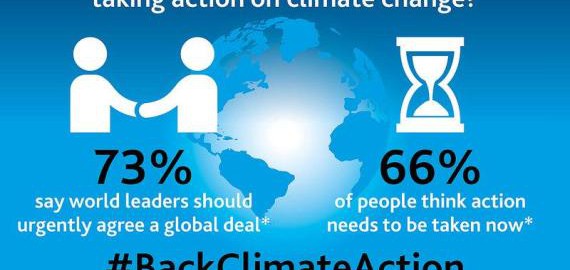
A new Populus survey conducted in the UK has found that 73% of people want world leaders to agree on a global deal to tackle climate change, while 66% want action now.

What does the UK public think about climate change? (Image: Crown Copyright)

The DECC’s Edward Davey and Amber Rudd said:

“The survey reveals an appetite for action on climate change by the UK public, with only 20% agreeing that it can wait a few years.”

Unsurprisingly, however, only 40% of respondents recognise the possible implications climate change will have on their own lifestyles.

The Populus poll, conducted in early November and covering 2000 people, sought answers on a number of climate change–related questions. The highlighted question asked respondents to agree or disagree with the statement, “World leaders must urgently agree a global deal to tackle climate change.” The net response of those agreeing came to 73%, combining 39% who agreed strongly and 35% who agreed slightly (which is better than a slight disagreement, I guess).

Ed Davey said:

“The science is clear. Climate change poses great risks to health, global food security and economic development – and unchecked will change every part of our lives. Without urgent action nowhere on earth will be left untouched.

“We are at a global turning point – never before have so many countries made clear their determination to act to tackle climate change. Those governments are backed by a groundswell of people who want to see action in their own countries and around the world.”

To tackle the issue in a different way, the DECC is taking to Twitter with other organisations such as the UN, Microsoft, and the Natural History Museum to answer a series of questions about the impact of climate change and what actions can be taken.

Amber Rudd said:

“In creating this global twitter relay we will help people to understand the possible impacts of climate change on day to day life as well demonstrate the level of government commitment for action.”

Source: Clean Technica