Category Archives: Energy and Climate Change

News and articles on climate change, vehicle pollution, and renewable energy.

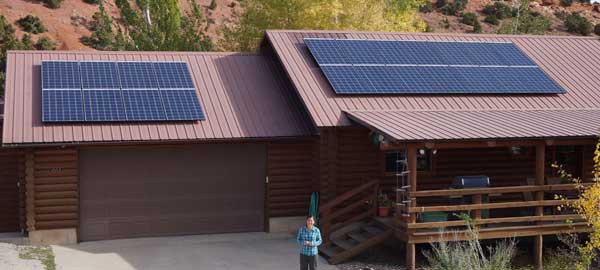
The Copelands’ home solar project (Photo: Creative Energies)

UK Cuts Red Tape for Commercial Rooftop Solar

LONDON — A change in the rules for permitted development rights in the UK has increased the development threshold for rooftop solar panels on commercial property by a factor of 20. Under the new rules, installations up to 1 MW no longer require full planning permission for development.

Previously, this threshold had previously been set a 50 kW and meant that — provided certain requirements are met — there will be no need to apply for planning permission for either solar thermal or solar photovoltaic installations up to this size. The decision to amend the planning rules was announced by Secretary of State for Communities and Local Government, Eric Pickles. It will clear the way from projects at the scale of a large warehouse or distribution centre.

In a related development, the UK’s Department of Energy and Climate Change (DECC) has also now confirmed that from 2019 it will be permissible for building-mounted solar panels to be moved to a different location without losing feed-in tariff (FIT) support. Under the former FIT scheme, an accredited installation would have been required to stay in the same position for 20 years — despite the fact that 65 percent of the UK’s commercial property assets are leasehold and commercial lease lengths are on average less than a decade long.

Responding, the Renewable Energy Association’s Chief Executive, Dr Nina Skorupska, said:

“Solar installed on commercial buildings has the potential to generate significant amounts of clean electricity, yet it is a considerably underdeveloped area, and the rigidity of the planning system has long been a major barrier to its progress.

“Increasing the threshold before a full planning application is required for a solar installation is a simple but effective step which will lift the shackles from the sector, and will help developers avoid uncertainty in terms of degression of feed-in tariff rates.”

The UK’s Solar Trade Association also welcomed the move, with STA Business Analyst David Pickup commenting:

“Getting planning permission is an extra hoop to jump through, and we are delighted that this is one more barrier to getting solar on roofs that has been removed.

“Extending the threshold from 50 kW to 1 MW is a boost for commercial solar. So many warehouses, factories and offices could save money on their energy bills by having solar PV on their roofs.”

But Pickup also warned:

“However, there isn’t enough room for this market to grow before the feed-in tariffs drops to zero, killing the market completely.”

Nonetheless, Giles Hanglin, responsible for the national coordination of solar rooftop delivery for Savills Energy, said:

“The government is certainly making the right moves to remove the former barriers in place which have hitherto dissuaded solar PV investment. In easing both the planning and building transference involved in the process, these amendments are set to make a huge difference in driving greater commercial use of this renewable energy.”

Source: Renewable Energy World

North West Bicester is a government-designated eco-town being built in the UK

UK’s “first eco-town” built green from the ground up

An eco-town described as the UK’s “most sustainable development” is moving closer to being occupied. The first residents are expected to move into North West Bicester later this year. Planning permission has also just been granted for up to 2,600 homes in the next stage of the project.

North West Bicester (pronounced “Bister”) is one of four designated eco-towns in the UK announced by the government in 2007. The aim is to create a town that is good for the environment, good for the economy and a nice place to live.

It is also one of a handful of One Planet communities around the world. The One Planet scheme was set up by sustainability charity BioRegional. It aims to find ways for people and societies to reduce their level of consumption to an extent that is sustainable based on the amount of resources that the planet can provide.

In addition to homes that are highly sustainable, North West Bicester will offer a mix of affordable housing. Homes will be built to a minimum standard of code level 4 for Sustainable Homes and Sustainable Homes and BREEAM excellence. Residents will be able to access a community hub via mobile devices that will allows them to check car club availability, monitor energy usage and prices, check public transport information and communicate with other residents. Homes will also be future-proofed with climate change adaptation in mind.

Primary schools will be located within 800 m (2,625 ft) of all homes in the town, and jobs will be created within a sustainable travel distance. Non-car use will be encouraged, as will the use of electric vehicles where required. Town residents will benefit from specially-designed cycle and pedestrian routes, a bus service within 400 m (1,312 ft) of every home, charging points for electric vehicles and an electric car club.

A minimum level of 40 percent public and private green space is to be maintained throughout North West Bicester. There will be a focus on local food production and an aim of attaining a net gain in local bio-diversity.

The first phase of the town being constructed is called Exemplar. Once completed, it will have 393 zero carbon homes and, according to project lead A2Dominion, will be the UK’s first true zero carbon community. Among the amenities in Exemplar will be a primary school, community center, eco-pub and an eco-business and retail center.

Each home in Exemplar has been designed to remain warm in winter, but not to overheat in the summer. A combined heat and power plant will provide heat and hot water to the houses, whilst solar arrays averaging 34 sq m (366 sq ft) will be fitted to every property. This is said to be the UK’s largest residential solar array in total, capable of powering 550 homes with excess power fed back into the national grid.

The recent planning approval for new homes is for an area adjoining the Exemplar site, which will be the next major phase of the project. Of the homes built here, 30 percent will be affordable, including extra care apartments for the elderly. A new primary school with playing fields, a nursery and a sports pitch with a pavilion will also be built.

The plan also features space for a network of allotments, a country park, play areas, a community farm and a woodland burial ground. The area will have its own center with a convenience store, cafe, restaurant and shops, a public square and community hall. Other amenities will include an energy center, a GP practice, business and office provision and a place of worship.

Residents are expected to begin moving into Exemplar later this year, with the phase due for completion in 2018. A2Dominion plans to develop North West Bicester over the next 25-30 years. When complete, the town will have up to 6,000 highly energy efficient new homes.

The video below provides an introduction to North West Bicester.

Source: Giz Mag

The Shale Debt Redux

Shale debt, falling prices and slack demand has tight oil producers in trouble. And yet, there is still burgeoning production. Why? Well, we’ve seen this before. It’s the shale debt redux.

Operators did it a few years ago in natural gas and prices have yet to recover. Unfortunately cheap money in the form of debt can mean poor investment choices for businesses and for investors. But it can also lead to an aberrant market because operators deep in debt won’t curtail production even though it is glutted. Debt coupons simply have to be met.

The shale revolution has always been funded by massive debt. Operators who were drilling for gas back in 2009-2011 used debt extensively. And just like now, they overproduced. By 2011, supply exceeded demand by four times. Then prices tanked. It is curious that so few asked the questions: why did they produce so heavily and glut the market; and why did they continue to produce into a glutted market? The answer is really quite simple. Many couldn’t afford to pull back production to help stabilize prices. Had they done so, they would not have been able to meet their debt payments. So they kept pumping…and pumping…and pumping.

And now they’ve done it again.

When interest rates are kept artificially low for extended periods of time, investors and businesses begin to take risks. They invest in stocks and high yield bonds, or they issue debt to get more money. In a normal functioning market such investments might not have been considered because reasonable returns would be available in more conservative areas. Some analysts argue that low interest rates encourage bubbles because investors begin chasing the most hyped sectors thinking they will get a better return. And nothing has been more hyped than shales. Low interest rates did indeed create the perfect environment for taking on heavy debt loads by companies and increasing the appetite on the part of investors for junk debt. Neither scenario, however, is ideal. Both can put you behind the eight ball very quickly.

Much of the debt issued by shale operators has been high yield or what is commonly referred to as junk. According to the Wall Street Journal:

“Junk bonds have financed the U.S. shale boom, and now the sharp drop in oil prices could lead to a massive wave of defaults on that high-yield debt.”

JP Morgan Chase estimates that as much as 40% of this junk debt may be defaulted on by shale companies in the next two years if prices stay below $65/bbl. Yeah, you read that right…40%! Prices are currently trading around $45/bbl and operators are still pumping huge amounts of crude into the market so a $20/bbl price rise would seem unlikely.

This picture is complicated enormously by the overwhelming need for cash by shale operators. Energy was the fastest growing sector of junk debt in 2014 and is the largest chunk of the high yield market. Energy junk debt rose from about 14% at YE 2013 to 19% by YE 2014. Prices began tanking, however, in 2014 driving up the yields on these bonds to nosebleed heights. Some big investors took a risk in early 2015 and started buying up this distressed paper. Unfortunately, the markets turned against them again and losses are mounting. According to Oil Price:

“The high-yield debt market is being overrun by the energy industry. High-yield energy debt has swelled from just $65.6 billion in 2007 up to $201 billion today. That is a result of shaky drillers turning to debt markets more and more to stay afloat, as well as once-stable companies getting downgraded into junk territory. Yields on junk energy debt have hit 7.44 percent over government bonds, more than double the rate from June 2014.”

The shale monster eats cash for breakfast, lunch and dinner. Desperate for cash, operators are now turning to equity issuance in addition to their mountains of shale debt to fund operations. Equity is the most expensive form of cash because it dilutes existing shareholders. Many, however, no longer have access to more debt having maxed out their ratios. So energy equity issuance has exploded in 2015 growing at the fastest clip in a decade. Approximately $8B in new equity was issued in the first quarter 2015 though prices continue to fall and shares are being hammered. Further, large investment banks have been left with rotting shale debt on their books that they can’t unload. A recent transaction saw these loans picked up at 65 cents on the dollar.

The shale debt redux is yet another indication that this business model has problems. The shale game cannot be kept going without continuous and breathtaking amounts of cash. Kepler Chevreux recently stated that US shale and Canadian oil sands account for about 18% of global production. They also account for approximately 50% of global CAPEX. So if shales and oil sands really are our energy panaceas, then hold on because prices are going through the roof for anything using crude or natural gas in the coming decades. Costs have simply gotten too high and there is no reason to think that they will abate.

So those non-OECD countries that are choosing to leapfrog hydrocarbons and spend their money on renewable infrastructure may certainly be on to something. With hydrocarbon costs skyrocketing, can the U.S. really afford to be dependent on oil and gas for decades to come? Because it sure would be nice to have energy without fuel costs.

Source: Energy Policy Forum

Goldilocks zone for oil prices is gone for good

Five years ago, I wrote an article for Reuters titled “Goldilocks and the Three Fuels.” In it, I discussed what I call the Goldilocks price zone for oil, natural gas  and coal, a zone in which prices are “just right” — high enough to reward producers but low enough to entice consumers. Ever since the start of the fossil- fuel era, such a zone has existed. Sometimes price boundaries were transgressed on the upside, sometimes on the downside, but it was always possible to revert to the zone.

But now, the Goldilocks zone for oil has ceased to exist. This will have staggering consequences throughout the economy for the foreseeable future.

During the past decade, the Goldilocks zone for oil steadily migrated higher. As conventional crude reservoirs depleted and production rates leveled off, drillers had to spend proportionally more to develop the capacity to pump the next marginal barrel. Oil prices soared from $30 a barrel in 2005 to nearly $150 a barrel in 2008, collapsed during the economic crisis, then clawed their way back to roughly $100 a barrel, a price that was maintained through mid-2014. But the economy did not do well during this period. Despite massive bailouts, stimulus spending and low interest rates, the recovery following the 2008 crash was anemic.

However, at $100 a barrel, the oil price was high enough to incentivize fracking. Small, risk-friendly companies leased land and used expensive drilling techniques to free oil from rocks that geologists had previously described as too impermeable to bother with. This entailed a tenuous business model that required not only high oil prices but easy money as well, as low interest rates enabled producers to pile on enormous amounts of debt.

Oil production in the United States rose sharply as a result, and this eventually had an impact on prices. Since mid-2014, the oil price has declined by half, settling around the historic, inflation-adjusted mean price of $50 a barrel. Consumers are much happier than they were with oil at $100 a barrel, but producers are wilting. The American petroleum industry has seen more than 75,000 layoffs, the balance sheets of fracking companies are bleeding and drilling rigs are being idled by the score.

For consumers, experience suggests the acceptable oil-price zone is $40 to $60 a barrel in today’s dollars; higher than that, goods and services, particularly transportation, become more expensive than current spending patterns can handle. For producers, the acceptable zone is more like $80 to $120 a barrel; lower than that, upstream investments make little sense, so production will inevitably stall and decline — eventually making consumers even less happy.

You will have noticed that there is no overlap. An oil price of $70 a barrel would not be high enough to give the industry a rebound of confidence sufficient to inspire another massive round of investment. Clearly, consumers would be happier with $70-a-barrel oil than they were with $100-a-barrel oil, but if $70 isn’t a high enough price to incentivize production growth, then it’s not really in the Goldilocks zone.

According to the narrative emanating from most mainstream energy economists, oil production rates will soon slow, prices will rebound and everyone will be happy. That narrative misses the all-important news that Goldilocks is dead. There is no longer a price that everyone can live with. And that’s a recipe for price volatility.

For oil traders, price volatility may offer opportunities for profit. But for everyone else, it is treacherous. Price volatility only hints at the real extent of our peril: We have built an economic system overwhelmingly reliant on a nonrenewable, depleting resource. This is not a sustainable situation. Unless our dependency on oil somehow magically disappears, we are in for a wild ride on an unmapped road.

Source: Reuters

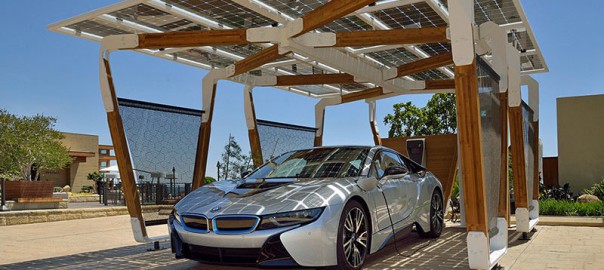
BMW i8 and Solar Car Port (Image: BMW)

Rethink the Grid: Personal Power Stations

Rethinking the grid is quickly emerging as one of the hottest topics. The concept of our own personal power stations can be seductive…and just might save us a whole lot of money too.

“Get big or get out!” Those were the famous, and controversial, words of Earl Butz, Secretary of Agriculture in the seventies. Considering the combination of renewable technology and battery storage, a new popular mantra may emerge: get small and be free.

Much ado about all things renewable together with the objections that technologies can never fully replace fossil fuel generation is popular among a certain set. Here in Texas, among arch conservatives, Solyndra lives on…and on…and on. But the truth is that Solyndra is ancient history. New technologies are ramping up and have been highly successful and may change the way we use the grid forever. Perhaps most interesting of all, however, is the way in which new ways to think about the grid and electricity are prompting entrepreneurs worldwide to rethink, remake and reuse. For instance, what if we all had the ability to transform our homes into micro personal power stations?

The grid is an interesting beast. It typically operates using several different power options together with some back up reserve. Oddly, it runs with virtually zero storage capacity because large amounts of electricity are difficult to store. So nobody really addressed that problem. Until now.

What if we decided to think outside our box and imagine that instead of myriad wires joining each of our houses, there were solar panels on the roof. These in turn pumped electricity into an array of batteries in our garages next to the work bench. Or into our EV which could also act as a storage vehicle. No pun intended.

Large scale storage is a problem because it is large scale. The needs of a utility are vastly different than the needs of an individual home. So tackling the problem of storage would seem to make the most sense if done on a small scale. GTM Research expects home battery storage to grow into a billion dollar a year money generator by 2018. That’s only three years away. Solar City, a large solar installer, is already offering battery storage for home use. They describe their system as:

“…a cost-effective, wall-mounted storage appliance that is small, powerful and covered by a long lasting full 10 year warranty.”

So our homes become a micro-grid. Having said all this, there will still be a need for large scale utility generation. Industrial users for instance would probably be better off using the grid system. This is where the larger scale storage solutions currently being tried and offered are coming into their own.

Electricity supply is never constant. It fluctuates throughout the day. To use renewable energy on a large scale, battery storage is needed. While lithium ion batteries have taken center stage, other less sexy technologies are being employed with success. If lithium ion batteries are the Tesla’s of the energy storage world, then flow batteries are the pick up trucks: hard working and reliable. Lead acid batteries too are gaining traction. All of these technologies perform different functions which are critical to grid reliability.

Navigant Research stated:

“Flow batteries have been shown to excel at long-duration energy storage applications and advanced lead-acid batteries have proven to be excellent performers in power-intensive applications.”

Further, these markets are expected to grow quickly. Navigant forecasts:

“…the annual revenue of cell sales for advanced batteries for utility-scale applications will grow from $221.8 million in 2014 to $17.8 billion in 2023.”

And equally interesting, Navigant projects:

“…the annual energy capacity of advanced batteries for utility-scale energy storage applications will grow from 412 megawatt-hours (MWh) in 2014 to more than 51,200 MWh in 2023, at a compound annual growth rate of 71 percent.”

Other aspects of storage are also being proactively addressed. One of the most common arguments heard is “what do we do with the spent automotive batteries”? Interestingly enough, BMW, and others, are working on that. Apparently an EV battery can have as much as 70% of its storage capacity still intact after its automotive life. So BMW has partnered up with Bosch and Vattenfall, a Swedish company, to repurpose used battery packs into grid storage. Home storage is also a possibility. So rethink, remake and reuse is really happening.

Another example of rethink is the recent announcement by Nissan that they have entered into a deal with Endesa, a Spanish utility behemoth. This arrangement would allow motorists to sell the unused power stored in their EV’s back to the grid. Such access to additional power could potentially provide extra stability for the utility and thereby the grid.

The grid doesn’t have to be run the way it has always been run. We can innovate. And innovation is precisely what is occurring. Perhaps the most important “rethink” of all is in our own heads as we learn to open our minds to using the grid in a whole new way.

Personal pizzas, personal computers, personal trainers…and now our own personal power stations.

Source: Energy Policy Forum

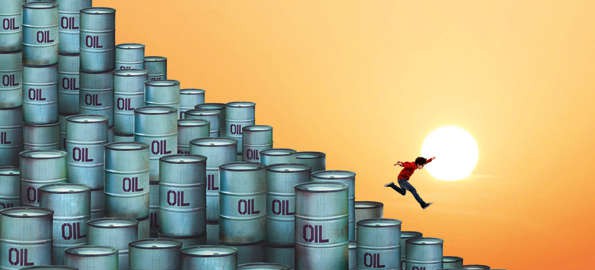
(Image: D. Bacon/Shutterstock/Economist)

Wall Street Losing Millions From Bad Energy Loans

Oil companies continue to get burned by low oil prices, but the pain is bleeding over into the financial industry. Major banks are suffering huge losses from both directly backing some struggling oil companies, but also from buying high-yield debt that is now going sour.

The Wall Street Journal reported that tens of millions of dollars have gone up in smoke on loans made to the energy industry by Citigroup, Goldman Sachs, and UBS. Loans issued to oil and gas companies have looked increasingly unappetizing, making it difficult for the banks to sell them on the market.

To make matters worse, much of the credit issued by the big banks have been tied to oil field services firms, rather than drillers themselves – companies that provide equipment, housing, well completions, trucks, and much more. These companies sprung up during the boom, but they are the first to feel the pain when drilling activity cuts back. With those firms running out of cash to pay back lenders, Wall Street is having a lot of trouble getting rid of its pile of bad loans.

Robert Cohen, a loan-portfolio manager at DoubleLine Capital, told the Wall Street Journal that he declined to purchase energy loans from Citibank.

“We’ve been pretty shy about dipping back into the energy names,” he said. “We’re taking a wait-and-see attitude.”

But some big investors jumped back into the high-yield debt markets in February as it appeared that oil prices stabilized and were even rebounding. However, since March 4 when oil prices began to fall again, an estimated $7 billion in high-yield debt from distressed energy companies was wiped out, according to Bloomberg.

The high-yield debt market is being overrun by the energy industry. High-yield energy debt has swelled from just $65.6 billion in 2007 up to $201 billion today. That is a result of shaky drillers turning to debt markets more and more to stay afloat, as well as once-stable companies getting downgraded into junk territory. Yields on junk energy debt have hit 7.44 percent over government bonds, more than double the rate from June 2014.

An estimated $1 trillion in loans were provided to the energy industry over the past decade, with most of that passed off to other investors. The practice is common, but starts to fall apart when the quality of loans starts to deteriorate. Banks like Citi have been sitting on bad loans, hoping for a rebound. But with oil prices dipping once again, big banks are starting to eat the losses. Some bad loans were sold off in mid-March at 65 cents on the dollar, the Wall Street Journal reported on March 18.

Souring debt comes at a time when oil and gas firms are also issuing new equity at the fastest pace in more than a decade. Drillers are desperate for cash, and issuing new stock, while not optimal because it dilutes the value of all outstanding shares, is preferable to taking on mountains of new debt. An estimated $8 billion in new equity was issued in the first quarter of 2015 in the energy sector, the highest quarterly total in more than ten years. But, falling oil prices have caused share prices to tank, reducing the value of new shares sold, and ultimately, the amount of cash that can be raised.

Big Finance’s struggle to unload some bad energy loans will ripple right back to the energy industry. If financial institutions cannot find buyers, they will be a lot less likely to issue new credit. That means that oil and gas companies in need of new cash injections may have trouble finding willing partners. Once access to cash is cut off, the worst-off drillers could be forced into a liquidity crisis.

Source: Oil Price

Car exhaust (Image: BBC)

‘Idling’ motorists in Westminster to face £20 fines

Motorists in Westminster who sit in a stationary car with the engine running and refuse to turn it off are to be fined £20.

The move reflects concerns from local residents and businesses about air quality, Westminster City Council said.

A team of traffic marshals will patrol the borough and ask car idlers to switch off their engines, it said.

The London Taxi Drivers’ Association (LTDA) said the move would not help abate London’s air pollution problem.

‘Ironic’ move

The penalties will come into force on 1 May, as a “last resort”.

The new policy follows Camden Council’s fines for buses which idle for too long, introduced in 2011, and Islington Council’s fines for idling vehicles introduced in August last year.

Westminster has the highest proportion of deaths attributable to air pollution, excluding the City of London, in the country, a report by the council said.

An air pollution monitoring station in Oxford Street, in the borough, recorded the acceptable limit set for air pollution – 200 micrograms per cubic metre – was broken 1,503 times in 2014.

A comparable station in Sutton did not break the limit at all last year.

Steve McNamara, general secretary of the LTDA said the fines were “absolute tosh” and a public relations and money raising exercise from the council.

He said:

“It is not going to do anything constructive to tackle the pollution crisis in London. When was the last time you saw someone idling in the city? It doesn’t happen.
Patrolling traffic marshals will ask drivers to turn off their engines

“One of the real problems is cars stuck in traffic – research has shown pollution is up by 30% in areas of heavy traffic. Do something to help get the traffic moving.”

Mr McNamara said another key factor was the number of diesel cars in the capital which emit greater levels of nitrogen oxides – which can cause health problems.

He said the move was “ironic” considering Chancellor George Osborne’s incentives to diesel vehicles which were exacerbating the problem.

Neil Greig, director of policy and research at the Institute of Advanced Motorists, said the “key issue” would be how the marshals enforced the fines.

He said:

“If they target private car drivers pulling up for a moment in relatively clean, modern cars in a draconian way – whilst ignoring old buses, coaches, large trucks, utility company vans or taxis idling for long periods – then it will quickly be seen as yet another revenue-raising exercise.”

Source: BBC

BMW Group: More Than 50% Of Electricity Use Worldwide From Renewables

BMW Group is now, for the first time in its history, receiving more than half of its electricity worldwide from renewable energy infrastructure, based on comments made by company representatives at the recent 2015 Annual Account Press Conference.

Bmw“More than half” in this case means 51%. 🙂 So, just above half. Still, considering where the company was only a few years ago, and compared to most other companies that is commendable. The company is reportedly aiming to receive around 100% of its electricity via renewable energy infrastructure over just the next few years, which could put it in competition with IKEA.

8-2411p_i8_wind_NewEnergyNews

That goal will be achieved via a step-by-step plan that will see the company first greatly improve energy efficiency at its various facilities around the world. After this step is completed, the company will then oversee a renewables generation buildout, and then, finally, a third step involves purchasing the remainder of its needed electricity from various energy companies.

The Head of Sustainability & Environmental Protection at the BMW Group, Ursula Mathar:

“We have a clear objective and a concrete plan for the transition to renewable energy. However, economic viability is essential for implementation. Only under the right framework conditions can we put our plans into action step by step in individual markets worldwide.”

A recent press release provides further details:

Some 51% of the electricity supplied to the BMW Group worldwide is already being drawn from renewable energy sources. In Leipzig, Germany, the BMW Group is using wind power. In mid-2013, four wind turbines started operation on the premises of the plant, with 100% of the power produced going into the production of the BMW i3 and BMW i8. At the Spartanburg plant in South Carolina, USA, a methane gas system provides around 50% of the energy required for production. At the Rosslyn plant in South Africa, the foundation stone for a combined heat and power unit fired by biogas was laid at the end of 2014. The gas used is sourced from the waste products created on cattle and chicken farms. Commissioning of this system will already enable the company to cover over 25% of the energy required by the production plant this year.

Good steps, for sure. It’ll be interesting to see how long it’ll take BMW Group to achieve its goal.

Source: Clean Technica

Coalition branded climate-change deniers over North Sea oil boost

[From 19 March 2015]

Plans to boost the North Sea oil industry, announced in the budget, could lead to the UK emitting tens of millions more tonnes of CO2 over the next five years, Guardian analysis reveals.

The chancellor, George Osborne, this week announced a package of measures in the budget designed to help boost North Sea oil production in the face of plummeting global oil prices. The moves include tax cuts on profits for oil producers, a new investment allowance, and funding for seismic surveys to help find oil deposits. In all, the measures will cost the exchequer £1.3bn over the next five years.

The budget document states that the aim is for the measures to lead, in the next five years, to at least 120m barrels “of oil equivalent, of additional production”.

The assumption prompted the Green party to question why the “greenest government ever” was providing additional support for burning fossil fuels.

“This Lib Dem, Conservative coalition government started claiming to be the ‘greenest government ever’, and ended giving huge subsidies to the oil industry,” said Andrew Cooper, the party’s spokesman on energy. “More investment is really needed in energy efficiency and renewable energy, precisely the areas this government has cut … this government are climate-change deniers in all but name.”

Figures published by the US Environmental Protection Agency suggest that on average each barrel of oil burned emits 0.43 tonnes of carbon dioxide, suggesting that if the UK budget measures succeed in producing an extra 120m barrels of oil in the next five years, these will add 50m tonnes of carbon dioxide to the UK’s emissions, if burned domestically.

Ed Davey, the energy secretary, last week pledged his support for the Guardian’s “keep it in the ground” campaign, which urges keeping most of the discovered fossil fuel deposits in the ground to avoid catastrophic climate change. However, Davey defended supporting North Sea oil extraction in the short-term as a solution to the UK’s dependence on Russia and the Middle East for energy resources.

“I have been clear that coal assets are very risky but you are not going to get rid of cars and gas heating systems overnight and so we are going to need quite a lot of oil and gas,” he said. “The question is, would you like that to come from Russia and Qatar or locally where it is well regulated, gives us jobs and provides tax revenues?”

The non-partisan Green Alliance noted it was possible for the UK to produce more oil without increasing global emissions, but said this relied on another country cutting back its own extractions in response to Britain’s increased activity.

Dustin Benton, the Green Alliance’s head of energy and resources, said:

“From a climate perspective, as long as UK oil production displaces production elsewhere, there’s no effect – other oil producers will just lose market share. But if new oil production increases the total amount of oil that gets burnt, then there’s an inconsistency with our climate aims.”

Benton also said there was a risk that subsidy and investment in North Sea oil could be a waste of money, due to the relatively high cost of extracting oil from those fields as opposed to elsewhere in the world. If oil prices stayed low, or if serious policies were enacted to tackle climate change, the investment and infrastructure could easily be wasted.

“From the perspective of financial prudence, the question is whether changing tax treatment to shift infrastructure investment towards high cost oilfields increases the risk that these will become stranded assets – even the Bank of England is concerned at this prospect,” he said.

A spokesperson for the Department of Energy and Climate Change said:

“The UK will continue to need oil and gas as a part of our energy mix even as we cut our carbon emissions over the coming decades. That includes working to maximise home-grown energy sources rather than relying on imports from volatile markets like Russia and the Middle East, which is why the government continues to work hard to support the future of the North Sea industry.”

Source: The Guardian

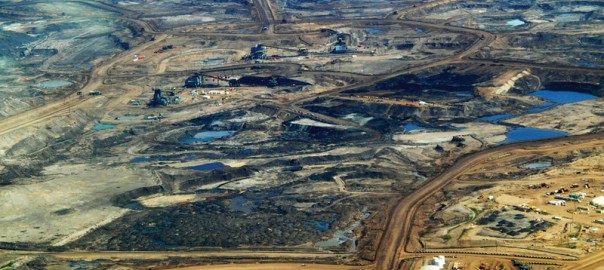
Tar Sands in Alberta (Image: Wikimedia/Howl Arts Collective)

Population controls ‘will not solve environment issues’

Restricting population growth will not solve global issues of sustainability in the short term, new research says.

A worldwide one-child policy would mean the number of people in 2100 remained around current levels, according to a study published in the Proceedings of the National Academy of Sciences.

Even a catastrophic event that killed billions of people would have little effect on the overall impact, it said.

There may be 12 billion humans on Earth by 2100, latest projections suggest.

Concerns about the impact of people on the planet’s resources have been growing, especially if the population continues to increase.

‘Can’t stop it’

The authors of this new study said roughly 14% of all the people who ever existed were alive today.

These growing numbers mean a greater impact on the environment than ever, with worries about the conversion of forests for agriculture, the rise of urbanisation, the pressure on species, pollution, and climate change.

The picture is complicated by the fact that while the overall figures have been growing, the world’s per-capita fertility has been declining for several decades.

The impact on the environment has increased substantially, however, because of rising affluence and consumption rates.

Many experts have argued the best way of tackling this impact is to facilitate a rapid transition to much lower fertility rates.

To work out the impact on population, the team constructed nine different scenarios for population change up to the year 2100, using data from the World Health Organization, and the US Census Bureau’s international database.

They also used “catastrophe scenarios” to simulate the impacts of climate disruption, wars or global pandemics on population trends.

According to the study, attempts to curb our population as a short-term fix will not work.

If China’s much criticised one-child policy was implemented worldwide, the Earth’s population in 2100 would still be between five and 10 billion, it says.

Read more: BBC