Category Archives: Energy and Climate Change

News and articles on climate change, vehicle pollution, and renewable energy.

Sonnenspeicher features an intelligent management system that automatically controls the charging and discharging current (Image: ASD)

Never pay an electricity bill again: Smart battery lets you use solar energy at NIGHT

  • Sonnenspeicher was designed by Wolfram Walter and German firm ASD
  • Its lithium iron phosphate battery stores energy from solar panels
  • Cheapest model is €8,450 (£6,170), but it will save money on electricity bills
  • It also comes with ‘intelligent management system’ that controls current 

In the past year solar power in the UK has more than doubled while in the US it has grown by 30 per cent.

But many current systems fail to solve the problem of how energy is managed and used overnight when the sun sets.

Traditionally, energy gathered during the day is sent back to the grid, but this can prove costly if you need to buy it back – unless you have a smart battery that stores the excess energy in your home.

With this in mind, German firm Automatic Storage Device (ASD) and designer Wolfram Walter have created the Sonnenspeicher.

It uses a lithium iron phosphate battery to store the energy harvested during the day by solar panels fitted to a roof.

Sonnenspeicher features an intelligent management system that automatically controls the charging and discharging current (Image: ASD)

This energy is used throughout the day, and any excess is stored for when the sun goes down.

Rather than selling this excess electricity to the grid, and potentially having to buy it back at a later date or time, homeowners can use this stored supply to power their home until the sun rises again.

Sonnenspeicher features an intelligent management system that automatically controls the charging and discharging current, to make it easier to manage how much energy is being used.

Read more: Daily Mail

(Image: D. Bacon/Shutterstock/Economist)

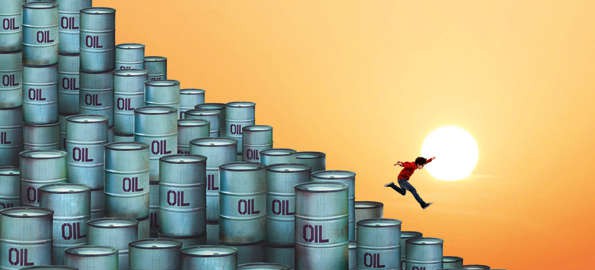
Cheap oil vs wind and solar: fight for future of energy

In a major new report, global investment bank Citigroup has defined the current battle between cheap oil, and renewables like wind and solar, to be so fundamental it will define the future of energy.

But it says that while the slump in oil and associated gas prices may provide some road-humps for wind and solar, renewables will win out because of basic economics, as well as energy security and environment issues. And, Citigroup says, because renewables are the cheapest way to substitute coal-fired power.

Oil is the single largest source of primary energy globally, and the seismic shifts in the oil market can send shockwaves through the world’s energy markets.

Citigroup says that two common statements have dominated recent dialogue: 1) that cheap oil will deal a serious blow to renewables, and 2) because oil and renewables rarely compete in the power sector, the impact will be minor.

It says neither is strictly true. Citigroup believes the fall in the oil price is terminal – it says the days of triple figure oil prices are over – meaning the end to some high-risk, high-polluting oil ventures in marginal regions such as the Arctic, tar sands and deepwater.

On the other hand, the long-term outlook for renewables remains bright. “Fundamental factors – increasing economic competitiveness, energy security, and environmental goals – all remain potent forces driving ever more rapid adoption of renewable energy globally.”

Wind and solar costs have fallen dramatically, and these cost declines should continue. On an unsubsidised basis, wind farms are getting built at costs below $40/MWh in some regions. Recent solar auctions in the Middle East have produced prices below $60/MWh.

“The straightforward answer to whether cheap oil threatens renewables is no – at first glance, oil poses few direct threats to renewables.”

Oil competes directly against renewables in only about 5 per cent of the market – those places where oil is used in generation – particularly the Middle East (Saudi Arabia uses oil for 55 per cent of its electricity needs, and the Middle east as a whole 36 per cent), and in the Caribbean (Jamaica 91 per cent).

But, as we noted in this report about low solar costs, and the assessment by the National Bank of Abu Dhabi, oil can no longer compete with solar and wind in electricity economics.

“Even with greatly reduced oil prices in the $50-60/bbl range, more mature renewables like wind and solar have little trouble competing with new oil-fired generation in the Middle East,” Citigroup writes.

Read more: RenewEconomy.au

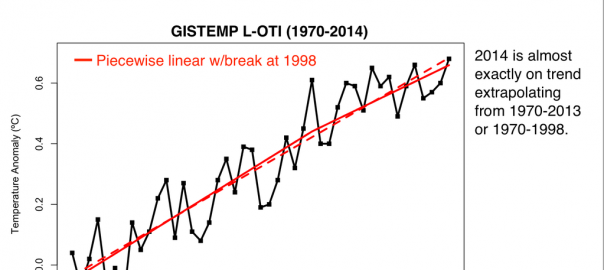
No significant change in temperature trend from 1998 (Image: NASA)

Long-Awaited ‘Jump’ In Global Warming Now Appears ‘Imminent’

We may be witnessing the start of the long-awaited jump in global temperatures.

There is “a vast and growing body of research,” as Climate Central explained in February. “Humanity is about to experience a historically unprecedented spike in temperatures.”

A March study, “Near-term acceleration in the rate of temperature change,” makes clear that an actual acceleration in the rate of global warming is imminent — with Arctic warming rising a stunning 1°F per decade by the 2020s.

Scientists note that some 90 percent of global heating goes into the oceans — and ocean warming has accelerated in recent years. Leading climatologist Kevin Trenberth of the National Center for Atmospheric Research explained here in 2013 that “a global temperature increase occurs in the latter stages of an El Niño event, as heat comes out of the ocean and warms the atmosphere.”

No significant change in temperature trend from 1998 (Image: NASA)

In March, NOAA announced the arrival of an El Niño, a multi-month weather pattern “characterized by unusually warm ocean temperatures in the Equatorial Pacific.”

How much of a temperature jump should we expect? Last month, Trenberth explained to Living on Earth:

Trenberth says it could mean a rise of two- or three-tenths-of-a-degree Celsius, or up to half a degree Fahrenheit. The change could occur “relatively abruptly,” but then stick around for five or 10 years.

I interviewed Trenberth this week, and he told me that he thinks “a jump is imminent.” When I asked whether he considers that “likely,” he answered, “I am going to say yes. Somewhat cautiously because this is sticking my neck out.”

Trenberth explained that it’s significant the Pacific Decadal Oscillation (PDO) “seems to have gone strongly positive” because that is “perhaps the best single indicator to me that a jump is imminent.” During a PDO, he explains, “the distribution of heat in the oceans changes along with some ocean currents.”

Read more: Climate Progress

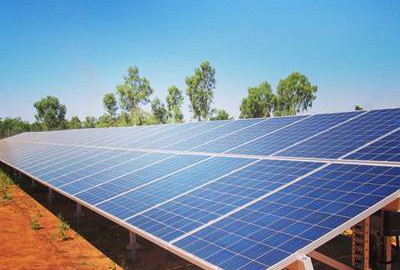
Solar Power (Image: ARENA)

Obama Pushes to Train Veterans for Solar Power

President Barack Obama on Friday unveiled an expansion of U.S. government efforts to train military veterans for jobs in the solar power industry during a visit to Utah.

The administration announced a new goal of training 75,000 people to enter the solar work force by 2020. That is an increase from a goal announced last year of training 50,000 workers by the same deadline.

Many of those workers would be veterans, administration officials said.

The Department of Defense plans to have “Solar Ready Vets” programs at 10 bases across the country to train military members who are returning to civilian life for solar jobs.

“It’s going to train transitioning military personnel for careers in this growing industry,”

Obama said of the program during remarks at Hill Air Force Base in Utah, standing near a set of solar panel installations.

Source: World Energy News

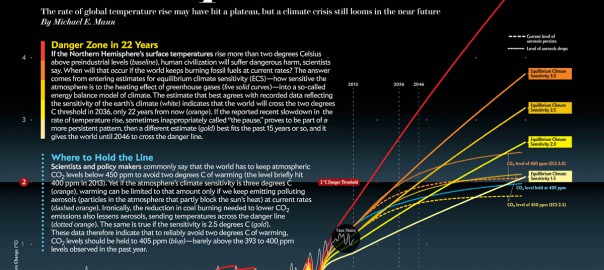
Earth Will Cross the Climate Danger Threshold by 2036

The rate of global temperature rise mayhave hit a plateau, but a climate crisis still looms in the near future

“Temperatures have been flat for 15 years—nobody can properly explain it,” the Wall Street Journal says. “Global warming ‘pause’ may last for 20 more years, and Arctic sea ice has already started to recover,” the Daily Mail says. Such reassuring claims about climate abound in the popular media, but they are misleading at best. Global warming continues unabated, and it remains an urgent problem.

earth-will_cross_climate-danger-threshold_ScientAm

The misunderstanding stems from data showing that during the past decade there was a slowing in the rate at which the earth’s average surface temperature had been increasing. The event is commonly referred to as “the pause,” but that is a misnomer: temperatures still rose, just not as fast as during the prior decade. The important question is, What does the short-term slowdown portend for how the world may warm in the future?

The Intergovernmental Panel on Climate Change (IPCC) is charged with answering such questions. In response to the data, the IPCC in its September 2013 report lowered one aspect of its prediction for future warming. Its forecasts, released every five to seven years, drive climate policy worldwide, so even the small change raised debate over how fast the planet is warming and how much time we have to stop it. The IPCC has not yet weighed in on the impacts of the warming or how to mitigate it, which it will do in reports that were due this March and April. Yet I have done some calculations that I think can answer those questions now: If the world keeps burning fossil fuels at the current rate, it will cross a threshold into environmental ruin by 2036. The “faux pause” could buy the planet a few extra years beyond that date to reduce greenhouse gas emissions and avoid the crossover—but only a few.

A Sensitive Debate

The dramatic nature of global warming captured world attention in 2001, when the IPCC published a graph that my co-authors and I devised, which became known as the “hockey stick.” The shaft of the stick, horizontal and sloping gently downward from left to right, indicated only modest changes in Northern Hemisphere temperature for almost 1,000 years—as far back as our data went. The upturned blade of the stick, at the right, indicated an abrupt and unprecedented rise since the mid-1800s. The graph became a lightning rod in the climate change debate, and I, as a result, reluctantly became a public figure. In its September 2013 report, the IPCC extended the stick back in time, concluding that the recent warming was likely unprecedented for at least 1,400 years.

Although the earth has experienced exceptional warming over the past century, to estimate how much more will occur we need to know how temperature will respond to the ongoing human-caused rise in atmospheric greenhouse gases, primarily carbon dioxide. Scientists call this responsiveness “equilibrium climate sensitivity” (ECS). ECS is a common measure of the heating effect of greenhouse gases. It represents the warming at the earth’s surface that is expected after the concentration of CO2 in the atmosphere doubles and the climate subsequently stabilizes (reaches equilibrium).

The preindustrial level of CO2 was about 280 parts per million (ppm), so double is roughly 560 ppm. Scientists expect this doubling to occur later this century if nations continue to burn fossil fuels as they do now—the “business as usual” scenario—instead of curtailing fossil-fuel use. The more sensitive the atmosphere is to a rise in CO2, the higher the ECS, and the faster the temperature will rise. ECS is shorthand for the amount of warming expected, given a particular fossil-fuel emissions scenario.

It is difficult to determine an exact value of ECS because warming is affected by feedback mechanisms, including clouds, ice and other factors. Different modeling groups come to different conclusions on what the precise effects of these feedbacks may be. Clouds could be the most significant. They can have both a cooling effect, by blocking out incoming sunlight, and a warming effect, by absorbing some of the heat energy that the earth sends out toward space. Which of these effects dominates depends on the type, distribution and altitude of the clouds—difficult for climate models to predict. Other feedback factors relate to how much water vapor there will be in a warmer atmosphere and how fast sea ice and continental ice sheets will melt.

Because the nature of these feedback factors is uncertain, the IPCC provides a range for ECS, rather than a single number. In the September report—the IPCC’s fifth major assessment—the panel settled on a range of 1.5 to 4.5 degrees Celsius (roughly three to eight degrees Fahrenheit). The IPCC had lowered the bottom end of the range, down from the two degrees C it had set in its Fourth Assessment Report, issued in 2007. The IPCC based the lowered bound on one narrow line of evidence: the slowing of surface warming during the past decade—yes, the faux pause.

Many climate scientists—myself included—think that a single decade is too brief to accurately measure global warming and that the IPCC was unduly influenced by this one, short-term number. Furthermore, other explanations for the speed bump do not contradict the preponderance of evidence that suggests that temperatures will continue to rise. For example, the accumulated effect of volcanic eruptions during the past decade, including the Icelandic volcano with the impossible name, Eyjafjallajökull, may have had a greater cooling effect on the earth’s surface than has been accounted for in most climate model simulations. There was also a slight but measurable decrease in the sun’s output that was not taken into account in the IPCC’s simulations.

Natural variability in the amount of heat the oceans absorb may have played a role. In the latter half of the decade, La Niña conditions persisted in the eastern and central tropical Pacific, keeping global surface temperatures about 0.1 degree C colder than average—a small effect compared with long-term global warming but a substantial one over a decade. Finally, one recent study suggests that incomplete sampling of Arctic temperatures led to underestimation of how much the globe actually warmed.

None of these plausible explanations would imply that climate is less sensitive to greenhouse gases. Other measurements also do not support the IPCC’s revised lower bound of 1.5 degrees C. When all the forms of evidence are combined, they point to a most likely value for ECS that is close to three degrees C. And as it turns out, the climate models the IPCC actually used in its Fifth Assessment Report imply an even higher value of 3.2 degrees C. The IPCC’s lower bound for ECS, in other words, probably does not have much significance for future world climate—and neither does the faux pause.

For argument’s sake, however, let us take the pause at face value. What would it mean if the actual ECS were half a degree lower than previously thought? Would it change the risks presented by business-as-usual fossil-fuel burning? How quickly would the earth cross the critical threshold?

Read more: Scientific American

Guardian Media Group to divest its £800m fund from fossil fuels

GMG becomes largest fund yet known to pull out of coal, oil and gas companies in a move chair Neil Berkett calls a ‘hard-nosed business decision’ justified on ethical and financial grounds

The Guardian Media Group (GMG) is to sell all the fossil fuel assets in its investment fund of over £800m, making it the largest yet known to pull out of coal, oil and gas companies.

The decision was justified on both financial and ethical grounds, said Neil Berkett, GMG chair:

“It is a hard-nosed business decision, but it is influenced by the values of our organisation. It is a holistic decision taking into account all of those things.”

Berkett said fossil fuel assets had performed relatively poorly in recent years and were threatened by future climate change action, while an ethical fund already held by GMG had been a “stellar” performer and renewable energy was growing strongly.

“This means we can adopt socially responsible investment criteria without putting at risk the core purpose of GMG’s investment funds: to generate long-term returns that guarantee the financial future and editorial independence of the Guardian in perpetuity,” he said.

A series of analyses have shown that current reserves of coal, oil and gas are several times greater than can be burned whilst limiting climate change to the internationally agreed limit of 2C. The fast-growing, UN-backed divestment campaign argues that the business models of fossil fuel companies, which continue to spend billions on searching for new reserves, are endangering the climate. The campaign also argues many fossil fuel assets could become worthless if the world’s governments act to curb global warming, a risk taken seriously by the World Bank and the Bank of England.

The Guardian’s Keep it in the Ground campaign is asking the world’s two biggest charitable funds – the Bill and Melinda Gates Foundation and the Wellcome Trust – to divest their endowments from all fossil fuels. Over 180 groups around the world have already taken this step, including Syracuse University, which on Tuesday committed to divesting its $1.18bn (£799m) endowment. Previously, the largest fund to divest from all fossil fuels was the Rockefeller Brothers Fund ($860m (£582m)), a fortune that originated from the company that became ExxonMobil. Others, including the world’s largest sovereign wealth fund, held by Norway, have divested from coal companies.

Berkett said the percentage of fossil fuel assets currently in the GMG investment fund was in the low, single digits. He said GMG, which owns the Guardian and Observer newspapers and website, has set a target of a “couple of years” to sell its direct fossil fuel investments, such as company shares and bonds, and five years to divest “co-mingled” funds which contained some fossil fuel assets. He said GMG would also be increasing its socially responsible investments.

Berkett led a two-month review with GMG’s investment advisers Cambridge Associates and said the critical step was deciding if GMG would be able to influence fund managers to provide the fossil-fuel-free investment options needed for GMG to divest. He said just a few dozen of the 17,400 institutional, high-quality managers were currently fossil free in their asset allocation.

“This [need to influence] is a major step in a strategy of managed divestment. It must be executed carefully to preserve our investment returns. But it remains the right thing to do,” Berkett said. “It is a policy we are proud to have initiated at a time when climate change has become an issue not just for investors, news organisations or UN negotiators – but for all of us.”

The Guardian’s editor-in-chief Alan Rusbridger said:

“I’m really delighted that GMG, having independently considered all the evidence, has decided to divest out of fossil fuels. What was a trickle is becoming a river and will, I suspect, become a flood. I’m glad that GMG is ahead of the trend – and believe this decision will be strongly influential on other companies and foundations.”

Bill McKibben, a US environmentalist who has led the divestment campaign said:

“The Guardian understands there’s an argument and a fight about climate change. The argument – as its reporters have chronicled – we have long since won; everyone knows by now the planet is in peril. But the fight with the fossil fuel industry has become a pitched battle, and now the Guardian lends its weight here as well. When the roll of honour for action on climate change is someday called, the Guardian’s name will be high on the list.”

Ellen Dorsey, executive director of the Wallace Global Fund and another key figure in the divestment movement, said:

“I think at pivotal moments in history we have seen editors and media outlets stand up and take unprecedented action. One could think of the abolition of slavery and the civil rights movement in the US and I liken the Guardian’s campaign to that kind of courageous action. I hope it will bring other institutions along to follow suit and join you.”

Source: The Guardian

Blades Being Installed on Turbine 5, Yelvertoft Wind Farm (Image: T. Larkum)

Overpopulation, overconsumption – in pictures

How do you raise awareness about population explosion? One group thought that the simplest way would be to show people

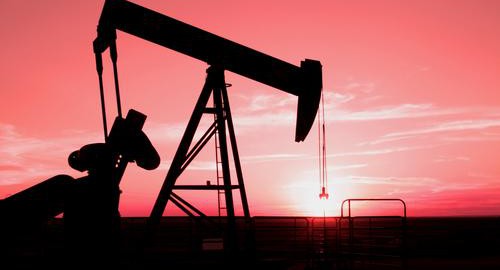
Oil wells

Blades Being Installed on Turbine 5, Yelvertoft Wind Farm (Image: T. Larkum)
Blades Being Installed on a Wind Turbine (Image: T. Larkum)

Depleting oil fields are yet another symptom of ecological overshoot as seen at the Kern River Oil Field in California

‘I don’t understand why when we destroy something created by man we call it vandalism, but when we destroy something created by nature we call it progress.’ Ed Begley, Jr.

Read more: The Guardian

Tesla/Solar City Energy Storage Solution System Is In The “Pilot Program” Stage Today

Elon Musk Announces Major New Product Line

Tesla CEO Elon Musk took to his favorite source to disseminate breaking news (Twitter of course) on Monday to announce a “major new Tesla product line” will be debuting on April 30th at 8pm PT from the company’s Hawthorne, California Design Studio.

Mr. Musk stressed that it was “not a car” in the tweet.

No other hints were dropped at what this new product line could be by the CEO, but we are still free to speculate.

The most obvious choice would be standalone battery packs/”home energy storage” packages that are designed to independently power your home (or office) if need be.

Tesla/Solar City Energy Storage Solution System Is In The “Pilot Program” Stage Today

Of interest, Solar City (sister company to Tesla) already has a pilot “home energy storage solution” project running in conjunction with Tesla batteries and their own solar technology to over 300 clients today, and has promised to have that project be available to the masses by “late summer” with an announcement coming “mid-2015″ with all the finer details.

We think it is a good bet that Elon Musk’s announcement of an announcement in April will be related to this project.

In theory, this system could also allow for much higher speed residential/charging to the Model S (or future Model 3) with the aid of an external/auxiliary battery.

Then again, maybe it is just a line of Tesla-themed leisure wear, or personal use, James Bond inspired electric submarines.

Source: Inside EVs

Electric cars on the SDG&E territory

San Diego Gas & Electric Integrates Electric Cars


San Diego Gas & Electric (SDG&E) announced a pilot project integrating electric cars and energy storage systems with California’s wholesale energy markets.

We don’t know the details, but there will be a group of energy storage systems and electric vehicle fleets at five separate locations, available for California Independent System Operator’s (CAISO). The first step for EVs is remote control of charging to avoid electricity peak demand.

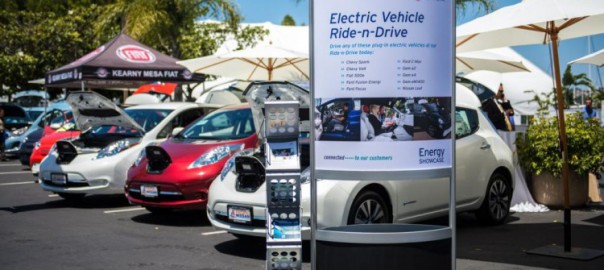
Electric cars on the SDG&E territory

There are over 13,000 plug-in electric cars in SDG&E’s service territory and, since the number of EVs is growing, charging power will be an important factor one day.

“The project currently aggregates stationary storage systems together with the charging demand of EV fleets at five separate locations throughout San Diego County. The assets are remotely controlled using software that both balances the participant’s charging needs, and identifies opportunities to provide demand response services at the grid level. Demand response is when customers don’t charge EVs or consume energy at peak hours, which alleviates stress on the grid and helps make sure adequate resources are available for the entire region. The project achieves this by correlating charging activity with wholesale energy prices. By agreeing to not charge in certain high price hours, the aggregated resource is paid the marginal energy price in those hours, similar to a conventional generator. The pilot project will end in late 2015.

Besides being among the first to integrate electric vehicles into California’s energy markets, the project is identifying both barriers and best practices for future, large scale integration and interaction of dispatchable distributed energy resources with wholesale markets, and creating tools to evaluate growth opportunities for those resources.”

Read more: Inside EVs

Powervault Energy Storage System (Image: Powervault.co.uk)

Visiting Ecobuild by Nissan Leaf

Picking up the Leaf in Wolverton early in the morning (Image: T. Larkum)

Having had a try out with a Nissan Leaf, I was ready for a longer journey in one, and the Ecobuild Event in March gave me the perfect opportunity. It was located at the Excel Centre in London’s docklands so was a good distance from home in Northampton, but not far as to make me nervous in a new car.

I booked the car from the e-Car Club as before. However, there wasn’t one free in Northampton this time so I had to get one from Wolverton, near Milton Keynes. That wasn’t a problem, though, as it was on the way to London. An advantage was that this Leaf had a satnav, which was noticeably missing from the Northampton one.

The journey was relatively straightforward, though it turned out that I was overconfident in my knowledge of the Leaf. It appeared to indicate that it had enough range to get me from MK to Excel without charging. However, I hadn’t appreciated that the satnav was set to choose the shortest distance route. Instead I had planned to stay on the motorway as much as possible, around the M25 and down the M11. Therefore as I passed ‘shortcuts’ off the motorway at each junction the satnav kept recalculating the remaining distance, and of course it kept increasing. One to remember for next time!

Anyway, to cut a long story short I had to pull off just short of my destination to get a top-up in Ilford. As has happened before, I suffered from not knowing the foibles of the local charging infrastructure. There didn’t seem to be charge points where they were supposed to be according the Zap-Map, and one that did exist had tapes over it saying “QA Passed Awaiting Commission”!

So near yet so far – an Ilford charge point installed but not yet commissioned (Image: T. Larkum)

I finally got a charge in a local council office car park, courtesy of the staff, though I had to share the charge point with an employee’s Toyota Prius. However I was disappointed to hear that it wasn’t supposed to be on the public map and that they would now apply to have it removed!

The irony was that having arrived at the Excel car park, and hunting out the area marked out for public charge points, there were dozens to choose from. Since the Ilford charge point had only been a slow one, and so I had only got a partial charge, I was very grateful to plug in here.

Borrowing a slow charge in a council car park (Image: T. Larkum)

Ecobuild is marketed as ‘The sustainable design, construction and energy event for new build, refurb, commercial and domestic buildings’. My interest in it was primarily about looking for potential domestic energy solutions for Fuel Included customers. Essentially these were solar panel systems, and domestic energy storage systems (ESS), both of which fit well with an electric car household.

I began my visit by meeting up with a colleague and having lunch. Then we toured the hall just seeing what caught our eye. There were dozens of stands offering solar panel systems – it is clearly now a commodity product. Of more interest was the handful of stands offering home battery storage – a market that is obviously in its infancy, but which has great potential for the future.

Powervault Energy Storage System (Image: Powervault.co.uk)

Most of the storage systems were unpriced, or had guide price that were very high – of the order of £5000-£10000 for a typical domestic system. However, we spoke at some length with Joe Warren, MD of Powervault, about their system and found it very interesting. It uses lead-acid batteries currently (to be economic) and so systems with capacities in the 2 to 4kWh range could be had for £1800 to £2200 respectively which is very encouraging. Later versions will have the option of Lithium Ion batteries.

After a loop of the hall we used our remaining time to attend a seminar entitled ‘Ask the expert: Energy storage masterclass’. This had five presentations, including ‘Energy Storage Systems’ by SMA Solar, ‘Optimising PV storage with electric vehicles’ by British Gas, and ‘Utilities perspective on storage’ by SSE.

Maslow Energy Storage System (Image: MoixaTechnology.com)

However, the standout presentation for me was ‘Distributed battery storage with Maslow’ by Simon Daniel, Founder and Chief executive of Moixa Technology. He talked about work done by Moixa on developing and trialling domestic storage systems, combined with a vision for using distributed storage at scale for network control and balancing. I think this strategy fits very well with Fuel Included’s philosophy of providing domestic electric vehicles, solar power and energy storage so perhaps our paths will cross again at some point in the future.

After the event was over for the day I returned to the Leaf and found it fully charged. Notwithstanding that, I planned to stop off on the way home for a quick charge. I did this uneventfully at South Mimms, after fighting through dreadful traffic to get away from Docklands. I then dropped the car in Wolverton before heading back home in my ZOE.

Grabbing a quick charge at South Mimms late in the evening (Image: T. Larkum)

It had been a very useful day, not just in terms of learning about future energy systems, but also in getting some real-world usage of a Leaf.