Category Archives: Energy and Climate Change

News and articles on climate change, vehicle pollution, and renewable energy.

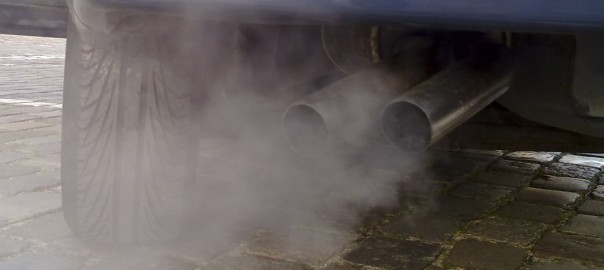
Car exhaust pollution (Image: Wikipedia)

Could Nottingham get a low-emission zone?

Nottingham could become a pioneer of fume-free electric transport thanks to recent innovations and grants.

A low-emission zone in Nottingham city centre is at the heart of proposals to encourage electric cars and improve the urban environment.

Under the plan, which would also mean the creation of a city-wide electric charger network, there could be fines for vehicles entering the city centre and failing to meet emission thresholds.

But there is no need for private drivers to panic.

A Nottingham City Council official confirmed to the Post that the targets would be buses, taxis, heavy goods vehicles and large goods vehicles.

“How we measure emissions is still up for consideration,” she said. “We will be looking at how other cities deal with it.”

The proposals will be part of Nottingham’s bid for a chunk of the £35 million the Government is making available through its Go Ultra Low initiative.

Nottingham is one of 12 cities selected to make a detailed bid and up to four winners will be named in the autumn.

Features of the city council plan include…

  • A low-emission zone in the city centre and a city-wide network of electric vehicle charging points.
  • A scheme to encourage local businesses to use low-emission vehicles, including grants.
  • Incentives for the public to rent electric cars in the City Car Cub fleet – an alternative to car ownership.

Councillor Jane Urquhart, portfolio holder for transport and planning at the council, said:

“After getting over this hurdle, the city council now has the chance to develop its electric vehicle vision further.

“At the heart of this is providing a comprehensive network of charging points for both residents and businesses to use.

“Making the city centre a low-emission zone would improve air quality and make the environment there much better.

“The introduction of electric City Cycles and Car Club vehicles will give people access to low-emission vehicles and we propose to develop a demonstration site so that residents and businesses can see that switching to low-carbon transport is easier than they might think.

“The city council will work with local energy suppliers to see how locally-generated electricity can be used to power our electric transport vision.”

The Go Ultra Low bid comes at a time when quiet, clean, electric-powered travel is getting a higher local profile.

Greater Nottingham’s second and third tram routes will open this summer, improving public transport in the western and southern suburbs.

At least one private hire firm is running all-electric cabs – DG Cars has added Nissan Leaf cabs to a fleet that also includes more than 90 hybrid vehicles.

“Nottingham is aspiring to be one of the greenest cities in the UK,” director Ian Pole said at the time of the purchase, “and this is the way we feel the transport industry should be going.”

Aside from trams and electric cars, Nottingham is making headlines with electric buses.

In the Linkbus service the city already has the largest electric bus fleet in Europe.

Now it is set to have the UK’s first all-electric park-and-ride service (see panel).

One of the inhibitors to the growth of electric car ownership has been the patchy provision of top-up charging points.

If Nottingham gets a share of the Go Ultra Low cash, part of it will be used to create charging units at both the Victoria and Broadmarsh centres, Eastcroft Depot, park-and-ride sites, city council and hospital car parks, Car Club bays and Nottingham and Bulwell stations.

The ideas is that a reliable network could incentivise business and private buyers to think electric when it is time to replace their vehicles.

There would be investment in electric bikes and in more electric vehicles in the Car Club project.

The city and county councils say they are committed to getting more ULEVs (ultra low-emission vehicles) in their fleets.

“Nottingham is in the process of setting up its own local energy company,” said a city council spokesman, “and as part of these arrangements we will work in partnership with local energy partners and suppliers to explore local energy generation and consider the potential impacts on grid capacity and any necessary mitigation to cope with local supply to support an electric transport system.”

He said the proposals, taken as a whole,

“would show a plan to encourage smarter travel options, making electric vehicles easier to use for domestic and business purposes”.

At the AA, Paul Watters said:

“The internal combustion engine is going to be here for a long time as a mainstream power source.

“The cost of purchase of electric vehicles will still be a factor for many people, even after the £5,000 grant.”

The Government is guaranteeing conditional £5,000 grants towards the private purchase of the first 50,000 plug-in cars.

Some 25,000 grants have already been made.

Source: Nottingham Post
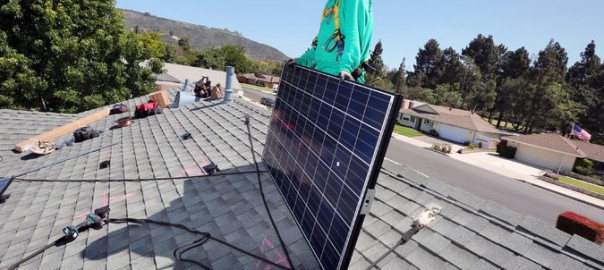
A solar panel being installed at a home in Camarillo, Calif. The state aims to get 50 percent of its energy from renewable sources by 2030. (Image: J.E. Flores/NYT)

Batteries and Renewable Energy Set to Grow Together

POMONA, Calif. — The future of American energy, according to one widely held view, will include solar panels and wind turbines continuing to proliferate, churning out ever more electricity and eventually eclipsing fossil fuels to help offset the forces of climate change.

With the cost of renewable technologies falling sharply, that vision is starting to take shape, especially in areas with abundant sunshine or steady wind. Here in California, the state is making such quick progress toward its goal of getting 33 percent of its electricity from renewable sources by 2020 that Gov. Jerry Brown raised the ante earlier this year, setting a target of 50 percent by 2030.

The shift sounds simple in theory — plug more solar and wind into the mix, and unplug more coal- or gas-burning power plants, sparing the world millions of tons of greenhouse gases.

But the reality is more complex. Because of the variable nature of these renewable sources — no electricity is generated when the sun goes down or the air is still — they add strains to the system of transmitting and distributing power.

A solar panel being installed at a home in Camarillo, Calif. The state aims to get 50 percent of its energy from renewable sources by 2030. (Image: J.E. Flores/NYT)

Batteries have long been seen as one of the main ways to work more renewables into the electrical grid, by storing electricity during times of excess generation and releasing it when needed. Now, spurred by mandates in California and other states to deploy storage, by the rise of rooftop solar systems, and by falling prices as Tesla Motors and other companies make plans to produce vast numbers of lithium-ion cells, batteries are set to play a significant part in the nation’s power supply.

“We can see the role of batteries playing out in different locations around the grid,” said Ravi Manghani, an analyst with GTM Media and author of a recent forecast for the energy storage industry over the next five years. “We expect that every year, we’re going to see on average 100 to 250 percent growth,” he added. “And most of that will be in batteries.”

Challenges remain, however. Despite plummeting prices, large battery systems generally are not yet economical for helping to integrate renewables on a broad scale. Instead, utilities and other companies are using them for different purposes.

“Let’s call it a stretch goal,” Imre Gyuk, who directs a Department of Energy program that has sponsored demonstration projects for energy storage, said of plans for vast deployment of batteries for integrating renewables. Costs still have to come down more, he said, and not just for the cells, but for the control equipment as well.

There are several ways that the electrical grid can cope with more renewables — by large consumers of electricity agreeing to have their power reduced at critical times, for example, a concept called demand response. And there are other ways to store electricity, such as pumping water, compressing air, spinning flywheels, or even making ice.

Battery systems, which feature racks of cells wired together, and are capable of storing large amounts of power and releasing it over an hour or longer, have some advantages over other storage methods. They can supply power nearly instantaneously and handle continual cycling between charging and discharging. And as the manufacturing of batteries and control systems scales up, it will be easier and cheaper to deploy “plug and play” systems, rather than designs that are unique to each situation.

A large battery storage project in Notrees, Tex., illustrates the current economics. Built in 2013 for about $44 million by Duke Energy Renewables (with the Department of Energy contributing half of the amount), the project consists of thousands of lead-acid battery cells near a large wind farm.

Greg Wolf, the president of Duke Energy Renewables, said the company found it hard to sell large electricity users so-called firmed wind, in which stored power from the battery is used to supplement the wind turbines to provide assured blocks of electricity at certain times.

“There was little interest from customers willing to pay for that,” Mr. Wolf said. “That has not evolved as much as some folks, including ourselves, thought.”

Instead, he said, the grid operator in Texas was interested in the Notrees battery as a fast-response source to regulate the frequency of the electrical current, which keeps the grid stable.

Maintaining a reliable grid is a high-wire act for operators, who struggle to keep a balance between the supply of electricity from generation sources and demand for it from customers. Batteries are especially valuable because they can respond quickly, adding more power to the system in a second or less.

Fossil-fuel plants that are often kept on standby for this purpose can take a few minutes or more to reach a level where they can provide the same service, Dr. Gyuk said. And all the while, fossil-fuel plants are emitting greenhouse gases.

Here at a Southern California Edison laboratory in the shadow of the San Gabriel Mountains, scientists and engineers are doing some of the fundamental work to help make widespread battery storage happen.

Accompanied by the steady thrum of electric current, batteries — lithium-ion cells like those used in electric cars and other types — sit in rows of sealed testing chambers. The batteries are undergoing continuous charge-discharge cycles in heat and cold, dripping humidity and desert dryness, to simulate the conditions they may face when deployed on the electrical grid.

“We’re trying to better understand their performance,” said Loic A. Gaillac, who manages the utility’s advanced energy storage group. “Ultimately, we want to get a sense of what degradation you see on the system and how long they last in the field.”

In 2013, California mandated that by 2020, Southern California Edison and the state’s two other large investor-owned utilities add a huge amount of storage — about 1.3 gigawatts, or more than 10 times the amount of storage deployed worldwide in 2011.

“We felt there were enough opportunities now where storage could be cost effective,” said Carla Peterman, a member of the California Public Utilities Commission, which oversees implementation of the mandate. “But we still recognized that this was a nascent industry.”

Mark E. Irwin, Southern California Edison’s director of technology energy storage, said that for now, the utility is most likely to use batteries to relieve its distribution system of peak loads that would otherwise require expensive improvement of wires and other equipment.

California has also set a priority to develop distributed generation, in particular moving away from large centralized solar farms and toward residential or neighborhood-scale solar power. Batteries will no doubt play a greater role in this, Mr. Irwin said.

“It will make it easier for people to put renewable systems out on the local grid,” he said.

“But in the meantime, storage has to find a way to first walk,” he added. Helping to defer upgrading costs, he said, is one way to get storage started.

“It’s the first business case,” Mr. Irwin said. “But it won’t be the last.”

Source: NY Times

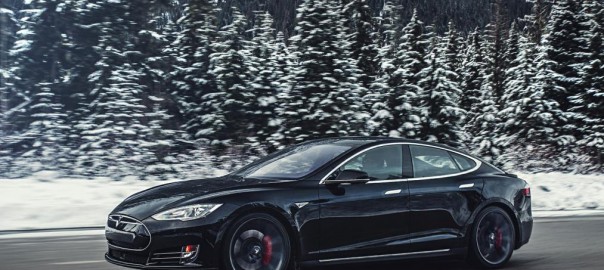
Tesla Model S P85D (Image: AutoExpress)

Norway to review electric car subsidies as sales soar

Norway is reviewing its subsidies for electric vehicles after generous government incentives made the country the biggest user of battery powered cars in the world, hurting state revenues, the finance ministry said.

Norway registered its 50,000th electric car on Monday, almost three years earlier than expected thanks to government schemes that have cut taxes and provided a plethora of benefits, including an exemption from tolls and parking fees, free recharging stations and the use of bus lanes.

A fifth of all new cars sold in Norway have been electric so far this year and tiny Norway, with just 5.1 million people, accounted for a third of all European battery powered car sales last year, official data showed.

“Our goal is to present a final agreement on the review of the future of automotive and fuel taxes,” the finance ministry said. “The outcome of the review will be announced in the revised budget (due in May).”

The current incentive scheme has been in place since 2012, but it came under criticism last year when sales of the Tesla Model S, a luxury sedan, soared and the budget lost 3 to 4 billion crowns ($380 to $510 million) in expected revenue.

Teslas, starting at about $70,000 and retailing for about$100,000 with extras, accounted for three percent of sales last year, prompting calls to end subsidies for wealthy buyers. Sales of the Nissan Leaf and Volkswagen e-Golf have also risen.

The Norwegian Electric Car Association argues that the benefits need to be maintained longer as only two percent of the cars on the road are electric, still a relatively small figure even if Norway leads the rest of the world by a wide margin.

Norway generates nearly 100 percent of its electricity from hydropower so the shift to battery powered cars results in a net reduction in greenhouse gas emissions — part of the country’s plans to reduce emissions by at least 40 percent by 2030 compared to the 1990 level.

Norway is also Western Europe’s biggest oil and gas producer with about 3.7 million barrels of oil equivalents per day and its offshore energy sector accounts for a fifth of the economy.

Source: Reuters

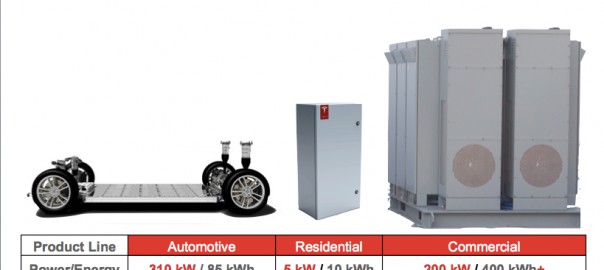
Tesla’s stationary energy storage (Image: Tesla)

IHS Predicts 9% Of Solar PV Installations Will Have Battery Energy Storage Systems By 2018

Good news for Tesla Motors and others in the battery energy storage market:

“IHS…announced that 9 percent of solar photovoltaic (PV) systems in North America will include attached storage in 2018. Led by commercial systems, IHS expects 700 megawatts (MW) of PV systems with energy storage will be installed by 2018, compared to just 30 MW in 2014.”

“The commercial PV energy storage market in the United States has gained huge momentum in recent months,” said Sam Wilkinson, research manager for solar and energy storage for IHS Technology.”

Tesla’s entry into this segment is mostly focused on residential, but rising usage in all segments will be a plus for the electric automaker and others who supply energy storage systems.

Tesla’s stationary energy storage (Image: Tesla)

Source: Inside EVs

Climate March poster on the Underground (Image: T. Larkum)

In historic move, BP’s shareholders adopt global warming resolution

BP’s shareholders overwhelmingly supported a resolution on Thursday that would force the company to disclose some of its climate change-related risks. The shareholder vote was extraordinarily lopsided, with about 98% of shareholders approving the resolution, which had the backing of BP’s chairman, Carl-Henric Svanberg.

The embrace of the climate change resolution is being called a watershed event in the history of climate-related shareholder resolutions, which investors large and small have been pursuing since 1999 to try to encourage oil, coal and gas companies to inform shareholders of their climate change-related risks and shift their investments into renewable sources of energy.

Previously, companies from Exxon to BP have spurned such resolutions.

Climate March poster on the Underground (Image: T. Larkum)
Climate March poster on the London Underground (Image: T. Larkum)

The risks that global warming poses to the business models of companies like BP are clearer now than ever before. Scientists are warning that in order to avoid the worst consequences of global warming, much of big oil’s fuel reserves, which these companies value so highly, would need to be left in the ground, rather than burned to create energy.

The BP vote and support of a similar resolution at Shell show that climate change has moved beyond the world of socially-responsible investing and into the mainstream, says Shanna Cleveland, a senior manager at Ceres, which advocates for more sustainable business practices and open disclosure of climate-related risks to investors, among other goals.

In an interview with Mashable, Cleveland called the BP vote:

“A sea change in the type of support and voting that we’ve ever seen in a climate-related resolution.”

“That is unprecedented… to have a fossil fuel company to actually come out and support a climate-related resolution has not happened before to have a fossil fuel company to actually come out and support a climate-related resolution has not happened before,” she said.

The resolution was filed by a coalition of shareowners in the U.S. and the UK, including the California Public Employees’ Retirement System (CalPERS). It asks BP to report on the risks and opportunities associated with climate change through routine annual disclosures, including ongoing emissions management at company facilities, preparation for the effects of global warming and low carbon research and development strategies and investments.

“What happened today I would classify it as historic, not only passing but getting that number of votes,” Cleveland said.

On Friday, a separate coalition of investors coordinated through Ceres is planning to ask the SEC to strengthen disclosure requirements from U.S.-based fossil fuel companies.

Read more: Mashable

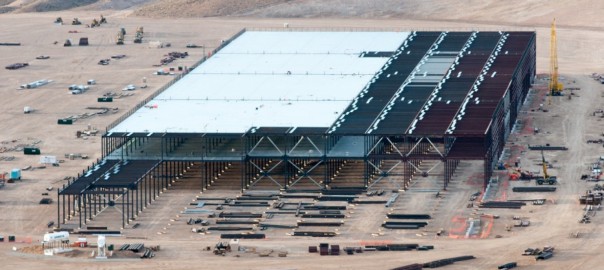
Construction on the Tesla Motors Gigafactory east of Reno, Nev., March 25, 2015 (Image: D Calvert/Washington Post)

Experts: Powering your home with batteries is going to get cheaper and cheaper

In the past few weeks, there’s been a battery of new studies on batteries. Not the kind in your cellphone, but a much more revolutionary make – the kind that is already powering many cars, and that might someday help power your home.

A recent study in Energy Policy, for instance, found that the cost of batteries for home systems (to store the energy collected by rooftop solar panels) is starting to decline – although even with these systems, it probably won’t be economically optimal for most people to ditch the grid entirely. Another report by the Rocky Mountain Institute similarly found that within 10 to 15 years in some places, the most economical choice for home energy could be a solar plus battery system, meaning that there could be a great deal of “load defection” from the traditional electricity grid.

Finally, a new study in Nature Climate Change documented that there has been a steep decline in the cost of lithium ion batteries for electric vehicles like Teslas – 14 percent per year plunge since 2007.

All of which is being hailed as pretty revolutionary. “Solar-plus-batteries is set to begin a dramatic transformation of human civilization,” wrote Bloomberg commentator Noah Smith recently, commenting not only on the declining price of batteries for electric vehicles, but also the potential for more batteries in homes.

Construction on the Tesla Motors Gigafactory east of Reno, Nev., March 25, 2015 (Image: D Calvert/Washington Post)

But there’s a need for caution. People with home battery systems paired with solar panels certainly exist, but are quite rare for the moment. One problem is that right now, there just aren’t many ways to make a home energy storage system investment pay off.

So why do some analysts nonetheless think that solar plus battery systems could become quite prevalent in homes, and maybe sooner than we think?

Read more: Washington Post

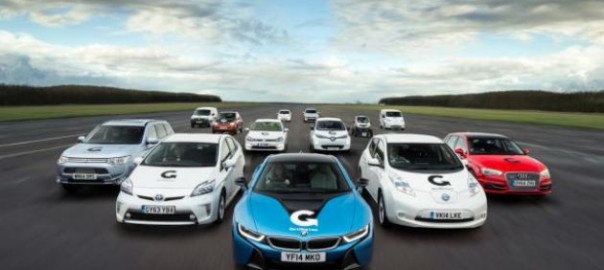
Go Ultra Low members boast 15 ULEVs across a range of segments (Image: OLEV)

Can Electric Vehicles Take The Private Transportation Crown?

Of late, there has been a lot of buzz related to electric vehicles. Volatility in oil, and thus fuel prices has the world in search of an alternative that can reduce the consumption of gasoline, motor oil and other fossil fuels. An electric vehicle (EV) is one such alternative that is muscling in on the market. So what can EVs offer to compete with conventional vehicles?

An electric vehicle is powered by one or more electric motors instead of a conventional internal combustion engine. Based on the source and method of electricity production, EVs are divided into: a. EVs requiring a continuous electric supply source such as trolley buses. b. EVs running on an electric battery or a flywheel, these are also referred to as Zero Emission vehicles (ZEV’s) and c. Hybrid EVs (HEVs) that uses a combination conventional engine and an electric motor) and Plug in EVs ( PHEVs).

If sales figures are an indicator, we see that the demand for EVs has risen at an incredible rate in the last few years. With around 320,000 new registrations in 2014, the total global count of EVs stood at around 740,000 vehicles with China, US and Japan having the highest EV growth rates of 120%, 69% and 45% respectively. Encouraged by growth rate of EVs, several automobile companies are investing in this technology.

Nissan is one such company that has invested heavily in developing and improving EV technology. The company has invested close to £1.4 billion (approximately $2 billion) in its facilities at Sunderland to manufacture EVs such as the highly successful all electric Nissan Leaf. The Chevrolet Volt, the Toyota Prius and Tesla’s vehicles are some other popular EVs available in the market today.

Read more: Oil Price

New Residential Energy Storage System for Solar and Smart Home Connectivity

JuiceBox Energy, Inc announces availability of a new 8.6kWh lithium-ion energy storage system for solar energy storage and smart home connectivity. With this product release, JuiceBox enters the rapidly growing residential energy storage market with a safe and reliable, web-connected product that can be installed on new and existing solar energy installations.

San Jose, CA (PRWEB) April 13, 2015Product Beauty (web) 4
Today, JuiceBox Energy, Inc. announces availability of their new 8.6kWh lithium-ion energy storage system for solar energy storage and smart home connectivity. With this product release, JuiceBox enters the rapidly growing residential energy storage market with a safe and reliable, web-connected product that can be installed on new and existing solar energy installations.

Distributed energy generation is at a crossroad in many locations as renewable energy net metering policies evolve, requiring customers to sell their excess solar energy to the grid at wholesale rates during the day and buy back energy in the evening at peak retail rates. The JuiceBox Energy system is designed to extend the solar day by supporting self-consumption when rates are highest, saving customers money on a daily basis. It provides value to both the customer and the utility by reducing peak power consumption and fluctuations on the grid. And when the grid goes down, the JuiceBox customer can operate indefinitely in an off-grid mode with the solar and battery system providing power to the home’s critical loads.

“The JuiceBox system is an innovative new home energy storage and energy management system,”

said Mark Byington, President, Cobalt Power Systems in Mountain View, CA.

“Cobalt Power has multiple JuiceBox installations in progress, and we are excited to be at the forefront of delivering intelligent grid-tied energy storage to our solar customers.”

The JuiceBox Energy system is maintenance-free with a minimum 10-year life. The battery, system controller and web-interface are housed in a custom designed indoor/outdoor NEMA 3R enclosure. The system is highly integrated with a bi-directional inverter/charger to enable quick and simple installation while ensuring redundant safety controls and an extended operating life.

The product is designed for rapid wall-mounted installation and communicates to web-based applications via a robust cellular connection for cloud-based monitor, control and remote firmware update. The high-reliability connection enables JuiceBox to help customers keep up with evolving smart grid standards as well as tariff rate structures managed by utilities. And as an increasing number of JuiceBox systems come on line, customers can visually see their system connected within the JuiceBox Energy Network and also elect to participate in future aggregated demand response markets.

JuiceBox is providing regular sales and installation training, and systems are available for order to certified installers upon completion of the training.

“Our Silicon Valley engineering team comprised of automotive electric vehicle and power semiconductor industry veterans is on a mission to deliver the highest quality, long lasting energy storage systems available.” said Neil Maguire, CEO at JuiceBox Energy. “The JuiceBox 8.6 kWh system is a safe, reliable clean technology that puts the customer in charge of their renewable energy. We look forward to supporting solar installers and their customers nationwide with our new residential energy storage system.”

Economic Collapse Will Limit Climate Change, Predicts Climate Scientist

If you think your doctor is hard to understand, try talking to a climate scientist.

In late 2014, the World Bank published a remarkable document that should have shaken the international business world. Titled “Turn Down the Heat: Confronting the New Climate Normal”, it drew on 1,300 publications to explore the impacts of a world four degrees centigrade warmer – the world our grandchildren seem likely to inherit before the end of this century.

Authored by climate scientists of the Potsdam Institute for Climate Impact Research, the report’s three hundred plus pages are densely written and often hard for non-experts to understand. However, some passages about the impact of a 4°C temperature rise are crystal clear. Here a section on North Africa:

“There is a considerable likelihood of warming reaching 4°C above pre-industrial levels within this century… Crop yields are expected to decline by 30 percent with 1.5-2°C warming and up to 60 percent with 3-4°C warming… Large fractions of currently marginal rain-fed cropland are expected to be abandoned or transformed into grazing land; current grazing land, meanwhile, may become unsuitable for any agricultural activity…”

One sentence really caught my attention: “In a 4°C world, mean summer temperatures are expected to be up to 8°C warmer in parts of Algeria, Saudi Arabia and Iraq…” If summer mean temperatures are set to rise by more eight degrees in this already scorching region, I wondered, what about maximum temperatures? According to the study:

“In a 4°C world, 80 percent of summer months are projected to be hotter than 5-sigma (unprecedented heat extremes) by 2100, and about 65 percent are projected to be hotter than 5-sigma during the 2071-2099 period.” [emphasis in the original]

As I’ve got no idea what that actually means, I jumped at the chance to talk with climate scientist Christopher Reyer, one of the co-authors of the study, on the edge of a public event organized by the World Bank in Morocco last week.

So, I asked, what kind of maximum summer temperatures do people in Morocco’s fabled desert city of Marrakech face in a +4°C world? “That’s very hard to answer,” he told me, “but the distribution curve will shift towards the extreme ends.”

Well, yes, but considering that the average summer maximum there is already 38 degrees, and the local record maximum to date is a sizzling 47 degrees Centigrade [116 degrees Fahrenheit], what kind of heat are we looking at? Reyer told me that he’d looked over that question with his team back in Germany – I’d emailed it to him beforehand – and basically couldn’t answer it without some complicated calculations taking into account the exact shape of the city’s current temperature curve.

Exasperated, I dug further. What does ‘5-sigma’ mean? “It’s quite clear that temperatures will be warmer,” Reyer said. By way of comparison, he explained, the 2003 heat wave in Europe [in which an estimated 70,000 people died during a 2.3°C hotter-than-usual summer], was only a 3-sigma event.

So, would it be possible to survive a 5-sigma event outdoors in Marrakech? “That depends how you define ‘survive’,” answered the climate wonk, adding that it would probably be survivable if you kept to the shade and didn’t move. However, any kind of human activity would be impossible in that kind of temperature.

To wrap up the interview, I asked Christopher Reyer how much hotter he thought the planet would be by the year 2100. “I’m not sure,” he replied, “I’m not an expert on the policy side.” I persisted, asking him not for an official projection, just for his best personal guess, a single number. He visibly relaxed.

“I guess it should be between three and four degrees hotter. We used to think that we were headed for +8°C, but that will never happen. We are not even on track for +6°C because economies will be collapsing long before we get there. We know that after +2°C, dangerous things start happening, and we start passing crucial tipping points, like the West Antarctica ice sheet collapse, which has reportedly already begun.”

What will a two degrees warmer world, which we seem likely to inhabit by 2050, look like?

“Two degrees is not a picnic either. Imagine events like the 2003 European heat wave, the 2010 Russian heat wave which had repercussions on the global wheat market, and Hurricane Katrina, all of them happening simultaneously everywhere in the world.”

Oh, so that’s what the climate scientist was trying to say all along: We face an avalanche of global disasters during our lifetime, and unless we slam the brakes on carbon pollution fast, the global economy will collapse to boot.

Source: Huffington Post

'Diesel fuel only' caution on Audi Q7 TDI (Image: GCR)

Are ‘Clean Diesels’ Actually Not Nearly As Clean As Claimed?

The only region where diesel passenger cars sell in equal numbers to gasoline-powered vehicles is Europe.

And until the advent this year of tougher Euro 6 emission standards, new European diesel cars were significantly dirtier than those sold since 2008 in North America.

But one European transport analysis group suggests that the newest European “clean diesels” actually emit far higher levels of nitrous oxides (NOx) than the legally permitted limits.

A report issued last October by the International Council on Clean Transportation (ICCT) showed that real-world emissions were far higher than the new Euro 6 emission standards and the U.S. Tier 2, Bin 5 limits would allow.

As the ICCT wrote in a summary, “On average, real-world NOx emissions from the tested vehicles were about seven times higher than the limits set by the Euro 6 standard.”

It said the excess emissions “could not be attributed to ‘extreme’ or ‘untypical’ driving.”

“Instead,” it concluded, “they were due to transient increases in engine load typical of everyday driving (e.g., going up a slight incline), or to normal regeneration events in the normal diesel exhaust aftertreatment systems.”

Read more: Green Car Reports