Category Archives: Energy and Climate Change

News and articles on climate change, vehicle pollution, and renewable energy.

US Crude Oil Consumption Peaked a Decade Ago

A world without crude oil is almost unthinkable. And yet, there are indications that such a transition is happening.

OPEC is jockeying for market share. Russia is increasing production and US tight oil producers as well as their Canadian oil sands counterparts have found themselves priced out of the market.

So what is going on?

As humans, we tend to like to place things in neat little boxes. So we look at coal and natural gas and think electricity generation. We look at crude oil and think transportation sector. And all this is correct. But trends are emerging that are likely to turn this on its head. For instance, on shore wind and solar are gaining traction as viable energy production means. Costs are falling rapidly and Lazard now estimates that onshore wind is the cheapest provider of electricity on a levelized cost basis. Solar is not far behind due to a rapid and precipitous drop in costs and is expected to compete with onshore wind as soon as 2018. This means that coal and natural gas will then be the higher cost producers and almost certainly lose market share for electricity generation. Investment going into new capacity additions is already hinting at this trajectory in that investment in renewable capacity has outpaced hydrocarbons each year since 2011. This is occurring globally. Michael Liebreich, founder of BNEF, recently stated:

“The electricity system is shifting to clean. Despite the change in oil and gas prices there is going to be a substantial buildout of renewable energy that is likely to be an order of magnitude larger than the buildout of coal and gas.”

And 2015 started strong right out of the gate. According to FERC, total new generating capacity additions in January and February amounted to 89% renewables, 11% natural gas. March was even stronger with about 94% of new capacity coming from renewables.

Now you may be wondering what this has to do with crude oil. In a word, everything.

It used to be that nothing could compare to crude oil for transportation use. And yet that is changing now. Electric vehicles (EVs) are already cheaper to run than internal combustion engine (ICE) automobiles. The U.S. Department of Energy, using data from the Idaho National Laboratory, estimates that the cost to run an ICE car is just under 16 cents/mile whereas the cost to run an EV is about 3 cents/mile. And EVs are not anywhere near scale so we can reasonably assume that these costs could fall further.

Now suppose that wind and solar continue to gain market share and costs continue to plunge. Those cost savings will be translated into cheaper electricity costs which in turn makes running an EV that much cheaper. And yet EVs are already about five times cheaper than a traditional car. You begin to get the picture. Simple economics tell us that it is in our best interest to buy an EV rather than an ICE automobile. Hence we do not need crude oil to the extent that we have in the past. And crude oil is overwhelmingly used only for transportation.

Automakers like BMW have grasped this reality and have announced that they will no longer make a stand alone ICE automobile by 2022, a mere seven years away. All of their vehicles will be either pure EVs or hybrids.

Interestingly, crude oil consumption in the US has stalled over the past decade. This is attributed to a large degree to greater fuel efficiencies in vehicles worldwide. Demand has essentially flatlined beginning about 2004-2005. At the same time this was happening, shale production began in earnest in the US. As production ramped up in tight oil, supplies flooded into the international market. But this was a market that was already struggling due to lesser demand. With burgeoning supplies, a tipping point was reached last summer and prices began their current plunge.

Perhaps what is most interesting, however, is that the roles played by major actors in this story have changed dramatically in the past six months. OPEC decided to protect market share and not stabilize prices as they had typically done in the past. Indeed for many decades. So why would they choose to change their policy?

The answer is actually quite simple.

If the world is indeed moving away from hydrocarbons then it makes sense if you have abundant hydrocarbon sources, you would want your source to be last to be used.

Tight oil is expensive to produce. So are deep water and oil sands. These are the marginal producers and can fairly easily be removed from the picture with low pricing. We are seeing this happening right now. Interestingly, however, other producers like Russia, which desperately need cash, have stepped up production. According to the Wall Street Journal quoting the IEA:

“…other non-OPEC producers continue to ramp up production. Russia’s output jumped an unexpected 185,000 barrels a day year-on-year in April and Brazilian production was up 17% in the first quarter…Meanwhile, production in China, Vietnam and Malaysia has also shown persistently strong growth. The IEA expects Chinese oil production to increase by 100,000 barrels a day this year to 4.3 million barrels a day.”

This may prove an interesting phenomenon in that producers worldwide are now locked into a battle for market share in a market that may be dying. Only time will tell. But simple economics like cheaper electricity costs speak loudly to consumers. Combine that with cheaper driving costs too and the combination is that much more powerful. And symbiotic.

The days of crude oil’s strangle hold on the transportation market may be coming to an end as incredible as that may seem. Producers appear to be acting like a snake swallowing its tail. They are dumping more and more crude into a market with less and less demand.

Source: Resilience.org
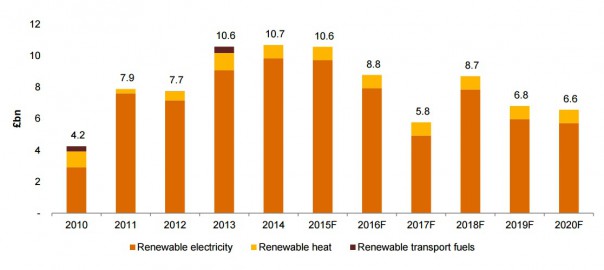
Historical and forecast investment in renewables 2010-20 (Image: PwC)

UK Renewable Energy Investment And Generation Surges In 2014

A new report shows that renewable energy investment in the United Kingdom hit a record high in 2014, with electricity generated from renewables increasing by 20% as well.

In fact, in 2014, not only did renewable energy investment hit a record of £10.7 billion, but renewable jobs increased by 9% as well.

Nevertheless, the authors of the report — PricewaterhouseCoopers (PwC) and Innovas, and commissioned by the UK’s Renewable Energy Association (REA) — are sure to warn that complacency will severely hurt the country’s renewable energy industry, especially in light of future decisions about Feed in Tariffs (FiT), the Renewable Heat Incentive (RHI), and transport.

The specifics of the report include a total electricity generation of 64,404GWh in 2014, up 20% from 53,667GWh in 2013. This news comes only a few weeks after the Renewable Energy Association announced that the UK’s renewable energy industry saw a 9% increase in jobs, with regions such as the East Midlands, North West, London and Scotland showing stronger than average employment growth. These are promising figures for the UK renewable energy industry, with the UK’s 2020 obligations quickly coming up.

“We are delighted that renewable energy sources are becoming an ever greater contributor to the UK’s energy mix,” said Dr Nina Skorupska, Chief Executive of the Renewable Energy Association. “Today’s figures show excellent progress in a number of sectors, both in terms of generation and installed capacity.”

However, according to the REA, the growth rate required to meet these 2020 obligations — 15% of the UK’s energy (including electricity, transport, and heat) from renewable sources by 2020 — currently sits at 16%, one of the highest rates in the European Union.

Subsequently, newly re-elected Prime Minister David Cameron has some serious decisions to make regarding the FiT review and whether or not to extend the RHI, which has only been allocated funding through to April 2016. And according to the REA, “renewable transport remains stagnant” ahead of the UK government needing to make a decision on the Renewable Transport Fuel Obligation.

“But we cannot be complacent,” Dr Skorupska continued. “Our analysis shows that where regulatory and financial support for renewable energy has been stable and sufficient, there has been considerable success, but where there has not, technologies have either stalled or gone backwards.

“In light of the growth rate for renewables needed for the UK to meet its 2020 targets, it is vital that the new government demonstrates the necessary leadership and ambition to enable our industry to thrive.”

The country’s investment figures also surged over 2014, though there are similar concerns over the future of the industry’s investments.

According to the report, 2014 saw investment of £10.7 billion, its highest levels, bringing the total investment into the UK renewables industry up to £50 billion forecast for the end of this year.

Historical and forecast investment in renewables 2010-20 (Image: PwC)

“2014 has been another strong year for investment in the renewable energy sector, bringing the total investment since 2010 to £40 billion,” said Ronan O’Regan, director, Renewables and Cleantech, PwC. “The majority of investment during 2014 was in renewable electricity generation, attracting almost £10 billion of capital, with solar the big winner representing £4.5 billion of investment.

“However, reaching the 2020 targets is estimated to require a further £50 billion of investment, The sector will be looking to the new Secretary of State to provide the investor certainty through to the end of the decade and beyond both in terms of funding and technology preferences.”

Source: Clean Technica

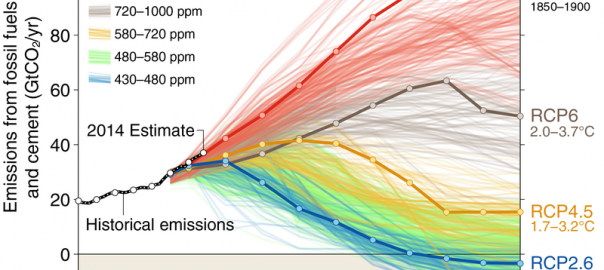
Climate modelling scenarios out to 2100 (Image: Global Carbon Project)

The awful truth about climate change no one wants to admit

There has always been an odd tenor to discussions among climate scientists, policy wonks, and politicians, a passive-aggressive quality, and I think it can be traced to the fact that everyone involved has to dance around the obvious truth, at risk of losing their status and influence.

The obvious truth about global warming is this: barring miracles, humanity is in for some awful shit.

Here is a plotting of dozens of climate modeling scenarios out to 2100, from the IPCC:

Climate modelling scenarios out to 2100 (Image: Global Carbon Project)

The black line is carbon emissions to date. The red line is the status quo — a projection of where emissions will go if no new substantial policy is passed to restrain greenhouse gas emissions.
Related 6 reasons conservatives should take climate change seriously

We recently passed 400 parts per million of CO2 in the atmosphere; the status quo will take us up to 1,000 ppm, raising global average temperature (from a pre-industrial baseline) between 3.2 and 5.4 degrees Celsius.

That will mean, according to a 2012 World Bank report, “extreme heat-waves, declining global food stocks, loss of ecosystems and biodiversity, and life-threatening sea level rise,” the effects of which will be “tilted against many of the world’s poorest regions,” stalling or reversing decades of development work.

“A 4°C warmer world can, and must be, avoided,” said the World Bank president.

But that’s where we’re headed. It will take enormous effort just to avoid that fate. Holding temperature down under 2°C — the widely agreed upon target — would require an utterly unprecedented level of global mobilization and coordination, sustained over decades. There’s no sign of that happening, or reason to think it’s plausible anytime soon. And so, awful shit it is.

Nobody wants to say that. Why not? It might seem obvious — no one wants to hear it! — but there’s a bit more to it than that. We’ll return to the question in a minute, but first let’s look at how this unsatisfying debate plays out in public.

Read more: Vox

The rise and rise of the 2015 El Niño

The Bureau of Meteorology has officially declared that we are in an El Niño, shifting its tracker from ALERT (a greater than 70% chance of El Niño forming) to an actual event.

Speculation began in early 2014 that the world would see an El Niño, possibly a significant “super” event, by the end of that year. However the event development hit a few setbacks, and many thought the El Niño was already dead.

In March this year, US National Oceanic and Atmospheric Administration officially declared that the “most-watched” 2014-15 El Niño had finally arrived. Now our own Bureau has followed suit.

So what’s going on? And how severe could the 2015-16 El Niño turn out to be?
Ghosts of El Niño past

El Niño usually develops over the southern autumn-winter, peaks around Christmas, and decays in the southern autumn.

So this event is unusual as an El Niño would generally be decaying by this time of the year, but observations over recent weeks show otherwise. Sea surface temperatures in the El Niño core region (eastern equatorial Pacific) are actually still warming and the pattern is now looking more like a classic El Niño.

In fact, the warm anomaly over the eastern equatorial Pacific – the typical indicator for an El Niño – has in the past three weeks exceeded 1C. Assuming this El Niño peaks at Christmas of 2015, this recent 1C temperature anomaly is unprecedented during the autumn of all developing El Niño years since at least the early 80s.

We’ve seen a similar size temperature anomaly in the autumn of 1987, but that was in the middle of two, back-to-back El Niño events: the summers of 1986-87 and 1987-88. At that time ocean heat under the surface was already on the decline following the peak of El Niño on Christmas 1986, while sea surface temperatures received a second boost to peak in August of 1987.

This year though it looks like the 2014-15 El Niño is yet to reach its peak. Both the temperature anomaly and amount of ocean subsurface heat are still building. The ocean heat has in fact surpassed last year’s massive value and is now rivalling that during the development of the 1997 super El Niño.

Read more: The Conversation

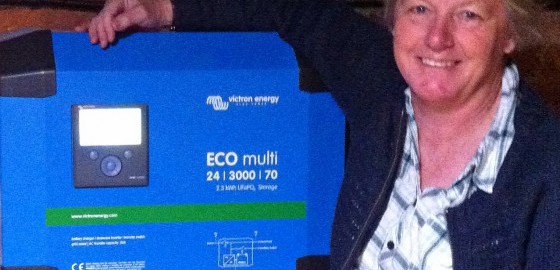
Jill Goulder with lithium battery for storing solar electricity (image: YouGen)

New lithium battery technology to store energy from solar PV panels

A houseowner in Lewes has become one of the first in the area to use state-of-the-art lithium battery technology to store energy from solar PV panels.

Jill Goulder has installed a lithium battery storage system linked to her solar PV panels. These recharge during sunlight hours and provide power in the evenings – very useful for households who use most of their electricity outside sunlight hours.

Jill Goulder with lithium battery for storing solar electricity (image: YouGen)

The system switches seamlessly between battery and mains supply as needed; a good system will cover a household’s normal needs, though major appliances such as washing machines and vacuum cleaners drain the batteries rapidly and will need mains top-up.

Jill says

“Lithium batteries are the new generation of energy storage, and they’re decreasing in price.  My electricity bills are already very low, but I liked the idea of using all the electricity that I generate with my solar PV panels; and it gives me supply security in case of the mains power cuts.”

The system can be monitored online by the user on their own computer, with graphics showing consumption and battery usage throughout the day.

The system is housed in a blue metal box about the size of an airline carry-on bag, bolted to a wall, for example in an attic. The installed price for a small-to-medium system is likely to be £4,000 – £8,000, so it is not for everyone, though it’s becoming a favoured investment for householders with solar PV panels who are looking to take the next energy reduction step. Jill thinks that sooner or later Britain will follow Germany’s lead in providing a subsidy for householders investing in these systems.

Importantly, this particular system will also work in a power cut. Jill comments

“I do know that some companies are selling systems that don’t work during a power cut (and unscrupulously not telling customers), but it was a no-brainer for me to have that – it was a major factor in buying it, as outages are increasing.”

Jill adds

“Do use a reputable supplier for your installation – there are cold callers in this area offering quick sign deals that are less good value than they seem; and check too that the system you buy will continue to work during a power cut. Analyse your electricity use carefully beforehand: when are your peak times for using electricity each day, and can you install more energy efficient appliances or LED lighting? And ask around for advice – in Lewes the Transition Town Lewes Energy Group will be able to help you.”

Jill’s installation is a Victron EcoMulti Hub-2 (2.3kWh storage, 3kVA inverter) installed by Bright Green Energy Ltd of Beckenham, linked to her 1.29kWp solar PV system.

The appearance of Tesla’s new battery solution we wrote about here has not gone unnoticed by Jill. She comments

“I’m simply boggled at seeing front page stories last week in the UK about Tesla unveiling magical new technology which would allow you to store the energy from your solar panels. Hello, storage batteries have been around for 200 years… Certainly lithium is a new, better technology, but Tesla certainly aren’t the first by a long mile.”

On the plus side, she says

“It all helps generally in focusing on storage. As you doubtless know, some sunny countries are pressing solar panel owners to invest in storage as the daily surge into the grid from the panels are causing problems!”

Jill Goulder is an archaeologist and also a SuperHomer. Jill has refurbished her Victorian terraced cottage and achieved a radical 61% carbon saving. See Jill’s SuperHomes page for more about her continuing house improvements including this latest addition of lithium battery technology.

Source: YouGen

Severe Flooding, Against a Background of Wind Turbines: November 2012, Tyringham, Bucks. (Image: T. Larkum)

Extreme El Niño expected to wreak havoc on weather this year

The bad boy of global weather is on its way. El Niño can cause floods, droughts, fires and epidemics around the world, and the next one could be a humdinger.

Severe Flooding, Against a Background of Wind Turbines: November 2012, Tyringham, Bucks. (Image: T. Larkum)
Severe Flooding, Against a Background of Wind Turbines (Image: T. Larkum)

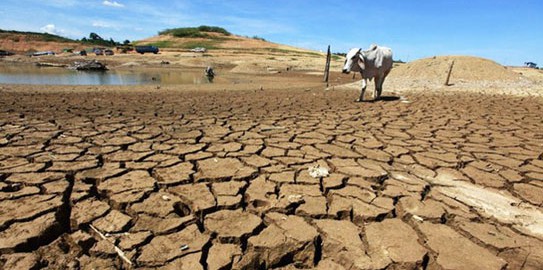
El Niño crashes on to the scene once every four years or so as hot water emerges in the Pacific and moves towards the Americas. This can bring drought to Australia and parts of Asia, while parts of the Americas experience heavy rain, flooding and outbreaks of waterborne diseases. Pacific Islands all the way from Tonga to Hawaii experience more frequent storms. And valuable fish stocks move all around the globe, following water of their preferred temperature.

Many experts are warning of a “super El Niño” this time round.

“We have this enormous heat in the subsurface that is propagating eastward and it’s just about to come to the surface,” says Axel Timmermann of the University of Hawaii in Honolulu. “I looked at the current situation and I thought, ‘oh my dear’.”

Similar forecasts were made last year, too, and proved wide of the mark. This time it’s different. For one thing, we are already in an El Niño year, which makes it easier for an extreme one to form.

“It’s much easier to build up from warm temperatures than from neutral temperatures,” says Timmermann.

Also, this year ocean temperatures seem to be coupled with atmospheric winds in a feedback loop that makes the El Niño stronger, says Wenju Cai at the CSIRO, Australia’s government research agency. US climate models, on average, are pointing to an El Niño comparable to the devastating 1997/98 event, says Timmermann.

Another thing likely to give this year’s El Niño an extra kick is the presence of the Southern Hemisphere Booster. A low-pressure system near Australia that boosts westerly winds across the Pacific, it helps unlock the heat fuelling El Niño, says Fei-Fei Jin of the University of Hawaii at Manoa.

“The chance of a large El Niño is quite large,” he says.

Timmermann says we should be preparing, clearing rivers of debris in flood-prone areas and storing water in drought-prone areas.

“There are lots of win-win things you can do,” he says.

He has already installed hurricane clips on his roof, as El Niño also increases the chances of hurricanes making landfall on Hawaii.

Source: New Scientist

Shell Assures Nation Most Arctic Wildlife To Go Extinct Well Before Next Spill

HOUSTON—Stating that any damage would be limited to just a handful of species that somehow managed to survive that long, officials from the Shell Oil Company assured the public Wednesday that most of the Arctic wildlife living near their proposed drilling site will be extinct well before their next oil spill.

“After conducting several environmental impact studies, we can confidently say that our offshore drilling operations pose absolutely no threat to the Arctic’s hundreds of native species, which will have already been completely wiped out by the time any drilling mishap or crude oil spill takes place,”

said Shell spokesman Curtis Smith, adding that the region’s polar bears, walruses, and bowhead whales will most likely be eliminated by some combination of overfishing, ocean acidification, and melting ice shelves long before the first drops of unrefined petroleum begin gushing into the Chuchki Sea.

“We can assure you that there will be no repeat of the BP oil spill, in which a complex, thriving ecosystem was destroyed. At most, only some algae and maybe a few mackerel will still be around when our rig explodes and spews millions of gallons of oil into their habitat, and we believe those species will pretty much be on their last legs by then anyway.”

Smith added that the environmental hazards associated with the initial installation of the rigs will also go a long way toward ensuring most of the fauna has died off prior to any future spills.

Source: The Onion

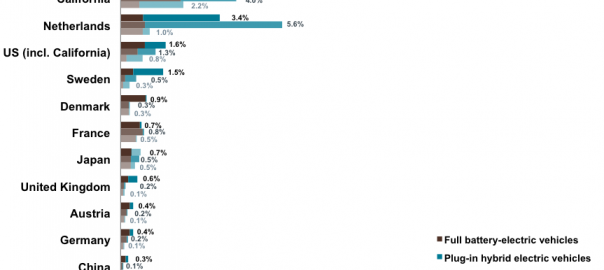
Market share (new sales) of electric passenger cars (Image: Business Spectator)

Fuel price turbulence hasn’t pulled the plug on EVs

Among the biggest stories of 2014 was the crash in global oil prices. Just when it looked like the world had started to take $100/barrel oil for granted, prices plunged by 50 percent. Some speculated that lower oil prices would translate into reduced consumer enthusiasm for electric vehicles (EVs). Now that we have EV sales for 2014 tallied up, let’s look at how the story actually played out.

As it turns out, EVs, including battery electric vehicles (BEVs) and plug-in hybrid electric vehicles (PHEVs), continued to sell consistently around the world. The EV market share in Norway is still far ahead of other countries, at 13.8% of new car sales in 2014. However, in Sweden, the United Kingdom, Denmark, and China the EV market tripled, while in Austria and Germany the EV sales share nearly doubled. The Netherlands is the only country that saw a big drop in EV sales, from 5.6% to 3.4%, likely due to a decline in fiscal incentives. Electric vehicle market share in other countries, including the US, France, and Japan, remained consistent in comparison to 2013.

Further, compared to the first half of 2014, the dramatic drop in global fuel prices during the second half of 2014 did not have any measurable impact on EV sales, and some markets even saw EV sales spike towards the end of the year. There are two main reasons for this: (1) Savings from fuel/electricity costs are only part of all EV incentives, which mainly consist of a variety of fiscal or non-fiscal benefits, and (2) in some countries, particularly in the European Union, fuel taxes already account for a large share of total fuel price, so even during times of fluctuation in global oil price the price at the pump remains relatively stable.

Market share (new sales) of electric passenger cars (Image: Business Spectator)

Read more: Business Spectator

Will Tories offer climate policy competence or chaos?

The green economy faces significant uncertainty as a Tory government with a wafer thin majority faces a host of energy and climate policy challenges

[From 8 May] Something truly historic and genuinely shocking has happened in the past few days. That’s right, the National Oceanic and Atmospheric Administration (NOAA) confirmed the monthly global concentration of CO2 in the atmosphere passed 400 parts per million for the first time in human history.

Meanwhile, on a small archipelago off the coast of Europe, David Cameron pulled off the biggest political shock in a generation and is now odds-on to deliver the first Tory majority government since that last electoral surprise in 1992, albeit with a wafer thin majority that may eventually see him long for the parliamentary stability of the Major years.

For all the immense challenges Cameron now faces – delivering his promised EU renegotiation and referendum, holding the union together when it is pulling apart at the seams, identifying the unfunded spending and tax cuts he promised, navigating ever louder (and entirely justified) calls for electoral and constitutional reform – it is the response to the ongoing global climate crisis that will one day be seen to define his generation of world leaders.

There are plenty of climate scientists who reckon by the end of this parliament global greenhouse gas emissions need to be peaking in readiness for a vertiginous decline.

Cameron knows this and in those quieter moments when he is allowed to present himself as the One Nation Tory Moderniser he instinctively remains – and this morning promised to become once again – he is committed to playing his role in delivering the global green industrial revolution. But green businesses and campaigners will this morning look at the result and wonder how many of those quieter moments he will be granted over the next five years. Cameron’s commitment to the Climate Change Act may be solid, but his commitment to the policies required to deliver on it has already been shown to be flaky.

Does he have the nerve, the authority and the political nous to face down climate sceptic backbenchers whose votes could be crucial? That is one of the many unanswered questions of this election for green businesses.

But first, the good news. Even if GDP is not, in the words of Boris Johnson, going gangbusters, there are signs the green economy is. Renewable energy capacity trebled over the past five years and is on track to hit a 20 per cent share by 2020. The electric car market is booming and a host of low carbon infrastructure projects, from new nuclear reactors, to CCS demonstration projects and giant offshore wind farms are in the pipeline.

The Conservatives remain committed to expanding the ultra-low emission vehicle fleet, rolling out rail electrification programmes, delivering smart meters to every building, and enhancing biodiversity protection rules, especially for marine habitats. The Tory manifesto may not have been as overtly green as the Lib Dems or Labour’s, but it is not without its strengths. Moreover, the bulk of the energy industry is celebrating this morning (and share prices are jumping) as the prospect of a potentially investment-disrupting energy price ‘freeze’ is buried with Ed Miliband’s political career.

However, if businesses can see investment and policy certainty on a number of fronts, it is tempered by chronic uncertainty on a host of other important issues.

Whoever takes up the reins at the Department of Energy and Climate Change (assuming of course it is not merged back into another department in pursuit of George Osborne’s steep Whitehall spending cuts) faces one of the most daunting in-boxes in Westminster.

Within the next 18 months they need to finalise a new carbon budget for the late 2020s, secure a new Levy Control Framework for supporting clean energy projects beyond 2020, tackle the ongoing problems with UK energy efficiency policies and the scandal that is fuel poverty, sort out the future of the Renewable Heat Incentive, clarify the detail of the Tory ‘halt’ to onshore wind farms, address fracking protests and planning objections, support the reform of the EU emissions trading scheme, ink the long-awaited deal with EDF to deliver a new nuclear power plant, dish out the similarly long-awaited £1bn of CCS demonstration funding, execute a smart meter rollout that has many informed observers worried, weigh in on debates about the UK’s illegal air pollution, potential airport expansion, and resource insecurity, and represent the UK at an international summit that plenty of people regard as the most important in the history of human civilisation. No pressure, then.

Each of these policy debates could yet be resolved in favour of a more environmentally sustainable, climate resilient, and technologically competitive economy. But there is little doubt the battle will be intense and there are legitimate fears that if the right wing media continues to position action on climate change as an unjustified cost a Conservative government will throw green policies to the fossil fuel addicted wolves. Will the party focus on a competent programme of cost-effective decarbonisation or a chaotic programme of contradictory policies and climate politicking?

These hard policy choices will be further complicated by three over-arching realities that promise to repeatedly dilute Cameron’s best intentions towards the green economy and further undermine investment certainty: Europe, austerity, and the Tory backbenches.

The first two years of the parliament will be dominated by the build-up to an EU referendum and, if the Scottish referendum is anything to go by, the following two years will be dominated by the fallout. Emissions targets, air pollution rules, waste and recycling directives, biodiversity and habitat protections, all face an ambiguous future. The likelihood is the UK will stay in the EU or leave and be forced to keep many of these rules through a trade agreement, but for now uncertainty rules.

Meanwhile, cuts to unprotected departments mean DECC, Defra and related departments such as Transport, Business, and Communities will all face extremely tough decisions over what green initiatives remain and which will be cut. They will all be wary of the backlash that results when cuts to something like flood protection are shown to be ill-conceived.

Finally, every green policy or programme the Conservative government pursues will face vocal opposition from those on its own benches who cling to the idea that anything to do with climate change is a Commie plot. Add in the fact that if Cameron does need additional votes his first port of call is likely to be the DUP and party management becomes as crucial to the Tory green vision as the formation of that vision in the first place. Will the Lib Dems and Labour be responsible enough to work with the Conservative leadership on some of these issues to sideline the few climate sceptic voices in parliament or will they be granted influence that is in complete disproportion to their numbers?

What, if anything, can green businesses do to navigate this uncertainty and deliver the policy victories that will help the low carbon economy build on its recent successes?

As always, more needs to be done to demonstrate that clear majorities of the public support clean technologies and are in favour of decarbonisation. Yesterday may have proven once again that you can form a government with the support of barely a third of voters, but a true One Nation Conservative Party has an obligation to represent the country as a whole on these issues.

Similarly, green businesses need to recognise policy is only part of the story and not get too disheartened if some green policies are shelved. It is a scandal the Conservatives will now scupper a popular, successful and cost-effective industry in the form of the onshore wind energy sector. But the march of clean technologies is a global trend whereby costs are falling and green products are becoming normalised all the time. Divestment, community energy, smart grids, solar cells, these are trends and technologies that continue to go from strength to strength, regardless of the political weather.

Finally, those Conservatives tasked with presenting the party’s green policies in recent months have repeatedly declared that their focus is on cost-effective decarbonisation. Green businesses need to take this at face value, reach out to those remaining green Tories (they may seem as rare as a happy badger this morning, but they do exist) and demonstrate how decarbonisation is already being delivered in a cost-effective manner and will only become more cost competitive in a way fossil fuels will not. They could start by pointing out how the Conservatives are missing a trick in failing to take action on energy efficiency much more seriously. The Tory manifesto says they will improve one million homes over the next five years; Labour claimed to have a plan to upgrade 2.5 million homes at negligible extra cost – regardless of the final result, it is worthy of consideration.

Most of all though, green businesses and campaigners need to cling to the hope that the David Cameron who once declared that climate change is one of the most serious challenges the UK faces, who once declared he wanted the UK to be the most energy efficient economy in Europe, who once declared he would lead the greenest government ever, has it in him to tackle the climate challenge that will one day define the history books of this most unpredictable of political eras.

Source: Business Green

Church Of England Divests From Coal And Tar Sands

[From 1 May]The official Church of England announced Thursday that it had divested its holdings of all investments in tar sands and thermal coal companies.

The mother church of the world’s Anglican Communion divested a total of $18.42 million in coal and tar sands investments from its holdings, a move that the church said is part of a larger goal of helping the globe make the transition to a lower-carbon economy. From now on, the church — which counts about 26 million baptized English residents as its members — will not invest in companies that generate more than 10 percent of their revenue from thermal coal or tar sands.

“Climate change is already a reality,” Reverend Canon Professor Richard Burridge, deputy chair of the church’s Ethical Investment Advisory Group, said in a statement. “The Church has a moral responsibility to speak and act on both environmental stewardship and justice for the world’s poor who are most vulnerable to climate change.”

The church’s investment portfolio totals about $12.1 billion. According to the Guardian, if the church divested its portfolio of all fossil fuel stock, including oil and gas companies, it would be the largest institution in the world to do so.

Bishop Nick Holtam, the Church of England’s lead Bishop on the environment, said in a statement that climate change “is the most pressing moral issue in our world.”

“Change is happening rapidly, I therefore particularly welcome the commitment to regularly review the policy recommendations in the light of our knowledge and experience,” he said.

This isn’t the first strong statement the Church of England has made on climate change. In 2014, when the church was deliberating over whether or not to divest its holdings, it said that it would stop investing in companies that fail to fight the “great demon” of climate change. The church also made clear, however, that it believed divestment was a “final option,” and that ultimately, humans must examine their way of life, which relies on “plentiful, cheap energy,” if climate change is to be addressed.

The church said last year that it sees tackling climate change as a way to engage with younger generations.

“At the moment, the church is perceived by most young people as supremely irrelevant,” Canon Giles Goddard said. “This is a significant opportunity for churches to engage with a new constituency, and it’s important that we take it.”

Though the church has divested its holdings from some fossil fuel sources, at least one of its prominent members has ties to the oil industry. Justin Welby, who worked for 11 years in the oil industry, became the Archbishop of Canterbury in 2013. In that role, Welby serves as the Anglican church’s spiritual leader and is also the senior bishop in the Church of England.

The Church of England’s announcement comes during a week of focus on climate change by the Catholic Church. On Tuesday, scientists, policy-makers, religious leaders, and U.N. Secretary General Ban Ki Moon held a summit on climate change. The summit was held in the lead-up to Pope Francis’ encyclical on climate change, an influential church document that’s expected to be released this summer.

At the end of the summit, leaders released a statement emphasizing that “human-induced climate change is a scientific reality” and “its decisive mitigation is a moral and religious imperative for humanity.” It also warned that the November U.N. climate talks in Paris may be the world’s last chance to negotiate a deal to limit climate change to 2°C.

“In this core moral space, the world’s religions play a very vital role,” the document states. “These traditions all affirm the inherent dignity of every individual linked to the common good of all humanity. They affirm the beauty, wonder, and inherent goodness of the natural world, and appreciate that it is a precious gift entrusted to our common care, making it our moral duty to respect rather than ravage the garden that is our home.”

Other religious institutions have made commitments in recent years to tackle climate change. The World Council of Churches, a global coalition of 345 churches including the Church of England, announced last year that it would pull investments of all fossil fuels. Union Theological Seminary in New York also announced it would be divesting from fossil fuels last year, becoming the first seminary to do so.

Some Evangelicals, too, want to see more action on climate change: the Evangelical Environmental Network emphasizes that, because God created the Earth and its creatures, humans have a duty to look after that creation — and action on climate change is part of that care.

Source: Climate Progress