Category Archives: Energy and Climate Change

News and articles on climate change, vehicle pollution, and renewable energy.

Crisis Preparation

I don’t think I’m yet convinced that in the UK we need to worry too much about being prepared for disasters. However, I found these articles interesting and worthy of ‘bookmarking’ to consider later.

100 Items to Disappear First

“From a Sarajevo War Survivor”

1. Generators (Good ones cost dearly. Gas storage, risky. Noisy…target of thieves; maintenance etc.)
2. Water Filters/Purifiers
3. Portable Toilets
4. Seasoned Firewood. Wood takes about 6 – 12 months to become dried, for home uses.
5. Lamp Oil, Wicks, Lamps (First Choice: Buy CLEAR oil. If scarce, stockpile ANY!)
6. Coleman Fuel. Impossible to stockpile too much.
7. Guns, Ammunition, Pepper Spray, Knives, Clubs, Bats & Slingshots.
8. Hand-can openers, & hand egg beaters, whisks.
9. Honey/Syrups/white, brown sugar
10. Rice – Beans – Wheat
11. Vegetable Oil (for cooking) Without it food burns/must be boiled etc.,)
12. Charcoal, Lighter Fluid (Will become scarce suddenly)
13. Water Containers (Urgent Item to obtain.) Any size. Small: HARD CLEAR PLASTIC ONLY – note – food grade if for drinking.
14. Mini Heater head (Propane) (Without this item, propane won’t heat a room.)
15. Grain Grinder (Non-electric)
16. Propane Cylinders (Urgent: Definite shortages will occur.
17. Survival Guide Book.

Read more: The Power Hour

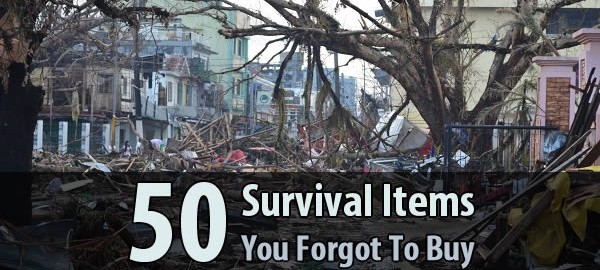
50 Survival Items You Forgot To Buy

1. Acoustic Instruments – For entertainment and morale.
2. Aluminum Foil – Great for all sorts of things like cooking food, boiling water, enhancing antennas, keeping sunlight out, etc.
3. Axes – How else will you chop firewood?
4. Baby Wipes – Really easy way to keep clean.
5. Baseballs, basketballs, footballs, etc. – Playing ball is a great way to stave off boredom and keep morale up during hard times.
Credit Card Knife
6. Bicycle Gear – If gasoline is in short supply, you might need your bike to get around. That means you’ll need a bike pump, extra tubes, etc.
7. Book lights – It’s difficult to read by candlelight and you don’t want to waste your flashlight’s batteries. Book lights are cheap and last a long time.
8. Books – You might be surprised how much free time you have after the SHTF. Now’s your chance to read those books you always meant to read (like Atlas Shrugged).
9. Bug Spray – There is usually a major lack of proper sanitation after a disaster, especially if there isn’t running water. That means there will be more roaches and other critters. There might also be a lot more mosquitoes.
10. Bullion Cubes – These make boring meals much more delicious.

Read more: Urban Survival Site
Planning and preparing for global catastrophe

A background to survivalism and going off-grid – some of it rather depressing

Environmental catastrophe, economic collapse, global pandemic … does it feel like the world is ending? If you think Armageddon is near and are trying to get ready, you are not alone.

National Geographic Channel’s Doomsday Preppers – a reality TV series that profiles various “survivalists” readying themselves to survive a range of apocalyptic circumstances – is the network’s most-watched series. It has prompted a slew of similar programming such as Discovery Channel’s rival Doomsday Bunkers.

Of course, even after an apocalypse one needs a place to live.

Since it first aired in 2012, Doomsday Preppers has featured survival retreats ranging from pre-fabricated steel shelters and decommissioned missile silos, to hand-built forest cabins and buried shipping containers. What has emerged is a picture of the ideal survival retreat (or “bug-out location” to use prepper slang) as rural, secluded, self-sufficient and fortified.

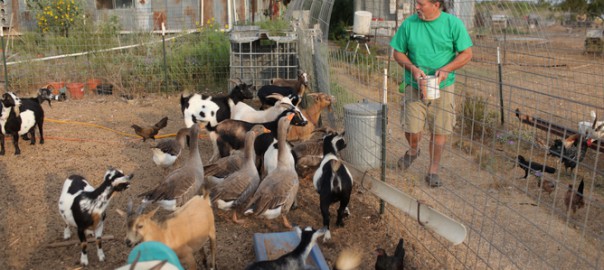
Floresville, Texas: Paul Range feeds his brood of livestock. Each can serve as a food source if things get bad. (Photo Credit: National Geographic Channel/ Sharp Entertainment)
Floresville, Texas: Paul Range feeds his brood of livestock. Each can serve as a food source if things get bad.
(Photo Credit: National Geographic Channel/ Sharp Entertainment)

Anthropologist Richard G. Mitchell’s Dancing at Armageddon (2001) is, I think, one of the most level-headed studies of survivalist culture. His work points to the way survivalism is rarely about extremist action. Rather, it is more often about tinkering with tools, exchanging ideas and creative storytelling.

We can see the design of the survival retreat as a wilder version of the more familiar impulse towards DIY and home renovation.

Survivalists use these projects as a focus for developing the personal skills, knowledge, and praxis needed to embrace a radically changing world. Potential chaos and crisis is embraced as the opportunity for developing personal autonomy.

Read more: The Conversation (November 2014)

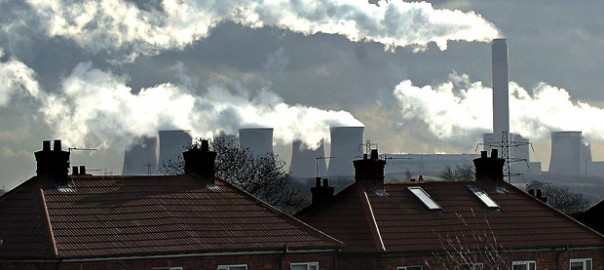
Pollution at Drax Coal Power Station near Selby (Image: J. Giles/PA)

Coal deserted by Total

And about time!

French oil major Total confirmed on Monday that it had stopped all production of coal as of last week after the South African government approved the sale of its coal mining operations there.

“We cannot claim to be providing solutions to climate change while continuing to produce or market coal, the fossil fuel that emits more greenhouse gas than any other,” Total Chief Executive Patrick Pouyanne said in a statement.

Pouyanne said in June last year that Total would halt all coal operations. The Paris-based group is one of the European oil majors that signed a letter urging governments around the world to introduce a pricing system for carbon emissions.

Pollution at Drax Coal Power Station near Selby (Image: J. Giles/PA)

The CEO said that in addition to withdrawing from mining the company had also decided to divest its coal marketing operations.

The group marketed 8.5 million tonnes of coal in the international market in 2013, with more than 80 percent coming from South Africa and the majority sold to Asia.

“By end-2016, we will no longer be involved in the coal business,” Pouyanne said.

Source: World Energy News

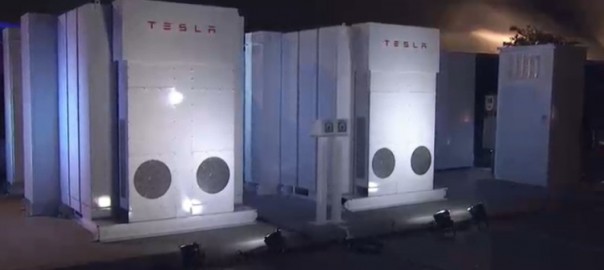
Tesla Energy “Power Packs” Using Solar PV Power

Energy Storage Boom Predicted

Bring it on!

The energy storage market is set to soar, predicts Navigant Research.

Tesla Energy “Power Packs” Using Solar PV Power

How big will the market become? According to Navigant, we can expect market revenue of nearly $75 billion for energy storage enabling technologies from 2015 to 2024:

Energy Storage Enabling Technologies Revenue is Expected to Total Nearly $75 Billion from 2015 to 2024, According to Navigant Research

Systems integration services are projected to be highest in the energy storage enabling technologies value chain, report finds

Read more: Inside EVs

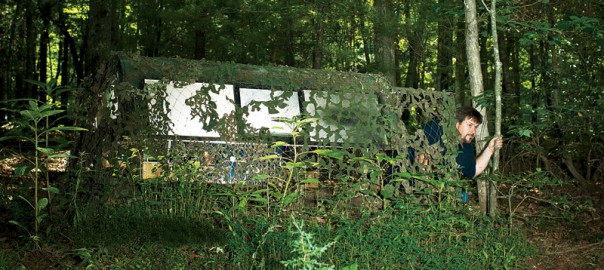
Bring it! Scott Hunt on his prepper property in South ­Carolina (Image: B. Finke)

Boom Times

An overview of the US prepping movement from 2012

Meet the preppers, a rattled, robust survivalist movement whose members just hate being called survivalists. Emily Matchar investigates the 21st century’s wildest new apocalyptic scene.

BEING PREPARED is just the sensible thing to do, Scott Hunt tells me. Power outage? Superstorm? Nuclear attack? He’ll be ready. That’s why he has a pickup truck that runs on wood.

Bring it! Scott Hunt on his prepper property in South ­Carolina (Image: B. Finke)

We’re standing by a toolshed in the backyard of Hunt’s home near Pickens, South Carolina, staring at a tall metal contraption that sits in the rusting bed of a Ford F-100. It’s a generator that can turn wood chips into wood gas, which, in turn, can run an internal combustion engine.

“I look at a tree, I see a battery,” Hunt says amiably, grabbing his yellow Bernzomatic Fat Boy torch and firing up the “gassifier.” He fans the flame with a gush of compressed air and the truck rumbles to life. “It’s my Mad Max backup.”

The 46-year-old Hunt, whose blue polo shirt and neat goatee say soccer dad more than road warrior, believes in backups. He’s got his water supply: a 1,600-gallon spring- and well-fed tank on a hill overlooking his property. He’s got power and heat: an enormous wood-fueled generator, a diesel generator, a propane generator, an old Army immersion heater, solar panels, a wood-burning stove, and solar ovens. There’s food: five rotating vegetable gardens backed by a basement full of canned salmon and refried beans, white and red wheat kernels, potatoes, and dried milk. To turn the wheat into flour, he’s rigged up an old Healthmaster 750 exercycle with a belt and grinding wheel.

“In a grid-down situation,” Hunt says, “I believe you need to be prepared to live like in the 1800s.”

Read more: Outside Online

Instead of Doomsday, How About ‘Now’ Day?

A view on Prepping from April 2014

While channel surfing a little while back, I stumbled across the National Geographic channel’s show Doomsday Preppers which follows people who have essentially made a lifestyle of preparing for what they believe is going to be a catastrophic disaster that will lead to the end of civilization as we know it.

Almost all of the people profiled appear to be gun-and-ammo-loving Americans, who stockpile decades worth of food and paper products and believe having gazillions of gallons of gas will be their new world’s currency — when they come out of hunkering in their bunkers.

images_doomsday_preppers_unk

I can’t claim to have seen every episode, but I saw enough to find it ironic how often its subjects are preparing for something like a collapse in the banking system or faith in paper currency, or for a dirty bomb, but no one ever seems to be preparing for global warming in this extremely fretful segment of society.

It’s an odd and unfortunate paradox that the people who seem most concerned about future threats to our way of life seem to disregard one of the most dangerous and obvious ones we face at this very moment, today.

A United Nations (UN) report has put the world on notice that climate change will force millions of people to relocate triggering famine, inciting conflict and losing trillions of dollars worth of economic gains. The irreversible consequences of climate change will lead to economic mass migration. Then, there is a risk of violence which will increase from protests triggered by international or civil conflicts.

While I don’t think it’s a good thing to scare people unduly, a healthy respect for something on this scale is warranted. It’s a good idea to get an emergency preparedness kit, decide on a plan, and have awareness of what to do in the event of a disaster. It’s doubtful you will need an underground bunker with a year’s supply of canned food; it is, however, common sense to have a weather radio, flash light, and some non-perishable food items and all your necessary medications on hand in case the power is knocked out by a storm for example.

Along with your emergency plans, find the time to discuss with your family where you would go if you needed to take shelter in your home or if you needed to leave town for an impending hurricane or earthquake. Are you are unsure of what disasters are likely in your area or where you should go during an earthquake or tornado? Do sensible research. There are a number of resources online to get informed about disaster preparedness.

CDC’s preparedness website and FEMA’s emergency strategies and solutions are excellent resources for reliable and credible information on how to look after yourself and your family. Share your research with your neighbors and other members of your community. Knowledge is powerful and life-saving, and should not be wasted in the selfish pursuit of only looking after number one.

I find the Doomsday Preppers resembling escapists more than survivalists. Focusing on how to abandon modern life with the motto of the SHTF scenario — when the “Shit Finally Does Hit the Fan,” alarming and void of any caring for mankind, outside their own families. We’re in this world together, and our responsibility to preserve this planet goes well beyond any single individual’s bunker’s walls.

Source: Huffington Post

The Earth’s Battery Is Running Low

An interesting analogy: the earth’s resources as a battery running down

In the quiet of summer, a couple of U.S. scientists argued in the pages of the Proceedings of the National Academy of Sciences that modern civilization has drained the Earth — an ancient battery of stored chemical energy — to a dangerous low.

155770046_planet_earth_shutterstock

Although the battery metaphor made headlines in leading newspapers in China, India and Russia, the paper didn’t garner “much immediate attention in North America,” admits lead author John Schramski, a mechanical engineer and an ecologist.
And that’s a shame, because the paper gives ordinary people an elegant metaphor to understand the globe’s stagnating economic and political systems and their close relatives: collapsing ecosystems. It also offers a blunt course of action: “drastic” energy conservation.

It, too, comes with a provocative title:

“Human domination of the biosphere: Rapid discharge of the Earth-space battery foretells the future of humankind.”

Read more: Resilience

Feeding people on our stressed planet will require a revolution

Two renowned scientists—Stanford’s Paul Ehrlich and UC-Berkeley’s John Harte — argue that feeding the planet goes way beyond food. Revolutionary political, economic and social shifts are necessary to avoid unprecedented chaos.

How do you make sure billions of people around the world have access to food?

You start a revolution.

hungry_kids_revolution_Flickr-FMSCc

At least that’s what two leading U.S. scientists argue in a new report. Feeding people will require cleaner energy, smarter farming and women’s rights, but also a “fundamental cultural change,” according to Paul Ehrlich, president of the Center for Conservation Biology at Stanford University, and University of California, Berkeley, professor and researcher John Harte.
John Harte (Berkeley.edu)

“What is obvious to us is … that if humanity is to avoid a calamitous loss of food security, a fast, society-pervading sea-change as dramatic as the first agricultural revolution will be required,” they wrote in their report published last week in the International Journal of Environmental Studies.

The amount of humans on Earth is growing—projections point to an extra 2.5 billion people by 2050.

But tangled within the problem of more hungry mouths is environmental degradation, social injustice and humans pushing toward the very boundaries of the planet when it comes to resources such as food, water and energy, according to Ehrlich and Harte.

Read more: Environmental Health News

Businesses from Crif Dogs to Goldman Sachs can be considered true business preppers in the aftermath of Hurricane Sandy (Image: dsgray16/Flickr)

Doomsday Preppers Vindicated By Hurricane Sandy

A look back at November 2012

Brian Shebairo, the owner of hipster hot dog haven Crif Dogs in Manhattan’s East Village, just made it through Hurricane Sandy’s devastating power outage without closing down. Now he’s sitting on 210 gallons of gas — during a quasi-apocalyptic fuel shortage — in anticipation of another looming crisis: the nor’easter expected Wednesday.

Businesses from Crif Dogs to Goldman Sachs can be considered true business preppers in the aftermath of Hurricane Sandy (Image: dsgray16/Flickr)

“People looked at me like I’m crazy, but the reality is you never know,” Shebairo told The Huffington Post.

“It sucks to need something and not have it, and it’s pretty awesome to need something and have it. And I’ve had it.”

Shebairo is prepping for the nor’easter just as he did for Sandy, not only with full gas cans, but with heavy duty extension cords, power strips, batteries, chainsaws, bolt cutters, pallets of water and about 10 generators.

“I don’t have a ‘go bag’,” he said. “I have a ‘go truck’.”

Shebairo is what’s known, in certain circles, as a doomsday prepper. And these folks are having something of a moment. Often mocked for fearing a nuclear war or zombie apocalypse, they’ve gotten a bad rap since Chicken Little, but the consequences of not being prepared for Hurricane Sandy has given preppers a credibility boost. Many believe it may draw the prepper movement from the fringe to the mainstream.

Read more: Huffington Post