Category Archives: Energy and Climate Change

News and articles on climate change, vehicle pollution, and renewable energy.

90% of EV users in survey regularly use public EV charging facilities

The Volkswagen scandal: say goodbye to the internal combustion engine!

By now, I guess that everyone in the world has heard of how Volkswagen cheated consumers by falsifying the results of the emission tests from their diesel engines. It is a true witch hunt unleashed against Volkswagen. Maybe there are good reasons for it, but I think it is also something that should be taken with caution. A lot of it.

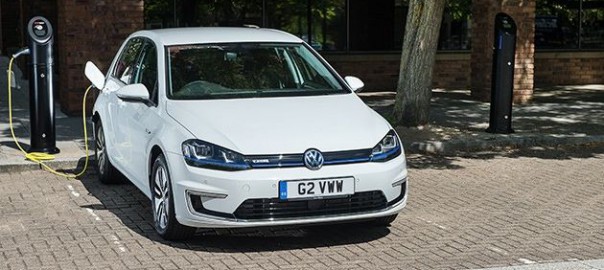
Volkswagen e-Golf (Image: J. Ramsey/Autoblog)

I have been a consultant for the automotive industry for some 20 years and I think that I know the way they operate. And I can tell you that they are not equipped for “cheating”, intended as willingly ignoring or breaking the law. They just don’t do that, they understand very well that the result could be something like what’s happening to Volkswagen nowadays; something that could lead to their end as a car manufacturer. On the contrary, carmakers tend to be extremely legalistic and apply to the letter the current laws and regulations.

This said, it is also clear that car makers are there to make a profit and their managers are supposed to “get results”. So, if the laws and the regulations are not clear, or do not explicitly say that something is forbidden; then, if that something is supposed to provide some advantage to the company, it may be done.

Read more: Cassandra Legacy
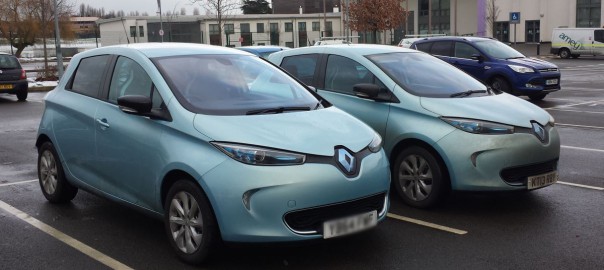
ZOE Twins (Image: T. Larkum)

Volkswagen Recall Casts Shadow Over France’s Auto Industry

How Will Emissions Scandal Affect The Future Of French Diesel?

ZOE Twins (Image: T. Larkum)
Renault’s electric car, the Zoe, accounted for half of all electric car sales in France in 2015. The car company, which traditionally produced diesel engines, has begun diversifying as the popularity of diesel wanes. (Image: T. Larkum)

Known for such cars as the classic Citroen Deux Chevaux and the luxury vehicles of powerhouse Renault, France has long been one of the largest and most recognizable car manufacturers in Europe — and indeed, in the world. But as its automotive market struggles to recover from lagging sales and more people grow skeptical of the environmental effects of diesel fuel (most French cars have diesel engines), a widening Volkswagen emissions scandal could mark a turning point for French auto manufacturing. A consumer shift to gasoline or alternative fuel would spell fiscal disaster for French car producers, unless they start diversifying engine fuels and looking to alternative energy, analysts said.

“I think it’s going to be negative; it’s very simple,” said macroeconomics analyst Jean Ergas, an adjunct assistant professor at the New York University School of Professional Studies. “This is going to be a big hit for them.”

Read more: IB Times

‘Think of what would change if we valued terrestrial water as much as we value the possibility of water on Mars.’ (Image: A. Krauze)

There may be flowing water on Mars. But is there intelligent life on Earth?

While we marvel at Nasa’s discoveries, we destroy our irreplaceable natural resources – so we can buy pre-peeled bananas and smartphones for dogs

‘Think of what would change if we valued terrestrial water as much as we value the possibility of water on Mars.’ (Image: A. Krauze)

Evidence for flowing water on Mars: this opens up the possibility of life, of wonders we cannot begin to imagine. Its discovery is an astonishing achievement. Meanwhile, Martian scientists continue their search for intelligent life on Earth.

We may be captivated by the thought of organisms on another planet, but we seem to have lost interest in our own. The Oxford Junior Dictionary has been excising the waymarks of the living world. Adders, blackberries, bluebells, conkers, holly, magpies, minnows, otters, primroses, thrushes, weasels and wrens are now surplus to requirements.

In the past four decades, the world has lost 50% of its vertebrate wildlife. But across the latter half of this period, there has been a steep decline in media coverage. In 2014, according to a study at Cardiff University, there were as many news stories broadcast by the BBC and ITV about Madeleine McCann (who went missing in 2007) as there were about the entire range of environmental issues.

Think of what would change if we valued terrestrial water as much as we value the possibility of water on Mars. Only 3% of the water on this planet is fresh; and of that, two-thirds is frozen. Yet we lay waste to the accessible portion. Sixty per cent of the water used in farming is needlessly piddled away by careless irrigation. Rivers, lakes and aquifers are sucked dry, while what remains is often so contaminated that it threatens the lives of those who drink it. In the UK, domestic demand is such that the upper reaches of many rivers disappear during the summer. Yet still we install clunky old toilets and showers that gush like waterfalls.

Read more: The Guardian

Mark Carney said: ‘Once climate change becomes a defining issue for financial stability, it may already be too late.’ He proposes that firms ‘would disclose not only what they are emitting today, but how they plan their transition to the net-zero world of the future’. (Image: Jonathan Brady/PA)

Carney warns of risks from climate change ‘tragedy of the horizon’

Business leaders are finally waking up to what’s coming down the line.

Bank of England governor tells Lloyd’s insurers that ‘challenges currently posed by climate change pale in significance compared with what might come’

Mark Carney said: ‘Once climate change becomes a defining issue for financial stability, it may already be too late.’ He proposes that firms ‘would disclose not only what they are emitting today, but how they plan their transition to the net-zero world of the future’. (Image: Jonathan Brady/PA)

Mark Carney, the governor of the Bank of England, has warned that climate change will lead to financial crises and falling living standards unless the world’s leading countries do more to ensure that their companies come clean about their current and future carbon emissions.

In a speech to the insurance market Lloyd’s of London on Tuesday, Carney said insurers were heavily exposed to climate change risks and that time was running out to deal with global warming.

The governor said that proposals would probably be put to the G20 meeting in Turkey in November urging the world’s leading developed and developing countries to bring in tougher corporate disclosure standards so that investors could better judge climate change risks.

“The challenges currently posed by climate change pale in significance compared with what might come,” Carney said. “The far-sighted amongst you are anticipating broader global impacts on property, migration and political stability, as well as food and water security. So why isn’t more being done to address it?”

Read more: The Guardian

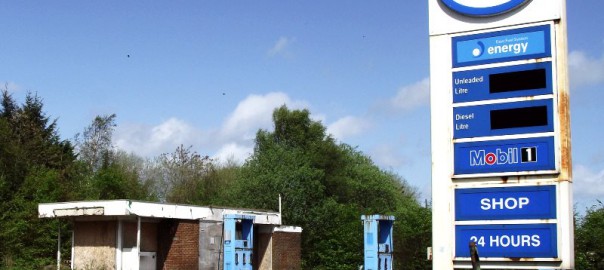
The derelict Crowood Petrol Station next to the dual carriageway on the Cumbernauld Road as you enter the wee town of Chryston on the edge of Glasgow (Image: byronv2 via Flickr)

VW wipeout means the end of fossil fuels looms near

Could VW really be responsible for tens of thousands of deaths from pollution?!

VW’s pollution cheating has caused thousands of premature deaths, write Mike Berners-Lee & Chris Goodall, creating costs that could destroy the company’s entire shareholder equity. But this is no ‘Black Swan’ event. It is an early example of the existential threat to the fossil fuel economy.

The derelict Crowood Petrol Station next to the dual carriageway on the Cumbernauld Road as you enter the wee town of Chryston on the edge of Glasgow (Image: byronv2 via Flickr)
The derelict Crowood Petrol Station next to the dual carriageway on the Cumbernauld Road as you enter the wee town of Chryston on the edge of Glasgow (Image: byronv2/Flickr)

No pension fund trustee can legitimately ignore the increasingly obvious likelihood of a rapid destruction of shareholder value as the world speeds up the switch away from coal, oil and even gas.

VWs diesel cars emit a much larger amount of nitrogen oxides (NOx) and fine particulates than regulators thought.

Greenpeace estimates that an extra 60,000 to 24,000 tonnes of NOx have been emitted each year from 11m vehicles sold around the world.

NOx and fine particulates have severe impacts on human health and are responsible for many early deaths each year.

We can put a crude financial figure on the impact of the loss of life. Roughly speaking, we think that VW’s actions resulted in costs of between £21 and £90bn for NOx pollution alone.

The larger figure is greater than the stock market value of the entire company. VW would therefore be worthless if called upon to pay the full price for its actions.

Our calculation is based on three separate numbers. All are approximate and can be argued over. But we thought it might be helpful to do the arithmetic nevertheless. These numbers only estimate the social cost of early deaths, not the full burden of ill health, from NOx pollution.

Read more: The Ecologist

Oil’s place in the global energy mix is transforming, including in mobility, which uses three-fifths of world oil (Image: Thinkstock/curraheeshutter)

The end of the Oil Age is in sight

Shell’s departure from the Arctic is a very significant event in the global energy picture, writes Energy Post editor-in-chief Karel Beckman. It is another sign that the End of the Oil Age is in sight.

Oil’s place in the global energy mix is transforming, including in mobility, which uses three-fifths of world oil (Image: Thinkstock/curraheeshutter)

After Volkswagen, a second major European company had to face acute embarrassment this week. Shell did not commit fraud, but they sure made a billion-dollar blooper in the Arctic. Yes, taking risks is part of what business is about, and sometimes wells turn up dry, but there is a lot more to the story than that.

Clearly the disappointing results of a single exploratory well (“Burger J”) in a single basin can’t have been sufficient reason for Shell to suddenly give up on its Arctic venture altogether. “For the foreseeable future”, as the company put it, i.e. indefinitely. In fact, the company did give two additional reasons: “the high costs associated with the project, and the challenging and unpredictable federal regulatory environment in offshore Alaska”.

But neither of these can have come as a surprise. Critics have been warning for a long time that the costs of Alaskan drilling are prohibitive, and the “regulatory environment” in this part of the world will inevitably be unpredictable.

Read more: Energy Post

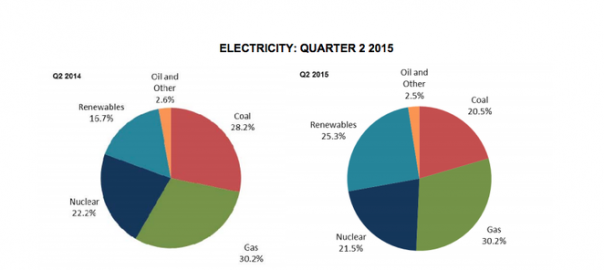
Electricity supply sources Q2 2015 (Image: UK gov)

Renewables beat coal in UK electricity mix

Some good news on renewables – despite government policy.

Often when we talk about countries breaking renewable energy records, we focus on momentary spikes caused by exceptionally sunny or windy days. While these records are, in and of themselves, important—they still leave a bigger question hanging: How does the electricity grid cope when the sun isn’t shining or the wind isn’t blowing?

Electricity supply sources Q2 2015 (Image: UK gov)

What’s becoming increasingly clear, however, as countries integrate more renewable energy into their grids, is that clean energy can indeed supply a significant portion of our energy over an extended period of time. Indeed, new data from the UK government on Q2 electricity supply suggests that renewables beat out coal in the country’s electricity mix for the first time ever over an entire quarter. Specifically, renewables accounted for 25.3% of electricity generated in Q2 2015 (up from 16.7% in Q2 2014). Meanwhile coal fell from 28.2% to 20.5% in the same period. Gas remained the same. And nuclear fell slightly to 21.5%.

Read more: Treehugger

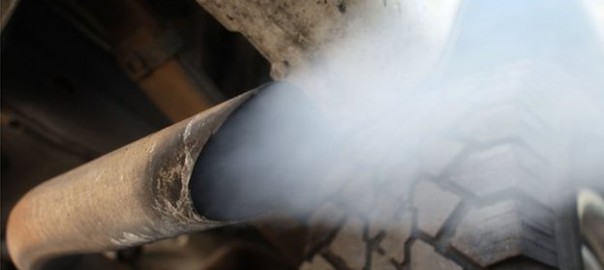
Car exhaust (Image: BBC)

After diesel scandal Volkswagen must go electric

Perhaps the VW emissions scandal will actually do some good.

Your new clean diesel turns to be less clean than you thought? Switch to an electric car.

Car exhaust pollution (Image: Wikipedia)

In recent days, the loudest thing in the automotive industry is Volkswagen’s scandal over diesel engine emissions.

We at InsideEVs don’t cover conventional cars, but there’s something we’d like to note. After over 100 years of developments, we simply don’t believe that internal combustion engines can be significantly improved upon in terms of fuel economy or emissions.

Proof of that is seen in such things as carmakers using more and more gears (like eight or even nine), while every next gear translates to less gain than the previous one, at some additional cost. Automakers are literally scratching at whatever they can.

In the world of tightening emission standards, evading them is worth billions of dollars and there could be plenty of people sitting tight-lipped about true emissions in various automotive groups.

Read more: Inside EVS

Car exhaust (Image: BBC)

Electric Cars Cut Greenhouse Gases and Energy Use

No surprise here for most EV drivers, but still good to see in black and white.

Electric cars charged on the grid generally have a lower carbon footprint than internal-combustion vehicles–and their wells-to-wheels carbon emissions only shrink as more renewable energy comes online.

That’s the conclusion of a new study on the environmental effects of future transportation electrification, jointly conducted by the Electric Power Research Institute (EPRI) and National Resources Defense Council (NRDC).

It follows and updates a landmark 2007 report by the pair that was among the first to analyze the long-term effects of electric cars, both on global carbon emissions and on electric-utility infrastructure.

goultralow2015_EVs_parliament_GUL

A transition to more electric cars and greener grid-electricity sources, it confirms, could have a significant impact in reducing greenhouse gas emissions.

The study confirms what several previous analyses have said: As the grid gets cleaner, so do electric cars.

Read more: Green Car Reports

Diesel pumps could run dry, says RAC Foundation

Britain’s diesel pumps could “run dry” because of a growing dependence on foreign fuel, according to the RAC Foundation.

85565100_85565099_diesel_unk

The motoring research group said diesel demand had been rising for decades, but UK refineries were struggling to cope.

There were 11 million diesel cars on the road last year, compared with just 1.6 million in 1994.

The RACF said that, at this rate, diesel would be four times more popular than petrol by 2030.

Yet we consume twice as much diesel as we produce, and that growing reliance on countries including Russia and India to supply the fuel could leave motorists “at the mercy of the global market” in future, the foundation said.

“Even if we are not in conflict with those countries that control the taps, they might simply decide they need more of what they produce for their own markets,” RACF director Steve Gooding told the BBC.

“If supply is interrupted, then at best we’ll see sharp rises in forecourt prices and, at worst, there is the unlikely but real possibility of pumps running dry.”

Read more: BBC