2015 saw the UK destroy its position as a climate and energy leader, and now faces some tough questions in the wake of a successful Paris climate agreement.
Despite a big year in 2014 which saw a number of renewable energy records broken and strong momentum created for the country’s renewable energy industry, following 6 months of baffling policy decisions and a lacklustre attendance in Paris, the UK has a long way to go if it is to accomplish its role in tackling climate change.
If we don’t cut greenhouse gases, it’s not just storms and rising seas we’d have to worry about. The heat alone could kill a lot of us.
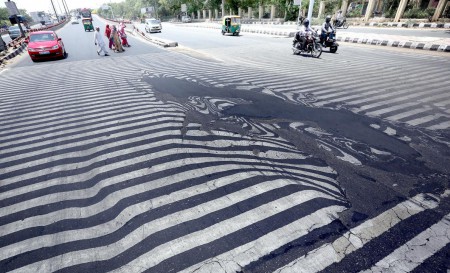
In India last May, temperatures rose to 120°F (50°C), killing more than 2,300 people—and melting this street in New Delhi (Image: H. Tyagi/EPA)
If greenhouse gas emissions are not reduced, rising temperatures and humidity wrought by global warming could expose hundreds of millions of people worldwide to potentially lethal heat stress by 2060, a new report suggests.
The greatest exposure will occur in populous, tropical regions such as India, Southeast Asia, the Middle East, and Africa. But even in the northeastern United States, as many as 30 million people might be exposed at least once a year to heat that could be lethal to children, the elderly, and the sick, according to the new study.
It’s the first study to look at future heat stress on a global basis, says Ethan Coffel, a PhD candidate in atmospheric sciences at Columbia University, who presented the results on Monday at the American Geophysical Union meeting in San Francisco. Coffel and his colleagues used climate models and population projections to estimate how many people could face dangerous heat in 2060—assuming that greenhouse gas emissions continue to rise sharply on a “business-as-usual” course.
Hedge fund manager and Kynikos Associates President, Jim Chanos was interviewed on CNBC on Thursday, and had a couple interesting (and uncharacteristic) observations worth noting.
The first being bullish on solar, but still maintaining a short position in Solar City (of whom Chanos says is not a tech company, but a finance company); despite the recent surge in PV stocks thanks to the pending 5 year renew of the 30% federal tax credit.
The second point of interest was a message to all the oil pumpers out there:
“I think if you were to look out five or 10 years, if I was a member of OPEC, I would be pumping as much as I could today while it’s worth something, because it might not be worth a whole lot by 2030.”
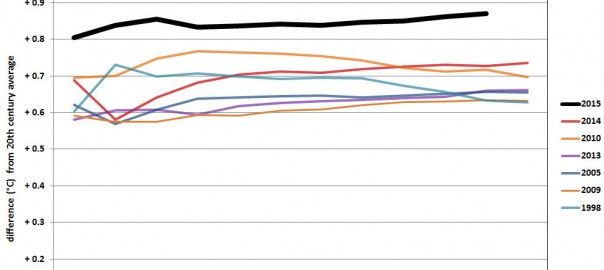
This year will go down in history as the warmest year on record, beating out 2014 for the dubious distinction. That fact alone is striking, considering the sped-up pace of global warming in recent years. However, it’s the margin by which this year is beating out all others that is most impressive.
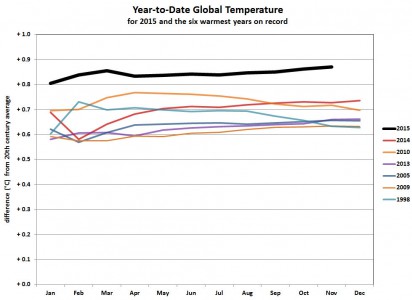
On Thursday, the National Oceanic and Atmospheric Administration (NOAA) released a chart that illustrates how far ahead 2015 is compared to the six other warmest years on record. The chart essentially shows that there’s no contest — 2015 is running away with the title, propelled by a one-two punch of manmade global warming and a strong El Niño event in the tropical Pacific Ocean:
Global average surface temperatures for the year-to-date compared to the six other warmest years-to-date (Image: NOAA/NCEI)
The new chart was released at the same time as data showing that November was the warmest such month in NOAA’s database, which extends back to 1880. The November global average temperature, averaged over the land and ocean using a variety of temperature sensors, from buoys to climate sites scattered around the world, was an astonishing 1.75 degrees Fahrenheit, or 0.97 degrees Celsius, above the 20th century average. This beat November 2013 by 0.27 degrees Fahrenheit, or 0.15 degrees Celsius.
November 2015 also became the seventh straight warmest month on record. The amount by which the monthly average temperature exceeded the typical reading was the second-highest temperature departure from average of any month on record.
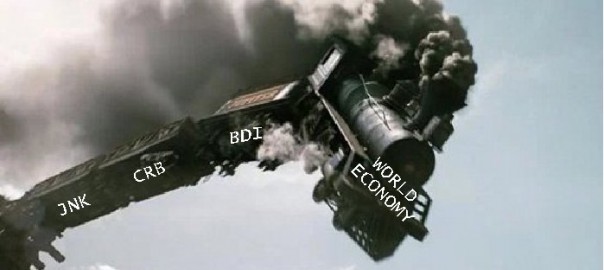
Today we are going to review irrefutable evidence that a slow motion train wreck is already well underway across global markets, that will end with the last wagons on the train, the S&P500 index and the Dow Jones Industrials, disappearing into the abyss right after their immediate predecessors.
There are still a remarkable number of investors out there, and an even more remarkable percentage of mainstream financial journalists, who seem to think that everything is alright just because the flagship indices like the Dow Jones Industrials and the S&P500 haven’t caved in yet, but as we will now see they are probably just about to.
Like the addict who will sacrifice his family to feed his addiction, western foreign policy has for decades supported tyrants who have oppressed the peoples of oil-producing states across the Middle East
It would be wrong to argue, as many did in the case of the Iraq War, that the motivation for bombing in Syria is to secure our access to oil. But what is clear is that the Syrian crisis and wider destabilisation of the Middle East has direct links to our addiction to oil. As a poignant reminder of the role oil plays in the conflicts of the Middle East, the first British bombing sorties targeted oil wells in eastern Syria.
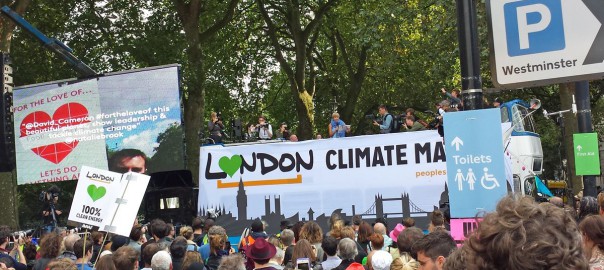
London Climate March (Image: T. Larkum)
Like the addict who will sacrifice his family to feed his addiction, western foreign policy has for decades supported tyrants who have oppressed the peoples of oil-producing states across the Middle East. Our interventions in the region have been driven almost entirely by self-interest, taking little account of the wish for self-determination of the people who live there.
The scientific evidence that our addiction to petroleum is also disrupting the climate is now unequivocal. Equally compelling is the suggestion that climate change is leading to conflict. A working group of the Intergovernmental Panel on Climate Change wrote in 2014 that there was “justifiable common concern” that climate change increased the risk of armed conflict in certain circumstances.Perhaps they had in mind exactly the sort of circumstances witnessed in Syria.
Scientists believe that an extreme drought between 2006 and 2009 was most likely due to climate change. This drought led to crop failures, forcing the migration of up to 1.5 million people from rural to urban areas. This in turn added to social stresses that eventually gave rise to civil unrest and eventually to the civil war.
There can be no complacency after the Paris talks. Hitting even the 1.5C target will need drastic, rapid action
With the climate talks in Paris now over, the world has set itself a serious goal: limit temperature rise to 1.5C. Or failing that, 2C. Hitting those targets is absolutely necessary: even the one-degree rise that we’ve already seen is wreaking havoc on everything from ice caps to ocean chemistry. But meeting it won’t be easy, given that we’re currently on track for between 4C and 5C. Our only hope is to decisively pick up the pace.
Severe Flooding, Against a Background of Wind Turbines: November 2012, Tyringham, Bucks. (Image: T. Larkum)
In fact, pace is now the key word for climate. Not where we’re going, but how fast we’re going there. Pace – velocity, speed, rate, momentum, tempo. That’s what matters from here on in. We know where we’re going now; no one can doubt that the fossil fuel age has finally begun to wane, and that the sun is now shining on, well, solar. But the question, the only important question, is: how fast.
The international climate deal agreed in Paris is a turning point in history which signals the end of the fossil fuel era, it has been claimed.
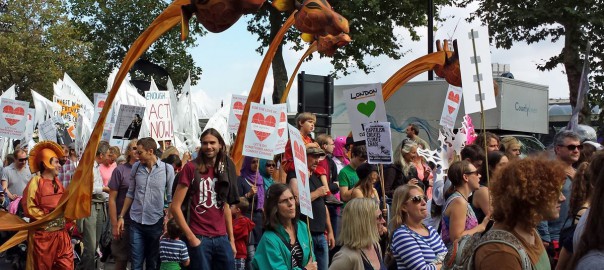
London Climate March (Image: T. Larkum)
The final draft of the agreement has received a largely positive response from environmental and aid campaigners, experts and analysts, although there are concerns it does not go far enough to tackle climate change.
Emma Ruby-Sachs, acting executive director of campaign group Avaaz, said:
“If agreed, this deal will represent a turning point in history, paving the way for the shift to 100% clean energy that the world wants and the planet needs.”
Michael Jacobs, senior adviser for the New Climate Economy project, and former adviser to Gordon Brown, also described it as a historic turning point.
“Historians will see this as the turning point: the moment when the world started shifting decisively away from fossil fuels and towards clean and safe energy systems.
“Remarkably this effectively signals the end of the fossil fuel era. This is unquestionably a great success. But the work really starts now. These commitments now need to turn into policy, and policy into investment.”
Kumi Naidoo, executive director of Greenpeace International, which campaigns strongly against fossil fuel expansion, went further, saying:
“The wheel of climate action turns slowly, but in Paris it has turned. This deal puts the fossil fuel industry on the wrong side of history.”
Has oil become an unwanted commodity? Plunging prices suggest something is going on.
The sun sets on drilling (Image: Pexels)
While diplomats in Paris hash out a legally binding accord to significantly curb greenhouse gas emissions, oil is trading at a seven-year low, closing Tuesday below $40 per barrel.
The price drop follows OPEC’s failure to put a cap on oil production last week. Energy analysts predict prices could go lower in the next 12 months, but Dan Dicker, an oil analyst with The Street and OilPrice.com, says we could be in for a wild ride that will drive oil prices back up — way up.
“I think there could be a change of four to five million barrels [a day] over the course of the next 22 or 23 months in terms of what comes off line in terms of supply and what gets added in terms of demand,” says Dicker, the author of “Shale Boom, Shale Bust: The Myth of Saudi America.” “It would mean a huge difference in the price of oil. In fact, I’m looking at prices in three digits as early as 2017.”
Dicker concedes that his hypothesis deviates sharply from other analysts who believes prices will stay low. He argues that the Saudis have reached a new limit when it comes to oil production.
“I think that they’re literally, and again I’m on the other side of this, as close to full production capabilities as they’re going to get,” he says. “They’re at a little more than 11 million barrels a day. We’ve talked about spare capacity for years with the Saudis, with a sort of a question mark on how much spare capacity they had. In other words, how much can the ultimately pump if they just wanted to open up the spigots full bore? This — 11 million barrels a day — has absolutely shocked the analysts from their predictions two, three, or four years ago. I think that the limits have really been reached.”
Over the next six to eight months, Dicker predicts that oil and gas prices will remain low, under $50 a barrel. In the long-term, other members of OPEC can increase production if they secure funding, including Iran and Iraq, but Dicker doesn’t find such a scenario possible.
“The potential there is huge,” he says. “But with all that’s going on there geopolitically, obviously that’s not a great bet to increase production two or three fold over the next three or four years.”
The International ZEV Alliance, an international group geared to cut greenhouse-gas emissions by spurring more electric vehicle sales, has used the United Nations’ COP21 climate-change conference in Paris to set a rather lofty goal.
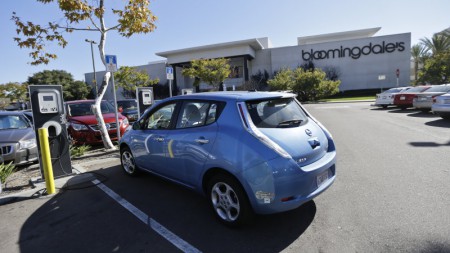
Nissan Leaf on charge
The group wants to have all new cars sold within their jurisdictions to be emissions-free by 2050, according to Green Car Reports. The group includes eight US states, (California, Connecticut, Maryland, Massachusetts, New York, Oregon, Rhode Island, and Vermont) along with Quebec, Germany, the Netherlands, Norway, and the UK.
The Alliance was officially founded in September. At the time, it was determined that the group accounted for seven percent of global vehicle sales but also made up 38 percent of electric-vehicle sales, so these entities already appear to be the world leaders in the zero-emissions vehicle movement. The eight US states have been at it for a while, of course, joining up in May 2014 to state their collective goal to have 3.3 million electric vehicles on their roads by 2025. Those states and their Multi-State ZEV Action Plan account for almost one-fourth of US light-duty vehicle sales.
Of course, Norway always shoots high when it comes to zero-emissions transportation. Long known for its abundance in hydroelectricity and big-time plug-in vehicle incentives, that country is aiming to have all new cars emissions-free within the next decade.
Another group of US and non-US entities, including California, France’s Alsace region and parts of Holland, signed onto the Under 2 MOU agreement at COP21. Those members aim to cut greenhouse-gas emissions by 2050 to less than 20 percent of those in 1990.