In 2000, Naomi Oreskes, a geologist by training, was working at the Scripps Institute for Oceanography in San Diego, an organization with a long history of climate change research.
Naomi Oreskes (Image: Harvard University photographer Claudio Cambon)
“All the scientists around me spoke about climate change as if it were a settled matter. Proven scientifically. Manmade,” recalls Oreskes, a renowned Harvard professor specializing in the history of science. “Yet I noticed that in the media, the issue was reported as if there were a big debate over whether it was even real. That contrast led me to the work I published in 2004.”
Oreskes, whom The New York Times has called “one of the biggest names in climate science,” did what any interested party could have done then, but didn’t. She counted the scientific papers on climate change — 928 at the time — and determined that not one disagreed: all found that climate change was real, underway and manmade. She exploded the myth that any debate existed. The media took notice; and she, of course, came under attack from climate science deniers.
Another Oil Crash Is Coming, and There May Be No Recovery. Superior electric cars are on their way, and they could begin to wreck oil markets within a decade.
It’s time for oil investors to start taking electric cars seriously.
In the next two years, Tesla and Chevy plan to start selling electric cars with a range of more than 200 miles priced in the $30,000 range. Ford is investing billions, Volkswagen is investing billions, and Nissan and BMW are investing billions. Nearly every major carmaker—as well as Apple and Google—is working on the next generation of plug-in cars.
This is a problem for oil markets. OPEC still contends that electric vehicles will make up just 1 percent of global car sales in 2040. Exxon’s forecast is similarly dismissive.
The oil price crash that started in 2014 was caused by a glut of unwanted oil, as producers started cranking out about 2 million barrels a day more than the market supported. Nobody saw it coming, despite the massively expanding oil fields across North America. The question is: How soon could electric vehicles trigger a similar oil glut by reducing demand by the same 2 million barrels?
That’s the subject of the first installment of Bloomberg’s new animated web series Sooner Than You Think, which examines some of the biggest transformations in human history that haven’t happened quite yet. Tomorrow, analysts at Bloomberg New Energy Finance will weigh in with a comprehensive analysis of where the electric car industry is headed.
Even amid low gasoline prices last year, electric car sales jumped 60 percent worldwide. If that level of growth continues, the crash-triggering benchmark of 2 million barrels of reduced demand could come as early as 2023. That’s a crisis. The timing of new technologies is difficult to predict, but it may not be long before it becomes impossible to ignore.
Will global oil demand peak by 2030? Is peak oil demand the new peak oil supply?
Many trends now point in the direction of this remarkable possibility:
In December the nations of the world agreed unanimously in Paris to leave most of the world fossil fuels in the ground.
Oil demand has been declining in developed countries for over a decade.
Electric vehicle sales are exploding around the world, especially China.
Battery prices are continuing their unexpectedly rapid price drop.
Tesla and Chevy now say their new 200-mile-range EV could cost Americans $30,000 — a game-changing price.
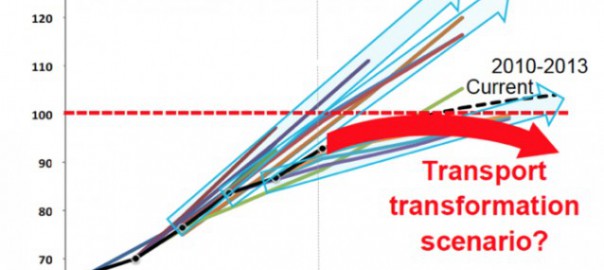
In November, a Bloomberg Business story, “The Oil Industry Has Been Put on Notice,” warned “the transformation of oil markets may be coming sooner than we think.” This recent Bloomberg New Energy Finance chart includes oil forecasts the International Energy Agency (IEA) has made since 1994:
The energy storage system market is expanding at a fast pace, and 2016 could double the world’s power output of installed ESS.
General Electric Lithium-Ion Energy Storage System (Image: GE)
ESS is becoming dominated by lithium-ion batteries – cost reductions of those batteries, combined with government funding programs and utility tenders, brings tremendous growth of orders, according to IHS.
The global pipeline of planned battery and flywheel (who still uses flywheels these days?) projects had reached 1.6 gigawatts (GW) in Q4 2015 (up 45% compared to Q3 2015).
IHS doesn’t reveal the MWh of ESS because they measure installations in MW or GW. That makes comparison to EVs more difficult.
45% of new ESS installations are planed in the U.S. followed by Japan with 20%.
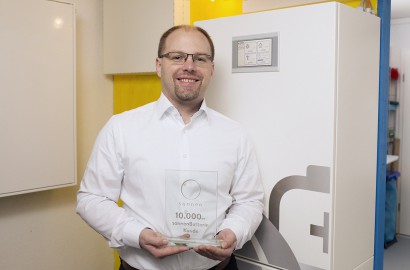
German startup Sonnen shipped its 10,000th battery system this week, claiming a leading position in the global smart energy storage market as it takes on Tesla and shakes up the traditional electricity business model.
“Our goal is really to create a world where everyone is able to cover their own energy needs with a decentralized energy source.”
Sonnen marked the milestone by gifting German homeowner Stefan Wolpert an extra 2 kilowatts of battery capacity and a free membership to sonnenCommunity — Sonnen’s decentralized energy trading platform.
The shipment announcement comes on the heels of the startup’s expansion into the U.S. last month, with a new headquarters unveiled in Los Angeles and a rapidly growing distribution network. Sonnen has already partnered with 30 local solar installers and aims to reach 100 partners by the end of the year.
In early February, Sonnen announced that it is now ready to install systems in Hawaii after meeting the advanced energy storage requirements from the Hawaii Electric Companies (HECO). The sonnenBatterie, which comes fully equipped with smart energy management technology, is billed as an “out-of-the-box” solution that meets the obligations under HECO’s new distributed energy tariffs. Company executives say a 4-kilowatt-hour sonnenBatterie in Hawaii will cost about $10,000 and provide a return on investment in as little as 6.5 years.
At the outset, Sonnen is targeting sales to solar customers in places with high electricity costs, like Hawaii and Puerto Rico. California is another promising market, where storage benefits from incentives and can help solar customers arbitrage time-of-use rates. But the company ultimately sees batteries offering financial and resiliency benefits across the U.S., and is currently working with Spruce to offer attractive financing packages for energy storage in all 50 states.
Sonnen already has 1,000 battery storage systems under contract in the U.S. and aims to contract for up to 3,500 systems through the year. As Sonnen increases its U.S. presence, it continues to grow sales in seven European countries, Australia and the Philippines.
“Our goal is really to create a world where everyone is able to cover their own energy needs with a decentralized energy source,” said Boris von Bormann, CEO of Sonnen North America, at the company’s L.A. office launch. “Of course we love the utilities, but just imagine if you could take your energy future into your own hands.”
Major study finds chemical-free agriculture restores the soil and can produce higher yields than ‘conventional’ methods
Severe Flooding, Against a Background of Wind Turbines: November 2012, Tyringham, Bucks. (Image: T. Larkum)
Organic farming – long held to be irrelevant in tackling world hunger – could be key to feeding the world as global warming takes hold, one of the biggest studies ever to be carried out into the “contentious” practice has concluded.
The research, which has reviewed hundreds of studies stretching back over four decades, not only overturns conventional wisdom but contradicts Britain’s official Food Standards Agency, which has repeatedly attacked chemical-free agriculture. It adds to emerging evidence that it may be more productive and profitable than conventional farming in the long term, especially in developing countries, and says it can provide an “ideal blueprint in addressing climate change”.
Just a week after the first Tesla Powerwall for residential use in Australia has reportedly been installed in a Sydney suburb, it’s now the UK’s turn to get its first Tesla home battery pack.
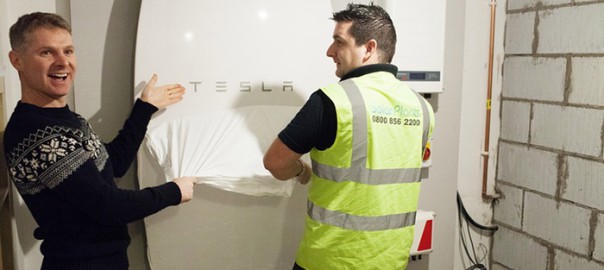
A SolarPlant engineer installs the UK’s first Powerwall home battery in Cardiff at Mark Keer and Lyndsey Bennett’s home (Image: G. Phillips/Guardian)
Homeowner Mark Kerr has become the first British Tesla Powerwall owner after a SolarPlant engineer installed the system at his home in Wales. Kerr and his family have a solar installation at their home and will use the excess energy produced during the day to charge the battery pack. Kerr talked to The Guardian about his new energy storage system:
“This is the future, definitely. For me this is the logical next step. We have the solar panels but we need a way to make best use of the power they produce. Me and my family are all out in the day, and we are not making use of the enormous amount of clean energy that our solar panels produce. The battery will allow us to store the energy we don’t use in the day to use when we need it in the evenings.”
Kerr, an electrician by trade, added about the design of the Powerwall:
“It’s a gorgeous-looking piece of technology, its design is very sleek and minimalistic and something you can hang on the wall like a piece of art, definitely nothing like some of the other clunky looking batteries.”
South Wales solar installer Solar Plants installed Kerr’s new home battery pack. The company shared some marketing statistics about the Powerwall. Since it has been made available, the company emailed 3,000 solar customers about the battery. Out of the 1,500 who opened the email, 600 said they wanted one.
These potential buyers will have to wait a bit since Solar Plants says Kerr’s installation will work as a pilot project to get a better idea of how the system works.
Renault will provide used EV batteries to Connected Energy Ltd for second-life application in its E-STOR product
Renault is the electric vehicle market leader in Europe
E-STOR is a revolutionary energy storage system that can reduce costs and enable more flexible and efficient use of energy – including high capacity fast charging
E-STOR will be available in the UK from July 2016
2016 -Connected Energy Ltd E-Stor and Renault ZOE (Image: Renault)
Renault and Connected Energy are partnering to develop sustainable and efficient ways of using electric vehicle batteries at the end of their useable in-vehicle life in order to supply innovative and more affordable vehicle charging solutions.
At the end of their useful in-vehicle life, Renault EV batteries still have considerable remaining capacity, which means that they can continue to give great service in other applications before they are ultimately recycled. And with rapidly increasing EV sales – 97,687 EVs were sold in Europe in 2015, up 48% on 2014 – so is the requirement in energy to charge them.
E-STOR: a flexible and environmentally friendly energy management system
Through its award-winning E-STOR technology, Connected Energy is offering a highly innovative solution to this conundrum through use of ‘second life’ EV batteries.
This can be used, for example, to store energy generated from on-site renewable generation resources such as solar panels and wind turbines, and then release it as it’s needed at a later time. The system also allows the batteries to be charged via low-cost off-peak electricity tariffs, enabling users to reduce their energy costs.
The batteries used are Renault EV batteries, chosen by Connected Energy because Renault, as EV market leader with 23,000 units sold in Europe in 2015, has expertise in the technology, its lifecycle and impact on the environment.
The first E-STOR product is nominally rated at 50kW/50kWhr which could typically be used to support one rapid charger or a cluster of fast chargers but the system is fully scalable and higher capacity units will follow.
In practical terms, as well as allowing more efficient use of energy, the system can also enable installation of rapid electric vehicle charging in sites where electricity supply would traditionally only allow slower rates. Instead of charging vehicles via a high-capacity supply directly from the grid, E-STOR allows multiple batteries to be charged at a slower rate over a period of time, ready to release their energy and charge a car when an EV driver needs it.
Renault offers two concrete solutions with its electric vehicles and their batteries through E-STOR. First to the grid, by providing energy storage that prevents power grid overload and balances supply and demand. Second to the environment, because batteries not fitted for automobile use, but that still have considerable remaining capacity, can have a longer life and lower carbon footprint before they are actually recycled.
In June 2015, E-STOR was named winner of the innovation category in the prestigious British Renewable Energy Awards 2015, hosted by the Renewable Energy Association.
Matthew Lumsden, Managing Director, Connected Energy, said:
“E-STOR will enable the more cost-effective roll-out of electric vehicles in commercial and industrial settings, thus increasing the overall sustainability of this clean form of transport. With Renault we have secured the supply of second life batteries for future E-STOR installations.”
Eric Feunteun, Electric Vehicle Program Director, Renault, commented:
“The second life application of Renault electric vehicle batteries supports Renault’s commitment to the energy transition in the automotive industry. Through E-STOR, EV owners can charge their car at reduced costs with electricity that is less carbon-dependent. It makes driving an EV a smart and even more sustainable transportation solution. With this energy management technology, EVs and their batteries become an asset for the grid rather than create overload.”
Renault is a leader and pioneer in the emerging electric vehicle market and has sold electric vehicles since 2011, offering a range of 100 per cent electric cars and vans to suit most requirements. The ZOE supermini sits alongside the fun and distinctive Twizy urban run-around which is also available in a commercial vehicle version with a boot instead of a rear passenger seat – Twizy Cargo. Completing the Renault Z.E (Zero Emissions) line-up is the Kangoo Van Z.E. – the perfect compact van for urban deliveries and tradesmen and is available in a range of bodystyles.
In 2015, Renault was the best performing EV brand in Europe, with sales rising 49 per cent to 23,086 units, with a 23.6 per cent European EV market share. It was a similar story in the UK, with ZOE sales up 102 per cent in 2015 to 2,053 vehicles – significantly outpacing the UK electric vehicle market, which was up 48 per cent on 2014.
As these new crisis bailouts for fossil fuels show, it’s those who are least deserving who get the most government protection
‘Oil companies have already been granted ‘ministerial buddies’ to ‘improve access to government’ – as if they didn’t have enough already.’ (Image: A. Krauze)
Those of us who predicted, during the first years of this century, an imminent peak in global oil supplies could not have been more wrong. People like the energy consultant Daniel Yergin, with whom I disputed the topic, appear to have been right: growth, he said, would continue for many years, unless governments intervened.
Oil appeared to peak in the United States in 1970, after which production fell for 40 years. That, we assumed, was the end of the story. But through fracking and horizontal drilling, production last year returned to the level it reached in 1969. Twelve years ago, the Texas oil tycoon T Boone Pickens announced that “never again will we pump more than 82 million barrels”. By the end of 2015, daily world production reached 97m .
Instead of a collapse in the supply of oil, we confront the opposite crisis: we’re drowning in the stuff. The reasons for the price crash – an astonishing slide from $115 a barrel to less than $30 over the past 20 months – are complex: among them are weaker demand in China and a strong dollar. But an analysis by the World Bank finds that changes in supply have been a much greater factor than changes in demand. Oil production has almost doubled in Iraq, as well as in the US. Saudi Arabia has opened its taps, to try to destroy the competition and sustain its market share – a strategy that some peak oil advocates once argued was impossible.
The outcomes are mixed. Cheaper oil means that more will be burned, accelerating climate breakdown. But it also means less investment in future production. Already, $380 billion that was to have been ploughed into oil and gas fields has been delayed. The first places to be spared are those in which extraction is most difficult or hazardous. Fragile ecosystems in the Arctic, in rainforests, in remote and stormy seas, have been granted a stay of execution.
ONE HUNDRED new charging points will be created in residential streets in Oxford to make electric vehicle ownership possible for 16,000 extra homes.
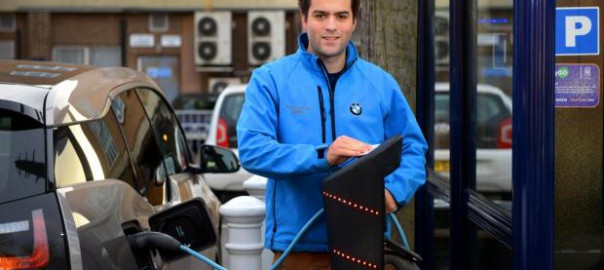
James Brown, from BMW I sales, with a BMW i3 electric car at a charging point at the Tesco car park off Cowley Road
The largest pilot of its kind in the world will begin when 30 trial points of various kinds are installed in pavements and lampposts by the end of this year.
The most successful types of charger points will then be rolled out in 100 residential streets around the city, probably from 2018.
Oxford City Council and Oxfordshire County Council hope to encourage thousands more people to buy electric cars to help cut emissions in the city.
City executive board member for climate change, John Tanner, said:
“Climate change and poor air quality are two of the biggest issues facing Oxford and we all need to do everything we can to cut vehicle emissions.
“However, for people living in Oxford’s beautiful but narrow terraced streets, charging an electric car is a real problem. This project aims to remove that barrier.
“By installing 100 electric charging points, we are going to turn the Oxford into a city filled with electric avenues.”