Category Archives: Energy and Climate Change

News and articles on climate change, vehicle pollution, and renewable energy.

Fully electric vehicles will be exempt from paying the future ULEZ charge

Guide to forthcoming London Ultra Low Emission Zone

London’s Mayor Sadiq Khan has announced that London’s new Ultra Low Emission Zone (ULEZ) could be introduced as early as 2019 in the latest attempt to reduce air pollution across the capital.

Fully electric vehicles will be exempt from paying the future ULEZ charge

This will be a year earlier than previously anticipated, with the roll-out initially focused on inner London, before expanding to both the North and South Circular starting from 2020.

Mr Khan stated:

“Just as in the 1950s, air pollution in London today is literally killing Londoners. But unlike the smoky pollution of the past, today’s pollution is a hidden killer.

“The scale of the failure to tackle the problem is demonstrated by the failure of the Government and the previous Mayor to meet legal pollution limits. Urgent action is now needed to ensure Londoners no longer have to fear the very air we breathe.”

Dr Ben Lane, Director of Next Green Car added:

“If we are to significantly improve air quality in our country’s cities and towns, we need just this type of bold and visionary measure. It is for this reason that we fully back the new London Mayor’s announcement to both widen the area of the planned Ultra Low Emission Zone and also to implement it well before 2020.

“We do, however, raise on note of caution as the proposed ULEZ standards are highly complex and may lead to confusion as to which vehicles are exempt from paying the charge. In addition, it is not immediately clear on TfL’s information website that all fully electric vehicles will be exempt from paying the ULEZ charge as they are for the existing Congestion Charge.”

Read more: Next Green Car

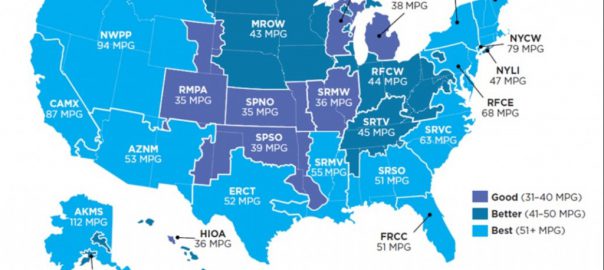
Electric-car wells-to-wheels emission equivalencies in MPG, Sep 2015 (Image: Union of Concerned Scientists)

How much do electric cars really pollute, even without tailpipes?

Personal automobiles have given hundreds of millions of people the great luxury of a convenient and comfortable mode of transportation.

Electric-car wells-to-wheels emission equivalencies in MPG, Sep 2015 (Image: Union of Concerned Scientists)

But there’s no escaping that manufacturing these vehicles, driving them for 10 years or more, and then disposing of them creates pollution that has a wide range of negative impacts.

As advocates and some governments push for more plug-in electric cars, that poses a valid question: what’s the total emission impact of driving a vehicle that plugs into the grid for its energy?

Over the last five years, electric vehicles have become a target for some who are not convinced that they will lead to less pollution.

Two different types of emission need to be considered. First, there is carbon dioxide (CO2), a climate-change gas.

Second are what the EPA calls criteria pollutants: other toxic substances that come out of the tailpipes of vehicles with combustion engines—and out of the smokestacks of any electric powerplant that burns any hydrocarbon fuel.

The CO2 question is more easily answered. Studies by numerous groups indicate that electric vehicles recharged on most North American grids are, at minimum, cleaner than almost any gasoline or diesel vehicle.

Read more: Green Car Reports

The report finds that even if London returned to the lowest recorded level of diesel car ownership in the UK, it would still not comply with World Health Organisation guidelines and UK law by 2025

Diesel vehicles must be phased out altogether to achieve clean air, says report

The Government must disincentivise diesel vehicles with a view to phasing them out altogether if air quality is to meet guidelines, a new report finds.

The report finds that even if London returned to the lowest recorded level of diesel car ownership in the UK, it would still not comply with World Health Organisation guidelines and UK law by 2025

The ‘Lethal and Illegal’ research, published by Greenpeace, in partnership with the Institute for Public Policy Research (IPPR), uses new modelling based on transport emissions and air pollution data undertaken by King’s College which reveals that, even if London were to return to the lowest recorded level of diesel car ownership in the UK (around 10% of the car fleet in 1995), it would still not reach compliance with World Health Organisation guidelines and UK law by 2025.

In response, the authors say that to tackle pollutants such as NO2 and PM2.5 the UK government would need to progressively reform Vehicle Excise Duty (VED) to disincentive diesel vehicles. Also, a scrappage scheme should be put in place for older diesel cars across the UK or in areas of non-compliance with air pollution laws.

Alan Andrews, lawyer for ClientEarth, which is taking the government to court over air pollution, said:

“This report should send a clear message to the UK government that an ambitious and bold Clean Air Act is needed for the whole country. It should phase out diesel across the country and accelerate the shift to zero emission transport. This would help our cities clean up their air and achieve legal limits as soon as possible. The new government must now step up and deal with this public health crisis so that the whole country can breathe cleaner air.”

Source: Fleet World

A Cumbria road destroyed in floods during storm Desmond, which scientists found had been made more likely by climate change (Image: A. Cooper/Barcroft Media)

UK poorly prepared for climate change impacts, government advisers warn

A 2,000 page report by Committee on Climate Change predicts global warming will hit UK with deadly heatwaves, more flooding and water shortages

The UK is poorly prepared for the inevitable impacts of global warming in coming decades, including deadly annual heatwaves, water shortages and difficulties in producing food, according the government’s official advisers.

A Cumbria road destroyed in floods during storm Desmond, which scientists found had been made more likely by climate change (Image: A. Cooper/Barcroft Media)

Action must be taken now, according to the report from the Committee on Climate Change (CCC) published on Tuesday, with more widespread flooding and new diseases among the risks in most urgent need of addressing.

The CCC further warns that climate-stoked wars and migration around the world could have very significant consequences for the UK, through disrupted trade and more military intervention overseas.

The 2,000-page report is a comprehensive assessment of the dangers of climate change to the UK, produced over three years by 80 experts and reviewed by many more. The main analysis is based on thetemperature rise expected if the global climate agreement signed in Paris in 2015 is fully delivered and also takes account of plans already in place to cope with impacts.

The worst case scenarios in the CCC report – if action to tackle climate change completely fails – foresees searing heatwaves reaching temperatures of 48C in London and the high-30s across the nation.

“We are not sufficiently prepared and we need to do more now, even for the [Paris deal] scenario of 2.7C of warming,”

said Lord John Krebs, chair of the CCC’s adaptation sub-committee.

“Many impacts are affecting us now, as climate change is already happening.”

“What we now think of as an extremely hot summer, where people are dying of heat stress and it is extremely uncomfortable in homes, hospitals and much of transport, that is likely to be a typical summer by the middle of the century and would be a cool summer in the 2080s,” he said.

Read more: The Guardian

Arctic sea ice crashes to record low for June

From mid-June onwards, ice cover disappeared at an average rate of 29,000 miles a day, about 70% faster than the typical rate of ice loss, experts say

The summer sea ice cover over the Arctic raced towards oblivion in June, crashing through previous records to reach a new all-time low.

The Arctic sea ice extent was a staggering 260,000 sq km (100,000 sq miles) below the previous record for June, set in 2010. And it was 1.36m sq km (525,000 sq miles) below the 1981-2010 long-term average, according to the National Snow and Ice Data Center.

That means a vast expanse of ice – an area about twice the size of Texas – has vanished over the past 30 years, and the rate of that retreat has accelerated.

Aside from March, each month in 2016 has set a grim new low for sea ice cover, after a record warm winter.

January and February obliterated global temperature records, setting up conditions for the further retreat of the Arctic summer ice cover, scientists have warned.

Researchers did not go so far as to predict a new low for the entire 2016 season. But they said the ice pack over the Beaufort Sea was studded with newer, thinner ice, which is more vulnerable to melting. Ice cover along the Alaska coast was very thin, less than 0.5 meters (1.6 ft).

The loss of the reflective white ice cover in the polar regions exposes more of the absorptive dark ocean to solar heat, causing the water to warm up. This goes on to raise air temperatures, and melt more ice – reinforcing the warming trend.

Scientists have warned the extra heat is the equivalent of 20 years of carbon emissions.

From mid-June onwards, ice cover disappeared at an average rate of 74,000 sq km (29,000 sq miles) a day, about 70% faster than the typical rate of ice loss, the NSIDC said.

Sea ice loss in the first half of the month proceeded at a lower pace, only 37,000 sq km (14,000 sq miles) a day.

The overall Arctic sea ice cover during June averaged 10.60m sq km (4.09m sq miles), the lowest in the satellite record for the month, according to the NSIDC.

There was more open water than average in the Kara and Barents seas as well as in the Beaufort Sea, despite below average temperatures, the NSIDC said.

Read more: The Guardian

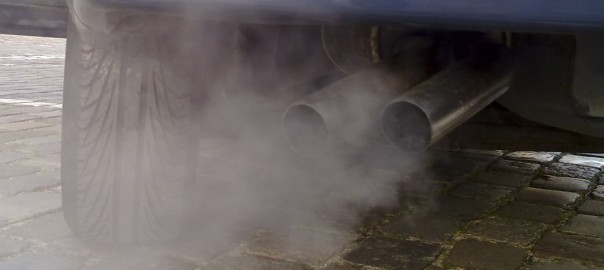
Car exhaust pollution (Image: Wikipedia)

Diesels even more polluting at low temperatures

Pollution from many popular diesel cars is much worse when it is colder than 18C outside, new research suggests.

Car exhaust pollution (Image: Wikipedia)

Testing company Emissions Analytics told the BBC it has measured a significant rise in poisonous gas emissions from a wide range of models as the temperature drops.

It found the problem is worst among the Euro 5 category of cars, which became mandatory in 2011.

The firm tested 213 models across 31 manufacturers.

The finding means millions of vehicles could be driving around much of the time with their pollution controls partly turned off.

But it seems many cars are deliberately designed that way and it is all perfectly legal.

Taking advantage

European rules allow manufacturers to cut back on pollution controls as long as it is to protect the engine.

Engineers agree that hot and cold weather can damage components.

But some suggest car companies are taking advantage of the rule to switch things off, even in mild weather, because it improves the miles per gallon of the car.

“I would say from the Euro 5 generation of cars, it’s very widespread, from our data. Below that 18 degrees [Celsius], many have higher emissions… the suspicion is, to give the car better fuel economy,” Emissions Analytics CEO Nick Molden told the BBC.

“If we were talking about higher emissions below zero, that would be more understandable and there are reasons why the engine needs to be protected. But what we’ve got is this odd situation where the [temperature] threshold has been set far too high, and that is a surprise”.

Read more: BBC

The welcoming entrance of Disney’s magic kingdom (Image: L. Larkum)

How Far Behind is the US in General, and Disney in Particular?

Culture Shock

With apparently ever-increasing globalisation most of us have an expectation that we can travel to other Western countries and find facilities and a culture similar to our own – after all, a McDonald’s Big Mac bought in Paris is recognisably the same as one from New York.

Occasionally, though, we find things to be suddenly different from what we expect. The difference is marked because it is not just a different food or architecture. It is marked – a culture shock – because it arises from very different assumptions about how a culture should be. I had such a feeling twenty-five years ago when, as a member of the British armed forces, I moved into married quarters in Germany. For the first time ever I encountered a culture with sustainability as a core value – we found recycling facilities all along our street, and were given full instructions on how to recycle our waste as part of moving in.

Such an approach was entirely absent in the UK, there we were still wondering whether we should consider starting to recycle some waste, and so returning to the UK felt like going back in time. Of course, since then the UK has caught up, at least to a large extent. For example, there are weekly collections of plastic and metal/can containers, of paper and cardboard, of glass, and of food waste, plus fortnightly collections of garden waste.

I write this as I approach the end of a vacation in Disney World and Florida, having experienced another such step back in time. Things are so far behind here it has been another culture shock. We last visited twenty-five years ago and it seems that the culture in general and Disney World in particular are virtually unchanged over that time.

Conspicuous Consumption and Pollution

It began with our accommodation – a lovely rented villa in a community estate in Davenport, half an hour outside Orlando. It’s huge and well-appointed with a very nice small pool and patio. However, it feels like living in a ‘consumption machine’. I write this in the open-plan kitchen/lounge area. Behind me upstairs the air conditioning system rattles away providing welcome cooling throughout the house – but it seems to be on permanently, 24/7, set to a temperature of 76°F (24°C). The energy consumption must be enormous, but its controls are locked away so we don’t have the choice to turn it off and save energy.

Behind me just outside the wall is the monstrous pump and filter system for the pool, whirring away. In front of me is a massive fridge which almost never goes quiet. Later today we’ll have men coming round making noise along the road (strimmers, leaf blowers, etc.). This evening we’ll have the sprinklers coming on to disturb our sleep. Not just carbon pollution, but noise pollution seems to be an accepted part of life here.

Even the cars of our neighbours coming and going seem inordinately loud, and why must they beep their horns every time they lock the doors? Everything is just so noisy (in this house we even watch TV in the same large living space as the dishwasher, washing machine and tumble dryer). The whole concept of noise pollution seems alien here, as though it were something to be embraced rather than avoided. I can’t imagine how hard it would be to try and get some peace and quiet. Yet in the UK people put a premium on quietness whether it’s buying a quiet car (such as an electric) or a house in the country – here the preference seems to be for cars and houses that are as big and noisy as possible.

The big irony, of course, is that the massive carbon footprint of this house is entirely unnecessary. A big chunk of it is for air conditioning because of the powerful sunshine here, yet it is precisely that excess of solar power that could be powering the house with solar energy for free. Instead, it is using fossil fuels and their associated carbon emissions to try and offset the energy being dissipated on the roof. I’ve only seen one house in the area with solar panels, and I noticed that precisely because it was an isolated example in a sea of blank rooftops.

Part of that irony is that we have solar panels on our home in England, even though we are at a much higher latitude than Florida and so get correspondingly less solar energy. Nonetheless, even with our supposedly cloudy and rainy climate the panels produce more than half the energy used by the house over the course of a year. In Florida a similar setup could potentially power the entire house, and with some left over going into the grid to reduce its overall footprint, or used to fuel an electric car.

It was good to see that our housing estate had a weekly recycling collection, even if it was just a mixed box (and many of our neighbours’ wheelie bins were overflowing with cardboard boxes and other items that could have gone in recycling).

No Leadership From Disney

So on to Disney. Over the last two weeks we have visited Magic Kingdom, Hollywood Studio and Animal Kingdom twice each, and Epcot and the Typhoon Lagoon water park once each. We had a good time on the roller-coaster and other rides, and at the various shows. However, it felt like very little had changed in the last quarter century.

A tram with its diesel exhaust just a few feet from waiting passengers (Image: T. Larkum)

After parking up we were transferred to the park entrances via vehicles referred to as ‘trams’. While in Europe that name implies electric trolley buses, and given their workload and fixed routes these vehicles could have been electric, it was immediately obvious they were not. You didn’t have to get very close to them to hear the roar and smell the nauseous and toxic fumes that gave away that they were powered by massive diesel engines. And this, in the 21st century, and with half the passengers being young children.

Read more: Linked In

Climate Change Impact in Africa (Image: iPhoto)

If You’re Younger Than 31, You’ve Never Experienced This

Life was cooler in 1985.

Climate Change Impact in Africa (Image: iPhoto)

Still not convinced the Earth is rapidly warming? Consider this: The last time the global monthly temperature was below average was February 1985.

That means if you are 30 years old or younger, there has not been a single month in your entire life that was colder than average.

“It’s a completely different world we’re already living in,”

Mark Eakin, coordinator of NOAA’s Coral Reef Watch, told scientists gathered this week for the International Coral Reef Symposium in Honolulu. He added it likely won’t be long before that same age bracket has experienced only above-average temperatures.

“It’s happening that fast,” Eakin said.

Michael Mann, a climate scientist at Penn State University, told The Huffington Post that as long as humans continue to warm the planet by burning fossil fuels, there is, in a sense, no “normal” or “average.”

“What is considered unusually warm today will be considered average in the future,” Mann said in an email. “And for what we call ‘warm’ in the future, there is currently no analog.”

The National Oceanic and Atmospheric Administration recently announced May 2016 as the 13th consecutive warmest month on record — the longest streak since global temperature records began in 1880.

“The combined average temperature over global land and ocean surfaces for May 2016 was the highest for May in the 137-year period of record, at 0.87°C (1.57°F) above the 20th century average of 14.8°C (58.6°F), besting the previous record set in 2015 by 0.02°C (0.04°F),” NOAA said.

NASA data shows global temperatures in May were 1.67 degrees Fahrenheit above the 1951-1980 average.

Read more: Huffington Post

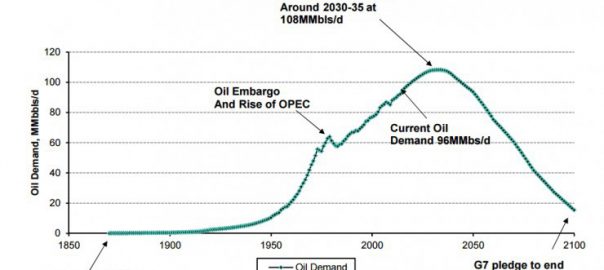
Peak Oil Could be in 15-20 Years (Image: Bernstein Research)

Big Oil Is Terminal

“Peak oil demand” is the new “peak oil supply” because of climate change and plummeting costs for electric car batteries.

It’s increasingly clear that we’re not going to move off of oil because we run out of supply. Rather, we’re going to move off of oil because it is both the economic and moral thing to do.

The research firm Bernstein notes that two “existential threats to the oil industry” exist — “climate change” and “advances in battery technology and computing power, which have resulted in a surge in interest in electric vehicles and autonomous driving.” They project the peak in oil demand could come as soon as 2030–2035:

Peak Oil Could be in 15-20 Years (Image: Bernstein Research)

Read more: Think Progress

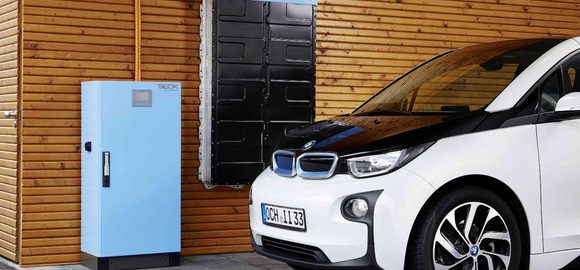
Carmaker announces plans to turn BMW i3 batteries into home energy storage kits (Image: BMW)

BMW follows Nissan into home energy storage market

Carmaker announces plans to turn BMW i3 batteries into home energy storage kits

Carmaker announces plans to turn BMW i3 batteries into home energy storage kits (Image: BMW)

The world of electric vehicles and energy storage are becoming increasingly intertwined, after German carmaker BMW last week became the second major carmaker in as many months to announce plans to enter the home energy storage market.

BMW told delegates at the Electric Vehicle Symposium & Exhibition 29 conference in Montreal last week it will use the high voltage batteries deployed in its i3 range of electric vehicles to create a new residential storage product in collaboration with German firm Beck Automation.

The BMW system will use new and second hand batteries from EVs, and will be available in a 22kWh or 33kWh sizes – powerful enough to keep the average home operating for 24 hours with no external generation.

In a statement BMW said the new storage system will allow BMW i customers to “more fully realise their commitment to sustainability” and take a step closer to energy independence. Customers will be able to store clean energy generated by rooftop solar panels, and protect their home against power outages from the grid, BMW said.

“The remarkable advantage for BMW customers in using BMW i3 batteries as a plug and play storage application is the ability to tap into an alternative resource for residential and commercial backup power, thus using renewable energy much more efficiently, and enabling additional revenues from the energy market,”

said Cliff Fietzek, manager for connected eMobility at BMW North America.

Read more: Business Green